

Most jawans hang up the uniform with twenty or more working years still ahead of them. The pension takes care of the household basics. Yet many veterans want something of their own: a small factory, a workshop or a service business in their home town.
The Prime Minister’s Employment Generation Programme (PMEGP) is built for exactly that. As an ex-serviceman, you put in just 5% of the project cost, a bank lends the rest, and the government covers 25% to 35% of the cost as subsidy. On a ₹50 lakh manufacturing unit in a village, that subsidy comes to ₹17.5 lakh.
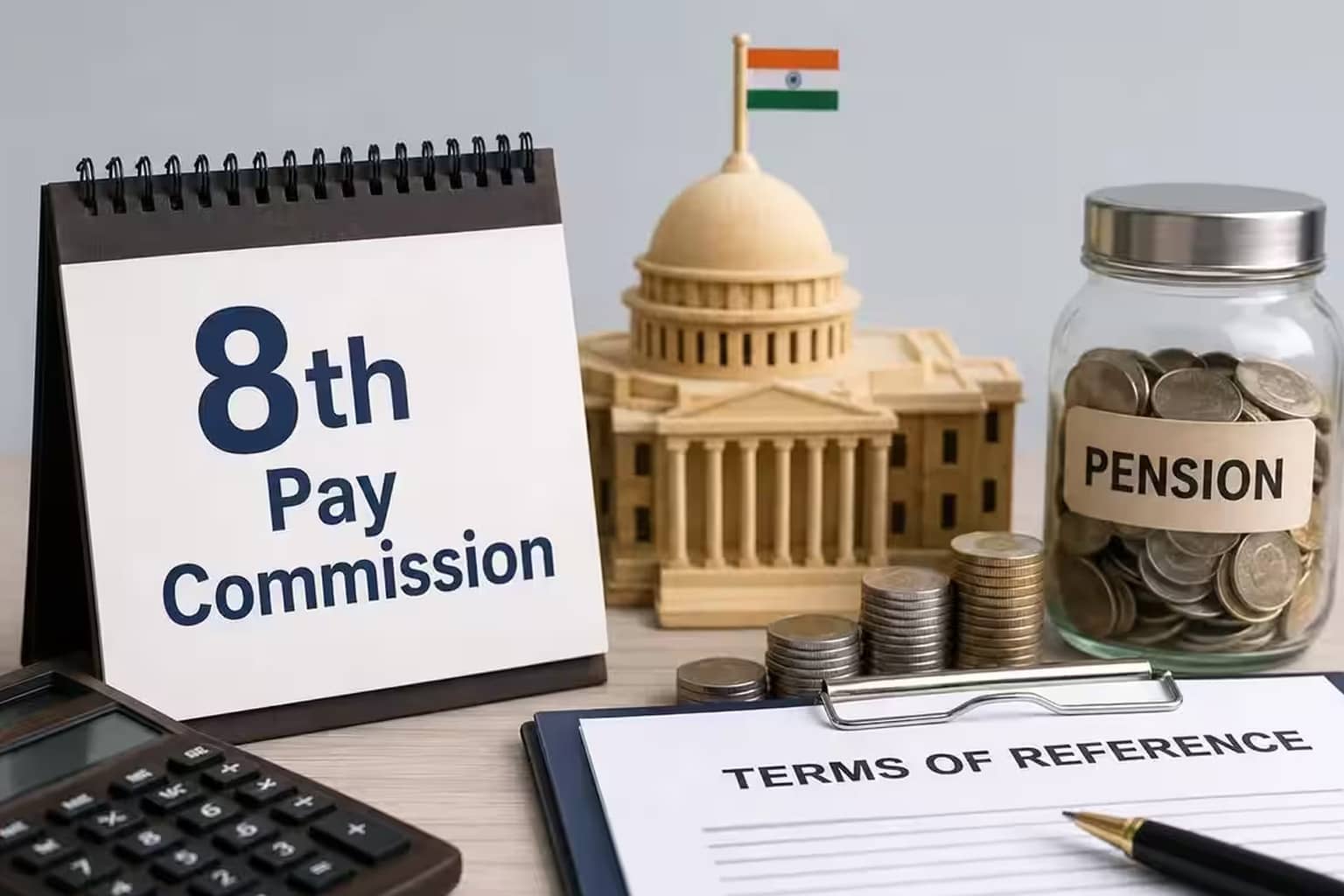
The timing matters too. The 8th Pay Commission was set up on 3 November 2025 with 18 months to report, so revised pensions are still some way off. A business that earns alongside your pension gives you income you control, and PMEGP has no income ceiling, so pensioners are fully eligible.
This guide covers the numbers, the rules, the paperwork and where the scheme stands as of November 2026.
PMEGP in Brief
PMEGP is a credit-linked subsidy programme for new micro enterprises outside farming. It is run by the Ministry of MSME, with the Khadi and Village Industries Commission (KVIC) as the national nodal agency. Applications are handled by KVIC, the State Khadi and Village Industries Boards (KVIBs) and District Industries Centres (DICs), while banks provide the loan.
- Biggest project covered: ₹50 lakh for manufacturing, ₹20 lakh for service or business units
- Your own money: 5% of the project cost
- Government subsidy: 25% in urban areas, 35% in rural areas
- Income limit: none
- Cost of applying: nothing; the application is free
The Ex-Serviceman Advantage
Ex-servicemen fall in PMEGP’s special category, which pays a noticeably richer subsidy than the general category. The same special rates apply to SC, ST, OBC, minority, women, differently abled and transgender applicants, and to units in the North East, hill and border areas. If you fit more than one of these groups, the rate stays the same; the benefits do not add up.
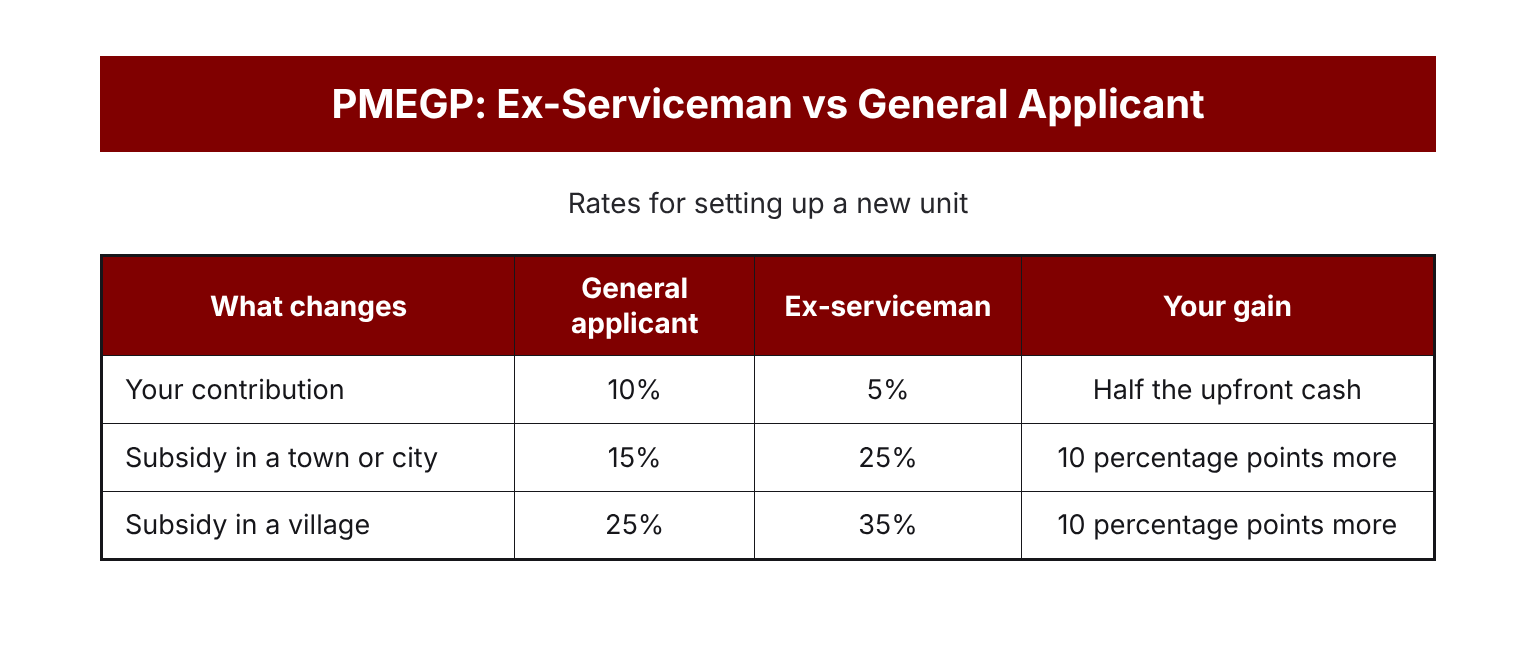
In plain terms: on a ₹20 lakh project in a village, a general applicant gets ₹5 lakh as subsidy, while you get ₹7 lakh and need ₹1 lakh less of your own savings to start.
How Much Subsidy Can You Get? A Ready Reckoner
The most an ex-serviceman can receive is ₹17.5 lakh, on a ₹50 lakh manufacturing unit in a rural area. The subsidy is a fixed share of your project cost, up to these ceilings:
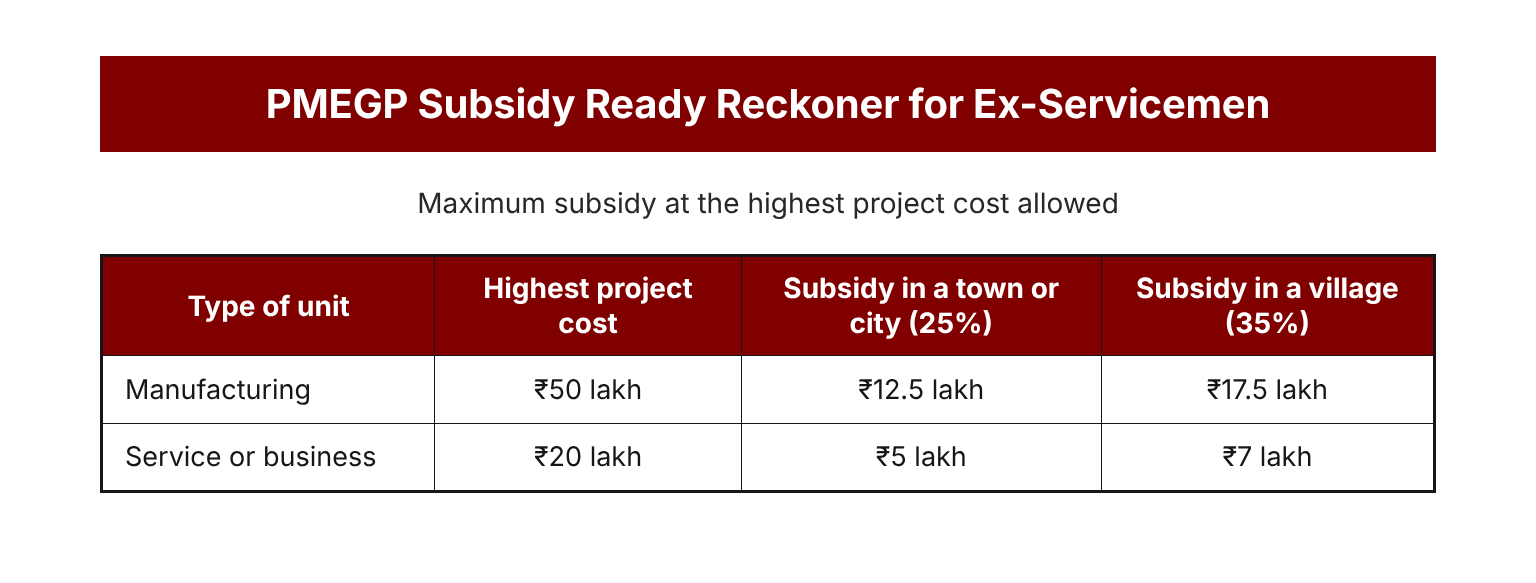
If your project costs more than the ceiling, the bank may fund the extra amount, but that part earns no subsidy.
What counts as rural? Any area recorded as a village in state revenue records is rural, whatever its population. Areas under Panchayati Raj institutions are also rural, while areas under a municipality are treated as urban. So the address of your shed decides whether you get 25% or 35%.
Example 1: A ₹10 lakh flour and spice unit in a village
Picture a retired Subedar who goes back to his village and sets up an atta chakki with a masala grinding line. Machinery, installation and starting stock come to ₹10 lakh.
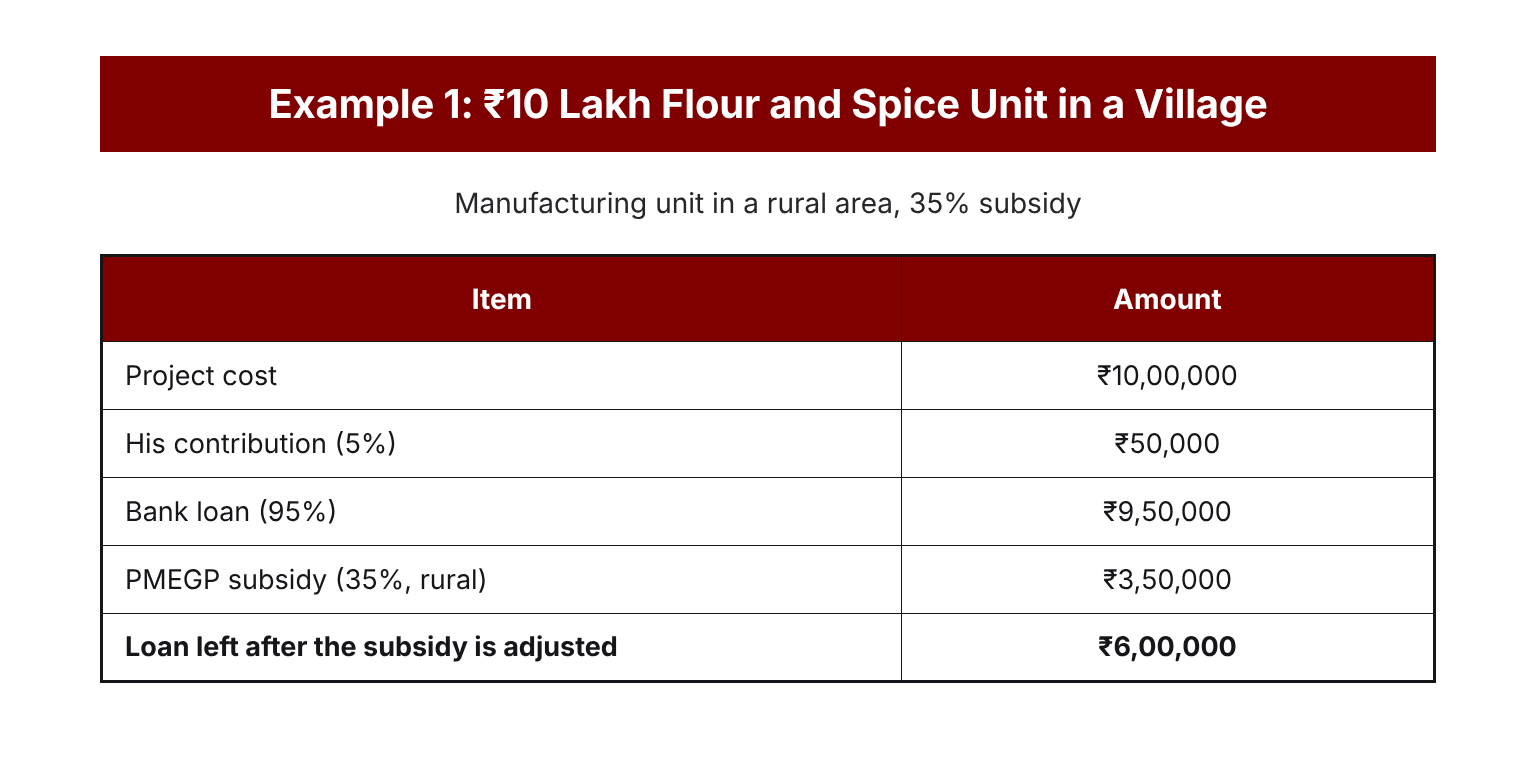
Two bonuses come with keeping this project at ₹10 lakh. He needs no Class 8 certificate, and at SBI the loan needs no collateral.
Example 2: A ₹15 lakh gym in a town
Now take a veteran who ran PT for his unit for years and opens a fitness centre in a district town that falls under a municipality. Equipment, flooring and fit-out cost ₹15 lakh.
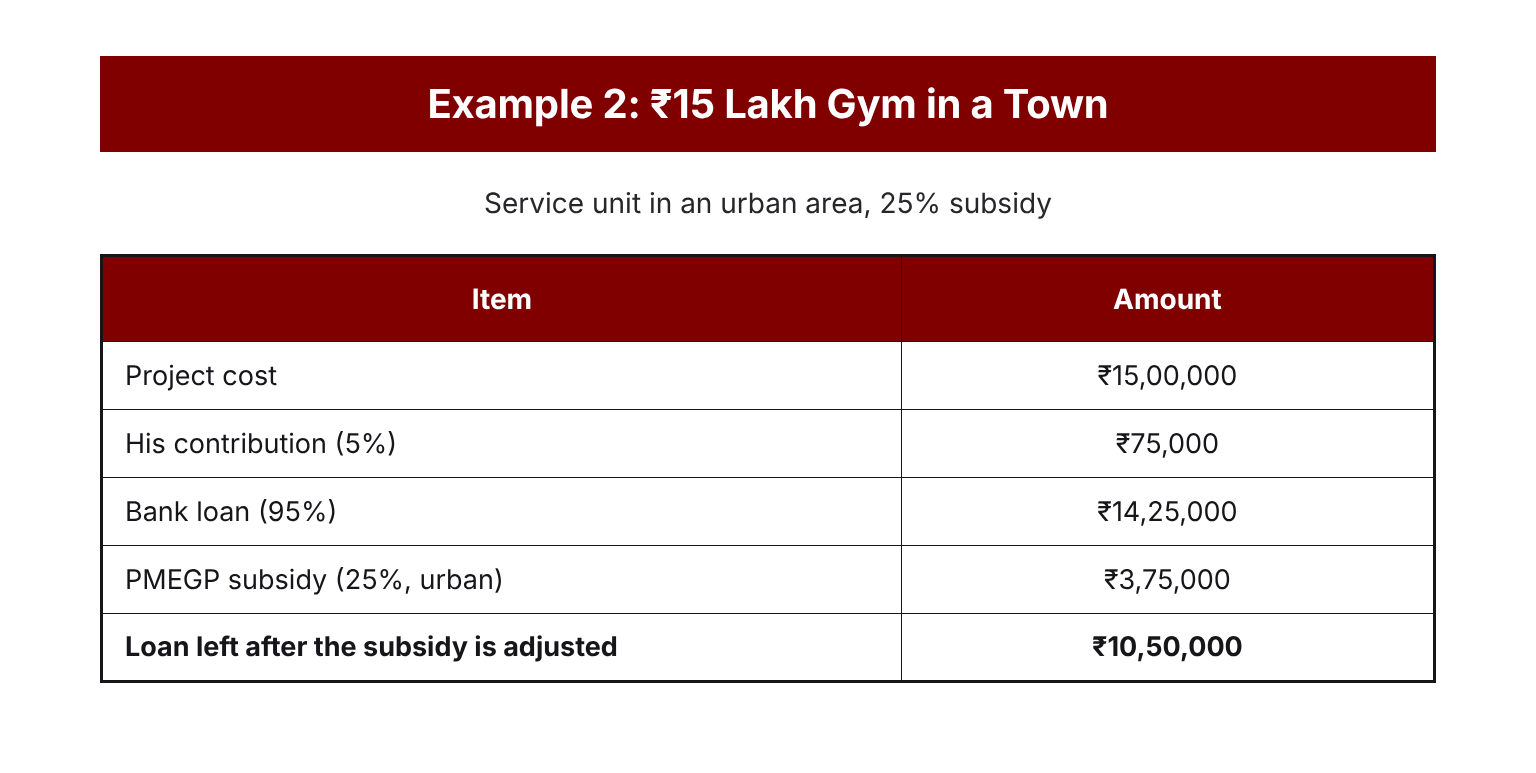
Because this is a service project above ₹5 lakh, he must show at least a Class 8 pass. The loan is above ₹10 lakh, so the bank covers it under the CGTMSE credit guarantee.
The Subsidy Is Not Cash in Hand: How It Really Works
Many first-time applicants expect the subsidy to land in their savings account. It does not. It works as a cushion inside your loan, and it turns into a real saving only if your unit keeps running.
- The bank parks it. Once your loan is released, KVIC sends the subsidy to your bank. The bank holds it in your name as a three-year term deposit receipt (TDR).
- That slice costs you no interest. The bank does not charge interest on the part of the loan equal to the subsidy. The rest of the loan carries the bank’s normal rate; SBI, for instance, prices PMEGP loans at its external benchmark rate plus 3.25%.
- Year three is the finish line. If the unit is still working and your account is regular after three years, the subsidy is adjusted against the loan, and your outstanding balance drops by that amount.
- Close early and you lose it. If the unit shuts down or the loan turns bad before then, the subsidy goes back to the government.
What about collateral? The machinery and assets you buy with the loan are hypothecated to the bank. Beyond that, SBI asks for no collateral on PMEGP loans up to ₹10 lakh, which are covered under the CGFMU guarantee, and covers larger loans under CGTMSE.
Are You Eligible? A Five-Point Check
You can apply as an ex-serviceman if all five of these hold true:
- Age: you are 18 or above. Pensioners and non-pensioners both qualify, and there is no upper income limit.
- New unit: the business is being set up fresh. Expanding a shop you already run does not count.
- One per family: neither you nor your spouse has taken PMEGP help before. PMEGP treats you and your spouse as one family.
- Real assets: the project involves capital spending on machinery, equipment or a work shed. The cost of land cannot be included in the project cost.
- Schooling, only for bigger projects: a Class 8 pass is needed for manufacturing projects above ₹10 lakh and service projects above ₹5 lakh. Smaller projects need no certificate.
You will be turned away if the unit already received a subsidy under another central or state scheme, or if the activity sits on the PMEGP negative list, covered next.
Business Ideas That Play to a Veteran’s Strengths
Years in service build discipline, team handling and hands-on trade skills. These are PMEGP-friendly ideas where those strengths count:
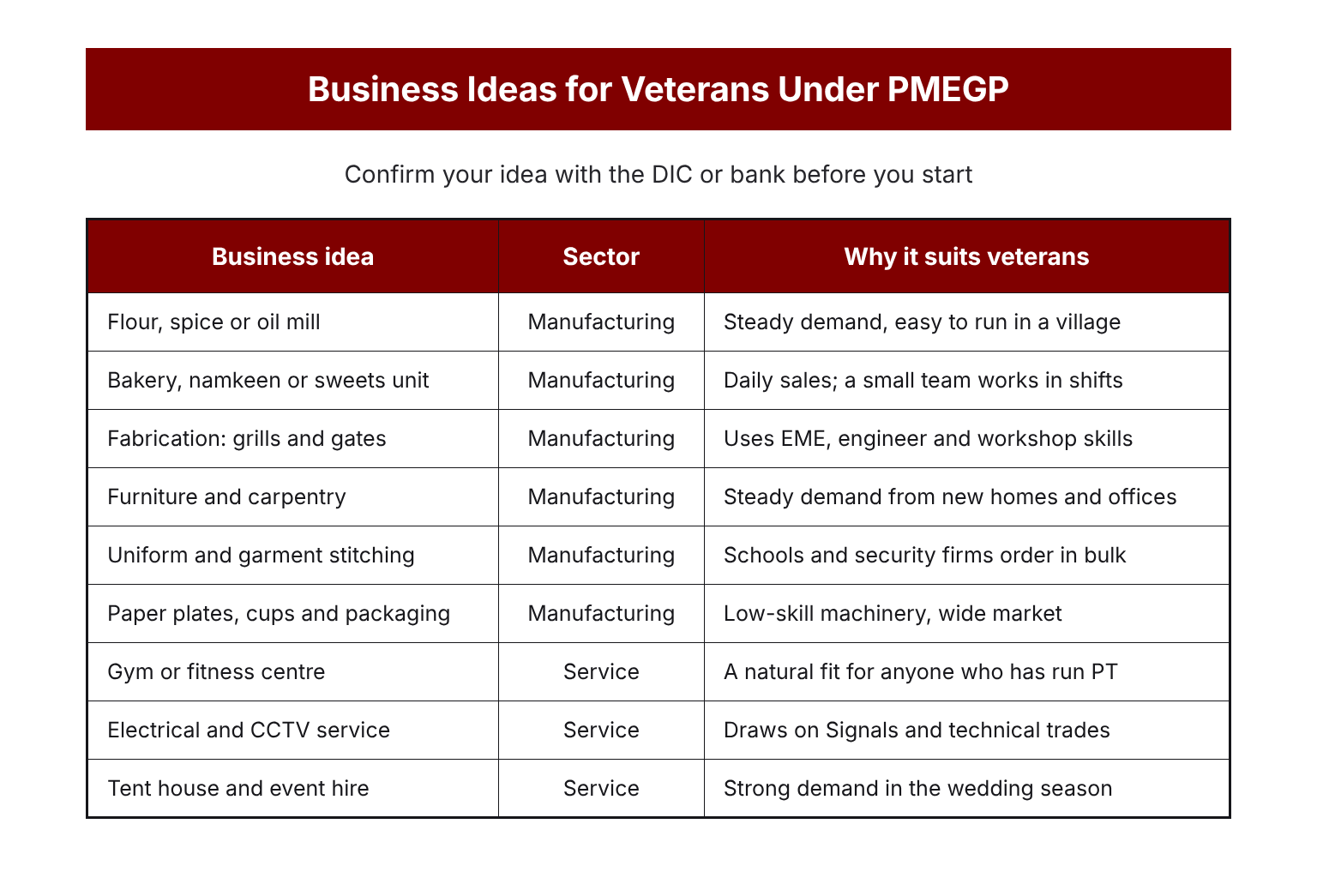
What PMEGP will not fund. The scheme keeps a negative list. Broadly, it rules out:
- Meat processing and anything linked to slaughter
- Intoxicants, such as liquor, beedi, pan, cigarettes and other tobacco products
- Crop cultivation and plantations, sericulture, horticulture and floriculture
- Animal rearing, such as goatery, piggery, poultry and fish farming
- Pure trading, such as a grocery or stationery shop that only buys and sells
- Taxis and most passenger transport, apart from a few exceptions such as auto rickshaws
- Polythene carry bags below the permitted thickness
A retail counter is allowed when it sits on top of your own manufacturing, processing or service set-up. Banks sometimes work from a slightly updated list, so confirm your idea with the DIC or the bank before you spend on a project report.
Documents to Keep Ready
Gathering these before you start saves weeks of back and forth with the agency and the bank:
- Aadhaar card and PAN card
- Proof of ex-serviceman status, such as your ESM identity card, discharge book or PPO
- A detailed project report (DPR) for the business
- Class 8 or higher certificate, if your project is above the limits mentioned earlier
- Proof of the unit’s location: a rent agreement or ownership papers for the premises
- Quotations for the machinery and equipment you plan to buy
- Passport-size photographs and your bank account details
- Your EDP training certificate, once you complete the training
How to Apply, Step by Step
- Shortlist your idea and place. Visit your nearest DIC or KVIB office. Officials there will tell you whether the activity is allowed and whether the location counts as rural.
- Prepare your project report. The PMEGP portal carries more than 1,000 model project reports you can adapt. Keep the numbers honest, because the bank will test whether the unit can repay.
- Apply online. Register on the official PMEGP e-portal on the KVIC website (kviconline.gov.in). Choose “Ex-Serviceman” under special category, pick your implementing agency and preferred bank branch, and upload your documents.
- Agency review. KVIC, the KVIB or the DIC checks the application and forwards it to the bank.
- Bank sanction. The bank appraises the project and sanctions the loan.
- Finish EDP training. Entrepreneurship Development Programme training is compulsory for projects above ₹2 lakh. If you have already done at least 10 days of such training offline, or 60 hours online, you do not need to repeat it.
- Put in your 5% and start. Deposit your share, the bank releases the loan, and the bank then claims your subsidy from KVIC.
Applying costs nothing. Anyone who asks for money to “get your file passed” is not part of the official process.
How Long Does It Take?
Plan for several months, not weeks. In a reply to Parliament reported on 31 July 2026, the government said implementing agencies take 58 days on average to process an application. Banks take about 70 days to sanction the loan, and KVIC about 84 days to release the subsidy. Starting your EDP training and arranging your 5% early keeps your file from waiting on you.
Already Running a PMEGP Unit? The Second Loan for Growth
Once your first unit has found its feet, PMEGP offers a second round of support for expansion, new machinery or automation. It is also open to well-performing MUDRA units.
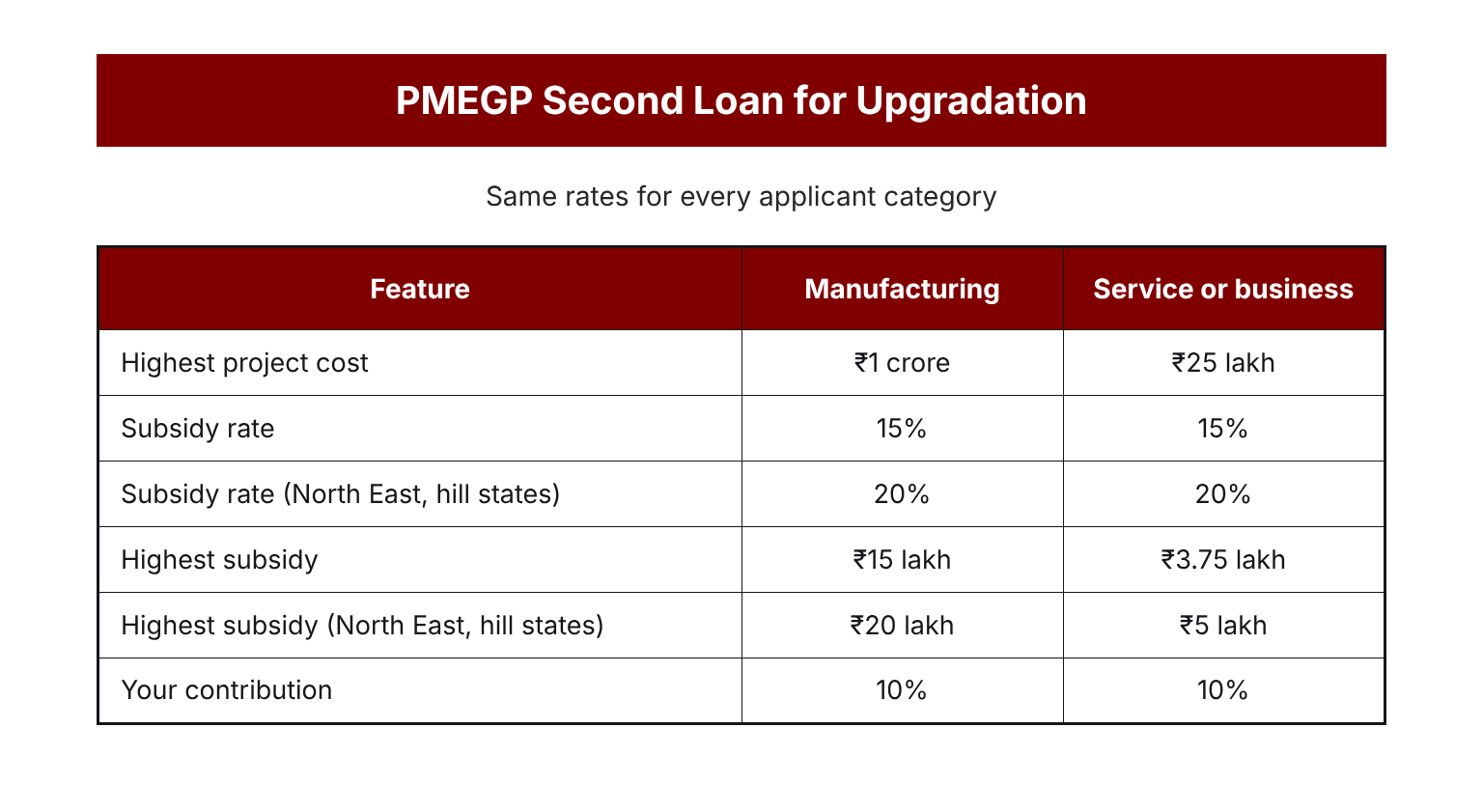
The same rate applies to every applicant, so there is no extra ex-serviceman benefit at this stage. To qualify, you must have repaid the first loan on time, your first subsidy must have been adjusted after the three-year lock-in, and the unit should be profitable with room to grow.
Where PMEGP Stands in November 2026
The scheme’s last formal approval covered five years, from 2021-22 to 2025-26. In early August 2026, the government told the Rajya Sabha that PMEGP had been continued only up to 31 March 2026. It added that further subsidy releases depended on approval of the scheme’s continuation.
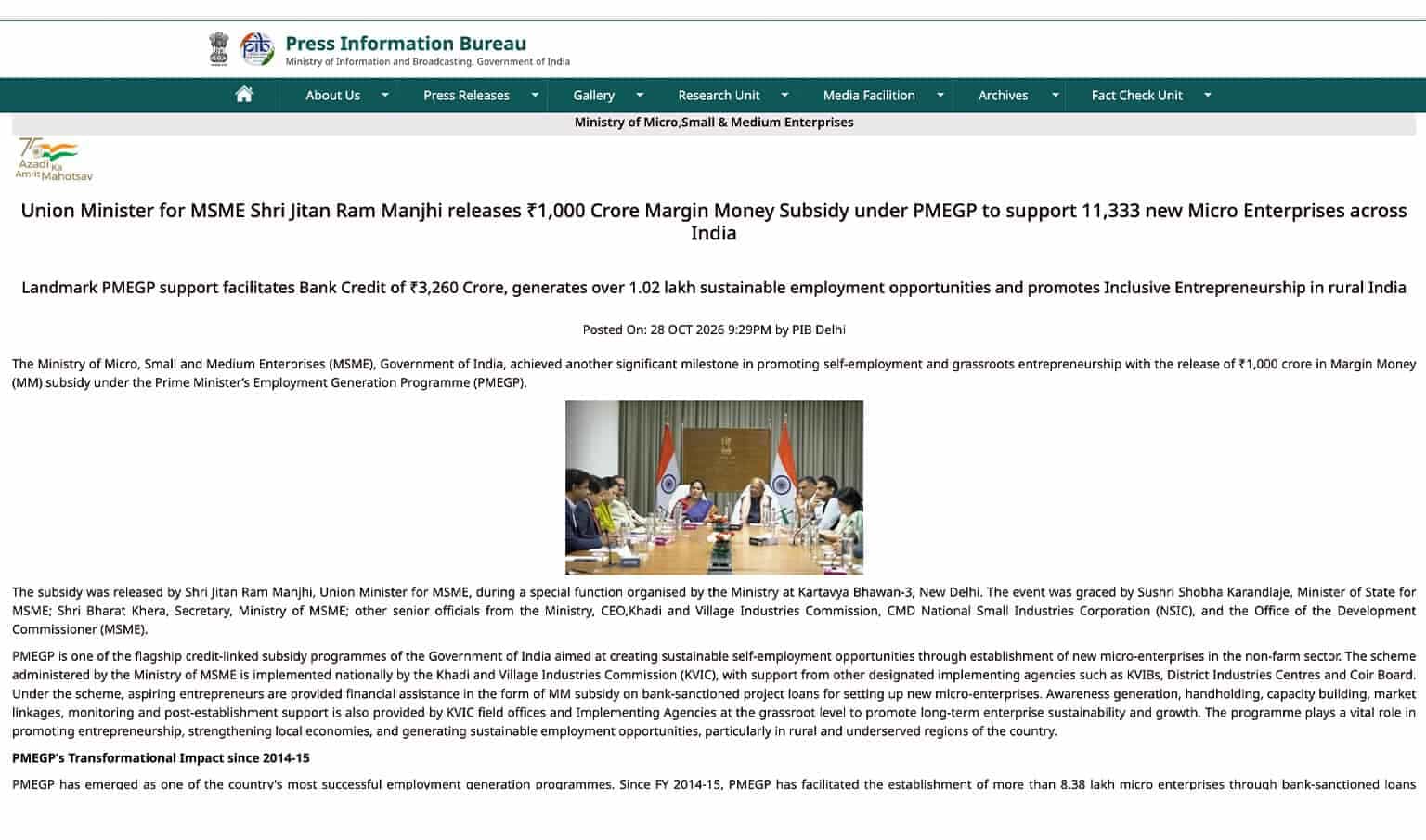
Since then, the money has started moving. On 28 October 2026, MSME Minister Jitan Ram Manjhi released ₹1,000 crore of subsidy for 11,333 new micro enterprises, backed by bank loans of about ₹3,260 crore. Before that release, PMEGP had already supported 25,895 units in 2026-27 with ₹794.52 crore of subsidy.
At the time of writing, we could not find a public notification extending PMEGP for the 2026-31 period. Before you put money into machinery or premises, check the current guidelines with your DIC or KVIC office.
Five Mistakes Veterans Should Avoid
- Paying a middleman. The application is free, and the DIC or KVIB will guide you at no charge. Nobody can guarantee approval for a fee.
- Padding the project report. An inflated DPR either gets rejected by the bank or leaves you with a loan the business cannot carry.
- Treating the whole loan as cheap money. Only the subsidy portion is interest-free. EMIs on the rest start like any business loan.
- Closing before three years. Shut the unit early, and the subsidy goes back to the government.
- Guessing the location rate. A shed just inside municipal limits earns 25%, not 35%. Confirm the status of your site before you sign a lease.
Frequently Asked Questions
Can a defence pensioner apply for a PMEGP loan?
Yes. PMEGP has no income ceiling, so drawing a pension does not disqualify you.
What is the highest PMEGP subsidy an ex-serviceman can get?
₹17.5 lakh, which is 35% of a ₹50 lakh manufacturing project in a rural area.
Will a pension hike under the 8th Pay Commission affect my eligibility?
No. Since there is no income limit, a revised pension makes no difference to your PMEGP application.
Do I need to give collateral?
At SBI, loans up to ₹10 lakh need no collateral, and larger loans are covered under the CGTMSE guarantee. The assets you buy are hypothecated to the bank.
Can my wife apply separately for her own unit?
No. PMEGP counts you and your spouse as one family, and only one PMEGP benefit is allowed per family.
Is the subsidy credited to my account?
No. The bank holds it as a three-year term deposit and adjusts it against your loan if the unit is running at the end of that period.
Can I open a kirana shop under PMEGP?
Generally not. Pure trading outlets such as grocery and stationery shops are on the negative list.
Is EDP training compulsory?
Yes, for projects above ₹2 lakh. Earlier training of at least 10 days offline or 60 hours online can count instead.
A Final Word
PMEGP will not hand you a business, but it does take a large share of the risk off your shoulders. For a veteran with a sound idea and the discipline to run it for three years, few government schemes offer better terms.
Disclaimer: This article is for general information and is not financial advice. Scheme rules, interest rates and the negative list can change, so confirm the latest position with your DIC, KVIB, KVIC office or bank before applying.
Sources
- Salient features of revised PMEGP, Delhi Khadi and Village Industries Board
- PMEGP loan terms, State Bank of India
- PMEGP negative list examples, Central Bank of India
- ₹1,000 crore PMEGP subsidy release, DD News, 29 October 2026
- PMEGP processing times, KNN India, 31 July 2026
- Rajya Sabha reply on PMEGP continuation, Kashmir Life, 3 August 2026
- 8th Pay Commission status, Business Today, 3 November 2026

Leave a Reply