

For ex-servicemen and their families, hospital treatment is not only a medical issue. It is also a financial and paperwork issue.
One wrong step before admission can turn a cashless treatment case into a stressful reimbursement file.
That is why ECHS beneficiaries must understand one basic rule clearly: planned treatment should normally begin with referral from the ECHS Polyclinic.
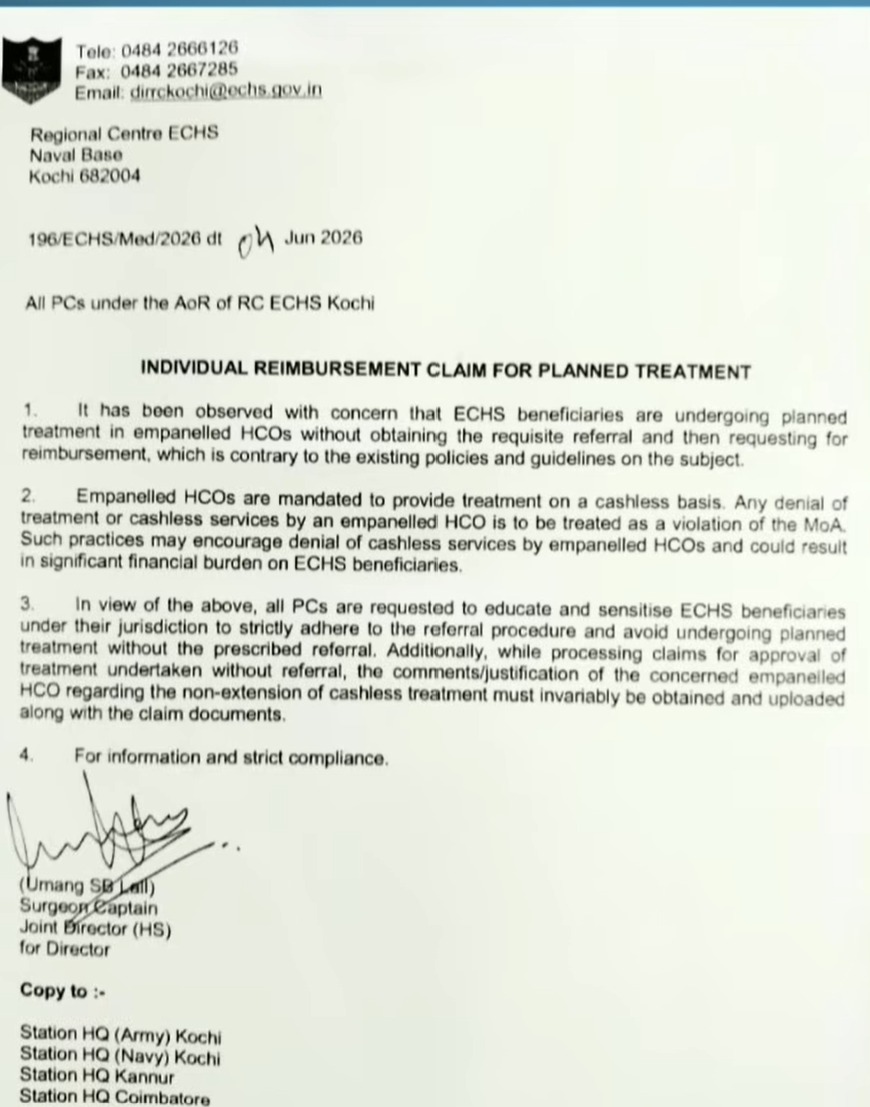
This point has become important after an advisory attributed to Regional Centre ECHS Kochi, dated 04 June 2026, highlighted cases where beneficiaries reportedly took planned treatment in empanelled hospitals without first obtaining referral, and then submitted reimbursement claims later.
The concern is practical. A beneficiary may think, “The hospital is empanelled, so I can go directly and claim later.” But in planned treatment, that assumption can create difficulty.
Why planned treatment needs referral?
Planned treatment means the patient has time to follow the official process.
It may be a planned surgery, scheduled admission, specialist consultation, investigation, procedure or follow-up treatment where the patient is not in an immediate life-threatening situation.
In such cases, the safe route is:
Visit ECHS Polyclinic.
Get medical advice.
Take referral.
Proceed to the empanelled hospital.
Use cashless treatment as per ECHS rules.
Referral connects the beneficiary, the Polyclinic and the hospital in an official chain. Without this chain, the hospital admission may later become a reimbursement dispute.
Why reimbursement after direct admission can become risky?
Many families pay first because they want treatment to start quickly. That is understandable, especially when the patient is elderly or in pain.
But if the case was planned and referral was not taken, the claim may face questions later.
The claim-processing side may ask:
Was it a planned case or an emergency?
Why was referral not taken before admission?
Was the hospital empanelled for that treatment?
Why was cashless service not provided?
Was the Polyclinic informed?
Is there written proof from the hospital?
If the family cannot answer these questions with documents, the case may become complicated.
This is why reimbursement should not be treated as an easy backup option for planned treatment.
Planned and emergency cases are different
This difference is very important.
Planned treatment gives the beneficiary time to follow the normal referral route.
Emergency treatment is different because the patient may need immediate care. In emergency situations, the family should follow the ECHS emergency process and inform or obtain referral through the prescribed route within the required time.
Official ECHS material explains that referral to empanelled hospitals is part of the treatment process, and official advisories also distinguish planned treatment from emergency care.
So the beneficiary should not mix the two categories.
If it is planned, take referral first.
If it is emergency, follow the emergency procedure and complete formalities as required.
Cashless treatment should not be casually denied
One more important point needs attention.
ECHS empanelled hospitals are expected to provide treatment according to ECHS rules and agreement conditions. If a hospital is empanelled and the beneficiary has proper referral, the patient should not be casually pushed into a paid case.
If cashless treatment is refused, the family should not remain silent.
They should immediately contact the ECHS Polyclinic, OIC Polyclinic or Regional Centre. They should also ask the hospital to provide the reason for denial in writing.
This written reason can become important if a claim has to be processed later.
What should beneficiaries do before planned admission?
Before going to an empanelled hospital for planned treatment, the family should keep a simple checklist.
Check whether the treatment is planned or emergency.
Visit the ECHS Polyclinic first.
Take proper referral.
Confirm whether the hospital is empanelled for the required specialty.
Carry ECHS card and identity documents.
Keep referral papers safely.
Ask the hospital to process the case as cashless.
Do not pay large amounts without understanding why cashless is not being given.
If payment is demanded, contact the Polyclinic immediately.
Take written explanation if cashless treatment is denied.
This may look like extra effort, but it can save the family from major stress later.
Why elderly beneficiaries need extra support?
Many ECHS beneficiaries are senior citizens. Some may not be comfortable with hospital billing counters, online systems, referral paperwork or claim procedures.
Family members should help them before admission.
A son, daughter, spouse or attendant should check the referral, hospital empanelment status, admission process and required documents. Medical stress is already difficult. Administrative confusion should not be added to it.
For a veteran family, preparation before admission is as important as treatment itself.
Why Polyclinics should spread awareness?
The advisory attributed to RC ECHS Kochi reportedly asks Polyclinics to educate beneficiaries under their area.
This is necessary because many disputes happen due to lack of awareness.
A beneficiary may not be trying to break rules. He may simply not know the correct process. Some may depend on hospital staff. Some may follow advice from neighbours. Some may think any empanelled hospital means direct admission and later reimbursement.
Clear guidance at Polyclinic level can prevent these mistakes.
Comment
The main lesson is simple: ECHS is a structured healthcare system, not an open reimbursement wallet.
For planned treatment, referral protects the beneficiary. It keeps the case inside the official system and supports cashless treatment.
Families should not wait until after discharge to understand the rules. By then, the bill may already be paid, documents may be incomplete and the hospital may refuse to give written explanation.
The smarter step is to act before admission.
Take referral, check hospital status, keep papers ready and ask for cashless processing.
Final takeaway
ECHS beneficiaries should be very careful in planned treatment cases.
If the treatment is planned, do not directly get admitted in an empanelled hospital and assume reimbursement will automatically be approved later.
Take referral from the ECHS Polyclinic first. Use the cashless route wherever applicable. If the hospital denies cashless treatment, report it immediately and take written justification.
For ex-servicemen, family pensioners and dependents, the safest rule is clear:
Referral before planned admission, documents before payment, and official guidance before reimbursement claim.
This one habit can protect families from avoidable hospital bills, claim delays and financial pressure.
Sources:-
ECHS official brochure 2023:
https://www.echs.gov.in/assets/policy/FINAL%20ECHS%20BROCHURE%202023.pdf
ECHS advisory for treatment at non-empanelled hospital:
https://www.echs.gov.in/assets/policy/ADVISORY%20FOR%20TREATMENT%20AT%20NON%20EMP%20HOSP.pdf
ECHS official website:
https://www.echs.gov.in/


Leave a Reply