

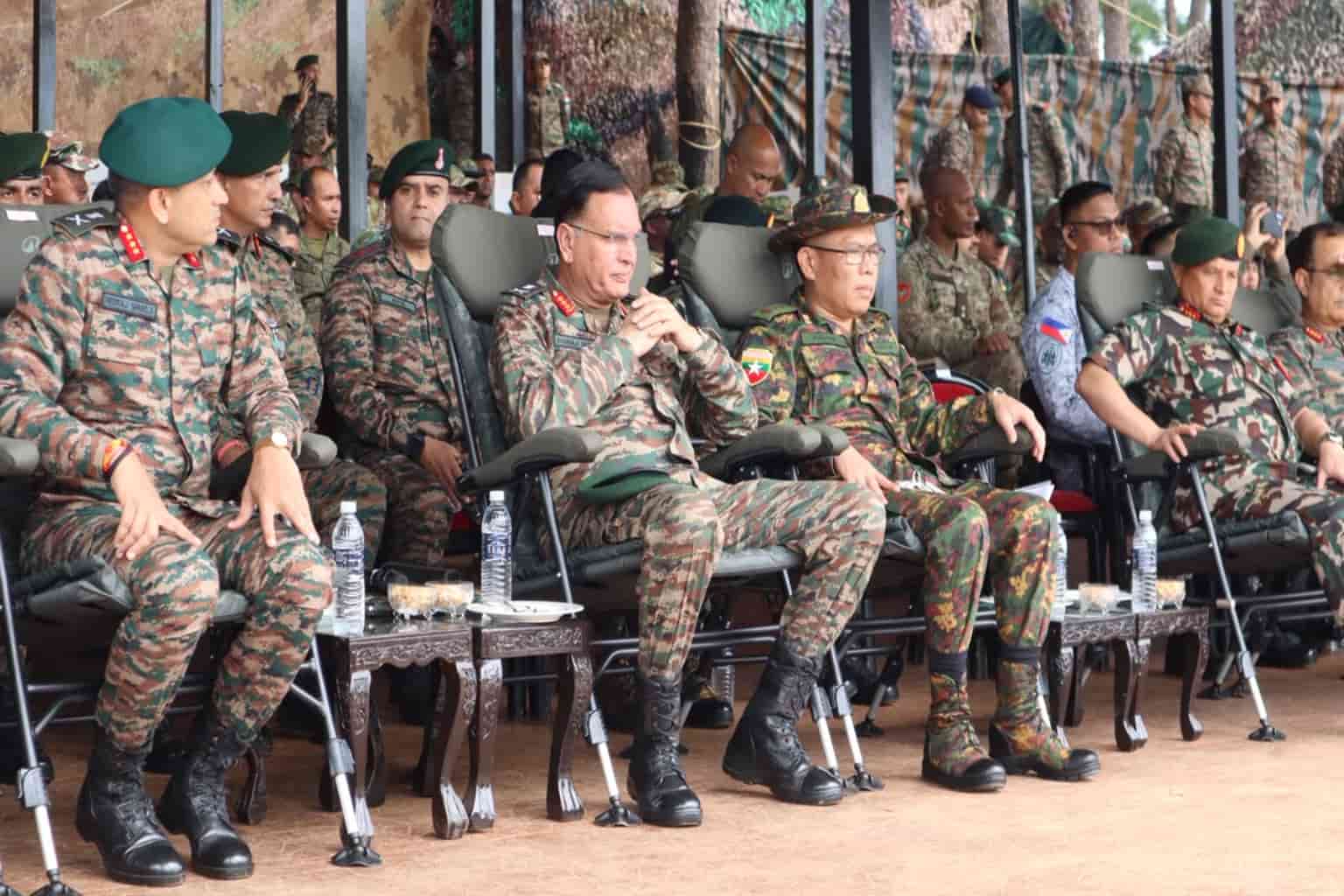
Exercise PRAGATI 2026 brought together the Indian Army and 12 friendly foreign nations at Umroi, Meghalaya. More than a military drill, it showed India’s growing role as a regional training partner, security connector and trusted defence partner in the Indian Ocean and Indo-Pacific neighbourhood.
A soldier can be trained in weapons, tactics and movement.
But one thing cannot be built in a hurry.
Trust.
Trust is built when soldiers train together, sweat together, make decisions together and learn how the other side thinks under pressure. In a real crisis, armies do not get time to introduce themselves. They must already know how to coordinate, communicate and act.
That is why Exercise PRAGATI 2026 should not be seen as just another military exercise.
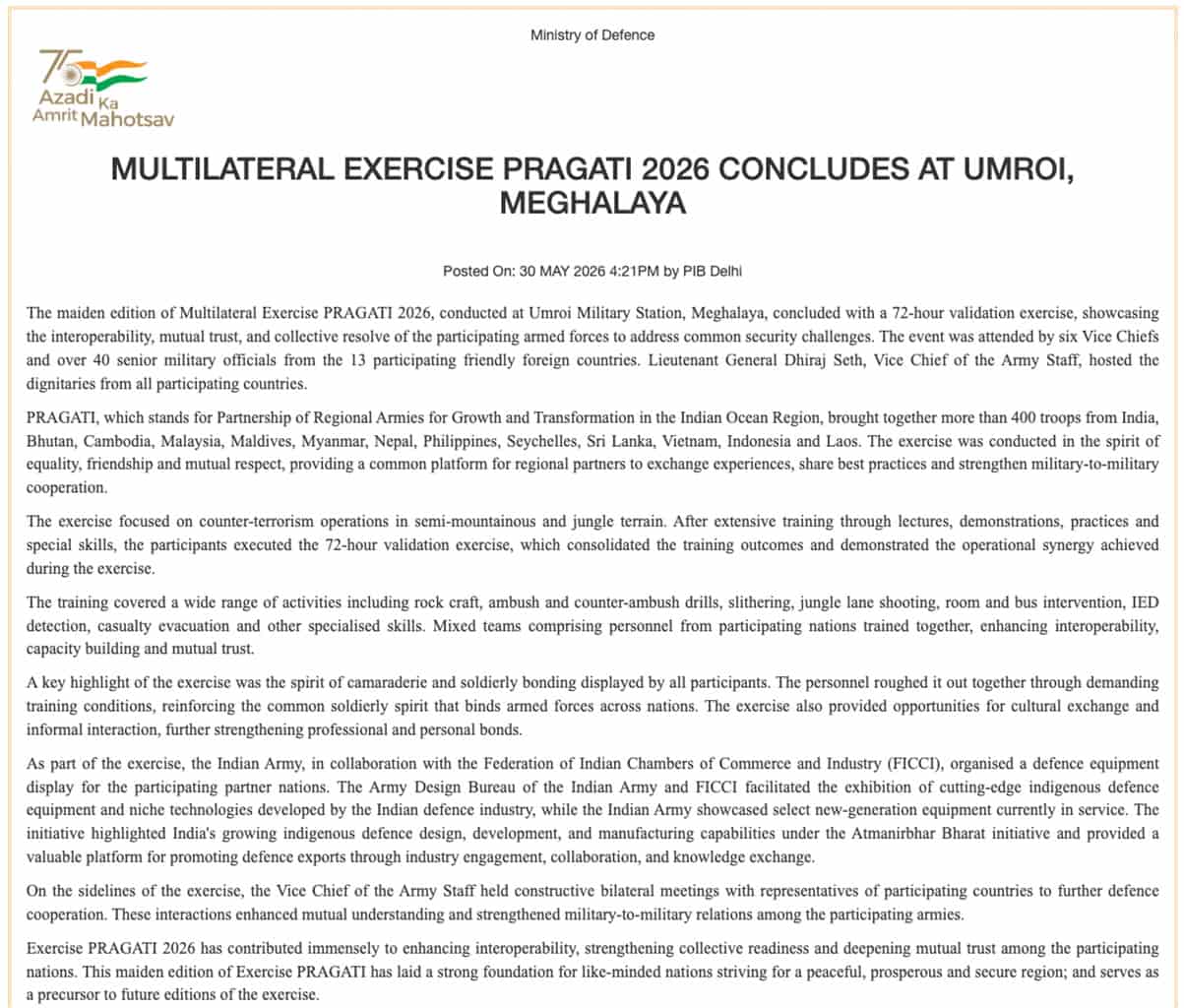
The maiden edition of Multilateral Exercise PRAGATI 2026 was conducted at Umroi Military Station in Meghalaya and concluded with a 72-hour validation exercise. According to PIB, the exercise showcased interoperability, mutual trust and collective resolve among the participating armed forces to address common security challenges. The event also saw participation from senior military leadership, including six Vice Chiefs and over 40 senior military officials from the participating countries.
This is the official update.
But the real story is deeper.
Exercise PRAGATI 2026 brought together India and 12 friendly foreign nations. The participating countries included Bhutan, Cambodia, Indonesia, Laos, Malaysia, Maldives, Myanmar, Nepal, Philippines, Seychelles, Sri Lanka and Vietnam. These are not random names on a participation list. Many of these countries are connected with India’s neighbourhood, Southeast Asia and the wider Indian Ocean region.
That gives the exercise a larger meaning.
India is not only training its own soldiers. It is creating a platform where regional armies can understand each other before a real security challenge appears.
This is defence diplomacy in uniform.
The name PRAGATI itself carries the idea. It stands for Partnership of Regional Armies for Growth and Transformation in the Indian Ocean Region. This tells us that the exercise is not only about tactical drills. It is about building a regional military habit of cooperation.
In simple language, India is saying: let us learn to work together before we are forced to work together.
That is important because future security challenges may not remain limited to one border or one country. Terrorism, illegal movement, disaster response, maritime instability, humanitarian emergencies, cyber-linked disruptions and regional security pressure can affect many countries at the same time.
No army can build coordination overnight.
If soldiers from different countries have trained together before, they understand each other better. They know communication patterns. They know how planning is done. They know how decisions are taken. They know how to adjust when terrain, weather, pressure and fatigue begin to test them.
This is why multinational exercises matter.
For the Indian Army, Umroi in Meghalaya is also a meaningful location. The terrain gives soldiers a realistic training environment. Reports around the exercise mention focus areas such as counter-terrorism operations in semi-mountainous and jungle terrain, joint planning, tactical drills and coordinated operations.
This terrain is not easy.
Jungle and semi-mountainous areas test endurance, movement, communication and team coordination. Soldiers have to deal with visibility challenges, physical strain, changing ground conditions and quick tactical decisions. When soldiers from different countries train in such conditions, they are not only exchanging theory. They are learning practical cooperation.
The final 72-hour validation exercise is especially important.
In any exercise, the final phase is where lessons are tested. By then, soldiers are tired. They have already gone through days of training. The environment becomes more demanding. Coordination is no longer a classroom discussion. It becomes a field requirement.
According to reports, the exercise involved around 400 military personnel from 13 nations and concluded with the 72-hour validation phase focused on interoperability, mutual trust and collective readiness.
That is where the real value lies.
It is easy to stand together for a photo. It is harder to plan, move, communicate and complete a tactical task together under pressure.
Exercise PRAGATI 2026 should therefore be read as a test of habits: how soldiers communicate, how they respond, how they understand commands, how they coordinate casualty evacuation, how they move in difficult terrain and how they adjust to multinational working.
This is also where India’s role becomes important.
India is increasingly positioning itself as a regional security partner. Not only through weapons, not only through statements, but through training platforms where friendly countries can work with the Indian Army in realistic conditions.
This approach is powerful because training creates confidence.
A country that trains with India does not only see equipment and formations. It sees professionalism, systems, leadership, discipline and field experience. This builds long-term trust in a way that speeches cannot.
For India, this is also linked with its wider regional outlook.
The Indian Ocean Region and Indo-Pacific are becoming strategically important. Countries in this region are watching maritime routes, disaster risks, regional stability, security partnerships and the behaviour of larger powers. In such a setting, exercises like PRAGATI help India strengthen relationships with friendly regional armies.
The message is not aggressive.
The message is cooperative readiness.
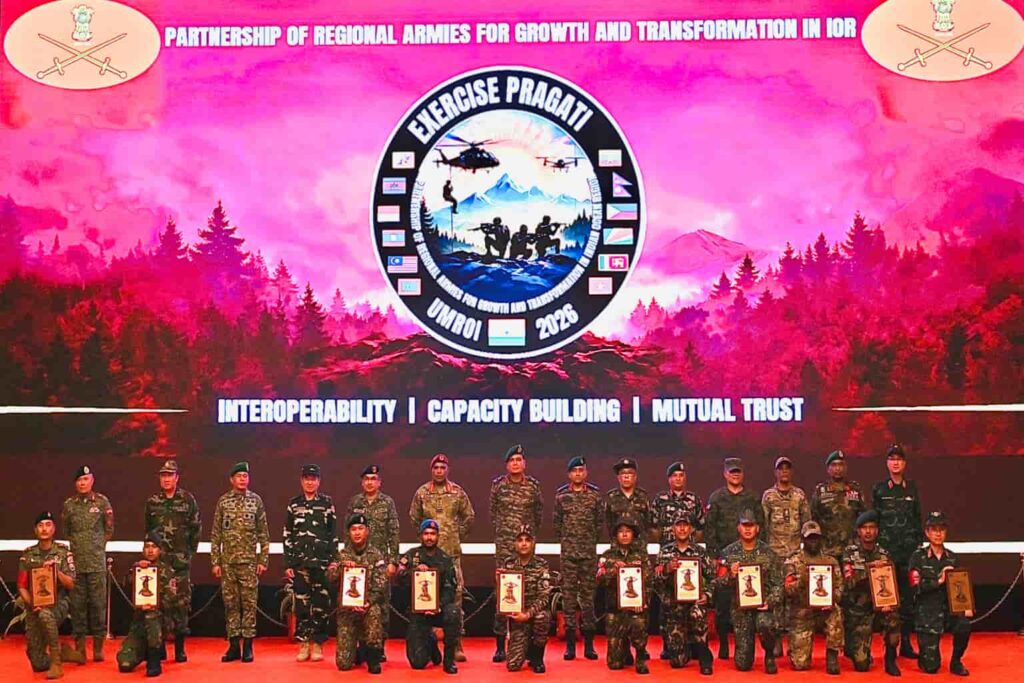
India is not saying that every challenge must be answered alone. It is building a framework where friendly nations can understand each other’s methods and respond better to common concerns.
For common readers, this may look like a defence event far away in Meghalaya. But the meaning is connected with regional stability.
When armies train together, they reduce confusion during crisis. When they understand each other’s systems, cooperation becomes faster. When they build trust in peacetime, they are better prepared for emergencies.
This matters during natural disasters. It matters during humanitarian assistance. It matters during counter-terror situations. It matters during regional instability. It matters when communication between militaries has to be quick and reliable.
For soldiers, the human side of this exercise is also important.
Imagine soldiers from 13 nations standing on the same training ground. They may speak different languages. They may wear different uniforms. Their military traditions may be different. Their food, climate experience and command styles may be different. But during training, they must understand one another.
They must learn how to move together.
They must learn how to trust instructions.
They must learn how to coordinate when the situation changes.
This is not built through one lecture. It is built through repeated drills, shared hardship and professional respect.
That is the real strength of Exercise PRAGATI 2026.
It has helped create a space where regional armies can meet not as strangers, but as partners preparing for a safer region.
For defence aspirants, this exercise also carries a lesson.
The future of military service will not be limited to national boundaries alone. Officers and soldiers may increasingly work in multinational environments, joint exercises, peacekeeping missions, disaster relief operations and regional security platforms. Communication skills, adaptability and cultural understanding will become more important along with physical fitness and tactical knowledge.
A future officer must know how to lead his own troops, but also how to coordinate with soldiers from another country.
That is why exercises like PRAGATI matter for young defence aspirants. They show that modern soldiering requires discipline, tactical skill, regional awareness and the ability to work with partners.
For veterans and serving personnel, the importance is even clearer. They understand that exercises are not only public events. They are rehearsals for uncertainty. They help identify gaps, improve procedures, test endurance and build confidence.
No one wants a crisis.
But if a crisis comes, preparation done earlier becomes valuable.
Exercise PRAGATI 2026 also gives a message about India’s defence diplomacy. India is not only strengthening itself. It is also creating platforms where regional armies can grow together. This is a mature way of building influence because it is based on training, professionalism and shared security concerns.
The official conclusion says the maiden edition of Exercise PRAGATI laid a strong foundation for like-minded nations striving for a peaceful, prosperous and secure region, and serves as a precursor to future editions of the exercise.
That line is important.
It means PRAGATI is not meant to be a one-time event. It can become a continuing platform. If future editions happen regularly, the trust and interoperability created in 2026 can deepen further.
This is how military relationships grow.
First, soldiers meet.
Then they train.
Then they understand each other’s systems.
Then their commanders exchange ideas.
Then future cooperation becomes easier.
For Sainik Welfare News readers, the takeaway is simple. Exercise PRAGATI 2026 is not just about 13 nations training in Meghalaya. It is about India building military trust with friendly nations before a real crisis. It is about regional armies learning to coordinate in difficult terrain. It is about India’s role as a defence training partner in the Indian Ocean and Indo-Pacific neighbourhood.
The most important point is this: military trust is not created during emergency. It is created before emergency, in training grounds, field exercises and shared hardship.
That is what Exercise PRAGATI 2026 represents.
It is a message of cooperation, preparedness and regional confidence.
Not loud. Not dramatic. But strategically important.
Sources:-
Official PIB release: Multilateral Exercise PRAGATI 2026 concludes at Umroi, Meghalaya
https://www.pib.gov.in/PressReleasePage.aspx?PRID=2266978&lang=1®=3
News On AIR report on Exercise PRAGATI 2026 with 12 friendly nations
https://newsonair.gov.in/india-hosts-pragati-2026-exercise-with-12-friendly-nations-participating/
Economic Times report on 13 nations and 400 personnel in Exercise PRAGATI 2026
https://m.economictimes.com/news/defence/13-nations-400-personnel-take-part-in-exercise-pragati-2026-in-meghalaya/articleshow/131411926.cms
Times of India report on Exercise PRAGATI 2026 conclusion
https://timesofindia.indiatimes.com/defence/news/13-nations-one-mission-indian-army-wraps-up-exercise-pragati-2026/articleshow/131407502.cms

Leave a Reply