


For thousands of engineering students in India, the dream of wearing the uniform often runs parallel to another dream: building a strong technical career. Until now, many aspirants saw these as two separate tracks. One path led toward engineering jobs, higher studies and public sector opportunities through GATE. The other led toward defence officer entry through exams like AFCAT. But the announcement shown in the image changes the way many aspirants may now look at that choice.
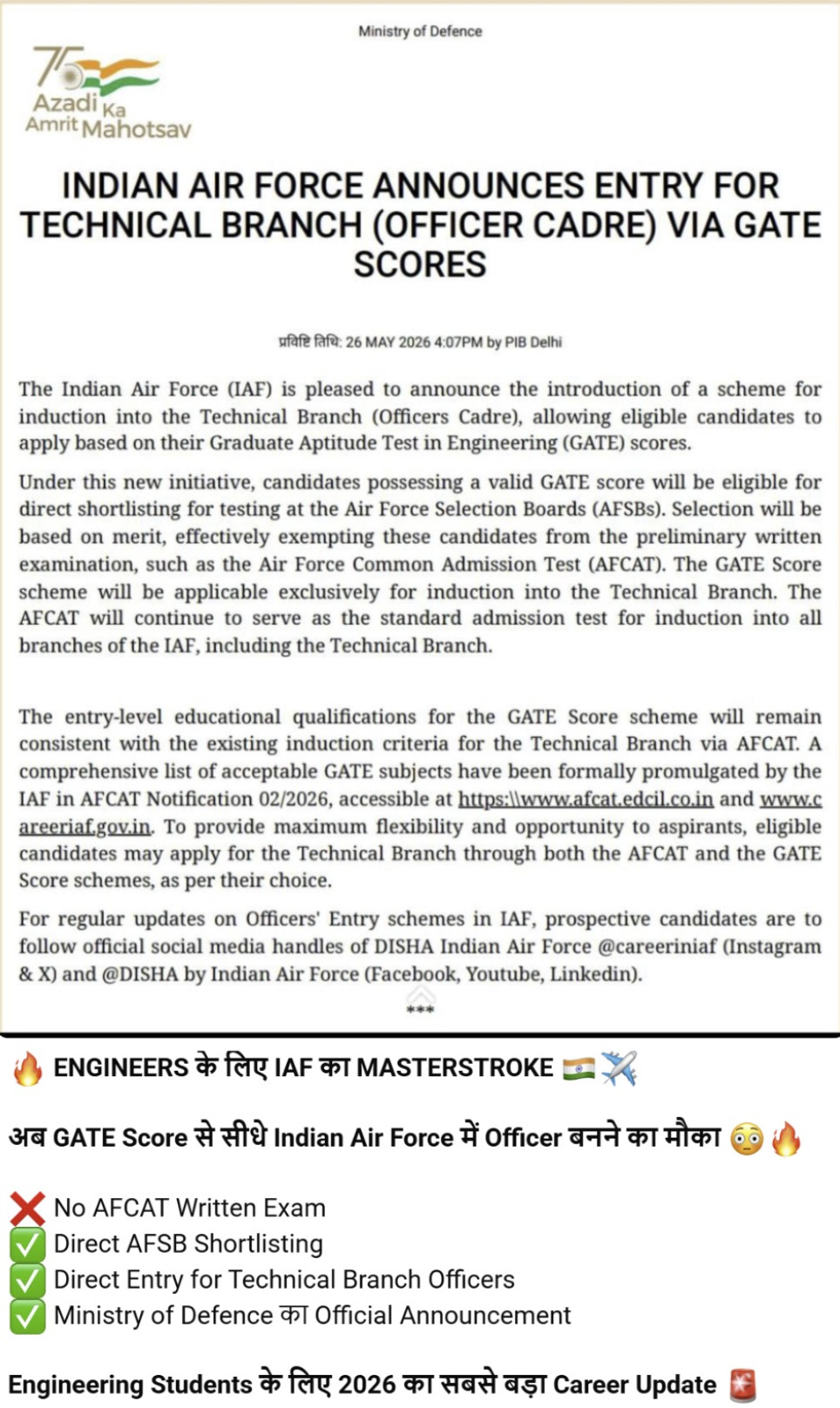
If the route is implemented as shown, the Indian Air Force Technical Branch may now become accessible through valid GATE scores, opening a fresh officer-entry opportunity for engineering graduates who already invest time, discipline and serious preparation into technical subjects.
That is why this update matters.
This is not just a recruitment tweak. It is a shift in how technical talent can be identified and channelled into the Air Force. In practical terms, it suggests that engineering merit may now play a more direct role in shortlisting future Technical Branch officers. For aspirants, that creates a powerful message: your technical preparation may now support your uniform dream in a more direct way.
The most important part of the announcement is the shortlisting logic.
The image says candidates with a valid GATE score may be eligible for direct shortlisting for testing at the Air Force Selection Boards, and that this route may exempt them from the preliminary written test stage such as AFCAT, at least for this specific path. That is a major point because it changes the pressure pattern for technical aspirants.
Earlier, many students had to prepare separately for defence entry and separately for GATE or engineering-career options. Now, if GATE is being accepted for this pathway, one strong technical score could support entry into a highly respected officer career option as well.
That makes this update especially important for final-year engineering students and recent graduates.
Many of them already prepare for GATE with intense focus because the exam is linked to postgraduate admissions, PSU opportunities and broader engineering credibility. If the same preparation can also help in moving toward the IAF Technical Branch, then the value of that effort increases significantly. For aspirants, this is not only about convenience. It is about opportunity multiplication.
At the same time, one misunderstanding must be avoided.
This is not the same as saying AFCAT is over.
The image itself clearly indicates that AFCAT will continue as the regular admission route for induction into all branches of the Indian Air Force, including the Technical Branch. That means GATE is being shown as an additional or alternative technical route, not a replacement for the traditional system. This is a very important distinction because many viral career updates become misleading when people reduce them to a single dramatic claim.
The better way to understand this is simple.
The Air Force appears to be creating a parallel merit-based technical entry window for eligible candidates, while keeping AFCAT alive as the standard route. In other words, the system is becoming wider, not narrower.
That is good news for engineering students.
A candidate who is serious about the IAF Technical Branch may now have two meaningful pathways to think about. One is the established AFCAT-based route. The other, based on the announcement shown, is the GATE-score route for direct shortlisting consideration. This gives aspirants more strategic flexibility and may also reward those who already have a strong academic and technical foundation.
There is another reason this update feels important.
The Air Force is a highly technical force. Modern air power depends not only on pilots and operations, but also on highly capable officers who understand systems, maintenance, electronics, aeronautical structures, communication networks, weapons integration and technical reliability. In that context, using GATE-linked technical merit as a selection filter makes sense from an institutional point of view as well.
A force that operates advanced platforms needs officers with strong technical understanding.
That is why this announcement should also be seen as part of a broader defence-modernisation mindset. The services are increasingly dealing with more complex machines, software-linked systems, integrated sensors and high-performance technical infrastructure. A strong engineering pipeline is therefore not just useful. It is necessary.
For aspirants, this means the message is changing.

The old assumption that defence entry is only about motivation, confidence and general exam preparation is no longer enough. Those qualities still matter deeply, especially at the SSB stage. But for technical branches, academic depth and engineering competence also matter in a serious way. This update reinforces that idea.
It also makes the Technical Branch more attractive for a certain kind of student.
There are many engineering aspirants who want a career with purpose, structure, status and national service, but who also do not want to leave their technical identity behind. For such candidates, Technical Branch officer entry can offer the best of both worlds: a uniformed career and a strong technical role. If GATE is now formally entering that route, it may draw even more serious talent toward the Air Force.
That said, aspirants should not rush into assumptions.
A valid GATE score alone does not mean automatic selection. Shortlisting is only one stage. The real journey still depends on eligibility, acceptable disciplines, medical fitness, document accuracy, merit position and performance in later stages such as AFSB. So this update should be seen as an important entry opportunity, not as a shortcut.
That is where many students need maturity.
A new route is useful only if the candidate studies the official eligibility properly. The image also suggests that the acceptable GATE subjects and technical qualifications remain tied to the broader notification framework, and that candidates may apply through both AFCAT and the GATE-score scheme according to their choice. That means aspirants should read the official notification carefully rather than relying only on social media summaries.
From an SEO and career-content perspective, this is a powerful story because it connects several high-interest search themes at once:
Indian Air Force Technical Branch entry, GATE score for defence jobs, IAF officer recruitment, AFCAT vs GATE route, AFSB direct shortlisting, and engineering career opportunities in defence.
But beyond search value, it also has a strong human story.
For an engineering student preparing late into the night for GATE, this kind of update can change how effort is viewed. What once looked like preparation for one exam may now become preparation for a larger future. The same score may now represent not only a technical credential, but a possible pathway to serve the country in uniform.
That is why this announcement has created excitement.
It speaks directly to a generation of technically skilled young Indians who do not want to choose between engineering excellence and national service. It tells them that the two may not be separate after all.
Final takeaway
The biggest significance of this update is not only that the Indian Air Force Technical Branch may now consider GATE scores for shortlisting. The bigger significance is that it can reshape how engineering graduates look at officer entry itself.
If handled seriously, this route could become one of the most important career openings for technical aspirants in 2026. But candidates should stay disciplined, read the official notification carefully, verify accepted branches and subjects, and remember that shortlisting is only the beginning.
For engineering graduates dreaming of the uniform, this is not just another recruitment update. It could be the moment when technical preparation and defence ambition finally meet on the same path.




Leave a Reply