


For many central government employees, pensioners and ex-servicemen, the extension of the 8th Pay Commission memorandum deadline comes as a genuine relief. What looked like a closing window has now reopened for one more month. The official 8th CPC website now says that the last date for submission of responses has been extended up to 31 May 2026, while the MyGov memorandum page also shows 5 March 2026 as the start date and 31 May 2026 as the closing date for online submission.
But this update should not be read only as extra time on the calendar. It should be understood as extra value in the process.
That is because the 8th Central Pay Commission is now in a live consultation stage. Its official website shows recent updates on the extension, a clarification on memorandum submission, forthcoming meetings, Delhi interactions, and the Pune visit. In other words, this is not a passive phase in which the Commission is simply waiting. It is actively collecting, sorting and examining inputs. That makes the extension important not because it postpones urgency, but because it gives stakeholders one more opportunity to improve the quality of what they submit.
This is where the story changes for employees and pensioners.
Earlier, many people were rushing only to meet the deadline. Now they have the chance to do something more useful: prepare a better case. In a pay commission process, a hurried submission is often weaker than a precise one. A vague complaint may express frustration, but it does not always help the Commission study the issue properly. A well-drafted memorandum, on the other hand, can identify the exact problem, the category affected, the financial or service impact, and the correction being sought. That is the kind of material that enters policy discussion more effectively. This is an inference from how the Commission has structured its submission system and categories on the official portals.
The extra month matters even more because the Commission has made one procedural point absolutely clear: submissions are online only. The official 8th CPC memorandum page states that all submissions must be made only through the specified link and that paper-based memoranda, hard copies, PDFs and emails are not being considered or entertained by the Commission. That single instruction changes the practical meaning of participation. It means a concern is not truly in the system unless it reaches the system through the prescribed channel.
That is why this extension should not encourage complacency.
Many employees still assume that if a matter is being discussed in unions, WhatsApp groups, retired employees’ circles or on social media, it is already receiving attention. That may create awareness, but it is not the same as official representation. The MyGov portal shows that the Commission is inviting representations from categories including Individual / Employee / Pensioner, Association / Union of Serving Employees / Pensioners, Ministry / Department / Union Territory, and certain court and judicial categories. The official 8th CPC page also lists a wide range of eligible stakeholders including defence personnel, pensioners, service associations and ministries. This means the platform is broad, but it still expects inputs to be formally structured.
That broader access is especially important for categories whose issues are often detailed and highly specific.
A serving employee may want to raise minimum pay, fitment factor, annual increment, MACP, cadre stagnation, HRA, TA, LTC or duty-related allowances. A pensioner may want to focus on pension revision, Dearness Relief, commutation, family pension, gratuity or medical access. Defence pensioners and veterans may need to highlight OROP-linked anomalies, MSP, disability pension, ECHS, CGHS, rank-related disparities, early retirement impact or field-condition concerns. These are not identical issues, and they should not be written as if one generic paragraph can cover them all. The extension gives stakeholders time to separate these issues properly and present them with more clarity. This practical advice is based on the Commission’s category-based submission design rather than a specific official drafting template.
Associations and unions may benefit even more from this added time.
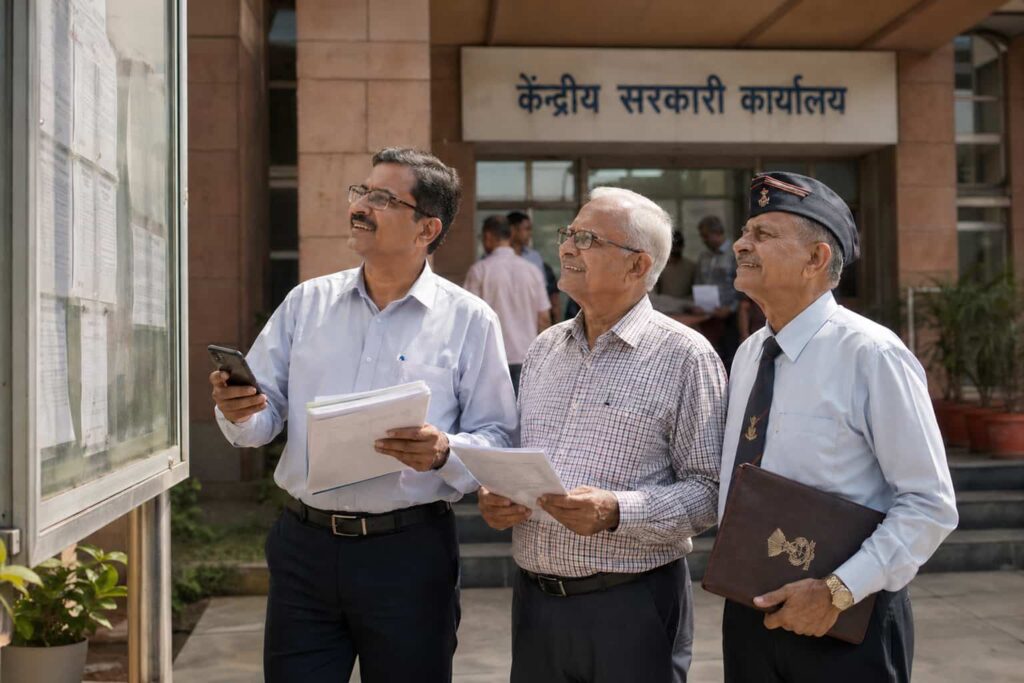
Representative bodies often need to consult members, compare cases, review older orders, check data and refine language before filing a collective memorandum. The difference between a rushed association submission and a carefully prepared one can be significant. A stronger memorandum can connect individual hardship to a larger pattern, show how a policy gap affects a full cadre or pension category, and explain why the issue deserves consideration at the Commission level. Since the official system expressly welcomes submissions from associations and unions, the extension creates room for better coordination, not just later filing.
There is also an important human side to this extension.
For senior pensioners, widows, veer naris and veterans in smaller towns or remote areas, online submission is not always easy. Login steps, category selection, drafting, attachments and confirmation records can all become obstacles. The extension gives families, welfare groups and local associations more time to help such people participate properly. That matters because some of the most genuine grievances come from people who are least comfortable with digital systems. If their concerns remain offline, they may remain outside the Commission’s working record as well. The online-only rule makes such assistance especially important.
The real value of this extra month, then, lies in moving from urgency to precision.
Instead of writing everything, stakeholders should focus on what they can explain well. Instead of long emotional narration, they should present issue-wise points. Instead of only asking for “higher pay” or “better pension,” they should show what the current gap is, who suffers because of it, what correction is needed, and why that correction is justified. The Commission may receive a very large volume of material. In that context, clarity becomes a strength. This is an inference, but it is strongly supported by the structured submission approach adopted on the official portals.
The extension to 31 May 2026 is therefore not just an administrative relief. It is a test of seriousness.
Those who use this time only to wait will gain very little. Those who use it to verify facts, write clearly, submit through the proper route and save their confirmation proof will be in a much stronger position. When the 8th CPC eventually studies the material before it, the most useful submissions will not be the loudest ones. They will be the ones that reached the official system in a clear and usable form.
That is why this extension should be seen as one final chance to build a stronger case, not as permission to postpone action.

Leave a Reply