

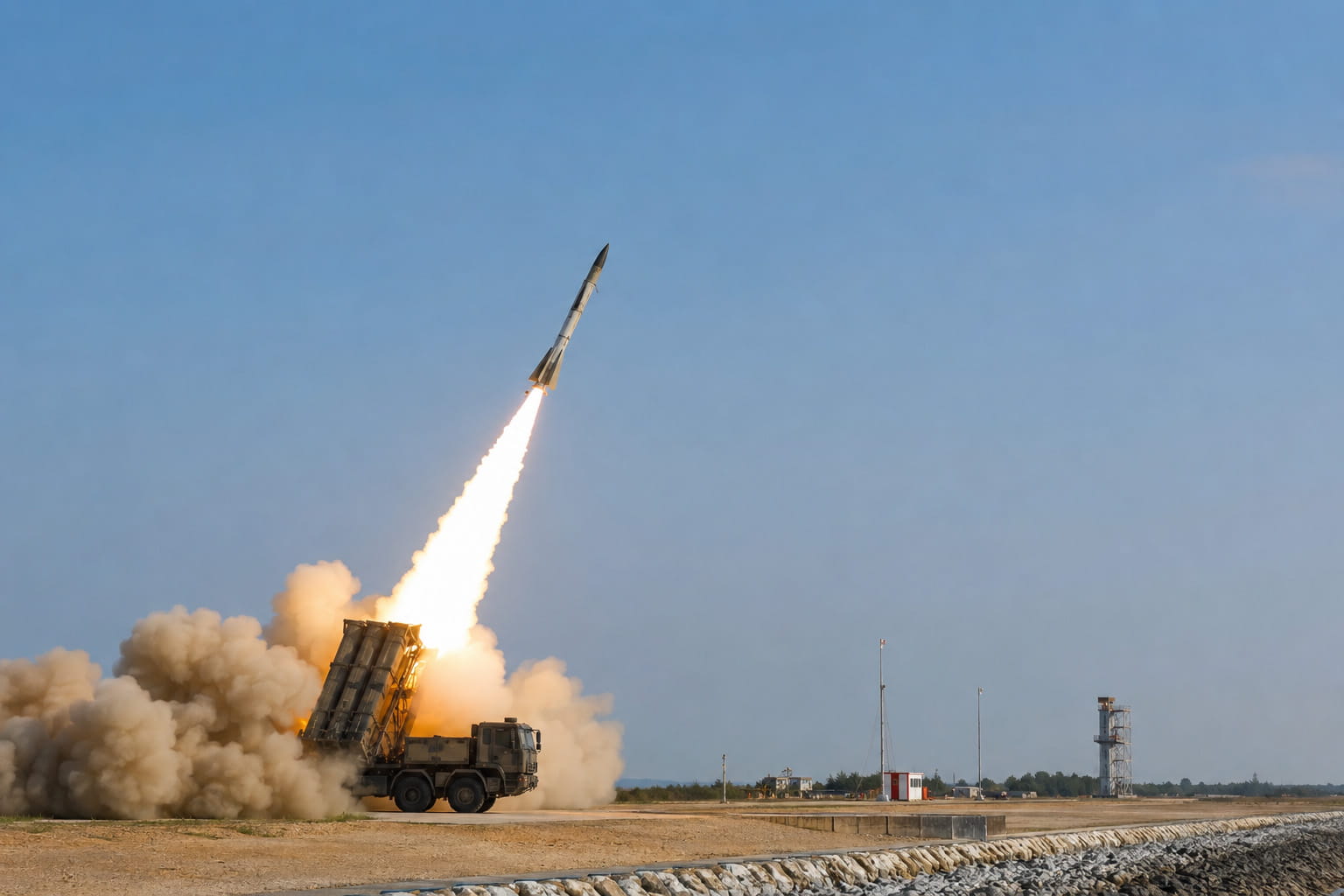
In war, the soldier at the frontline is often seen as the face of battle. But many battles are shaped much earlier and much deeper. What happens to enemy ammunition storage, command posts, logistics routes, communication hubs and staging areas can decide how much force actually reaches the front. That is why long-range precision firepower matters so much. It does not just destroy targets. It changes the enemy’s ability to organize, move and sustain a fight.
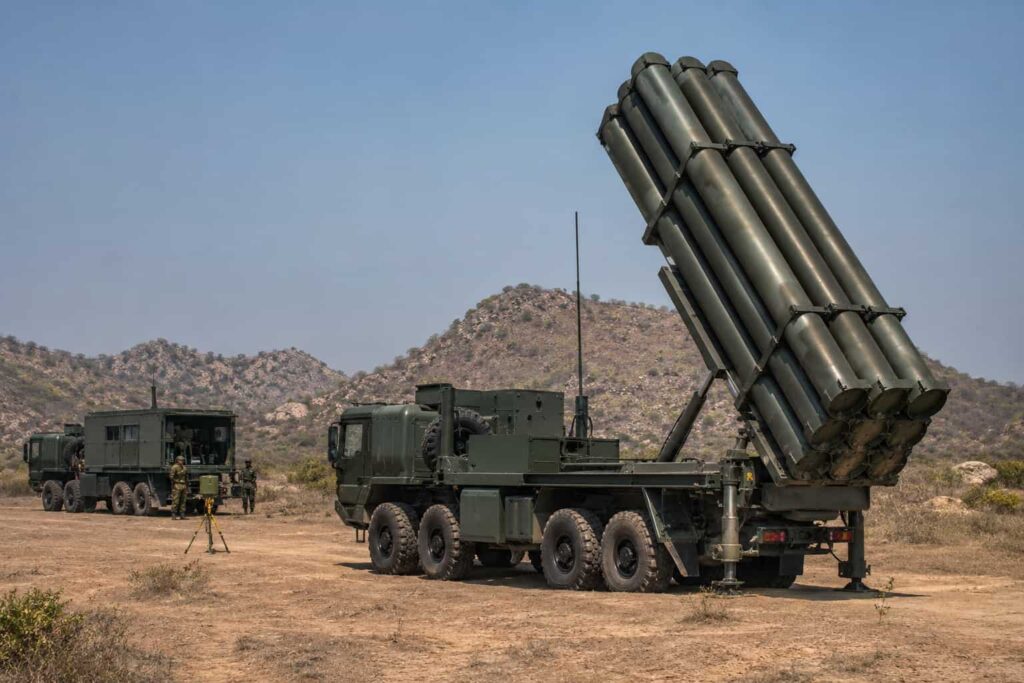
That is the right way to understand the reported Suryastra test.
According to NIBE Limited’s stock-exchange disclosure, the company said it had received a purchase order in January 2026 under the Emergency Procurement of the Indian Army for the SURYASTRA Universal Rocket Launcher and rockets of 150 km and 300 km range. The same disclosure said test firing was successfully conducted at ITR Chandipur, Odisha, on 18 and 19 May 2026. Media reports from The Economic Times and The Times of India also linked the demonstrations to an Indian Army procurement programme.
This immediately makes the story bigger than a routine industry trial.
If a system is being demonstrated in connection with Army emergency procurement, it suggests that the discussion is not theoretical. It points to a real battlefield requirement. The Army is clearly looking for options that can hit farther, faster and more accurately than older firepower models allowed. That matters because the modern battlefield punishes slow build-up and exposed concentrations. Precision at long range is now one of the most valuable advantages any force can have.
The reported range figures tell us why this matters.
A 150 km capability already gives commanders a significant deep-strike tool. But a 300 km strike option changes the conversation further. At that distance, the target set expands sharply. What was once considered a relatively safe rear area may no longer be safe. Command nodes, fuel points, launch areas, reserve positions and supply hubs can all come under pressure. In simple words, a force with accurate 300 km firepower can attack not only the enemy’s fighting edge, but also the system that keeps that fighting edge alive.
That is why long-range rockets are not just about distance.
They are about shaping the battlefield before direct contact intensifies. If rear logistics are disrupted, front units receive less ammunition. If command nodes are hit, decision-making slows. If launch sites are neutralised, pressure on Indian troops reduces. In that sense, deep precision firepower is not separate from frontline protection. It is one of the ways to improve it.
The reported accuracy claims add another layer.
NIBE’s disclosure said the rockets achieved a CEP of 1.5 metres at 150 km and 2 metres at 300 km during the tests. Those are company-stated figures and should be treated as such until broader official confirmation appears, but if such precision is validated in service conditions, it would place the system in a very serious category of battlefield utility. Long-range firepower becomes far more useful when it is not only distant, but also selective and accurate.
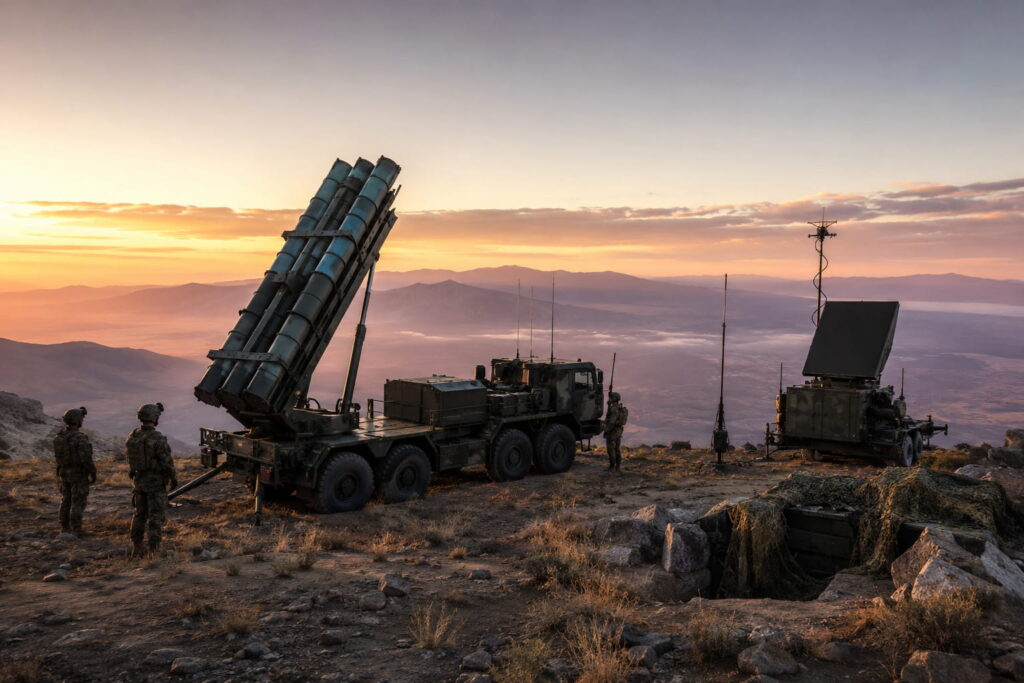
This is also part of a larger Indian Army shift.
The Army has been putting increasing emphasis on longer-range artillery and rocket systems, including modernisation around precision and deep-strike capability. Separate Defence Acquisition Council approvals in late 2025 also showed continued investment in systems like Pinaka, reflecting the wider importance of long-range fire support in India’s evolving warfighting plans. Suryastra fits into that broader picture of greater stand-off reach and more flexible strike options.
There is another important angle here: the private sector.
For years, major battlefield firepower stories in India were usually tied to government-run defence entities or long-established public programmes. The Suryastra reporting suggests something different. It points to a growing role for private Indian defence manufacturing in advanced launcher and rocket systems. That matters because it broadens the industrial base behind military capability. A stronger private role can improve scale, speed, competition and technology absorption if execution remains solid.
The technology background also explains why the story has drawn attention.
In July 2025, NIBE Limited announced a Technology Collaboration Agreement with Elbit Systems for advanced universal rocket launcher manufacturing in India. Elbit’s PULS family is known internationally as a flexible long-range rocket artillery system, and Reuters has separately reported that the platform offers precision strike capability up to 300 km. This gives useful context to the Suryastra story and helps explain why the reported ranges and procurement interest are being taken seriously.
For the ordinary reader, the simplest way to see this is through battlefield effect.
A soldier in a forward area benefits when the enemy’s deeper support structure is under threat. If a launcher can strike a distant ammunition dump, a command vehicle cluster or a key logistics point, it may reduce what eventually arrives against Indian troops. In practical military terms, precision at 300 km can influence the fight long before the enemy closes the distance.
Mobility also matters here.
Modern rocket artillery is valuable not only because it can hit far, but because it can fire and relocate quickly. In an era of drones, radars and counter-battery detection, a launcher that remains exposed after firing becomes vulnerable. Systems associated with the universal rocket launcher concept are attractive partly because they support faster launch-and-move operations, improving survivability while keeping strike pressure high. This is an inference based on the class of launcher being discussed and the broader design logic of such systems.
Still, one caution is essential.
As of now, no separate PIB or Ministry of Defence press release confirming this specific Suryastra test was found in public search. That means the most responsible wording is to say that, according to NIBE’s disclosure and multiple media reports, the test happened at Chandipur and is linked to an Indian Army procurement programme. That is strong enough to make the story newsworthy, but careful enough to preserve credibility.
That careful distinction matters because defence news spreads quickly and often becomes exaggerated. A responsible blog should separate what the company has disclosed, what established media have reported, and what the government has formally announced. In this case, the first two are available. The third, at least in public search, is not yet visible.
Even with that caution, the larger meaning of the story remains strong.
The reported Suryastra test suggests India is moving toward a battlefield model in which the enemy’s rear areas are no longer treated as safe space. It suggests the Indian Army wants deeper, more accurate firepower. And it suggests private Indian industry is beginning to enter a more serious class of weapon systems, not just support components.
That is why this story matters.
Not because one rocket flew far, but because it reflects a bigger change in how future battles may be fought. The frontline will always matter. But in modern war, the side that can strike deeper, faster and more precisely often begins shaping the result before the frontline battle fully unfolds.






Leave a Reply