


Some defence stories are important not because they involve large weapons systems or border headlines, but because they test how a disciplined institution responds when something goes seriously wrong inside a controlled environment. The Pulgaon firing range incident is one such case.
What makes it especially serious is not only the loss of life. It is the fact that the death took place during a military firing practice, inside a sensitive defence establishment, and later became the subject of a police FIR carrying grave legal consequences. That combination changes the nature of the story. It is no longer just a tragic training incident. It is now also a case about facts, procedure and public confidence.
According to the broad facts reflected in the original reports, DSC Subedar Major Om Bahadur Khand died during firing practice at Central Ammunition Depot Pulgaon on 15 May 2026. Initial defence-side communication reportedly described the incident as a firing accident during routine practice. But the matter took a much more serious turn when later reports said Wardha police registered an FIR under BNS Section 103(1) against an Army Major and sought custody as part of the investigation.
That shift is what has changed the public conversation.
Whenever a death happens in a controlled military setting, questions arise immediately. But once criminal law enters the picture in such a serious form, the case stops being only an internal matter. It begins to attract wider scrutiny from veterans, legal observers, military families and the general public. People want to know not just what happened, but how the system will establish the truth.
This is exactly why balance is necessary.
An FIR is not a conviction. It is a formal start to a criminal investigation. It means the allegation is serious enough to be examined under law. But it does not mean guilt has already been proved. At the same time, the registration of such an FIR also means the matter cannot be brushed aside casually under the label of accident without detailed inquiry. Both points must be held together if the public discussion is to remain responsible.
The identity of the deceased also matters in understanding the emotional weight of the case.
Subedar Major Om Bahadur Khand was not a junior or inexperienced figure in the military system. A Subedar Major is a senior Junior Commissioned Officer rank with deep institutional respect. In the Defence Security Corps too, such personnel carry experience, discipline and responsibility. When someone of that standing dies during a controlled firing activity, the incident naturally raises difficult questions inside and outside the force.
Another reason the case is especially sensitive is the location itself.
CAD Pulgaon is not an ordinary cantonment environment. It is associated with a highly sensitive military function. Any fatal incident there inevitably involves two layers at once. One is the human and legal layer. The other is the operational and security layer. That is why such cases cannot be handled casually either by police speculation or by public rumour.
The core question, of course, is simple: what actually happened on the firing range?
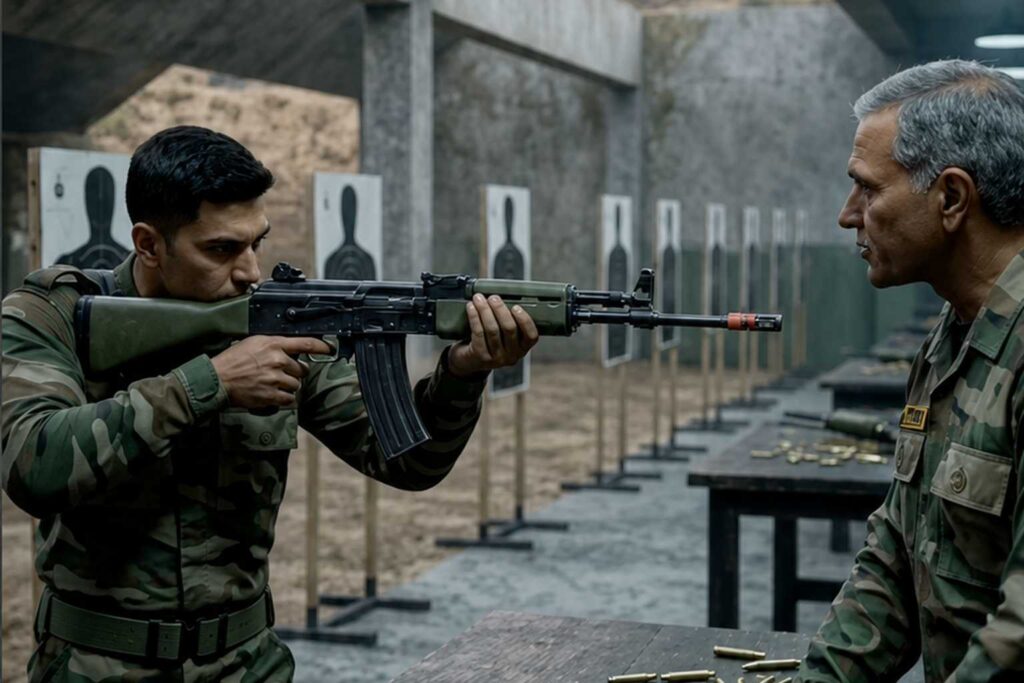
That question sounds straightforward, but in reality it demands careful reconstruction. Investigators will need to examine the sequence of activity on the range, the role of each person present, the weapon involved, the firing position, supervision, commands issued, safety procedure, witness statements, ballistic evidence, medical findings and the physical layout of the practice area. In a firearm-related death, details matter. A small fact can change the entire understanding of the event.
This is also why social media reactions are often more harmful than helpful.
In cases involving the armed forces, public opinion tends to split very quickly. One side rushes to declare it murder. The other side rushes to defend the institution and label it an unfortunate accident. Both responses are premature if evidence has not yet been fully tested. A sensitive defence matter deserves seriousness, not instant camps.
At a deeper level, this case also raises an issue that should concern every military family: firing range safety.
Live weapon training is among the most tightly controlled parts of military activity. It depends on discipline at every stage. Weapon issue, range briefing, firing orders, lane control, supervision, target discipline, post-firing checks and weapon safety are all there for one reason: to prevent exactly this kind of tragedy. If a fatal incident still occurs, then the investigation must examine whether procedure failed, whether supervision failed, whether human conduct failed, or whether something else happened entirely.
That does not automatically mean wrongdoing. But it does mean the inquiry must be rigorous.
The public should also understand that the Pulgaon matter may move through more than one institutional path. The Army has its own internal mechanisms for inquiry, discipline and legal action where applicable. Civil police, once an FIR is registered, operate under criminal law. When a serving military person is involved, questions of custody, jurisdiction and process can become complicated. But complication should not be mistaken for confusion. It simply means the law has to be followed carefully.
For the family of the deceased, however, the issue is more immediate and more painful.
A family loses a serving member and then watches reports, allegations and legal developments unfold in public. In such situations, dignity becomes very important. The family deserves truth, not rumour. It deserves due process, not institutional opacity. And it deserves a system that treats both the loss and the investigation with seriousness.
For the Army, the stakes are also high.
A disciplined force survives not only on command structure, but on internal trust. Soldiers must believe that safety rules mean something. JCOs must believe that accountability will be fair. Officers must believe that truth will be established through evidence, not panic. If the institution responds firmly and transparently, it protects not only justice in one case but also credibility across the system.
For the police too, the responsibility is significant.
Once such a case enters the criminal process, the investigation must be thorough without becoming sensational. A defence-related case cannot be handled like social media theatre. It requires sensitivity, professionalism and respect for both the seriousness of the allegation and the nature of the installation involved.
The larger lesson from Pulgaon is not limited to one unit or one date.
It is a reminder that in all live-fire training environments, safety must remain active, not routine. Procedures lose value when they become mere habit. Commands, supervision and weapon handling discipline have to be enforced every single time with full seriousness. Military accidents, negligence questions and legal disputes often begin where routine replaces alertness.
That is why this case should be followed carefully but soberly.
Subedar Major Om Bahadur Khand’s death is a grave loss. The FIR and allegations are grave. The investigation therefore has to be grave as well. Not emotional. Not selective. Not performative. Just honest and evidence-based.
In the end, the most responsible public position is clear.
Respect the deceased. Avoid rumour. Do not sensationalise the Army. Do not prejudge the accused. Let the inquiry and investigation do their work. Because in a case like Pulgaon, justice will matter only if it is built on fact, and credibility will matter only if the process is fair from beginning to end.





Leave a Reply