

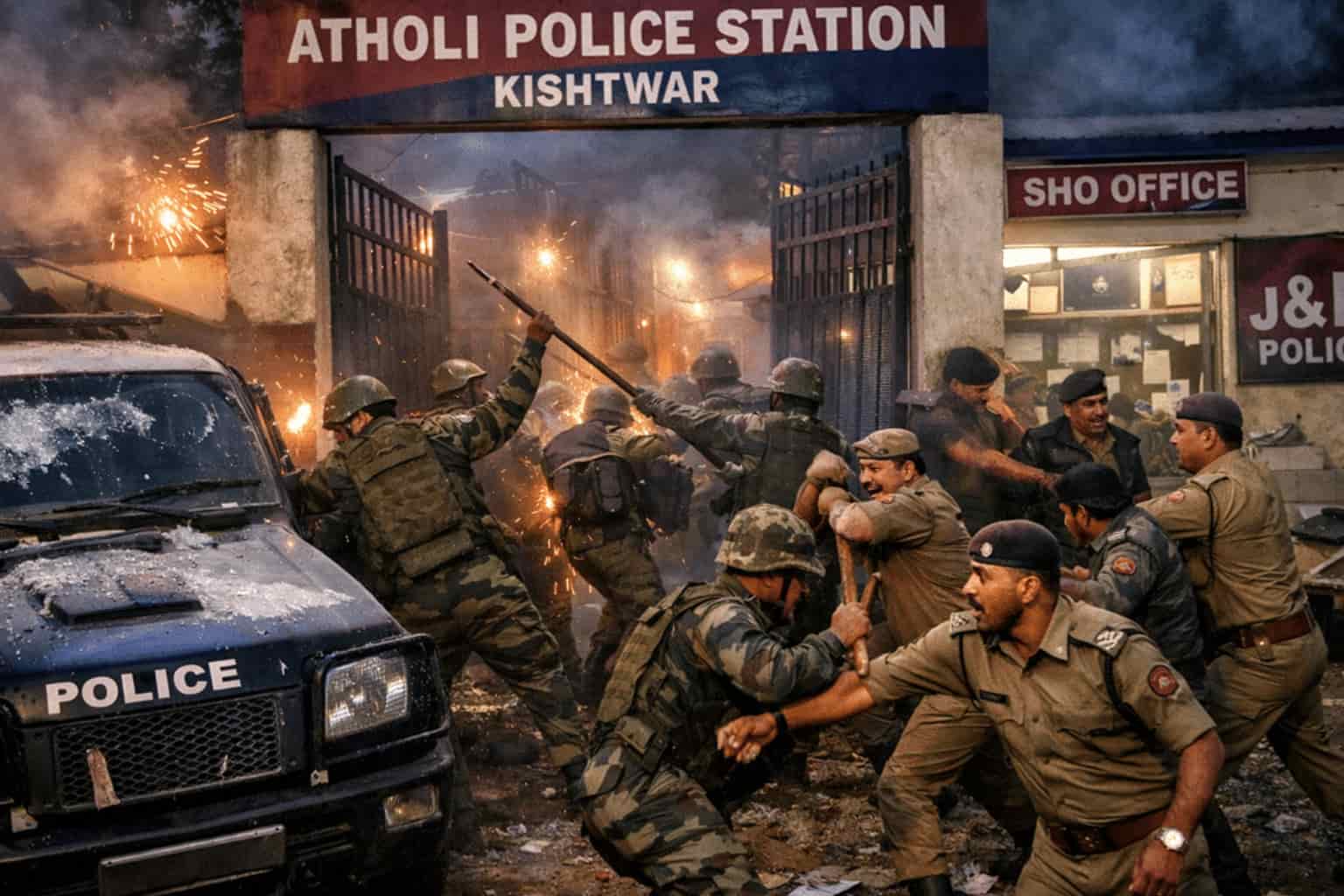
A serious FIR has brought an Army–Police incident in Kishtwar into public attention.
But in such matters, the first responsibility is not to shout the loudest.
The first responsibility is to write carefully.
Media reports say Jammu and Kashmir Police has registered an FIR against personnel of 17 Rashtriya Rifles, including senior Army officers, over an alleged incident at Atholi Police Station in Kishtwar district.
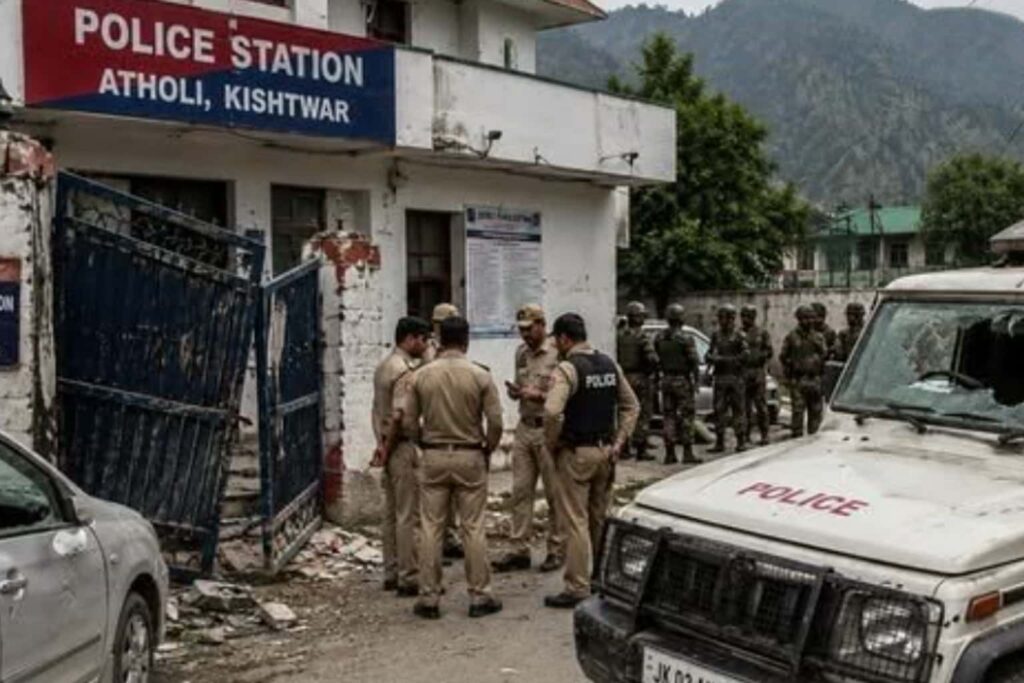
The allegations are serious.
The institutional sensitivity is also serious.
That is why this story must be understood with balance: an FIR can begin a legal process, but it cannot replace the findings of an investigation.
What is the Kishtwar Army–Police FIR issue?
According to multiple media reports, J&K Police has registered an FIR in connection with an alleged confrontation involving Army personnel and police officials at Atholi Police Station in Kishtwar.
Reports say the FIR names senior Army personnel, including officers of 17 Rashtriya Rifles, along with other personnel.
The allegations reportedly include entering the police station premises, assaulting police personnel, damaging government property and other serious offences.
Some reports also mention sections related to rioting, trespass, assault on public servants, attempt to murder, criminal intimidation and damage to public property.
These are grave allegations.
But they remain allegations until tested through investigation and legal process.
Why the wording matters?
This is not a normal local dispute.
It involves two security institutions that operate in a sensitive region.
The Army and J&K Police both work in a difficult security environment where coordination, discipline and trust are extremely important.
That is why words must be chosen carefully.
It is safer and more accurate to write:
“FIR alleges”
“as per media reports”
“Army personnel have been named in the FIR”
“the matter is under investigation”
“Army has said it will cooperate with the legal process”
It would be wrong to write as a final fact that the allegations have been proved.
A responsible article should not act like a court.
What reportedly triggered the confrontation?
Different reports point to a road-related incident before the matter reached the police station.
According to media reports, the situation reportedly began when a vehicle linked to Army personnel was stopped or taken into the police station after an issue connected with movement on a narrow road and a local official convoy.
After that, the FIR reportedly alleges that a group of Army personnel entered the police station premises and assaulted police personnel.
This version comes from the police complaint/FIR as reported by media.
It should not be treated as the final finding.
The exact sequence of events will become clearer only after investigation, statements, evidence and institutional inquiry.
What has the Army said?
The most important balancing point is the Army’s response.
Media reports have quoted the Defence PRO/Army side as saying that the matter is under examination through appropriate institutional mechanisms.
Reports also say the Army will extend full cooperation in the legal process and that appropriate action will be taken depending on the outcome of the joint investigation.
This means the Army has not dismissed the process.
It has also not accepted guilt as a final conclusion.
The matter is now in the zone of inquiry and legal examination.
Why investigation must come before judgement?
In sensitive cases, public opinion often moves faster than facts.
One side starts blaming the Army.
Another side starts blaming the Police.
Social media turns a legal matter into a shouting match.
But investigation exists for a reason.
It checks the FIR.
It records statements.
It examines evidence.
It studies CCTV or physical damage, if available.
It looks at the timeline.
It checks who was present.
It determines individual responsibility.
It separates allegation from proof.
Without this process, public discussion becomes speculation.
Why this issue is institutionally sensitive?
Jammu and Kashmir is not an ordinary policing environment.
The Army, police and other security forces often operate in overlapping spaces.
They may work together in counter-terror operations, area domination, intelligence-led actions, public security, road movement and crisis response.
That is why any Army–Police friction must be handled with maturity.
Both institutions are important.
Both have legal duties.
Both are expected to follow discipline.
Both must retain public trust.
If allegations are found true, accountability must follow.
If allegations are exaggerated or incomplete, that too must come out through investigation.
The process must be fair to both institutions.
Why FIR is important but not final?
An FIR is an important legal document.
It records the first version of a criminal complaint and allows the police to begin investigation.
But an FIR is not a conviction.
It is not the final proof of guilt.
It is not the court’s conclusion.
This distinction is important because the names mentioned in an FIR can create immediate public perception.
In a case involving uniformed personnel, that perception becomes even stronger.
That is why every article on this issue should clearly separate:
what is alleged,
what is reported,
what is confirmed,
and what is still under investigation.
What is confirmed from reports?
The confirmed media-backed points are:
An FIR has been registered in Kishtwar.
The case relates to an alleged incident at Atholi Police Station.
Personnel of 17 Rashtriya Rifles are mentioned in the reports.
Senior Army officers are reportedly named in the FIR.
The allegations include assault, damage to property and other serious offences.
The Army has said the matter is under examination and that it will cooperate with the legal process.
These points are enough to understand the seriousness of the matter.
They are not enough to declare final guilt.
What remains unclear?
Several important questions remain unanswered.
What exactly happened before the police station incident?
Who first initiated the confrontation?
How many personnel were actually present?
What evidence supports each allegation?
Was there CCTV footage?
What do medical reports show, if injuries were alleged?
What does the Army’s internal examination find?
What will the joint investigation conclude?
Until these answers are available, the safest position is to wait for the inquiry outcome.
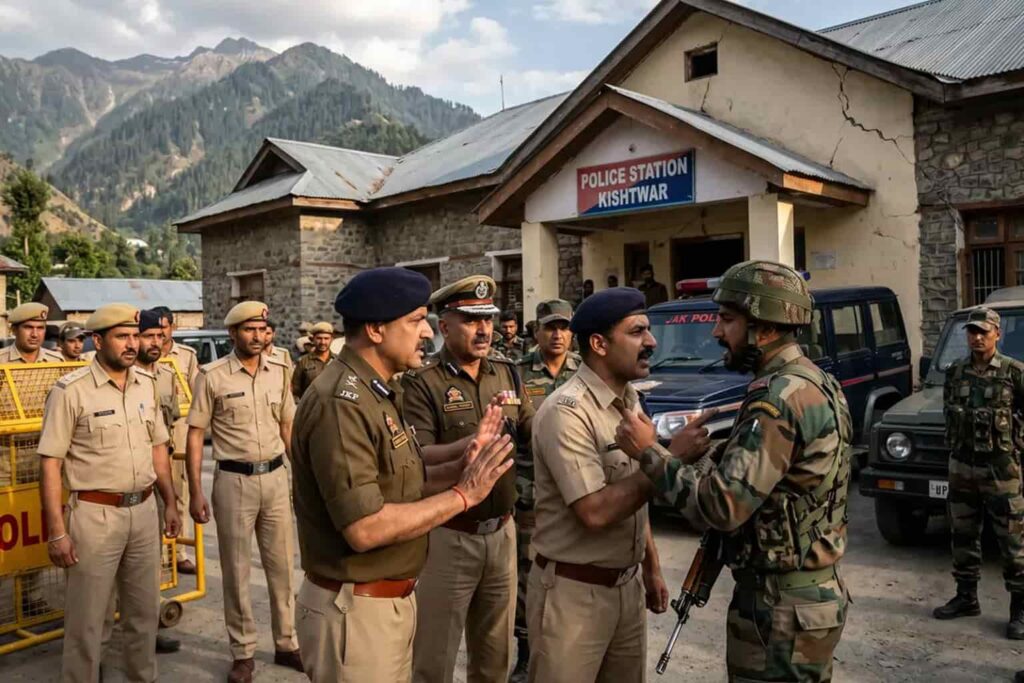
Why social media should be careful?
This case is likely to generate strong reactions.
Some people may try to use it to attack the Army.
Some may use it to attack the Police.
Some may circulate half-information.
Some may add unverified videos or old visuals.
This should be avoided.
In a security-sensitive region, careless sharing can damage trust between institutions and confuse the public.
A responsible reader should ask one question before sharing any claim:
Is this a verified fact, or only a forwarded allegation?
Why both accountability and dignity matter?
A balanced approach does not mean ignoring allegations.
If police personnel were assaulted, it is serious.
If government property was damaged, it is serious.
If public servants were obstructed or attacked, it is serious.
But a balanced approach also means not declaring guilt before the process is complete.
Uniform does not place anyone above the law.
At the same time, the legal process must protect fairness, evidence and institutional dignity.
Both things can be true together.
What should not be written?
This story should not be written with reckless certainty.
Do not write that the Army personnel are guilty unless a competent authority establishes it.
Do not write that the police version is final.
Do not write that the Army version is false.
Do not use words like “war between Army and Police,” “mutiny,” “institutional collapse,” or “confirmed attack” unless officially supported.
Do not turn the incident into a political or emotional campaign.
The correct frame is:
Serious allegations have been made. An FIR has been registered. The Army says the matter is being examined. Investigation must decide the facts.
Why this story matters for public trust?
Public trust in security institutions depends on two things: discipline and accountability.
When allegations arise, the public must see that the system is capable of examining them fairly.
If wrong has happened, action should follow.
If facts are different from early claims, that should also be clarified.
The strength of an institution is not shown only by denying allegations.
It is shown by allowing a fair process, cooperating with inquiry and taking action where required.
That is why the Army’s reported statement about cooperation with the legal process is important.
Comment
The Kishtwar FIR should be treated as a serious legal and institutional matter.
It should not be treated as social media entertainment.
In Jammu and Kashmir, the Army and Police often stand on the same side of security challenges. That is why any incident between them must be handled with extra care.
The allegations must be investigated.
The Army’s response must be recorded.
The police complaint must be examined.
The final conclusion must come from evidence, not emotion.
In such cases, facts should move slower than outrage.
Final takeaway
The Kishtwar Army–Police FIR has raised serious questions after J&K Police registered a case against personnel of 17 Rashtriya Rifles over an alleged incident at Atholi Police Station.
The allegations are grave, but they are still allegations.
The Army has said the matter is under examination and that it will cooperate with the legal process.
The correct approach is not to take sides blindly.
The correct approach is to wait for investigation, evidence and institutional findings.
This case must be reported with balance, restraint and responsibility.
Because in a sensitive security environment, justice needs facts — not noise.
Source links
Indian Express report:
https://indianexpress.com/article/india/colonel-others-booked-for-attempt-to-murder-after-jawans-storm-kashmir-police-station-10756483/
ThePrint report:
https://theprint.in/india/army-vs-police-in-jk-after-attempted-murder-fir-against-major-personnel-for-storming-police-station/2969712/
New Indian Express report:
https://www.newindianexpress.com/india/2026/Jun/25/fir-filed-against-17-rashtriya-rifles-personnel-for-alleged-assault-on-police-vandalism-at-kishtwar-station
Times of India report:
https://timesofindia.indiatimes.com/india/commanding-officer-major-among-30-named-in-fir-over-assault-rioting-by-army-at-jk-police-station/articleshow/132002191.cms
Economic Times report:
https://economictimes.indiatimes.com/news/defence/colonel-major-named-in-fir-over-alleged-attack-on-jks-kishtwar-police-station/articleshow/132001421.cms
The Week report:
https://www.theweek.in/news/india/2026/06/25/army-probes-alleged-ambush-on-jandk-police-station-by-rashtriya-rifles-officers-intention-was-to.html


Leave a Reply