

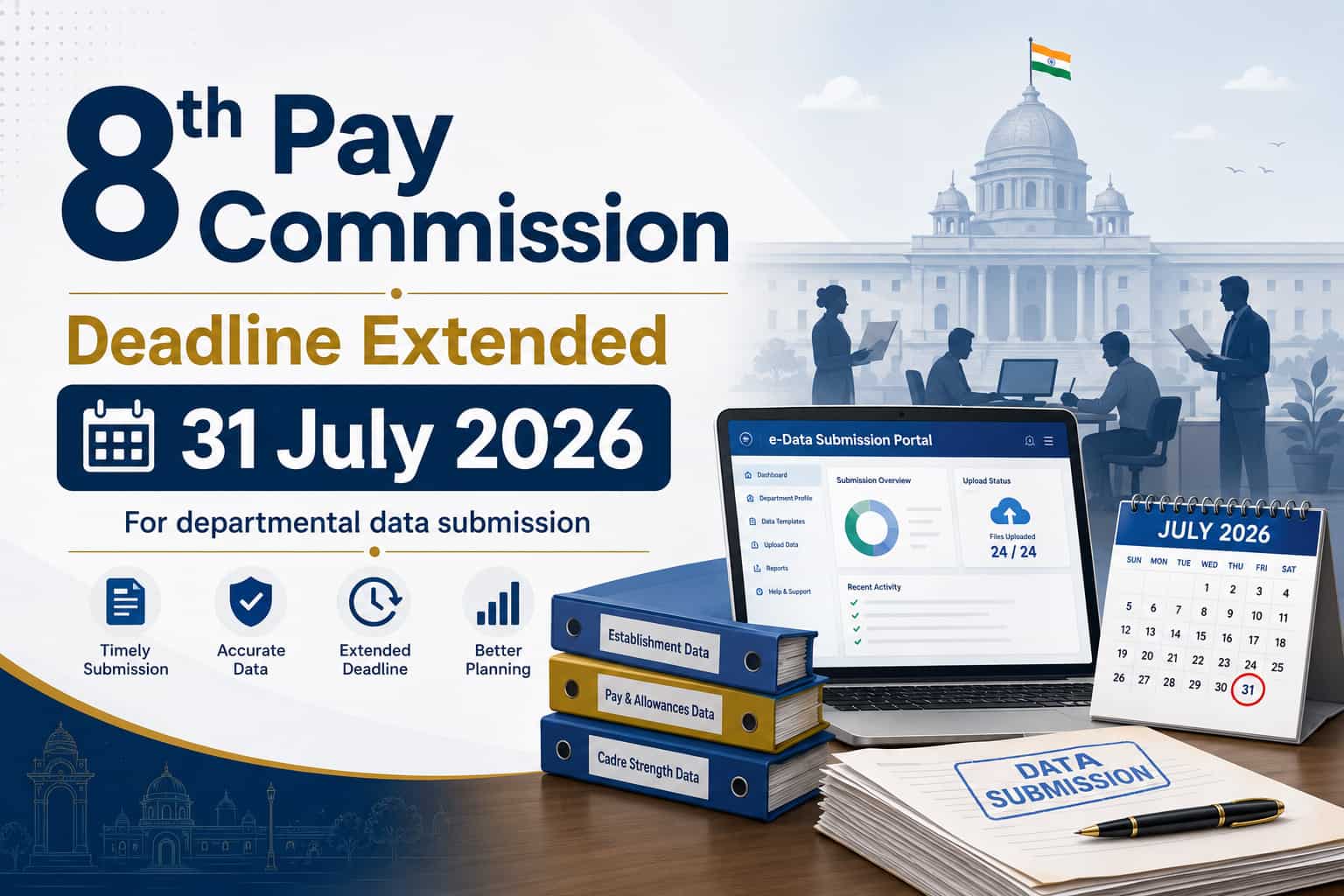
The 8th Pay Commission has once again become a major topic of discussion among central government employees, pensioners and employee associations. The latest update says that the deadline has been extended to 31 July 2026. But this update has also created confusion.
Many employees are asking one direct question: Can employees now submit fresh demands to the 8th Pay Commission till 31 July 2026?
The answer is no.
The 31 July 2026 deadline is not a fresh opportunity for individual employees or pensioners to submit new salary, pension or allowance demands. This deadline is related to official data submission by ministries, departments and Union Territories through the 8th Pay Commission’s data collection system.
This means the update is important, but it should not be misunderstood as a salary hike announcement or a new public submission window.
What Is the Real Update?
The 8th Central Pay Commission has extended the deadline for uploading employee-related data to 31 July 2026. Earlier, the deadline was 30 June 2026. The extension has been given because several ministries, departments and Union Territories needed more time to complete and upload the required information.
This data is important because the Commission needs an accurate picture of the central government workforce before making recommendations on pay, pension, allowances and service conditions.
The information is to be submitted through the official data collection portal. Reports clearly mention that the focus is on structured departmental data, not casual submissions through email, physical copies or informal documents.

Important Dates Employees Should Know
There are two different deadlines that should not be mixed.
The first one is the 15 June 2026 deadline. This was related to the memorandum submission process. The official 8th Pay Commission website states that the response submission window closed on 15 June 2026.
The second one is the 31 July 2026 deadline. This is related to departmental data submission by ministries, departments and Union Territories.
So the correct understanding is simple:
15 June 2026 was for memorandum responses.
31 July 2026 is for official departmental data submission.
This difference is very important because many social media posts are mixing both deadlines and creating confusion among employees.
Who Is the 31 July 2026 Deadline For?
The 31 July deadline is mainly for:
- Central government ministries
- Government departments
- Union Territories
- Official nodal officers
- Concerned administrative offices responsible for employee data
It is not meant for:
- Individual central government employees
- Individual pensioners
- General public
- Fresh salary demand letters
- New fitment factor representations
- Personal pension revision claims
This is why employees should not treat the 31 July deadline as a fresh chance to submit individual demands.

What Is True and what Is Rumour?
There are many claims circulating around this update. Some are correct, but many are misleading.
What is actually true?
The deadline for official employee data submission has been extended to 31 July 2026.
The extension is mainly for ministries, departments and Union Territories.
The data will help the Commission study pay, pension, allowances, vacancies, retirement trends, promotion structure and financial impact.
The Commission needs this information to prepare balanced and practical recommendations.
What is rumour or misleading?
It is misleading to say that employees can submit fresh demands till 31 July 2026.
It is false to say that the salary hike has been announced.
It is false to say that the fitment factor has been finalized.
It is false to say that the pension revision formula has been declared.
It is also wrong to assume that DA will stop immediately because of this update.
The real update is about data collection, not final implementation.
Why is the 8th Pay Commission collecting data?
A Pay Commission cannot prepare recommendations only on the basis of expectations, media reports or employee demands. It needs actual government data.
The Commission has to understand how many employees are working, how many posts are vacant, how many people retired, how many resigned, how promotions are moving and how much financial burden a pay revision may create.
This data helps the Commission understand the real condition of the government workforce.

How the data submission process works?
The process is simple but very important.
First, ministries, departments and Union Territories collect employee-related information from their respective administrative systems.
Then, nodal officers upload that information through the official data collection portal.
After that, the 8th Pay Commission studies the data and compares it with employee demands, pensioner concerns, service conditions and government expenditure.
Finally, this analysis becomes part of the broader recommendation process for pay, pension, allowances and related service matters.
In simple words, the data submission process is not a formality. It is one of the foundations on which the Commission’s recommendations may be built.
What type of data is being collected?
The data being collected is directly linked to the structure of central government employment. It may include details related to sanctioned strength, vacancies, retirements, resignations, employee age profile, promotion patterns and salary expenditure.

This type of data can help the Commission understand several important issues.
For example, if vacancies are high, it may show pressure on existing employees. If resignations are rising, it may indicate dissatisfaction or better opportunities outside government service. If promotions are delayed, it may bring focus to career progression and MACP-related concerns.
Similarly, retirement and age-profile data help the Commission understand future pension liability and workforce planning.
So, while this update does not give employees an immediate benefit, it is still important because the final recommendations need strong data support.
Does this mean salary hike is coming immediately?
No.
The 31 July 2026 deadline does not mean that salary hike is being announced immediately. It also does not mean that the fitment factor has been finalized.
A Pay Commission follows a process. First, it collects representations and memorandums. Then, it studies government data. After that, it holds consultations, examines financial implications and prepares recommendations. Finally, the report is submitted to the government.
The government then examines the report and takes the final decision on implementation.
Therefore, employees should not confuse a data deadline with a salary hike announcement.

No final fitment factor yet
At present, no final fitment factor has been officially announced.
Different numbers such as 2.86, 3.0, 3.68, 3.833 or 4.0 may appear in media discussions, employee demands or online calculations. But none of these should be treated as final unless the Commission or the government officially confirms it.
The same applies to minimum pay, pension formula, allowances and DA merger claims.
Until an official recommendation and government decision come, all such numbers remain demands, expectations or estimates.
Why employees should still take this update seriously?
This update may not be a direct salary hike announcement, but it is still important.
The reason is simple: the quality of data submitted by ministries and departments can affect the quality of recommendations.
If the Commission receives complete and accurate data, it can better understand the real problems of employees and pensioners. This includes vacancies, workload, promotional stagnation, retirement trends and financial impact.
For central government employees, pensioners and associations, this stage shows that the 8th Pay Commission process is moving forward in a structured manner.
What happens after 31 July 2026?
After the data submission deadline, the Commission is expected to continue its analysis and consultations. It will study the data along with the memorandums and representations already received.
The Commission may then examine key issues such as:
- Revised pay structure
- Minimum pay
- Fitment factor
- Pension revision
- Allowance rationalisation
- MACP and promotion issues
- Pay matrix corrections
- Defence and civilian employee concerns
- Financial impact on the government
After completing this exercise, the Commission will prepare its recommendations and submit the report to the government. The final decision will come only after government examination and approval.
Final conclusion
The 31 July 2026 deadline is real, but it is being misunderstood by many people.
This deadline is for ministries, departments and Union Territories to submit official employee-related data to the 8th Pay Commission. It is not a new deadline for individual employees or pensioners to submit fresh demands.
No salary hike has been announced. No fitment factor has been finalized. No pension formula has been declared.
The real meaning of this update is that the 8th Pay Commission is now working on an important data-analysis stage. This stage will help the Commission understand the actual condition of central government employees and pensioners before making recommendations.
For employees and pensioners, the correct takeaway is clear:
31 July 2026 is a departmental data submission deadline — not a salary hike announcement and not a fresh demand submission window.
Sources:-
- Live Hindustan report on 31 July 2026 deadline
https://www.livehindustan.com/business/personal-investments/8th-pay-commission-increased-deadline-last-date-to-submit-data-is-31-july-2026-201783081082993.html - Official 8th Central Pay Commission website
https://8cpc.gov.in/ - Official 8CPC Memorandum Submission page
https://8cpc.gov.in/8cpc-memorandum-submission/ - Official notice: Memorandum response deadline extended up to 15 June 2026
https://8cpc.gov.in/document/last-date-for-submission-of-responses-to-8cpc-memorandum-extended-upto-15-06-2026/ - Economic Times report on 31 July 2026 data submission deadline
https://m.economictimes.com/wealth/save/latest-news-on-8th-pay-commission-data-submission-deadline-extended-to-july-31-why-this-is-important-for-employees-salary-hike/articleshow/132154085.cms - Angel One report on 8th CPC Data Collection Portal deadline extension
https://www.angelone.in/news/personal-finance/8th-pay-commission-extends-data-submission-deadline-to-july-31-2026 - Moneycontrol report on ministries getting time till 31 July 2026
https://www.moneycontrol.com/news/business/personal-finance/8th-pay-commission-gives-ministries-until-july-31-to-submit-requisite-data-13965409.html - NDTV Profit report on earlier 30 June data submission deadline
https://www.ndtvprofit.com/personal-finance/8th-pay-commission-june-30-data-submission-deadline-and-next-steps-explained-11707321



Leave a Reply