

A 17-year-old first-term cadet of the National Defence Academy died after suffering a medical emergency during morning physical training at the academy’s Khadakwasla campus near Pune on 10 July 2026.
Cadet Abhinav Bajpai, who was from Uttar Pradesh and had joined the NDA on 24 June 2026, complained of uneasiness during the routine morning session and suddenly became unconscious. He was immediately evacuated to Military Hospital, Khadakwasla, where the medical team carried out intensive resuscitation efforts. He could not be revived.
The National Defence Academy subsequently ordered a Court of Inquiry to establish the facts and circumstances surrounding the incident. Local police were informed and registered an accidental-death case.
The tragedy has raised understandable questions about the medical cause of death, the nature of the physical-training session, the emergency response and the safeguards available for newly inducted cadets.
However, the most important distinction must be maintained: the sequence immediately preceding Abhinav’s death has been reported, but the final medical cause and any finding of procedural responsibility have not yet been made public.
Abhinav Bajpai case at a glance
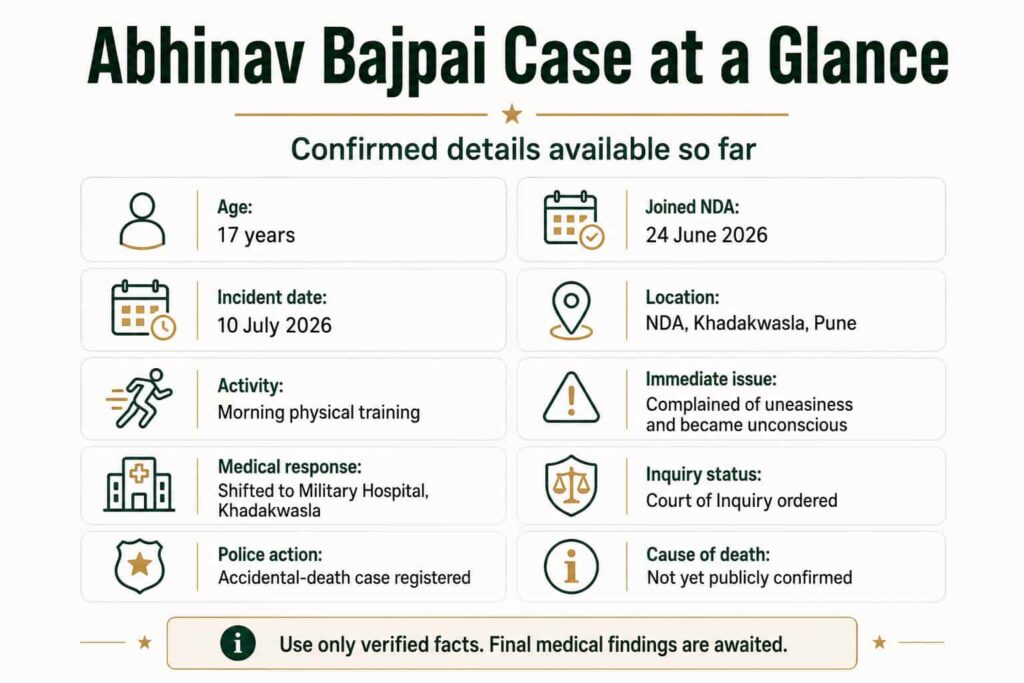
| Detail | Information currently available |
|---|---|
| Cadet | Abhinav Bajpai |
| Age | 17 years |
| Status | First-term NDA cadet |
| Date of joining NDA | 24 June 2026 |
| Date of incident | 10 July 2026 |
| Location | National Defence Academy, Khadakwasla |
| Activity | Routine morning physical training |
| Initial complaint | Uneasiness |
| Subsequent development | Became unconscious |
| Medical response | Evacuated to Military Hospital, Khadakwasla |
| Institutional action | Court of Inquiry ordered |
| Police action | Accidental-death case registered |
| Final cause of death | Not yet publicly confirmed |
The Defence Public Relations Office stated that the incident occurred during the routine morning PT session following the first official physical-training parade for the newly inducted course.
What happened during the morning PT session?
According to the official account reported by several national publications, Abhinav was participating in the morning physical-training session when he complained of uneasiness.
He then suddenly became unconscious.
The academy stated that he was immediately evacuated to Military Hospital, Khadakwasla, where doctors undertook sustained efforts to revive him. Despite those efforts, he was declared dead.
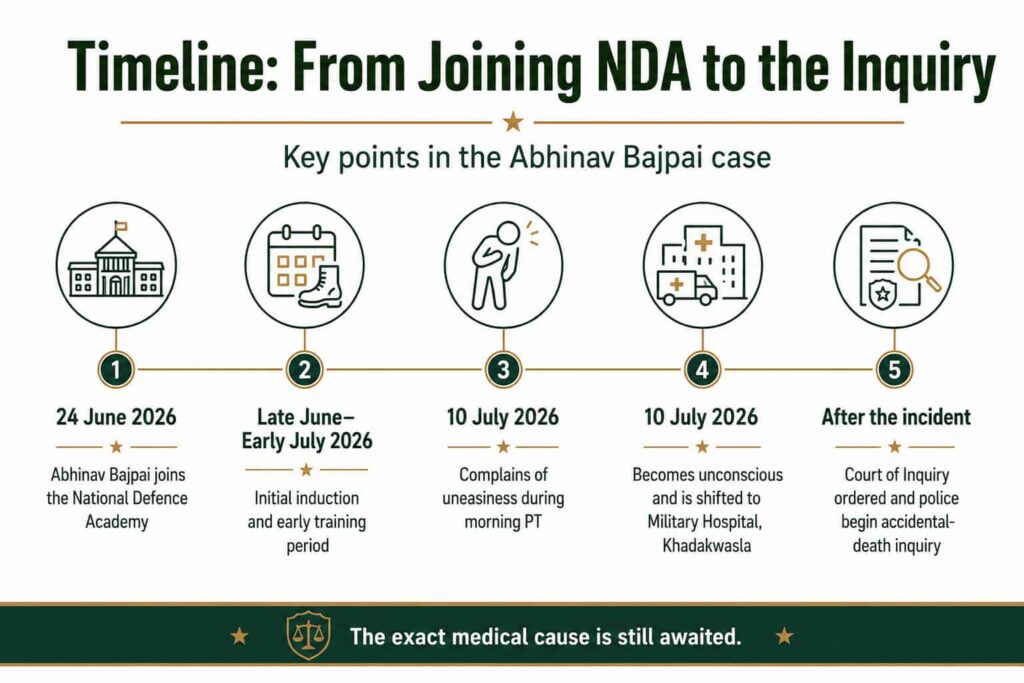
The publicly available statement establishes the broad sequence, but it does not separately provide:
- the complete exercises performed before he felt unwell;
- the exact duration or intensity of the session;
- the weather and hydration conditions;
- his recorded vital signs after reporting uneasiness;
- the precise medical-response timeline;
- the provisional post-mortem conclusion; or
- the final physiological cause of death.
These questions cannot responsibly be answered through assumption. They require examination of medical documents, training records, witness accounts and the findings of the inquiry.
Who was Abhinav Bajpai?
Abhinav had joined the National Defence Academy less than three weeks before the incident.
The Defence PRO statement described him as being from Kanpur, Uttar Pradesh. Family-based reporting identified his home as Shuklaganj in Unnao district, which is located near Kanpur.
Reports stated that he had completed his Intermediate examination from Kendriya Vidyalaya, Kanpur Cantonment, and had been selected for the National Defence Academy.
His father, Pradeep Kumar Bajpai, works as a ward orderly at a government hospital in Kanpur. His mother is a homemaker, while his elder sister is pursuing medical education.
Family statements described Abhinav as a young man who had chosen the path of military service and was excited about joining the academy.
What did Abhinav’s father say?
Abhinav’s father had accompanied him when he reported to the academy in June. He recalled that his son was happy and enthusiastic about beginning his NDA journey.
According to his father, Abhinav had described the training as difficult but had not indicated that he wished to leave. He had reportedly told his family that he was enjoying the experience and believed that he would complete the training.
Speaking while grieving the loss of his only son, his father questioned his own decision to support Abhinav’s ambition. His statement reflected the anguish of a bereaved parent and should not, on its own, be treated as proof of institutional wrongdoing.
Police later stated that the parents had not submitted a complaint regarding the training when their statements were recorded.
The family’s grief deserves dignity. It should neither be used to sensationalise the incident nor be dismissed while the circumstances remain under examination.
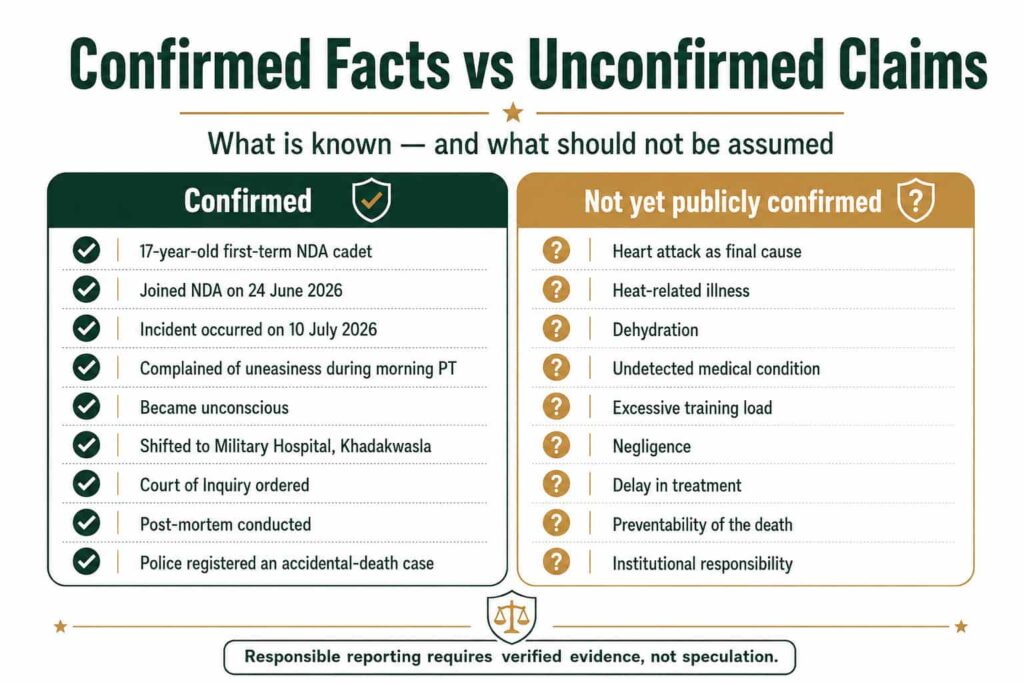
Has the cause of Abhinav Bajpai’s death been confirmed?
No final medical cause of death had been publicly established in the available reports as of 13 July 2026.
A post-mortem examination was reported to have been conducted at Sassoon General Hospital in Pune. Local reports said the exact cause would depend on the final medical findings.
Some reports referred to a suspected heart-related event. However, the official Defence PRO account described the incident as a medical emergency and did not publicly declare a heart attack as the confirmed cause.
Until the final medical findings are available, the death should not be conclusively attributed to:
- a heart attack;
- a cardiac disorder;
- dehydration;
- heat-related illness;
- an undetected medical condition;
- excessive physical exertion;
- training negligence;
- delay in medical intervention; or
- any other specific factor.
Similarly, the absence of a publicly proven procedural failure does not establish that every aspect of the system functioned perfectly.
The purpose of the investigations is to replace competing assumptions with documented facts.
What action has been taken?
The National Defence Academy ordered a Court of Inquiry to ascertain the circumstances leading to the incident.
The family and local police were informed. Uttamnagar police registered an accidental-death case based on the initial information and statements from cadets who were present during the training session. Police subsequently recorded statements from Abhinav’s parents.
Three different processes are relevant to understanding the case.
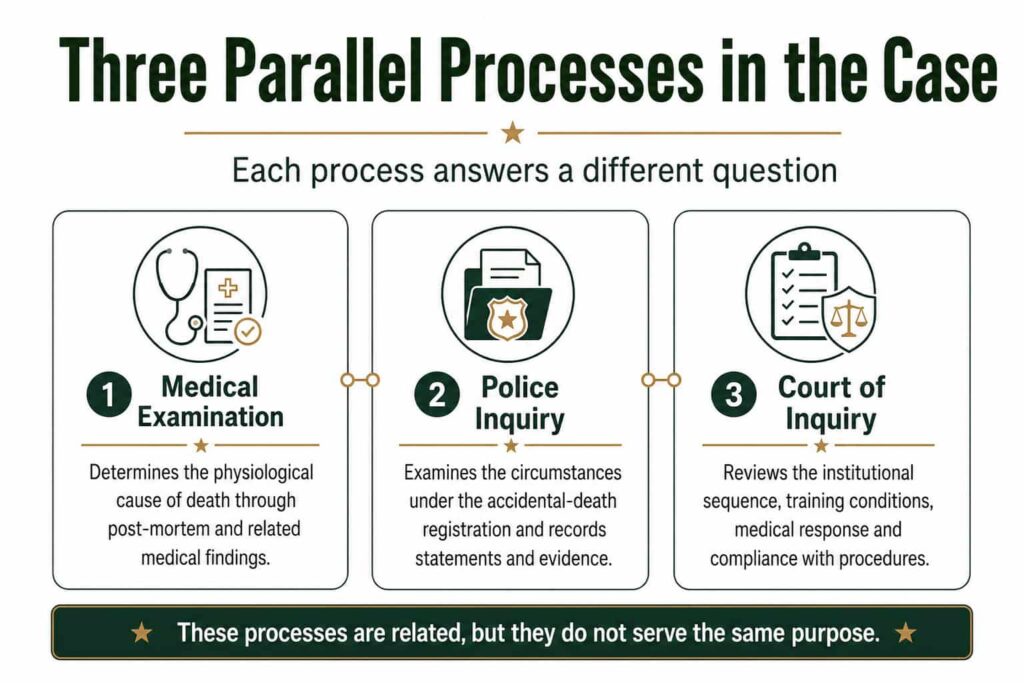
Medical examination
The medical process is expected to establish the physiological cause of death through post-mortem findings and any related laboratory or medical examination.
Police inquiry
The police process examines the surrounding circumstances under the accidental-death registration and determines whether the available evidence requires any further legal action.
Court of Inquiry
The Court of Inquiry is expected to reconstruct the institutional sequence and assess the training circumstances, response, records and compliance with applicable procedures.
These processes may examine overlapping material, but they answer different questions. A medical conclusion alone may not establish whether every procedure was followed, while an institutional inquiry cannot substitute for the final medical findings.
What should the Court of Inquiry establish?
A meaningful inquiry should not stop after recording that the cadet complained of uneasiness and became unconscious.
It should reconstruct the incident in sufficient detail to explain what happened, whether the applicable procedures were followed and whether any preventive lesson can be identified.
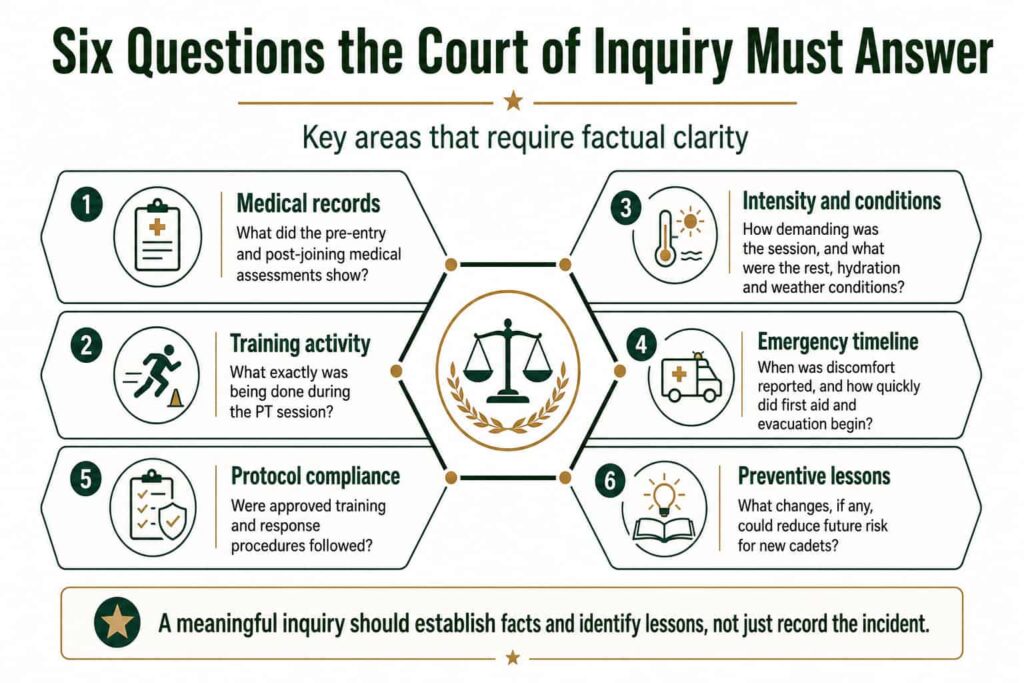
Abhinav’s medical records
The inquiry should review:
- the medical examinations completed before admission;
- health declarations submitted at the time of joining;
- any medical assessment conducted after reporting to the academy;
- any illness, injury or complaint recorded during his first weeks;
- whether he had reported uneasiness earlier; and
- any relevant medical findings from the post-mortem examination.
Passing a pre-entry examination is an important fact, but the inquiry must still examine the complete medical record rather than presuming the cause.
The exact physical-training activity
The term “morning PT” can cover several different exercises. The inquiry should identify:
- what activity was being conducted;
- how long the session had lasted;
- the pace expected from the cadets;
- rest intervals;
- whether the workload was adjusted for newly inducted cadets;
- the instructions given before the session; and
- whether Abhinav had displayed difficulty before reporting uneasiness.
Without this information, it is impossible to evaluate whether the activity itself contributed to the medical emergency.
Training intensity and environmental conditions
The Court of Inquiry should consider the conditions under which the session took place, including:
- temperature and weather;
- hydration arrangements;
- rest and recovery;
- earlier physical activity;
- sleep and meal schedules;
- the progression of training after joining; and
- whether the session followed the approved training plan.
These are questions for factual examination, not evidence that a violation necessarily occurred.
The emergency-response timeline
One of the most important tasks will be establishing the timeline from the first complaint to hospital treatment.
The inquiry should determine:
- When did Abhinav first report uneasiness?
- To whom was the discomfort reported?
- Was he immediately permitted to stop?
- When did he become unconscious?
- When did first aid or resuscitation begin?
- When were medical personnel informed?
- When did evacuation commence?
- When did he reach Military Hospital?
- What interventions were undertaken?
- What do the medical records state about his condition on arrival?
The NDA’s statement says he was evacuated immediately and that intensive resuscitative efforts were undertaken. The inquiry should document that sequence through official records and witness statements.
Compliance with approved procedures
The inquiry should establish whether:
- the training session was officially authorised;
- the workload matched the plan for a first-term course;
- qualified instructors were supervising;
- medical support arrangements were available;
- warning symptoms were acted upon;
- evacuation procedures were followed;
- incident records were prepared accurately; and
- the family and police were informed without avoidable delay.
A procedural review does not automatically imply negligence. Its purpose is to determine whether the system operated as intended.
Preventive lessons
Even when an emergency cannot be predicted, an inquiry can identify ways to reduce future risk.
Possible areas for review include:
- medical and fitness assessment after cadets report for training;
- phased progression of physical workloads;
- early recognition of warning symptoms;
- instructions encouraging cadets to report discomfort;
- hydration and recovery arrangements;
- accessibility of emergency medical equipment;
- response drills for instructors and cadets; and
- review of serious injuries and medical withdrawals, not only fatalities.
Any recommendation should be based on evidence from the case rather than on public speculation.
Does the case raise wider questions about first-term cadet safety?
Abhinav’s death was reported as the third death involving a first-term NDA cadet since October 2025.
The earlier incidents reportedly involved different circumstances, including a death during swimming practice and a separate alleged suicide. They should not be grouped under one assumed cause.
However, multiple deaths involving recently inducted cadets make a transparent review of health screening, acclimatisation, training progression and emergency readiness particularly important.
A former physical-training officer quoted in reporting on Abhinav’s death called for stronger physical assessment during the selection process, medical and fitness screening after joining, scientifically structured workloads, and greater emphasis on rest and recovery. These were expert recommendations and not findings that any specific failure occurred in Abhinav’s case.
What has the NDA said about its training and medical response?
The official statement said Abhinav was immediately evacuated to Military Hospital, Khadakwasla, and that intensive resuscitative efforts were undertaken.
A senior NDA officer quoted separately said the academy’s training system is reviewed periodically and implemented according to its mandate. The report also stated that military medical and emergency-response facilities are available during training activities.
These statements form part of the available account. They must be assessed alongside:
- medical records;
- instructor reports;
- witness statements;
- training schedules;
- emergency logs; and
- the Court of Inquiry findings.
Fair reporting requires avoiding two premature conclusions: that negligence has already been proved, or that the incident was necessarily unavoidable.
Abhinav given a final farewell in Unnao
Abhinav’s mortal remains were taken to Uttar Pradesh, and his final rites were conducted in Unnao on 12 July.
Reports described a military farewell attended by family members, service personnel, local representatives and residents. His body was draped in the Tricolour as the community paid tribute to the young cadet who had recently begun his journey towards becoming an armed-forces officer.
This part of the story should remain centred on the family’s loss rather than being used for dramatic presentation.
What is confirmed and what remains unanswered?
Confirmed information
- Abhinav Bajpai was 17 years old.
- He was a first-term cadet.
- He joined the NDA on 24 June 2026.
- The incident occurred on 10 July 2026.
- He complained of uneasiness during morning PT.
- He subsequently became unconscious.
- He was evacuated to Military Hospital, Khadakwasla.
- Medical personnel attempted to revive him.
- A Court of Inquiry was ordered.
- Local police registered an accidental-death case.
- A post-mortem examination was reported to have been conducted.
Not yet publicly established
- the final medical cause of death;
- whether a cardiac event occurred;
- whether heat or dehydration contributed;
- whether an underlying condition was present;
- whether the physical workload contributed;
- whether any procedural rule was violated;
- whether the response involved an avoidable delay;
- whether the death could have been prevented; and
- whether any individual or institutional responsibility will be identified.
Why responsible reporting matters?
The death of a 17-year-old cadet can understandably generate grief, anger and demands for accountability.
Those demands should be addressed through transparent investigation rather than unsupported claims.
Calling the death a confirmed heart attack, training-related killing, ragging incident or proven act of negligence would be premature without documentary evidence.
At the same time, referring to the event as merely an unavoidable medical emergency before the inquiry is completed would also be an unsupported conclusion.
Responsible reporting must preserve three principles:
- treat the family with dignity;
- seek institutional accountability through evidence; and
- distinguish confirmed facts from allegations and unanswered questions.
Final takeaway
Cadet Abhinav Bajpai joined the National Defence Academy on 24 June 2026 with the ambition of serving in the armed forces.
On 10 July, during routine morning physical training after the new course’s first official PT parade, he complained of uneasiness and became unconscious. He was shifted to Military Hospital, Khadakwasla, but could not be revived.
The NDA has ordered a Court of Inquiry, while police have registered an accidental-death case.
What happened immediately before and after he became unconscious has been broadly reported. Why the medical emergency occurred, whether every required procedure was followed and whether any preventive lesson emerges remain matters for the medical findings and inquiry.
The most meaningful outcome would be:
- a definitive medical explanation;
- a documented emergency-response timeline;
- clarity about the training conditions;
- transparent examination of applicable procedures; and
- corrective action wherever the evidence identifies a preventable risk.
Abhinav’s death should not become a contest between speculation and institutional defence. It should lead to a factual account that respects the family, answers legitimate questions and strengthens the protection of future cadets.
Frequently asked questions
Who was Abhinav Bajpai?
Abhinav Bajpai was a 17-year-old first-term cadet at the National Defence Academy in Khadakwasla. He had joined the academy on 24 June 2026.
When did the incident occur?
He suffered a medical emergency during morning physical training on 10 July 2026.
What happened during the PT session?
The official account stated that he complained of uneasiness and suddenly became unconscious during the routine morning session following the first official PT parade of the newly inducted course.
Was he taken to hospital?
Yes. He was immediately evacuated to Military Hospital, Khadakwasla, where medical personnel carried out resuscitative efforts.
Has the cause of death been confirmed?
No final cause had been publicly established in the available reports as of 13 July 2026.
Did Abhinav Bajpai suffer a heart attack?
Some reports mentioned a suspected heart-related event, but it has not been publicly confirmed as the final medical cause.
Has a post-mortem been conducted?
Reports said a post-mortem examination was conducted at Sassoon General Hospital. The final medical findings were awaited.
Has the family accused the NDA of negligence?
Abhinav’s father expressed profound grief. Police were quoted as saying that the parents had not filed a complaint regarding the training when their statements were recorded.
What investigation has the NDA ordered?
The academy has ordered a Court of Inquiry to ascertain the facts and circumstances leading to the incident.
Is the police also investigating?
Yes. Local police registered an accidental-death case and recorded statements connected with the incident.
What should the Court of Inquiry examine?
The inquiry should examine Abhinav’s medical records, the exact training activity, environmental conditions, workload, emergency-response timeline and compliance with procedures.
When will the complete facts become known?
Greater clarity is expected after the final medical findings and completion




Leave a Reply