

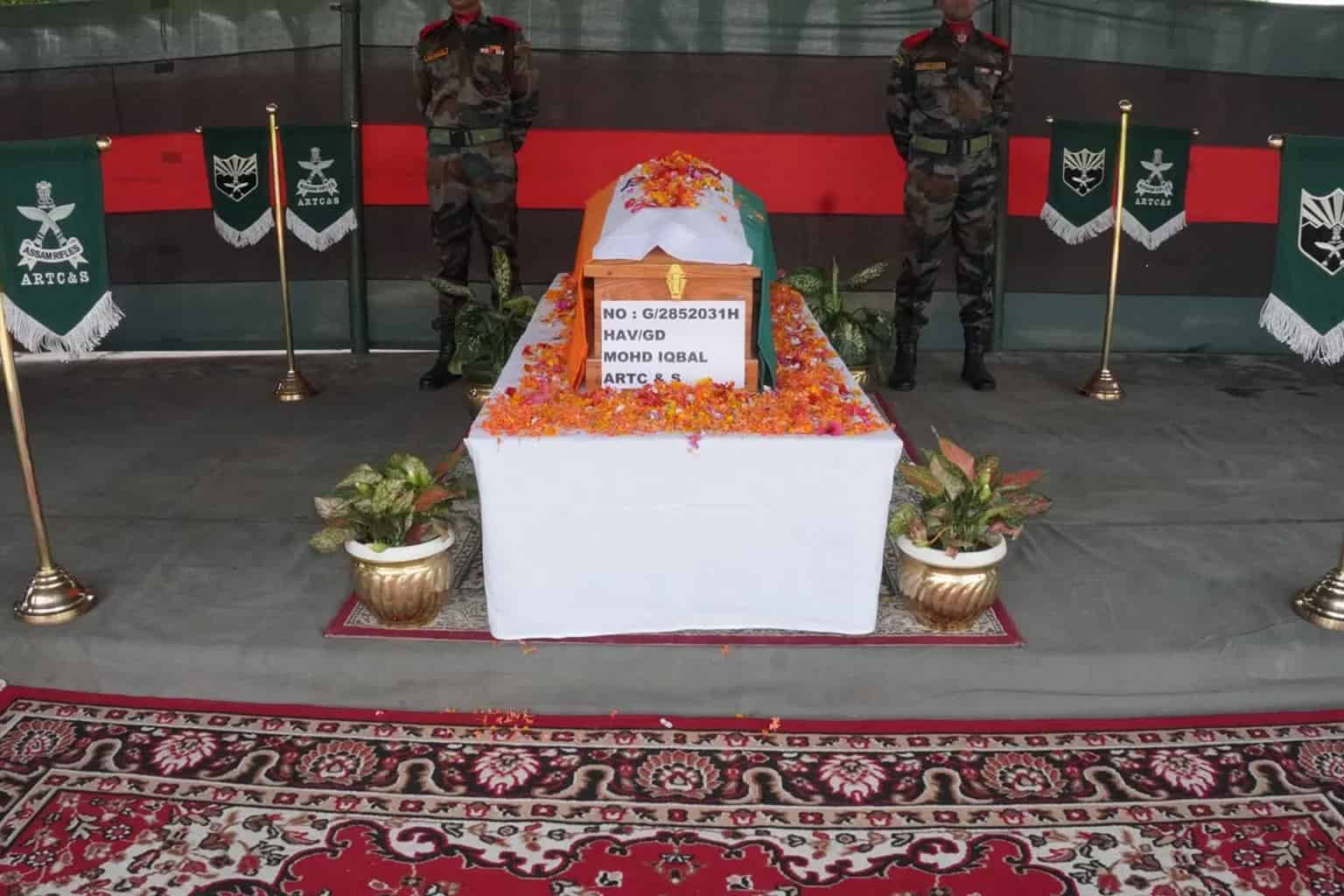
Havildar Mohd Iqbal of 28 Assam Rifles made the supreme sacrifice after a suspected IED blast hit an Assam Rifles vehicle in Nagaland’s Chümoukedima district on 13 July 2026. Four Assam Rifles personnel and one civilian were injured. The investigation is continuing with NSG, NIA and Nagaland Police forensic teams examining the evidence.
For a soldier’s family, the news of a blast is never just a news update.
It is a phone call that changes everything. It is a village waiting in silence. It is a family trying to understand a loss that cannot be explained in words. It is a Tricolour-draped coffin returning home after a life spent in service.
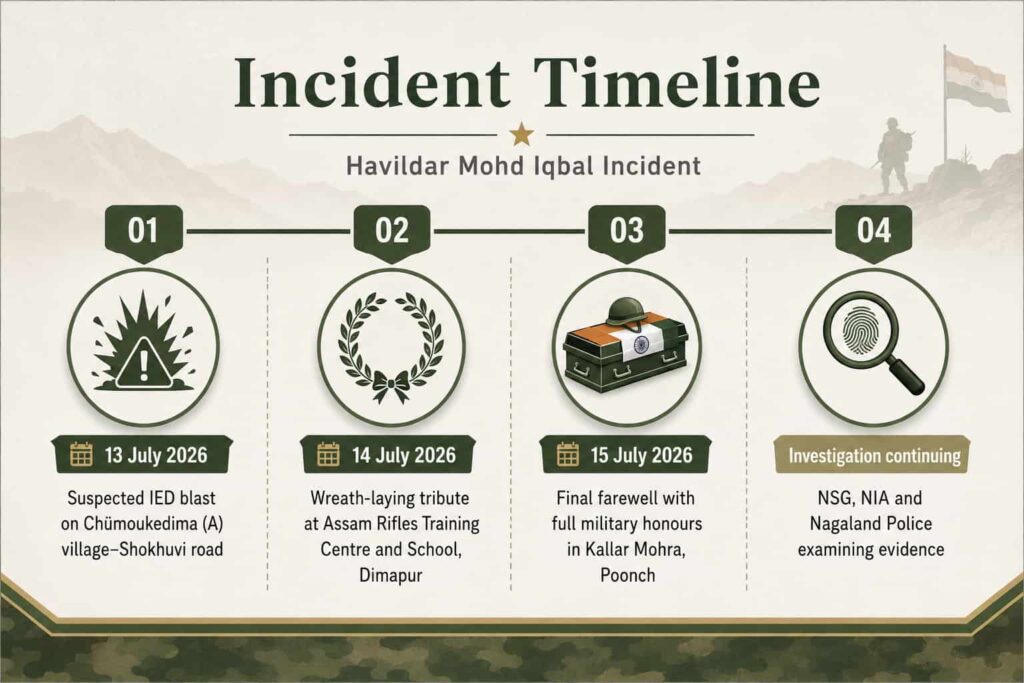
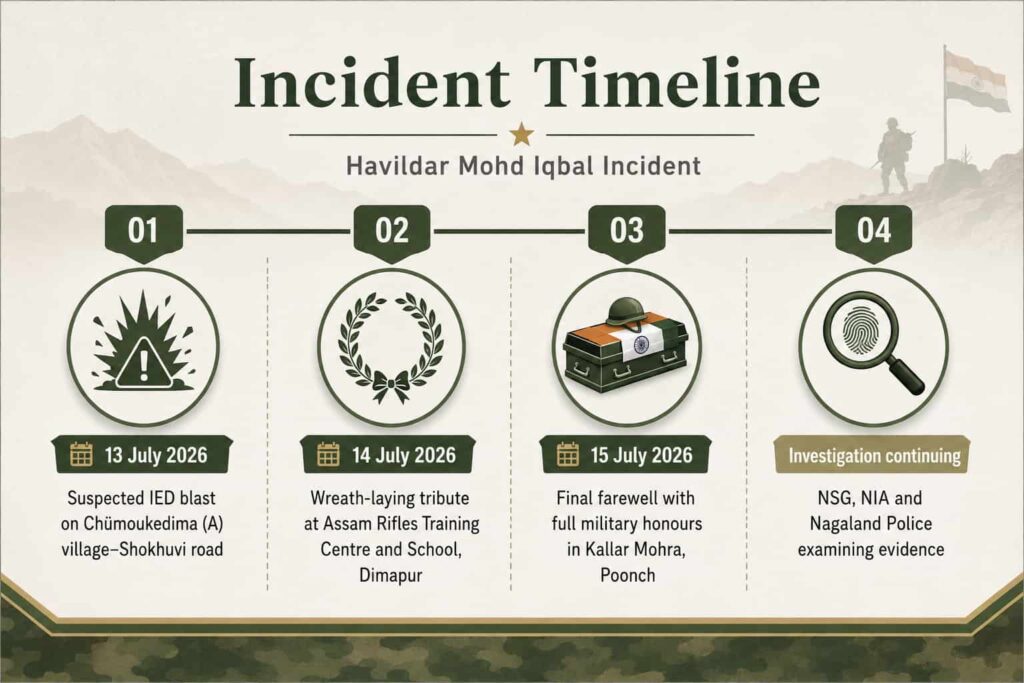
Havildar Mohd Iqbal of 28 Assam Rifles lost his life after a suspected improvised explosive device struck an Assam Rifles vehicle in Nagaland on 13 July 2026. The incident took place on the Chümoukedima (A) village–Shokhuvi road.
He was reportedly driving the Assam Rifles vehicle when the explosion occurred.
Four other Assam Rifles personnel were injured in the blast. A civilian was also injured. Later reports said the injured security personnel were stable and out of danger.
At this stage, the most important thing is to stay with confirmed facts. No organisation has been officially named as responsible for the attack. The investigation is still underway. Therefore, any report on this incident must avoid speculation and should not blame any group unless investigating authorities officially establish responsibility.
What happened on 13 July?
The blast took place around 2 pm on 13 July 2026.
An Assam Rifles vehicle was moving on the road between Chümoukedima (A) village and Shokhuvi when a powerful explosion hit it. The blast is suspected to have been caused by an IED.
The vehicle was badly damaged. Local reports also mentioned damage to a nearby autorickshaw, and the impact of the explosion was felt in the surrounding area.
Residents helped evacuate the injured before they were shifted for treatment. Police, Assam Rifles personnel, district officials and forensic teams later reached the spot and secured the area.
Location clarification: Chümoukedima or Shokhuvi?
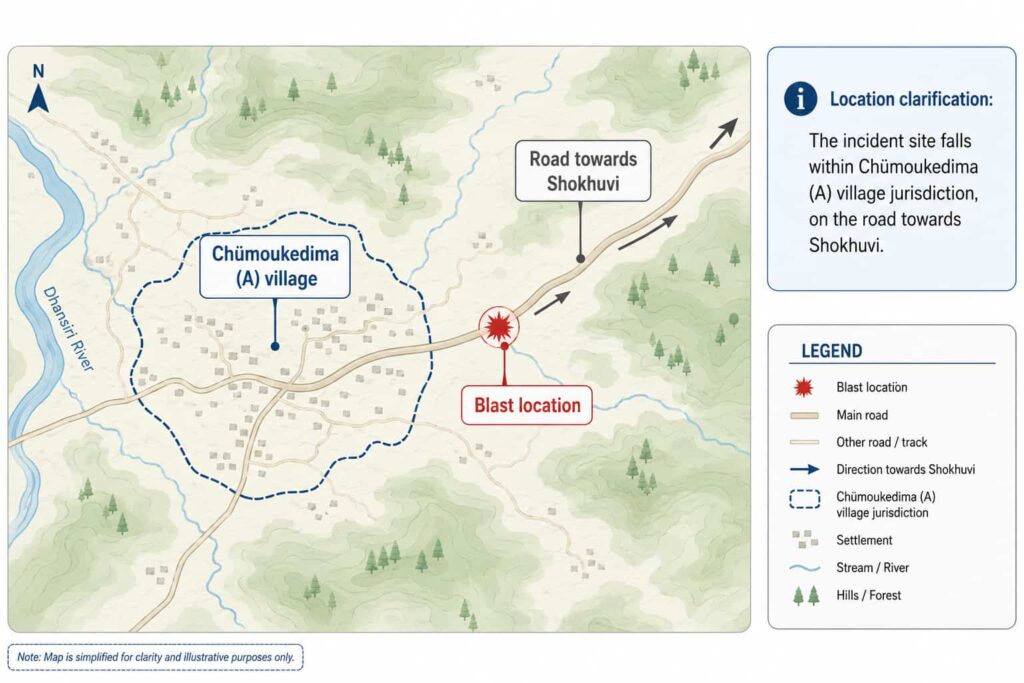
Several initial reports described the incident as having occurred in or near Shokhuvi village.
The Shokhuvi Village Council later clarified that the incident site falls within the jurisdiction of Chümoukedima (A) village, although the road leads towards Shokhuvi.
The most accurate description is:
The blast occurred on the Chümoukedima (A) village–Shokhuvi road, within Chümoukedima (A) village jurisdiction.
This correction matters because in sensitive security incidents, even location details can be repeated incorrectly during the first few hours.
Who was Havildar Mohd Iqbal?
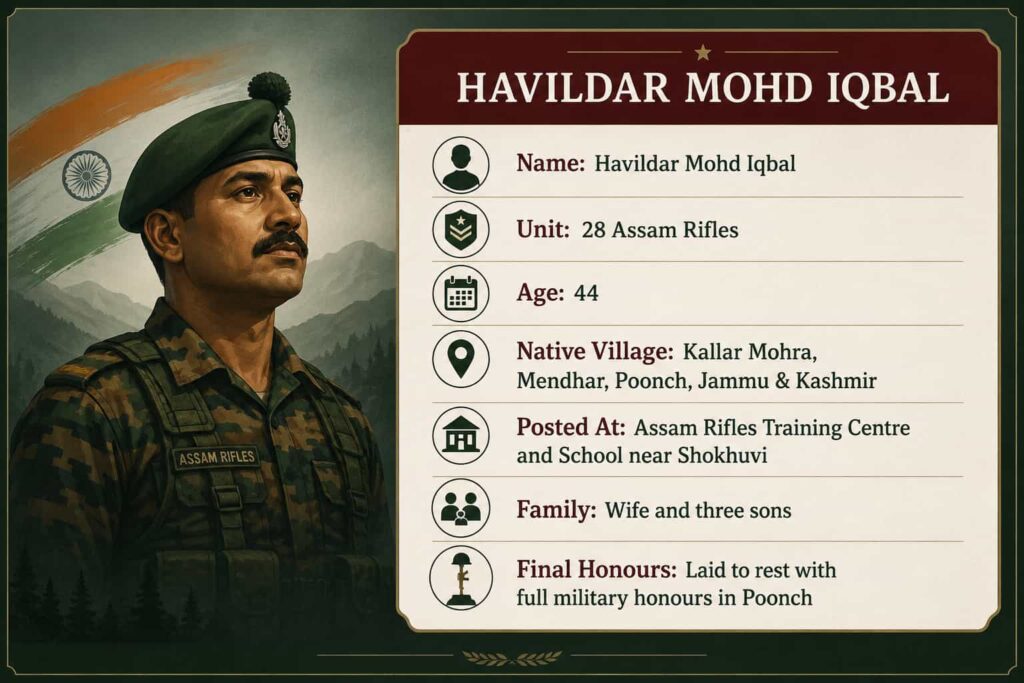
Havildar Mohd Iqbal was serving with 28 Assam Rifles.
He was posted at the Assam Rifles Training Centre and School near Shokhuvi. He belonged to Kallar Mohra village in the Mendhar area of Poonch district, Jammu and Kashmir.
He was 44 years old.
Family-linked reports said he had returned to duty a little over a month before the incident after spending leave at home. He had reportedly planned to visit his family again in September during the agricultural season.
He is survived by his wife and three sons. His sons were reported to be studying in Classes 12, 8 and 6.
This is the human side of the story. A soldier has fallen in Nagaland, but the grief has reached a family in Poonch. A wife has lost her husband. Three children have lost their father. A village has lost one of its sons.
Assam Rifles tribute in Dimapur
A solemn wreath-laying ceremony was held at the Assam Rifles Training Centre and School in Dimapur on 14 July.
Senior Army and Assam Rifles officers paid tribute to Havildar Mohd Iqbal. Director General Assam Rifles Lt Gen Vikas Lakhera was among those who honoured the fallen soldier.
His coffin was draped in the Tricolour.
The Director General Assam Rifles said necessary steps would be taken to safeguard security. He also appealed to people not to allow the incident to disturb Nagaland’s hard-earned peace.
He further confirmed that the four injured Assam Rifles personnel, including an Assistant Commandant, were stable and out of danger.
This message is important because an attack of this nature can easily create fear, anger and speculation. The appeal for peace and restraint should be seen as part of a responsible response.
Final farewell in Poonch
Havildar Iqbal’s mortal remains reached his native village, Kallar Mohra, on 15 July.
Army personnel, relatives and local residents gathered to pay their final respects. He was laid to rest with full military honours.
His son, Fasal Iqbal, reportedly expressed pride in his father’s sacrifice and said he wished to follow in his footsteps by joining the Armed Forces and serving the nation.
That one statement carries deep emotion.
A family is grieving, but the spirit of service has not weakened. A son has lost his father, yet he sees his father’s life as an example. That is the meaning of military legacy in many defence families.
Investigation update
The investigation has moved into a technical and forensic stage.
Forensic experts from the National Security Guard, National Investigation Agency and Nagaland Police joined the post-blast examination. Nagaland DGP Rupin Sharma said NSG assistance was requested because of its specialised post-blast forensic capability.
Investigators are collecting physical evidence, studying the nature of the explosive device and examining how it may have been planted and triggered.
This means the NIA has participated in the investigation process through expert assistance. However, a formal transfer of the case to the NIA should not be reported unless it is officially announced.
This distinction is important.
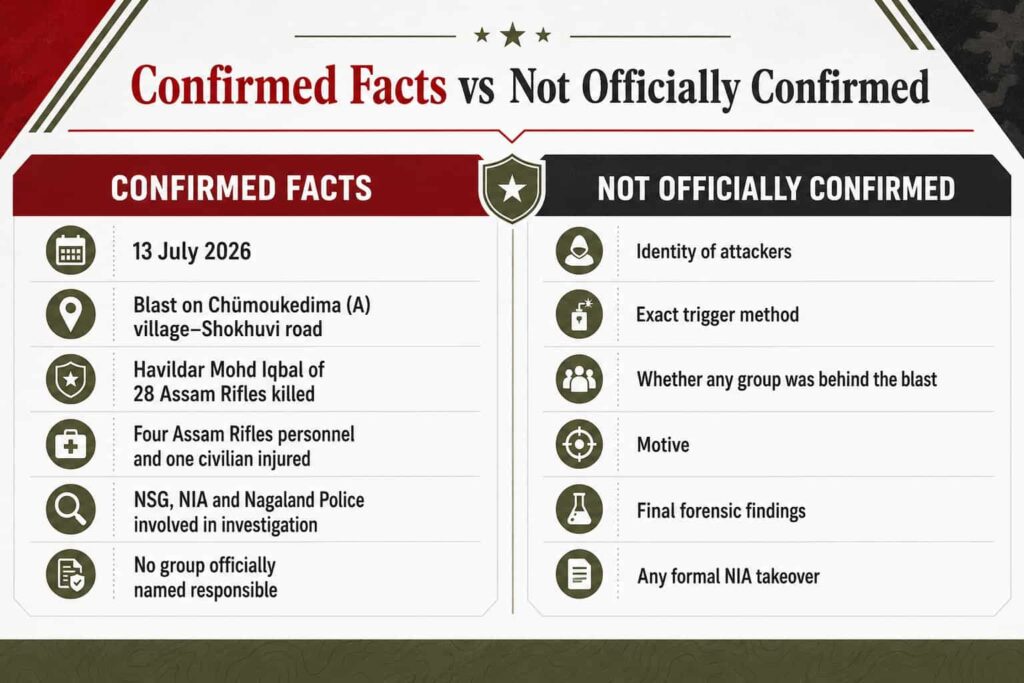
In sensitive cases, social media often moves faster than investigation. But an evidence-based investigation takes time. The identity of the attackers, the organisation behind the blast, the method used and the motive must be established through forensic and investigative findings.
Has any organisation claimed responsibility?
As of the latest available reports, no organisation had officially claimed responsibility for the blast.
The NSCN-IM condemned the attack and distanced itself from the violence. Several political, tribal and civil society groups in Nagaland also condemned the incident and called for a professional investigation.
At this stage, neither Assam Rifles nor Nagaland Police has officially identified the attackers.
Therefore, responsible reporting should use careful terms such as:
suspected IED attack
unidentified attackers
investigation is continuing
no group has been officially held responsible
This is not only a legal caution. It is also a matter of public responsibility.
Wrongly naming a group before official confirmation can create tension, mislead readers and damage the credibility of the report.
Why this incident matters?
The incident matters for several reasons.
First, it involved Assam Rifles personnel during movement.
Second, it happened near a major Assam Rifles establishment.
Third, it took place in Nagaland, where communities, security forces and political groups have invested years in maintaining peace.
Fourth, the blast shows how one violent incident can create fear and uncertainty even before investigators establish the full facts.
That is why the investigation must be allowed to proceed professionally.
The public also has a role. Investigators have reportedly sought information about suspicious movement in the area before the blast. Anyone with credible information should share it with the authorities, not spread rumours online.
What is still not confirmed?
Several important questions remain unanswered.
Who planted the explosive device?
How was it placed?
Was the Assam Rifles vehicle specifically targeted?
Was there any local support?
What was the exact method used to trigger the IED?
Will the case be formally transferred to a central investigating agency?
Will there be arrests or recoveries?
Until these questions are answered officially, facts must remain separate from speculation.
Information about compensation, financial assistance or service benefits for Havildar Iqbal’s family has also not been clearly detailed in the reviewed sources. No amount should be published unless confirmed by Assam Rifles, the Government or the family.
Confirmed facts at this stage
Havildar Mohd Iqbal belonged to 28 Assam Rifles.
He was killed in a suspected IED blast on 13 July 2026.
The blast occurred on the Chümoukedima (A) village–Shokhuvi road.
Four Assam Rifles personnel and one civilian were injured.
The injured security personnel were reported stable and out of danger.
NSG, NIA and Nagaland Police forensic experts joined the investigation.
No organisation has been officially identified as responsible.
Havildar Iqbal was laid to rest with full military honours in Poonch.
Final takeaway
Havildar Mohd Iqbal’s final journey from Nagaland to Poonch reflects the personal cost of service in difficult and sensitive areas.
For the country, it is a security incident.
For Assam Rifles, it is the loss of a brave soldier.
For his village, it is a moment of grief and pride.
For his family, it is a permanent loss.
The most respectful way to remember Havildar Mohd Iqbal is to honour his sacrifice, support the bereaved family, pray for the injured personnel and allow the investigation to proceed on the basis of evidence.
Until the authorities announce their findings, facts must come before claims.
A soldier has made the supreme sacrifice. The least we can do is report his story with dignity, accuracy and restraint.
Frequently asked questions
Who was Havildar Mohd Iqbal?
He was a 44-year-old soldier of 28 Assam Rifles, posted at the Assam Rifles Training Centre and School near Shokhuvi.
Where did the blast take place?
The blast took place on the Chümoukedima (A) village–Shokhuvi road, within Chümoukedima (A) village jurisdiction.
How many people were injured?
Four Assam Rifles personnel and one civilian were injured.
Are the injured personnel safe?
The injured Assam Rifles personnel were reported stable and out of danger.
Who carried out the attack?
No organisation or individual has been officially identified so far. The investigation is continuing.
Has the NIA taken over the case?
NIA experts joined the post-blast investigation, but a formal NIA takeover should not be reported unless officially announced.
Where was Havildar Iqbal laid to rest?
He was laid to rest with full military honours in his native village of Kallar Mohra in Poonch district.
Sources:-
1. India Today North East / PTI report
https://www.indiatodayne.in/nagaland/story/search-intensified-after-ied-blast-kills-assam-rifles-jawan-in-nagaland-nscn-im-condemns-attack-1424025-2026-07-14
2. NDTV report
https://www.ndtv.com/india-news/army-calls-for-peace-after-attack-on-assam-rifles-in-nagaland-kills-1-11773597
3. Economic Times report
https://m.economictimes.com/news/india/ied-blast-in-nagalands-chumoukedima-kills-assam-rifles-havildar-injures-four-search-intensifies/articleshow/132406576.cms
4. ThePrint report
https://theprint.in/india/assam-rifles-jawan-killed-in-nagaland-ied-blast-suspected-first-such-attack-since-2004/2985451/
5. Sentinel Assam report
https://www.sentinelassam.com/north-east-india-news/nagaland-news/nagaland-ied-blast-massive-search-for-attackers-as-assam-rifles-honours-slain-havildar-mohammad-iqbal
6. Times of India initial report
https://timesofindia.indiatimes.com/india/ied-blast-in-nagaland-assam-rifles-personnel-killed-four-injured/articleshow/132366593.cms
7. Times of India follow-up
https://timesofindia.indiatimes.com/city/guwahati/assam-rifles-nagaland-police-intensify-combing-op-day-after-ied-blast/articleshow/132399127.cms




Leave a Reply