

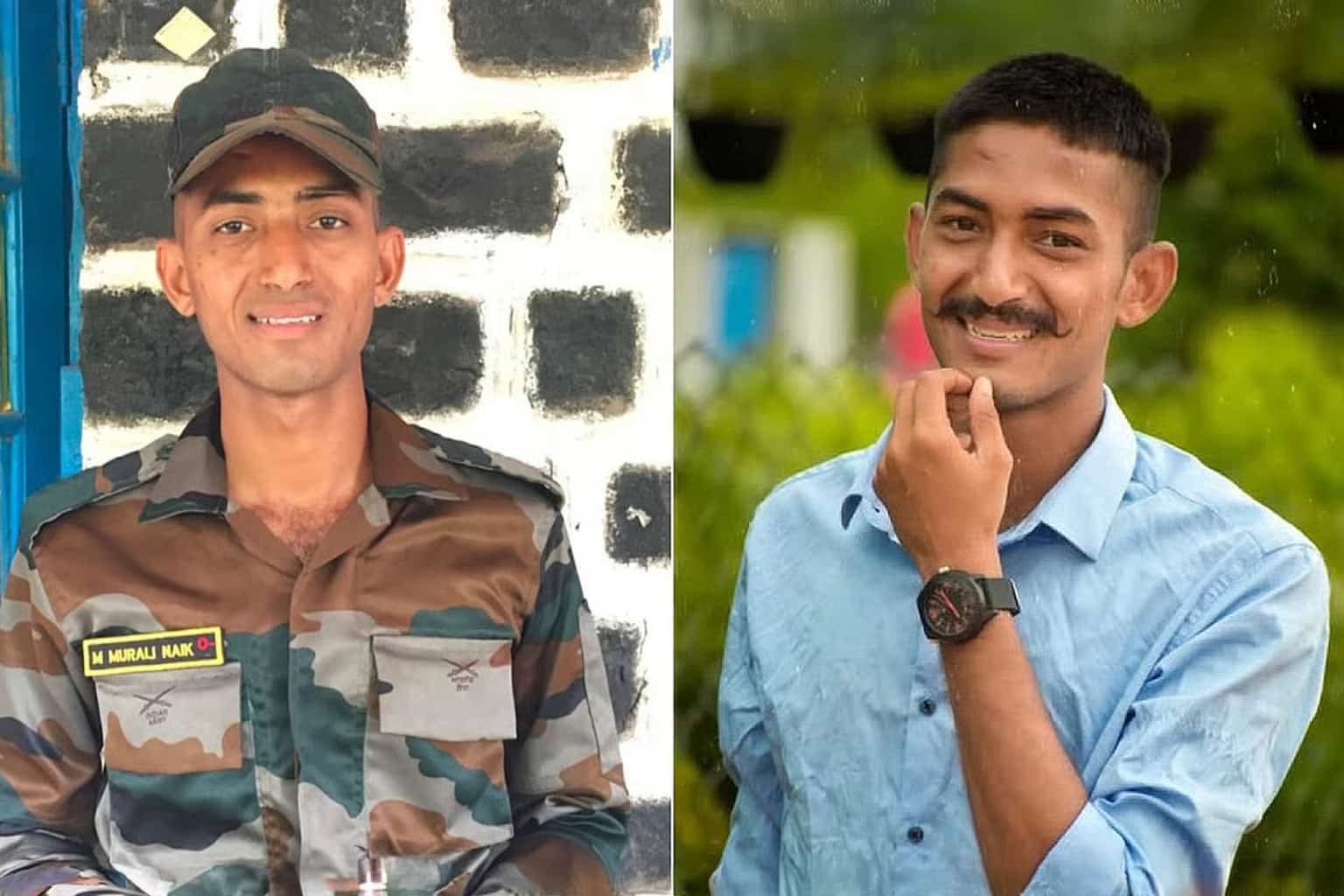
The Centre says the family of Agniveer M. Murali Naik has received approximately ₹2.3 crore in admissible financial and terminal benefits.
His mother has still approached the Bombay High Court.
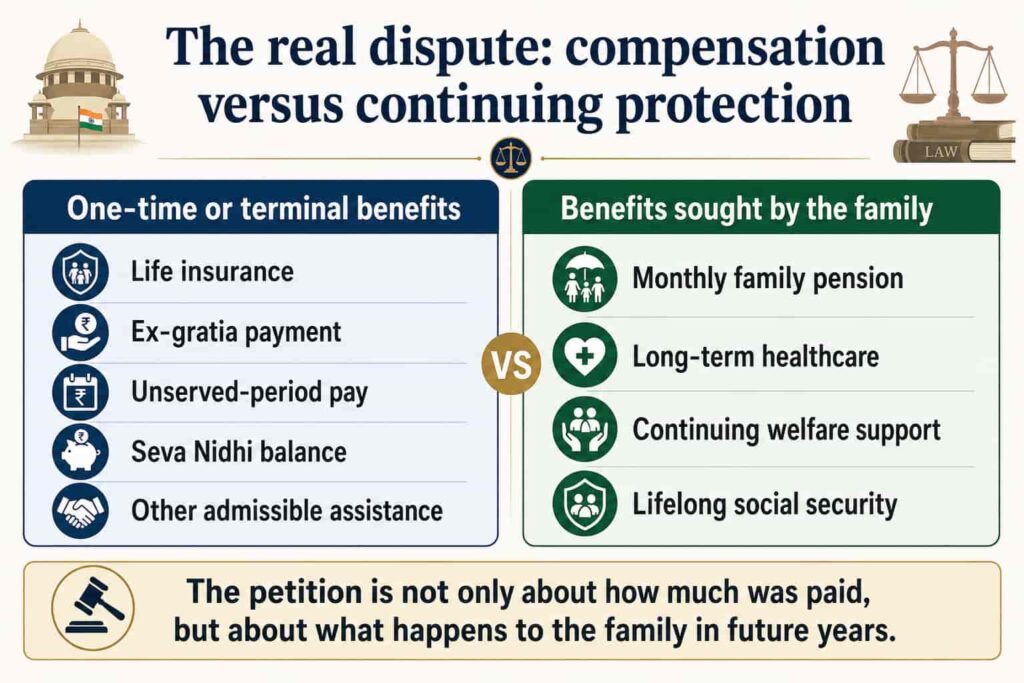
The reason is simple: the dispute is not only about how much compensation was paid. It is about whether the family of an Agniveer killed in action should also receive regular family pension, long-term healthcare and continuing welfare protection similar to the family of a regular soldier.
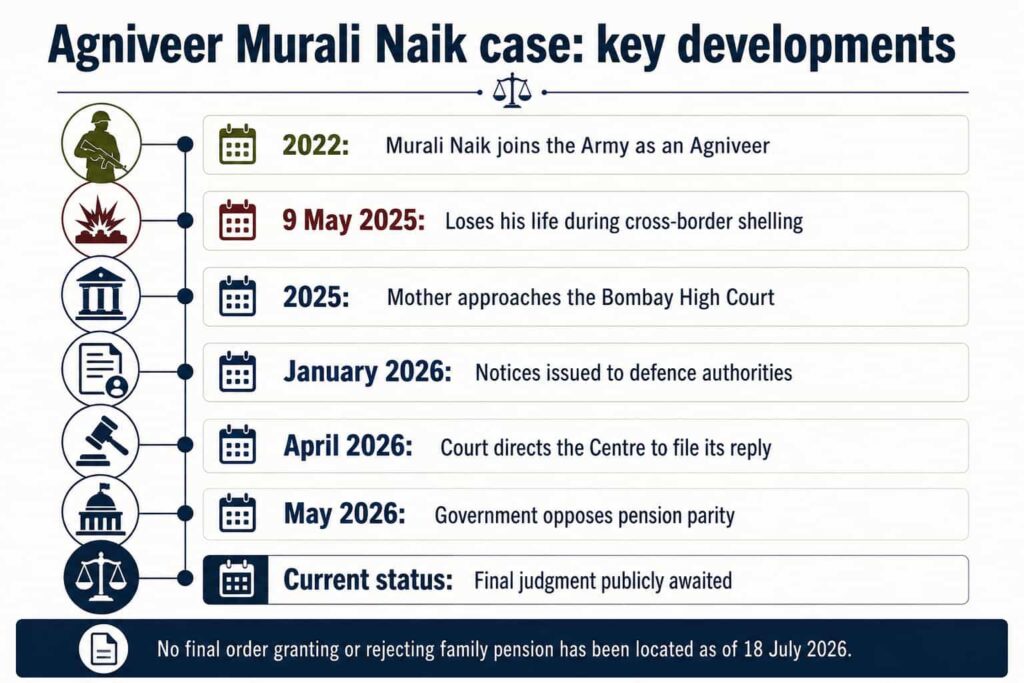
Murali Naik lost his life on 9 May 2025 during cross-border artillery and mortar shelling in the Poonch sector of Jammu and Kashmir. The government has stated that he was treated as a battle casualty and killed in action.
The Bombay High Court case now raises a wider question:
Can two soldiers facing the same operational danger receive different long-term family benefits only because they entered military service under different recruitment systems?
Murali Naik case at a glance
| Point | Current position |
|---|---|
| Soldier | Agniveer M. Murali Naik |
| Home state | Andhra Pradesh |
| Joined Army | 2022 under the Agnipath Scheme |
| Date of death | 9 May 2025 |
| Place | Poonch sector, Jammu and Kashmir |
| Official status | Battle casualty; killed in action |
| Centre’s payment claim | Approximately ₹2.3 crore |
| Family’s demand | Regular family pension and continuing welfare protection |
| Court status | Final judgment publicly awaited |
Who was Agniveer Murali Naik?
Murali Naik belonged to Kalli Thanda village in the Sri Sathya Sai district of Andhra Pradesh.
He joined the Indian Army through the Agnipath Scheme in 2022. In May 2025, he lost his life during operational cross-border firing in the Poonch sector.
His mortal remains were taken to his native village in a military convoy, and the final rites were conducted with military and state honours.
The dispute before the Court is therefore not about recognition of his sacrifice. It concerns the difference between the benefits available to Agniveer families and those available under the regular military pension system.
How did the matter reach the Bombay High Court?
Murali Naik’s mother, Jyothibai Naik, approached the Bombay High Court seeking continuing benefits for the family.
Her reported demands include:
- regular family pension;
- long-term healthcare;
- continuing welfare protection;
- equal posthumous treatment for soldiers facing comparable operational risks;
- clearer guidelines for families of Agniveers who die during service.
The petition argues that Agniveers may perform operational duties similar to regular soldiers and may face the same enemy action, but their families do not receive the same long-term pensionary protection.
What is the family actually asking for?
The family is not claiming that no financial assistance was paid.
Its case concerns the difference between two forms of protection.
One-time financial support
This may include:
- life-insurance payment;
- ex-gratia compensation;
- salary for the remaining unserved engagement period;
- Seva Nidhi balance;
- state-government or other admissible assistance.
Continuing social security
The family is seeking:
- monthly family pension;
- long-term healthcare;
- continuing welfare support;
- predictable financial protection for dependants.
This is the central issue in the case.
A large lump-sum payment can provide immediate relief. Family pension, however, provides a regular income over many years.
What benefits are available when an Agniveer dies on duty?
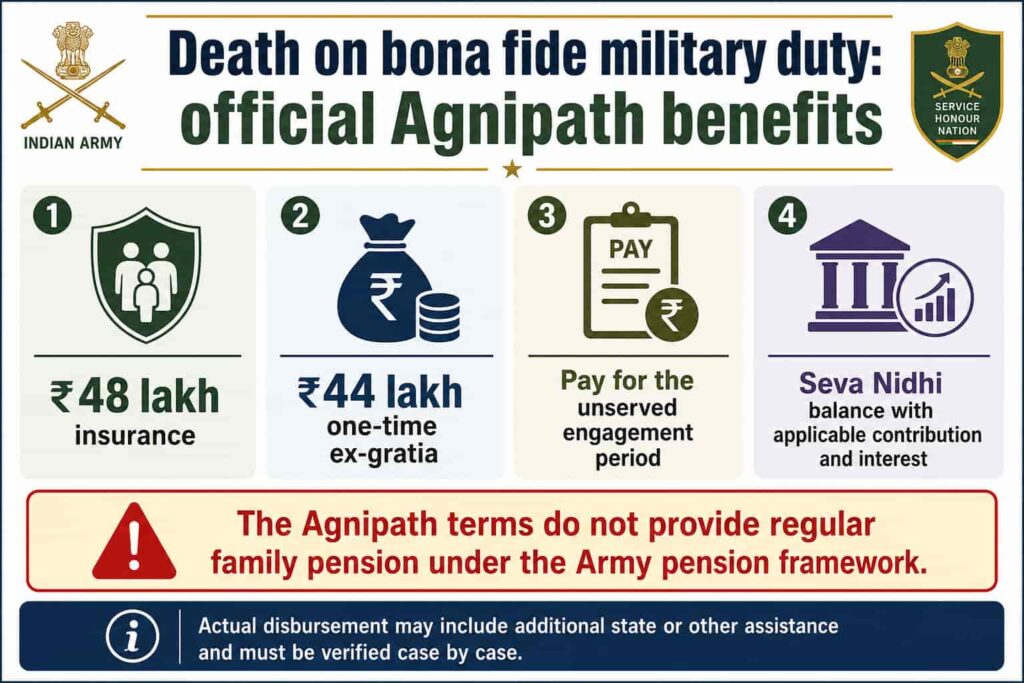
Under the official Agnipath framework, death during bona fide military duty under the relevant operational category may provide:
| Benefit | Official framework |
|---|---|
| Non-contributory insurance | ₹48 lakh |
| One-time ex-gratia | ₹44 lakh |
| Unserved engagement pay | Payable under applicable terms |
| Seva Nidhi | Accumulated balance, contribution and interest |
| Regular family pension | Not provided under regular Army pension rules |
Agniveers are engaged for four years and are not automatically governed by the regular Army pension system.
They ordinarily do not receive:
- regular pension;
- gratuity;
- ex-serviceman status;
- post-release ECHS benefits;
unless they are later selected for enrolment in the regular cadre.
Has the family received ₹2.3 crore?
The Centre has reportedly told the Bombay High Court that approximately ₹2.3 crore in admissible financial and terminal benefits has been disbursed.
This figure must be reported carefully.
It is the government’s statement before the Court. It should not be presented as an independently verified public payment statement unless an itemised official order is available.
The correct description is:
The Centre has informed the Bombay High Court that around ₹2.3 crore in admissible benefits was paid to the family.
The payment figure does not automatically settle the separate legal demand for regular family pension and continuing welfare.
What is the family’s legal argument?
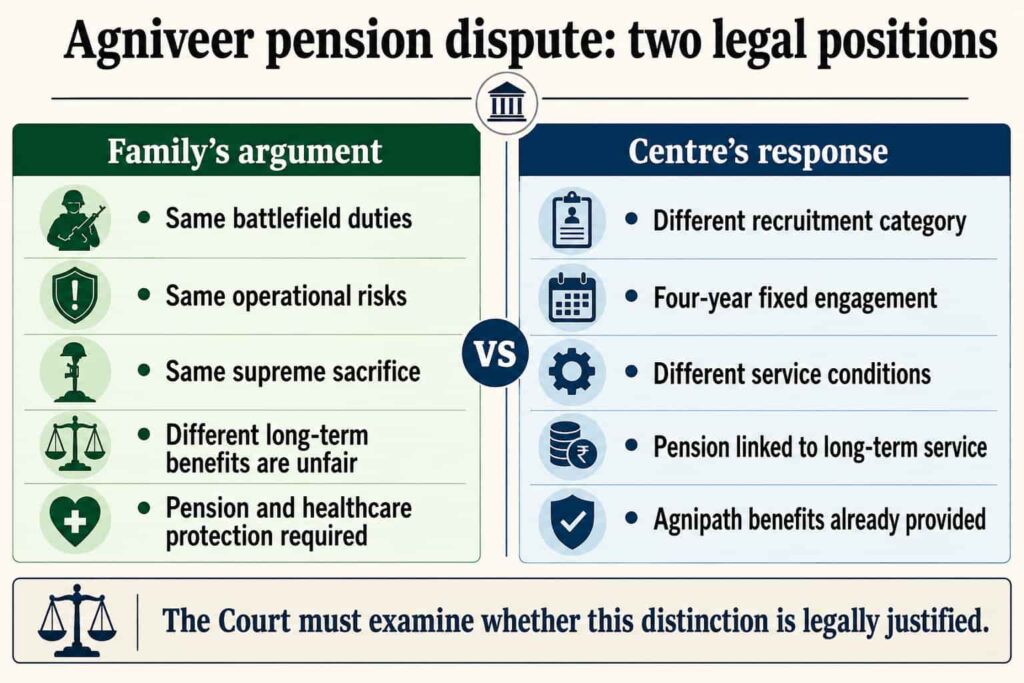
The family’s case is based on equality and the nature of military sacrifice.
Its reported argument is:
- Agniveers and regular soldiers may perform similar operational duties;
- both can face the same battlefield danger;
- the loss suffered by their dependants is comparable;
- different long-term benefits based only on recruitment category may be discriminatory;
- the nature of sacrifice should carry greater weight than the duration of the contract.
In simple terms, the family is asking whether a shorter engagement can justify lower continuing welfare protection after a soldier dies in action.
What is the Centre’s response?
The Union government opposes automatic pension parity.
Its reported position is:
- Agniveers and regular soldiers are separate service categories;
- Agniveers accept a fixed four-year engagement;
- regular soldiers serve under a long-term career structure;
- pensionary benefits are linked to the terms and length of service;
- the classification supports the objectives of the Agnipath Scheme;
- regular family pension is not provided under the accepted Agniveer conditions;
- all admissible benefits have already been paid.
The Centre has therefore asked the Court to dismiss the petition.
Is the entire Agnipath Scheme under challenge?
The case should not be presented as an attempt by the Bombay High Court to cancel the entire Agnipath Scheme.
The narrower issue is whether existing Agnipath rules can lawfully deny regular family pension and continuing welfare benefits to the dependants of an Agniveer killed during military operations.
No publicly available final decision has been located declaring the entire scheme unconstitutional.
What has the Bombay High Court decided so far?
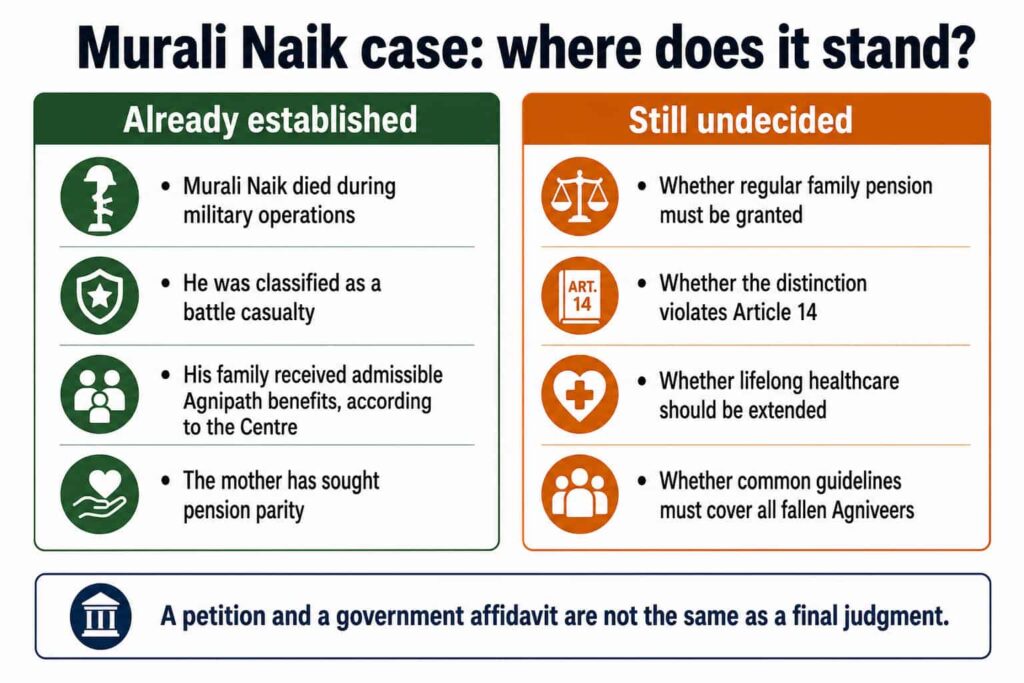
The Court has reportedly:
- entertained the mother’s petition;
- issued notices;
- sought responses from government authorities;
- expressed concern over delay in filing replies;
- directed the Centre to place its position on record.
The Court has not yet publicly been shown to have:
- granted regular family pension;
- ordered lifelong healthcare;
- struck down the Agnipath benefit structure;
- extended regular-soldier benefits to every Agniveer family;
- declared the distinction unconstitutional.
Why could this case matter beyond one family?
The judgment may influence future debate involving Agniveers who die:
- during war or border operations;
- in terrorist attacks;
- during operational accidents;
- while performing bona fide military duty.
However, even a favourable ruling may not automatically create a universal pension right for every family.
The Court could:
- Reject the petition and uphold the existing rules.
- Grant relief only to Murali Naik’s family.
- Direct the government to reconsider the claim.
- Interpret the existing framework more broadly.
- Ask the government to create clearer guidelines.
The exact effect will depend on the wording of the final judgment.
Why lump-sum compensation and pension are different?
A lump-sum payment provides immediate financial support.
Family pension offers:
- stable monthly income;
- protection against rising living costs;
- greater security for elderly parents;
- continuing institutional support;
- financial protection after the original compensation is exhausted.
The policy question is therefore not simply whether the amount paid was large.
The deeper question is:
What long-term responsibility does the State have towards the family of a short-tenure soldier who dies during combat?
Important reporting cautions
Until the Court gives its final ruling, avoid claims such as:
- Murali Naik’s family received no money.
- The Bombay High Court has granted family pension.
- The ₹2.3 crore figure has been independently itemised publicly.
- Every fallen Agniveer’s family will receive regular pension.
- The entire Agnipath Scheme has been struck down.
- The government refused to recognise Murali Naik’s sacrifice.
The unresolved issue is continuing pension and welfare protection—not the official recognition of his service and sacrifice.
Conclusion
The Murali Naik case is not a simple compensation dispute.
The Centre says the family received all financial benefits allowed under the Agnipath framework. The mother argues that a soldier’s family requires more than a one-time payment when the soldier dies in combat.
Her petition seeks regular family pension, healthcare and continuing welfare protection comparable to the regular military system.
The government maintains that Agniveers and regular soldiers enter different service structures and therefore have different entitlements.
The Bombay High Court has not yet publicly delivered a final judgment on this central issue.
Until then, the case should be described accurately:
The family has reportedly received Agnipath compensation, but it is seeking long-term pension and welfare benefits that are not currently part of the standard Agniveer service framework.
Sources:-
- Ministry of Defence clarification on Operation Sindoor bravehearts
This PIB release confirms that the six personnel who made the supreme sacrifice during Operation Sindoor were officially recognised and honoured. - Indian Army Agniveer recruitment notification containing Agnipath service conditions
This official Army notification includes the four-year engagement, Seva Nidhi, ₹48 lakh insurance cover and the provision that Agniveers are not governed by regular Army pension rules.
Bombay High Court proceedings
- Mother of slain Agniveer files petition seeking equal benefits — The Indian Express
Published on 27 November 2025, this report covers the mother’s petition seeking benefits comparable to those available to families of regular soldiers. - Bombay High Court directs Centre to respond to pension plea — The Indian Express
Published on 21 April 2026, this report covers the Court’s dissatisfaction over the delayed response and its direction for a common affidavit.


Leave a Reply