

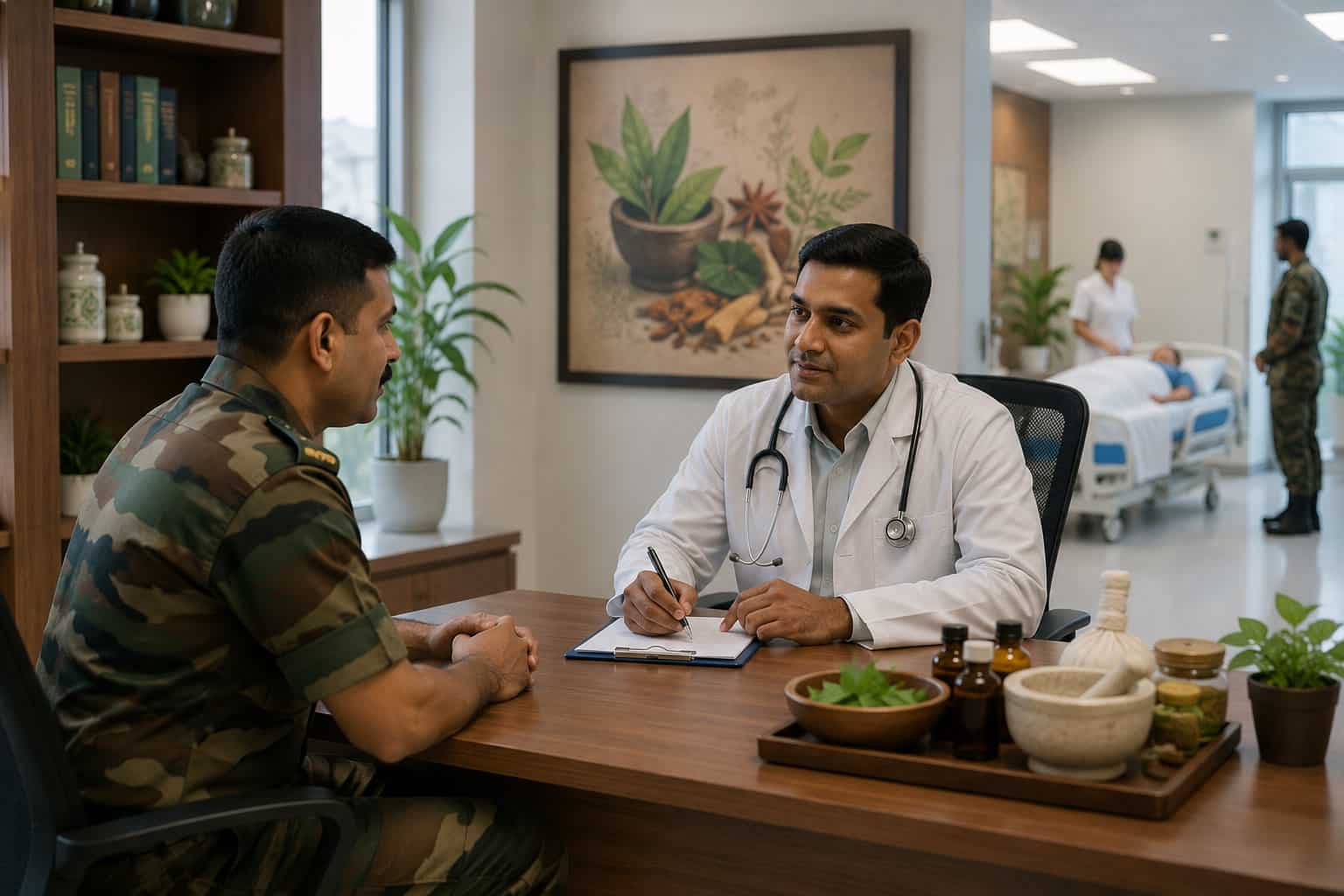
India’s defence personnel serve in difficult climates, remote operational areas and physically demanding conditions. While the Armed Forces Medical Services already maintain a modern healthcare network, the Government is now considering whether traditional systems of medicine can play a larger supporting role in preventive care, rehabilitation and overall well-being.
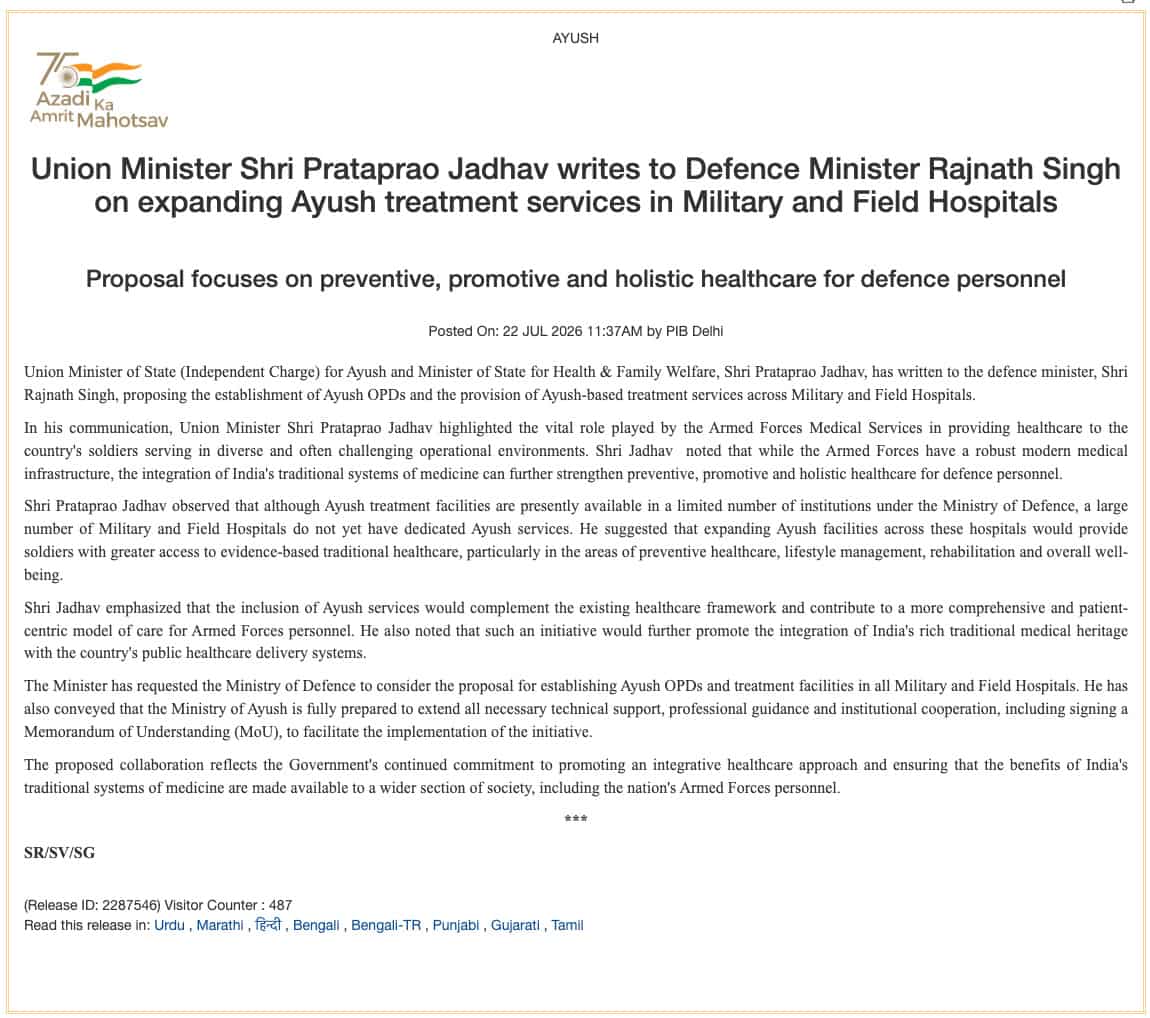
On 22 July 2026, Union Minister of State (Independent Charge) for Ayush and Minister of State for Health and Family Welfare Prataprao Jadhav wrote to Defence Minister Rajnath Singh, proposing the establishment of Ayush OPDs and Ayush-based treatment facilities across Military and Field Hospitals.
The proposal could eventually widen healthcare options available to defence personnel. However, it is important to understand its current status correctly.
Ayush services have been proposed, but no nationwide implementation order has yet been announced.
What exactly has the Ayush Ministry proposed?
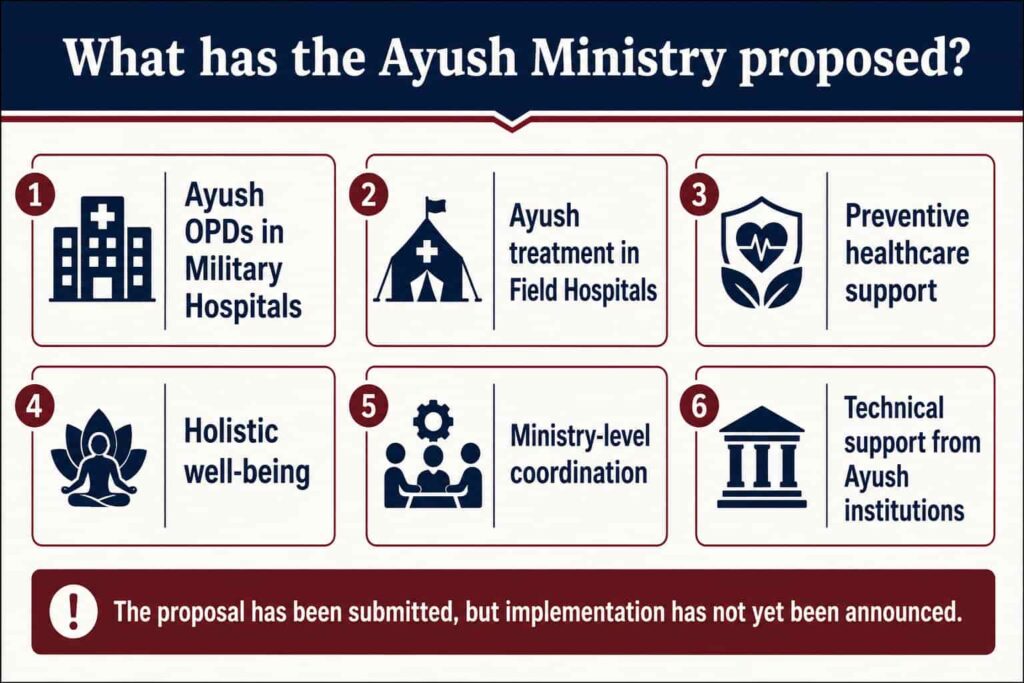
The proposal seeks to expand Ayush-based services within hospitals serving Armed Forces personnel.
The major elements mentioned in the official communication include:
- Ayush OPDs in Military Hospitals
- Ayush treatment facilities in Field Hospitals
- Preventive healthcare support
- Lifestyle management
- Rehabilitation
- Promotive healthcare
- Holistic well-being
- Technical assistance from Ayush institutions
- Institutional cooperation between the Ayush and Defence Ministries
The Ministry of Ayush has also indicated that it is prepared to provide professional guidance and technical support. A formal Memorandum of Understanding may be considered to facilitate future implementation.
Why has the proposal focused on Armed Forces personnel?
Military service places unusual demands on the human body and mind.
Defence personnel may be required to serve in high-altitude regions, desert areas, difficult terrain and operational locations with limited civilian healthcare access. Preventive health, rehabilitation, physical recovery and lifestyle management can therefore become important parts of long-term military fitness.
The official release acknowledges that the Armed Forces already possess a robust modern medical infrastructure. The proposal is not intended to replace that system.
Instead, the Ministry of Ayush has suggested an integrated healthcare approach in which traditional systems may complement existing medical treatment.
This distinction is important.
Ayush-based care would have to function alongside modern diagnosis, emergency medicine, surgery, specialist treatment and other services already provided through the Armed Forces Medical Services.
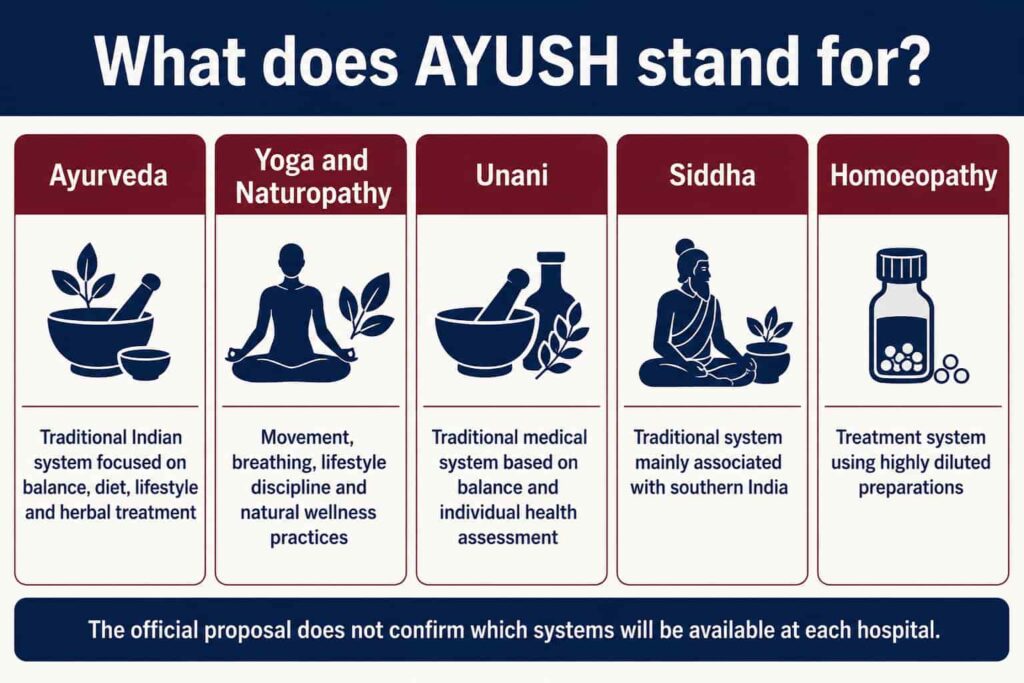
What does AYUSH stand for?
AYUSH represents multiple recognised systems of healthcare:
- A — Ayurveda
- Y — Yoga and Naturopathy
- U — Unani
- S — Siddha
- H — Homoeopathy
These systems do not all follow the same methods. Their clinical practices, medicines and therapeutic approaches are different.
The official proposal does not specify:
- Which Ayush systems will be introduced first
- Whether every hospital will offer all systems
- Which treatments will be approved
- Whether yoga, Ayurveda, naturopathy or other services will receive priority
- Whether facilities will vary from one Military Hospital to another
Therefore, readers should not assume that every Ayush service will become available at every defence hospital.
What is officially confirmed?
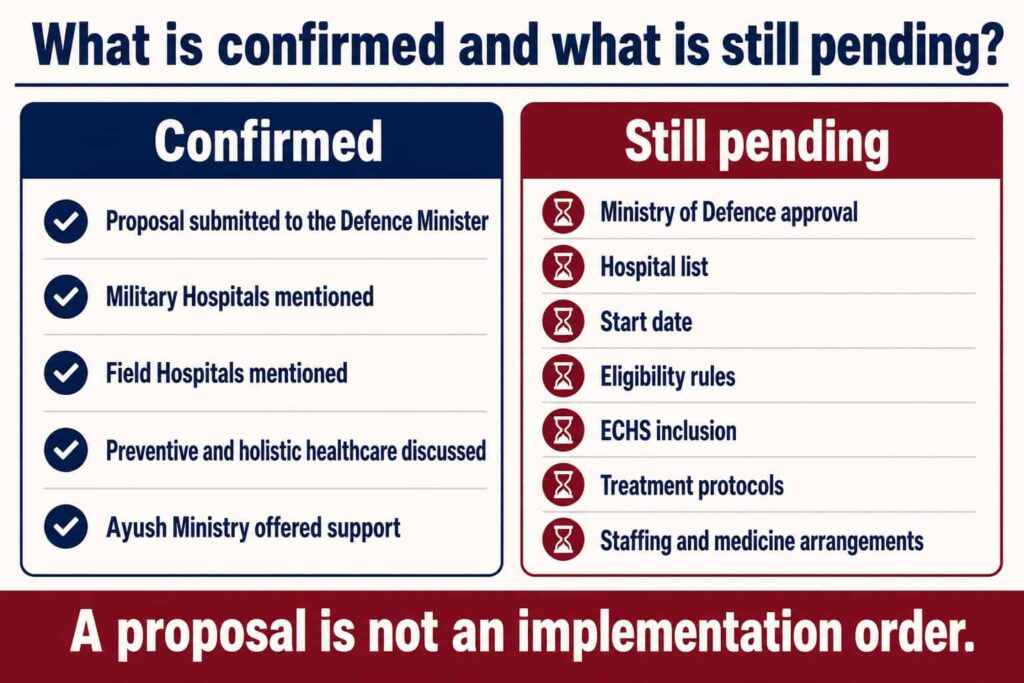
The official release confirms that:
- The Ayush Minister has written to the Defence Minister.
- Ayush OPDs have been proposed for Military Hospitals.
- Ayush-based treatment services have been proposed for Field Hospitals.
- The proposal focuses on preventive, promotive and holistic healthcare.
- Rehabilitation and lifestyle management have been identified as possible areas of benefit.
- The Ministry of Ayush has offered technical and professional support.
- Institutional cooperation and a possible MoU have been suggested.
These are important policy developments, but they do not amount to final approval.
What is still pending?
Several operational details remain unanswered:
- Approval from the Ministry of Defence
- List of participating Military Hospitals
- List of participating Field Hospitals
- Start date
- Budget allocation
- Staffing pattern
- Appointment of Ayush doctors and support staff
- Medicine procurement
- Treatment protocols
- Referral procedure
- Patient eligibility
- Coverage for dependants
- Coverage for retired personnel
- ECHS inclusion
- Monitoring and clinical-quality standards
Until these details are officially notified, personnel should not treat the proposal as an available healthcare entitlement.
Has the Defence Ministry approved the proposal?
As of the information contained in the official release dated 22 July 2026, no final approval from the Ministry of Defence has been announced.
The release states that the Ayush Minister has requested the Defence Ministry to consider the proposal.
This means the matter is at the proposal and consultation stage.
It would be misleading to claim that:
- Ayush OPDs have opened in all Military Hospitals
- Treatment has already started
- All defence personnel can immediately access the facility
- ECHS beneficiaries have automatically been included
- A fixed rollout date has been approved
No such implementation details were included in the official release.
What must happen before Ayush OPDs can begin?
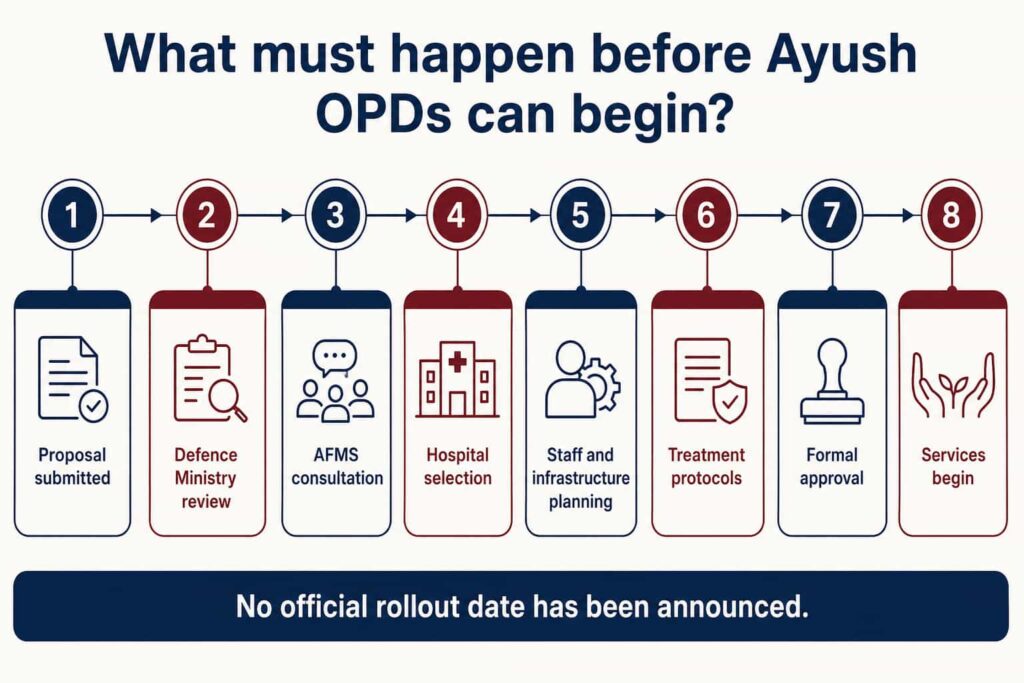
The Government has not published a formal implementation sequence. However, a practical rollout would normally require several administrative and clinical steps.
These may include:
- Examination of the proposal by the Ministry of Defence
- Consultation with the Armed Forces Medical Services
- Identification of suitable Military and Field Hospitals
- Assessment of available space and infrastructure
- Appointment or deployment of qualified Ayush professionals
- Preparation of treatment and referral protocols
- Formal administrative and financial approval
- Hospital-wise commencement of services
This is an explanatory implementation pathway, not an officially announced schedule.
No rollout date has yet been disclosed.
Are Military Hospitals, Field Hospitals and ECHS the same?
No. These healthcare arrangements serve different roles.
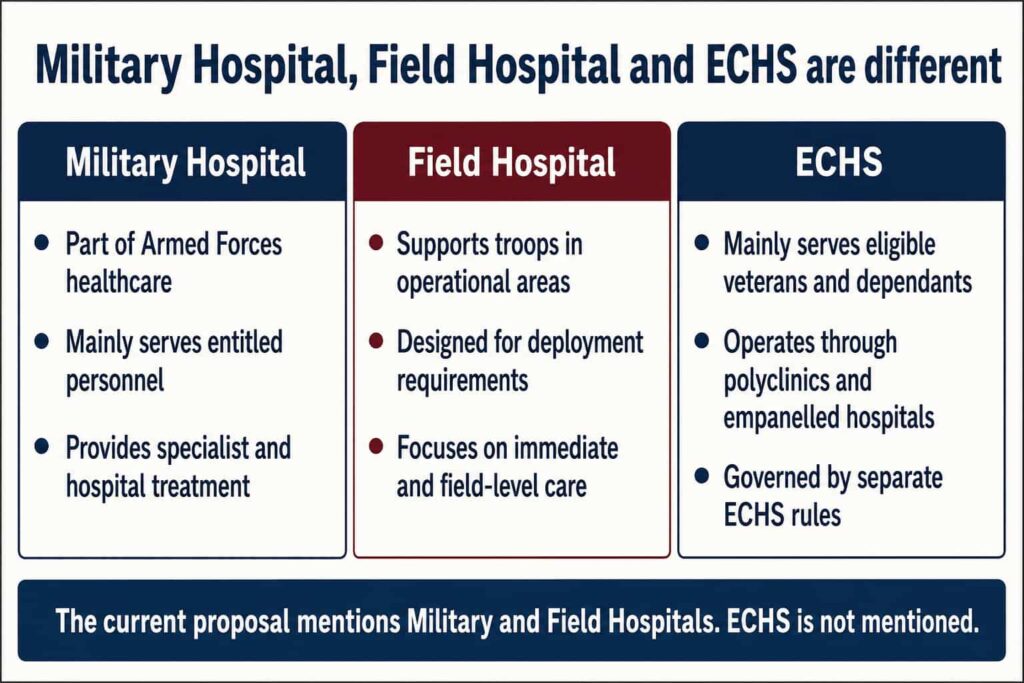
Military Hospitals
Military Hospitals form part of the Armed Forces healthcare system. They primarily provide hospital-based and specialist treatment to entitled personnel under applicable military medical rules.
Field Hospitals
Field Hospitals are designed to support troops in operational and deployment areas. Their focus is generally on immediate and field-level medical care according to operational requirements.
ECHS
The Ex-Servicemen Contributory Health Scheme primarily serves eligible veterans and their authorised dependants through ECHS polyclinics and empanelled hospitals.
ECHS operates under a separate administrative framework.
This distinction matters because the latest Ayush proposal specifically mentions Military Hospitals and Field Hospitals.
It does not expressly announce the inclusion of ECHS.
Will Ex-Servicemen and ECHS beneficiaries receive Ayush treatment?
The official release does not provide a clear answer.
It refers broadly to defence personnel and proposes services across Military and Field Hospitals. It does not specifically mention:
- Ex-Servicemen
- ECHS cardholders
- Military widows
- Retired Armed Forces personnel
- Dependants of veterans
- ECHS polyclinics
- ECHS-empanelled private hospitals
Therefore, ECHS inclusion should be treated as unconfirmed.
A separate order from the Department of Ex-Servicemen Welfare, Central Organisation ECHS or the Ministry of Defence may be required if Ayush services are extended through the ECHS network.
Will military families be covered?
The release does not clarify whether spouses, children or other authorised dependants will be eligible.
Eligibility could depend on:
- The category of hospital
- Existing entitlement rules
- The final scope of the approved scheme
- Referral requirements
- Availability of doctors and treatment
- Whether the patient is serving personnel, a dependant or a veteran
Families should wait for a formal hospital-wise or service-specific notification.
What type of treatment could be offered?
The official statement highlights broad areas rather than specific procedures.
These include:
- Preventive healthcare
- Promotive healthcare
- Lifestyle management
- Rehabilitation
- Holistic well-being
The release does not provide a final list of treatments, medicines, therapies or medical conditions.
Therefore, it cannot yet be confirmed whether future facilities may include:
- Yoga therapy
- Ayurveda consultation
- Naturopathy
- Pain-management support
- Rehabilitation programmes
- Lifestyle counselling
- Unani treatment
- Siddha treatment
- Homoeopathic consultation
The actual service package would need to be defined through approved clinical protocols.
Will Ayush replace modern military medicine?
No such replacement has been proposed.
The official release specifically presents Ayush as a system that may complement the existing healthcare framework.
Modern military healthcare would continue to remain essential for:
- Emergency care
- Trauma treatment
- Surgery
- Critical care
- Infectious diseases
- Specialist consultation
- Diagnostics
- Operational medicine
- Medical evacuation
Any Ayush component would need to work within a coordinated and patient-centred framework.
Why will treatment protocols be important?
Military healthcare cannot introduce new services only through a general announcement. Proper clinical governance would be necessary.
The final system may require:
- Qualified and registered practitioners
- Defined scope of treatment
- Patient-selection criteria
- Referral from existing medical officers
- Medical-record integration
- Contraindication and safety guidelines
- Medicine-quality standards
- Follow-up and outcome monitoring
- Coordination with specialist doctors
- Clear responsibility for clinical decisions
These safeguards would help ensure that treatment is appropriate and that patients receive timely conventional medical care whenever required.
Could the proposal benefit personnel posted in operational areas?
Potentially, yes—but the actual benefit will depend on implementation.
The reference to Field Hospitals suggests that the Government is examining whether Ayush-based preventive and supportive services could reach personnel serving in challenging locations.
However, several practical questions remain:
- Will Ayush doctors be posted in operational areas?
- Will treatment be provided permanently or through visiting teams?
- Will facilities be available in every Field Hospital?
- How will medicines be transported and stored?
- What conditions will be treated?
- How will Ayush practitioners coordinate with military doctors?
- Will emergency treatment continue to take priority?
The official announcement does not yet answer these questions.
What should defence personnel do now?
Serving personnel, dependants and veterans should avoid treating the proposal as an open facility.
For now, they should:
- Continue following existing military healthcare procedures
- Use authorised Military Hospitals and medical units
- Follow normal referral rules
- Do not purchase treatment on the assumption that reimbursement will be available
- Do not rely on social-media claims about hospital-wise rollout
- Wait for an official Ministry of Defence order
- Check whether a future notification covers serving personnel, dependants or ECHS beneficiaries
No separate registration form or application process has been announced.
Frequently asked questions
Have Ayush OPDs opened in all Military Hospitals?
No. The official release announces a proposal, not an operational rollout.
Has the Defence Minister approved the proposal?
No final approval was mentioned in the release dated 22 July 2026.
Will Field Hospitals receive Ayush facilities?
They are included in the proposal, but hospital-wise implementation has not been announced.
Is ECHS included?
ECHS is not specifically mentioned in the proposal.
Will treatment be free?
The release does not explain payment, entitlement or reimbursement rules.
Will a referral be required?
No referral procedure has been notified.
Which Ayush therapies will be available?
No hospital-wise or treatment-wise list has been released.
Has an MoU been signed?
The Ministry of Ayush has offered cooperation, including the possibility of an MoU. The release does not confirm that an MoU has already been signed.
When will services begin?
No official start date has been announced.
Why does this proposal matter?
The proposal is significant because it recognises that military healthcare is not limited to treating illness or injury after it occurs.
Preventive health, physical rehabilitation, lifestyle management and long-term well-being can also influence the readiness and quality of life of defence personnel.
If approved and implemented responsibly, Ayush services may add another layer to the Armed Forces healthcare system.
Its success, however, would depend on:
- Scientific and clinical oversight
- Properly qualified practitioners
- Clear treatment protocols
- Coordination with Armed Forces Medical Services
- Transparent eligibility rules
- Outcome-based assessment
- Adequate staffing and infrastructure
Conclusion
The Ministry of Ayush has proposed an expansion of Ayush OPDs and treatment services across Military and Field Hospitals.
The proposal focuses on preventive care, lifestyle management, rehabilitation and holistic well-being. The Ayush Ministry has also offered technical assistance and institutional cooperation to the Ministry of Defence.
But the proposal has not yet become an implementation order.
No hospital list, start date, eligibility criteria, treatment package or ECHS coverage has been officially announced.
For defence personnel and their families, the correct takeaway is:
The Government is examining a broader integrated-healthcare model for the Armed Forces, but beneficiaries must wait for formal Defence Ministry approval and detailed operational instructions before assuming that Ayush services are available.
Source:-
Press Information Bureau, Ministry of Ayush
Release ID: 2287546
Date: 22 July 2026
Subject: Proposal to expand Ayush treatment services in Military and Field Hospitals
Editorial note
This article distinguishes between the proposal announced by the Ministry of Ayush and the operational decisions that remain pending.


Leave a Reply