

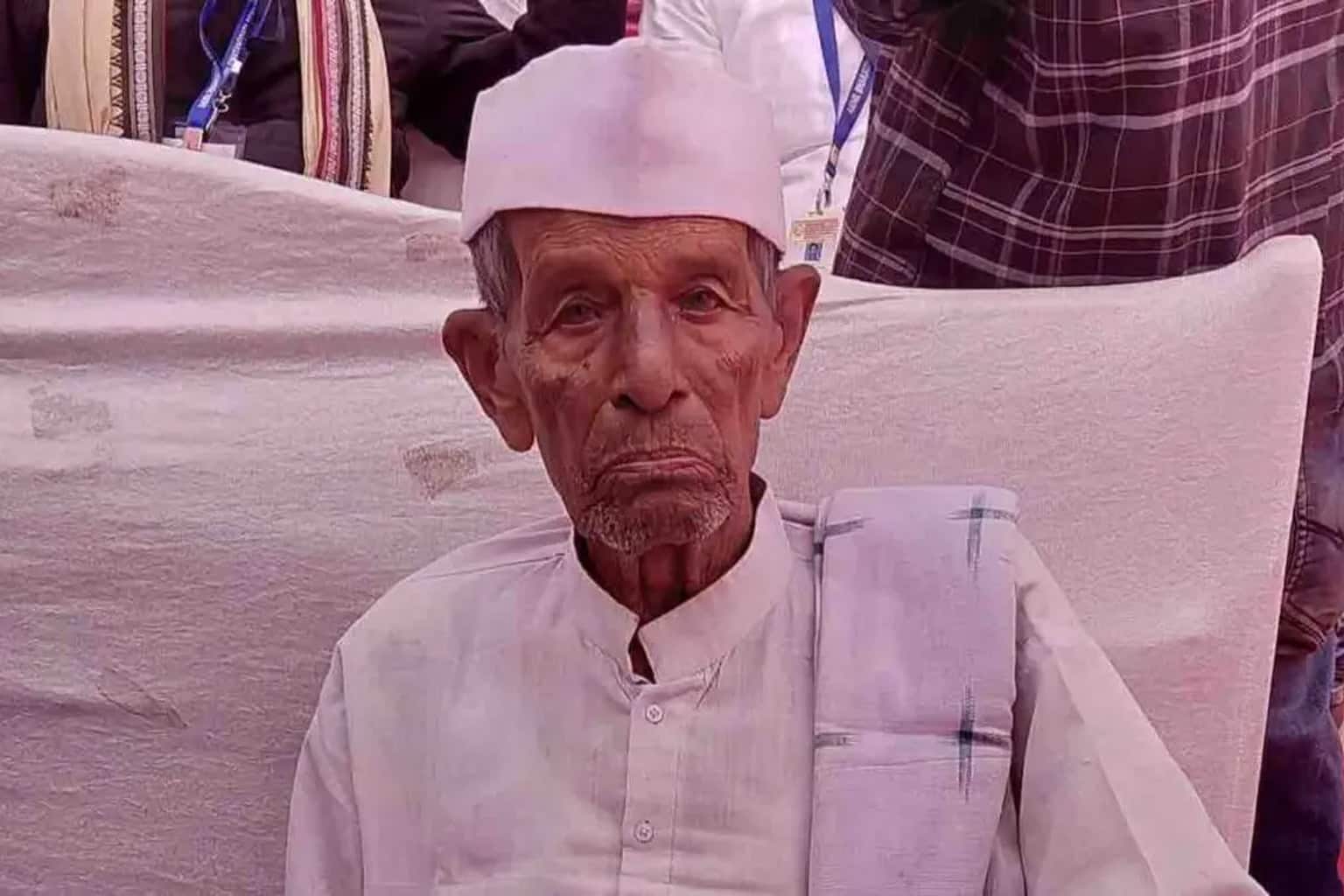
At SCB Medical College and Hospital in Cuttack, the final chapter of a life spanning more than a century came to an end.
Veteran freedom fighter Bimbadhar Muduli, a native of Odisha’s Kendrapara district, died at the age of 102 while undergoing treatment. His family said that he had been suffering from age-related ailments.
His death was followed by condolences from Odisha Chief Minister Mohan Charan Majhi, Leader of Opposition Naveen Patnaik and several other public figures.
But Muduli’s passing represents more than the death of a respected centenarian.
He belonged to a rapidly disappearing generation that experienced colonial rule directly and witnessed India’s transformation from a freedom-seeking nation into a modern republic.
The available reports, however, reveal very little about his individual role in the independence movement. That absence raises an important question:
When the life of a freedom fighter is not fully documented, how much local history disappears with that person?
Who was Bimbadhar Muduli?
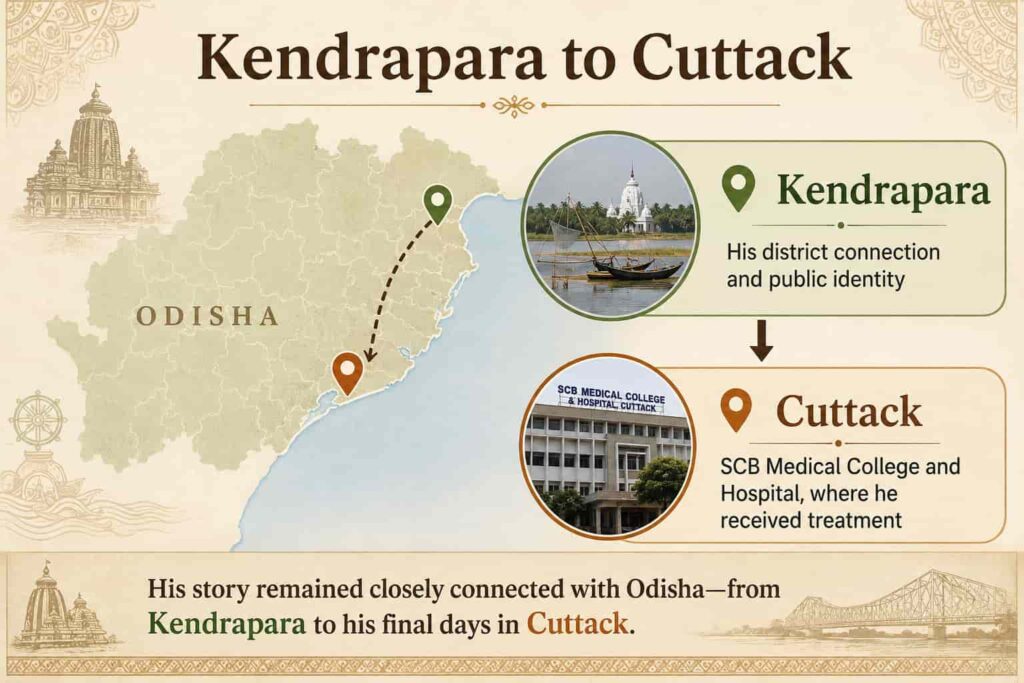
Bimbadhar Muduli was a veteran freedom fighter associated with Kendrapara district in Odisha.
Reports published after his death confirm three central details about his public identity:
- He was 102 years old.
- He belonged to Kendrapara district.
- He had recently been elected president of the Odisha State Freedom Fighters’ Association.
His election to the association’s highest position is especially significant.
It indicates that even at an advanced age, he remained connected with the community of surviving freedom fighters and continued to command their respect.
Sambad English reported that he remained actively associated with the freedom-fighters’ community despite his age.
His final days in Cuttack
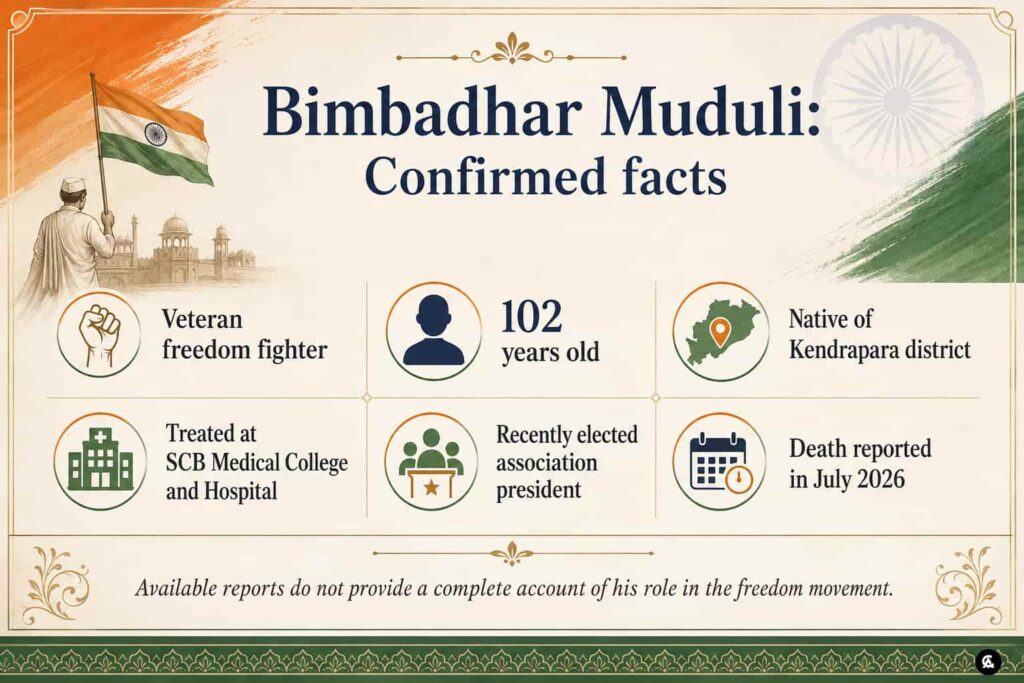
Muduli was receiving treatment at SCB Medical College and Hospital in Cuttack when he died.
The PTI account published on 24 July 2026 stated that he had been suffering from ailments associated with advanced age. The reports do not disclose a specific disease or immediate medical cause of death.
Regional representatives and political figures visited the hospital to pay their respects. Sambad English reported that Cuttack Municipal Corporation Mayor Subhash Singh, BJP leader Prabhat Biswal and other dignitaries were among those who visited SCB Medical College and Hospital.
The private medical details of an elderly patient should not be assumed or added unless confirmed by the family or hospital.
Why his association leadership matters?
Muduli had reportedly been elected president of the Odisha State Freedom Fighters’ Association shortly before his death.
This detail changes the story from a routine obituary.
He was not remembered only through ceremonial tributes. He was still being entrusted with representing a community whose numbers are steadily declining.
An association of freedom fighters can serve several purposes:
- Representing the welfare concerns of surviving members
- Maintaining contact with widows and families
- Preserving records and historical memories
- Coordinating commemorative programmes
- Passing first-hand experiences to younger generations
- Raising unresolved recognition or pension matters
The reviewed reports do not explain Muduli’s specific plans as president, the exact date of his election or the priorities he intended to pursue.
Those details would require confirmation from the association.
A lifetime connecting colonial India with the present
Muduli’s age placed his life across one of the most dramatic periods in Indian history.
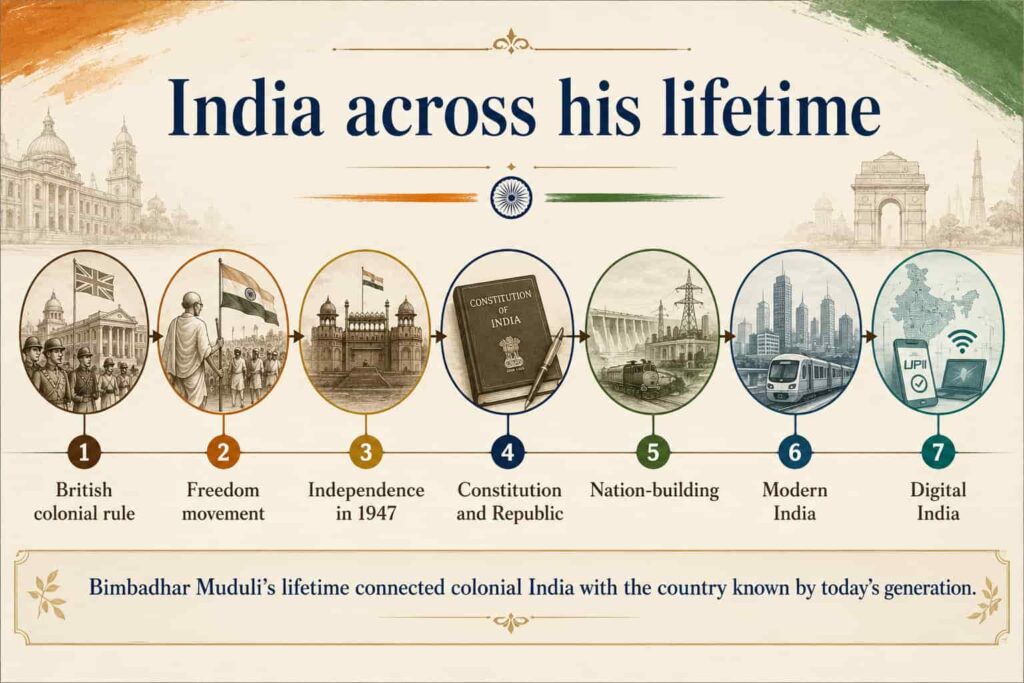
His lifetime extended through:
British colonial rule
→ The freedom movement
→ Independence in 1947
→ The Constitution and Republic
→ Post-Independence nation-building
→ Modern India
→ Digital India
This timeline is not a detailed biography of Muduli. It is a historical interpretation of what a 102-year lifespan represented.
He belonged to a generation for whom colonial rule was not a chapter in a school textbook. It was part of lived experience.
People born decades after Independence understand the freedom movement through books, archives, monuments and commemorations. Freedom fighters carried something different: personal memory.
Their recollections could contain details that official records missed—names of local organisers, small meetings, underground communication, village protests and the risks faced by ordinary participants.
The missing chapter in his publicly available story
The reports repeatedly identify Muduli as a respected or veteran freedom fighter.
However, they do not explain:
- Which freedom movement he participated in
- Whether he was imprisoned or detained
- What responsibilities he performed
- Which local leaders or organisations he worked with
- Whether he carried messages or organised protests
- Whether his oral testimony was recorded
- Which certificates, letters or photographs remain with his family
- Whether a detailed official biography exists
This information gap should not be filled with assumptions.
Muduli should not automatically be described as a participant in the Quit India Movement or any other specific campaign unless documentary evidence or a reliable first-hand account confirms it.
Similarly, titles such as “Odisha’s oldest freedom fighter” or “Kendrapara’s last surviving freedom fighter” should be avoided without official verification.
The absence of details does not reduce the value of his contribution.
It highlights the urgency of documentation.
Why local freedom fighters matter?
India’s freedom struggle was not carried forward only by nationally recognised leaders.
It also depended upon people working in districts, towns and villages—often without expecting that their names would enter history books.
Local participants may have:
- Mobilised residents
- Organised meetings
- Distributed information
- Supported underground workers
- Raised funds
- Arranged shelter
- Joined demonstrations
- Faced surveillance or arrest
- Protected families of imprisoned activists
These are examples of the broader roles performed during mass movements. They should not be attributed specifically to Muduli without evidence.
District-level histories are valuable because they show how national movements reached ordinary communities.
Without those records, history can become limited to major personalities while the experiences of thousands of local contributors slowly disappear.
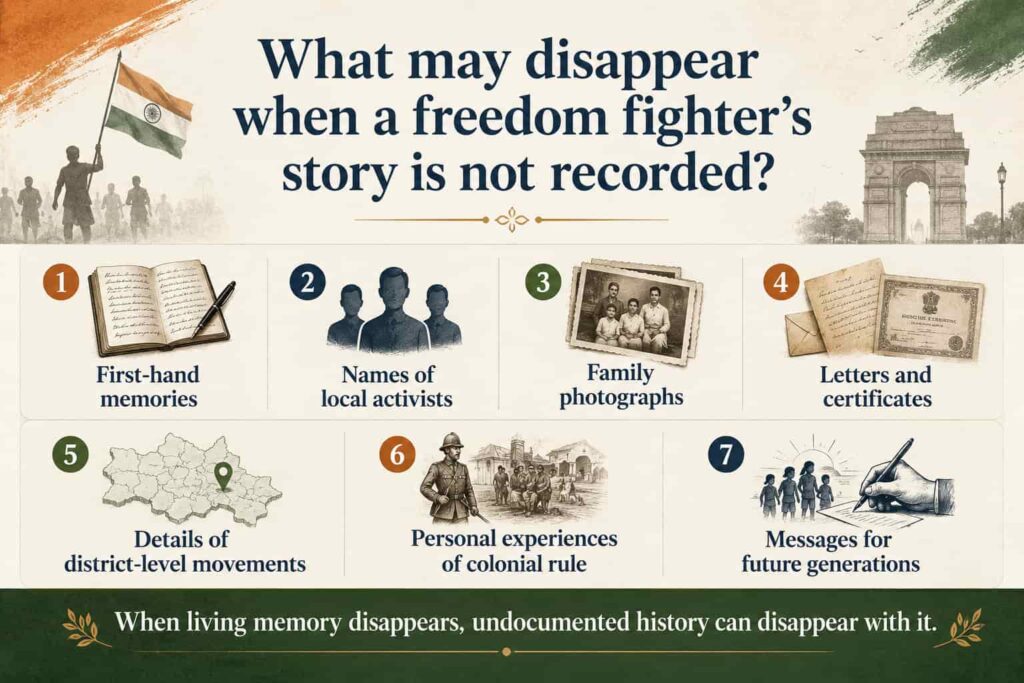
What families and institutions should preserve?
The most meaningful tribute to a freedom fighter is not limited to a condolence message.
Families, associations, universities and district administrations can work together to preserve:
Recorded interviews
A person’s voice, language and expressions can reveal details that a written certificate cannot.
Photographs
Every photograph should be digitised and labelled with names, dates, locations and occasions wherever possible.
Letters and diaries
Personal writings can show how national events affected people at the district level.
Recognition documents
Freedom-fighter certificates, pension papers, citations and government correspondence can help establish an accurate record.
Newspaper cuttings
Local newspapers may contain information that is unavailable in national archives.
Names of fellow activists
A single recorded interview can help historians identify several lesser-known participants.
Family testimony
Children and grandchildren may remember stories repeatedly shared at home, even when formal interviews were never conducted.
Digital copies
Original documents can deteriorate. High-resolution scans should be maintained in more than one secure location.
A certificate can confirm that a person was recognised. An oral history can explain the life behind that recognition.
Political leaders pay tribute
Odisha Chief Minister Mohan Charan Majhi expressed grief over Muduli’s death and praised his contribution and service to the country.
Former chief minister and Leader of Opposition Naveen Patnaik also offered condolences, remembering Muduli’s sacrifice in the struggle for Independence and his concern for people’s rights.
Such tributes acknowledge his public standing.
However, the greater long-term tribute would be to ensure that his personal history, surviving documents and experiences are properly recorded.
What is confirmed—and what remains unknown?
| Confirmed by available reports | Not established by available reports |
|---|---|
| He was a veteran freedom fighter | His exact role in the freedom struggle |
| He was 102 years old | His complete date of birth |
| He belonged to Kendrapara district | His specific village |
| He died during treatment at SCB Hospital | Exact medical cause of death |
| He had age-related ailments | Complete treatment history |
| He was recently elected association president | Date and details of the election |
| Political leaders expressed condolences | Full list of honours or awards |
| He remained connected with the freedom-fighters’ community | Arrest, detention or imprisonment record |
This distinction protects the article from exaggeration and keeps the tribute factually responsible.
Frequently asked questions
Who was Bimbadhar Muduli?
Bimbadhar Muduli was a veteran freedom fighter from Odisha’s Kendrapara district. He had recently been elected president of the Odisha State Freedom Fighters’ Association.
How old was Bimbadhar Muduli?
He was 102 years old at the time of his death.
Where did Bimbadhar Muduli die?
He died while undergoing treatment at SCB Medical College and Hospital in Cuttack.
Which district did he belong to?
He was a native of Kendrapara district in Odisha.
What role did he play in India’s freedom struggle?
The available reports identify him as a veteran freedom fighter but do not provide reliable details about his specific movement, responsibilities or activities.
Was he the president of a freedom-fighters’ association?
Yes. Reports state that he had recently been elected president of the Odisha State Freedom Fighters’ Association.
What was the cause of his death?
Reports say that he had been suffering from age-related ailments. A specific medical cause has not been publicly established in the reviewed sources.
Conclusion
Bimbadhar Muduli’s life ended at 102, but the questions surrounding his historical journey remain.
He came from Kendrapara, lived through the era of colonial rule, became part of India’s freedom-fighter community and remained publicly connected with that community until the final stage of his life.
His recent election as association president showed that his presence still carried meaning.
Yet the reports announcing his death provide only a brief outline of a century-long life.
They tell us who he was, where he came from and where he spent his final days. They do not tell us how he entered the freedom movement, what he experienced or which memories he carried.
That gap should become the lasting lesson of this story.
India must honour its freedom fighters not only after their deaths, but by recording their voices, documents and memories while they are still available.
Bimbadhar Muduli’s death marks the end of one remarkable life. Preserving his complete story would ensure that the history connected with that life does not end with him.
Sources:-
- ThePrint / PTI — confirms his age, Kendrapara connection, treatment at SCB Medical College and Hospital, age-related ailments, association leadership and condolences.
https://theprint.in/india/veteran-freedom-fighter-bimbadhar-muduli-dies-at-102/2995457/ - The Tribune / PTI — confirms the core account and condolence statements from Odisha’s political leaders.
https://www.tribuneindia.com/news/india/veteran-freedom-fighter-bimbadhar-muduli-dies-at-102/ - Sambad English — covers his role in the State Freedom Fighters’ Association, continued community involvement and visits by local dignitaries.
https://sambadenglish.com/latest-news/centenarian-freedom-fighter-bimbadhar-muduli-passes-away-at-102-12192844 - Odisha Bytes — provides regional coverage of his death during treatment at SCB Medical College and Hospital in Cuttack.
https://odishabytes.com/centenarian-freedom-fi


Leave a Reply