

Government employee training is gradually moving away from occasional classroom programmes towards a role-based digital learning system.
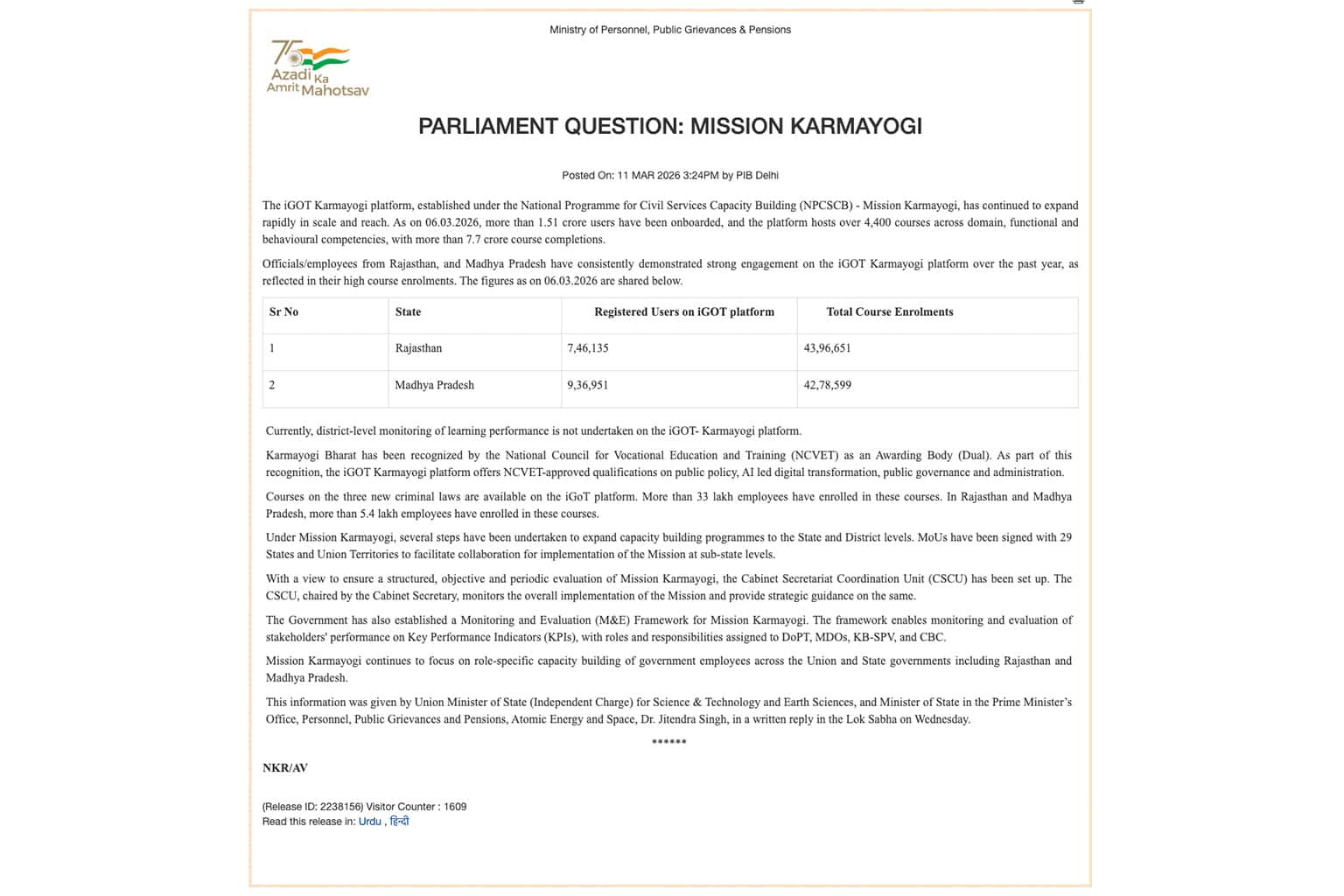
Under Mission Karmayogi, the Government is increasingly connecting an employee’s job role with required competencies, prescribed iGOT courses, assessments and the performance-management framework.
The latest official data shows how large this system has become. As of 12 August 2026, the iGOT Karmayogi platform had:
- 1.7 crore+ registered users
- 5,600+ courses
- 14.42 crore+ course completions
- 6,953 hours of learning content
- courses available in 23 languages
But for Central Government employees, the most important question is not how many courses exist.
It is:
Which prescribed courses apply to your role, and how does their completion connect with APAR?
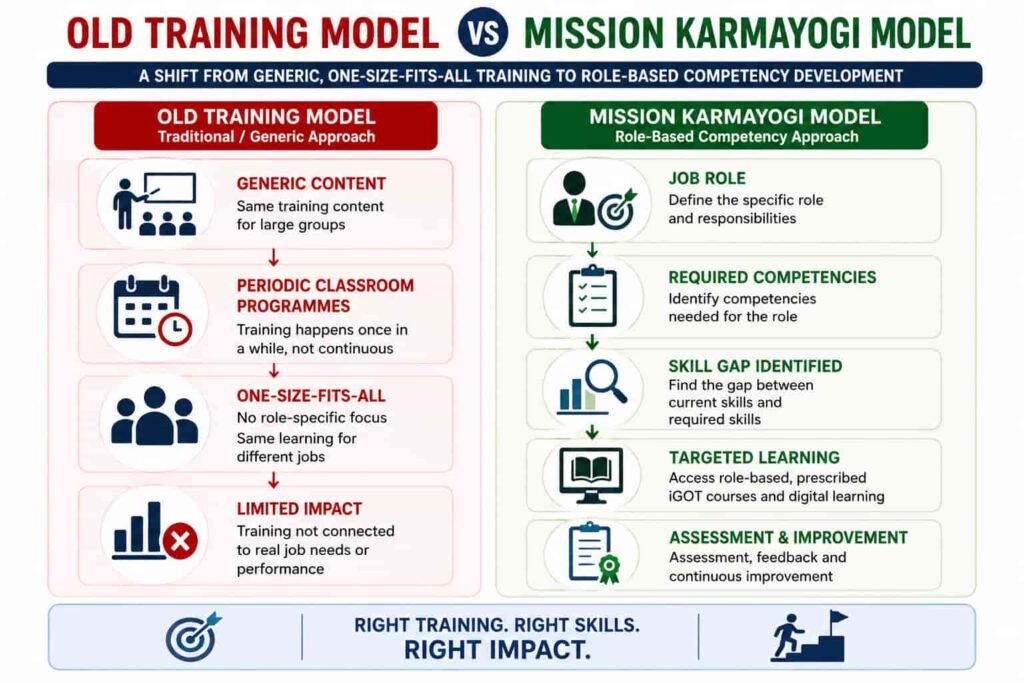
Why Mission Karmayogi matters to Government employees?
Mission Karmayogi is not simply a website containing online courses.
Its broader objective is to build a competency-driven civil-service training system.
In practical terms, this means an employee’s training can increasingly be linked with:
- the role being performed;
- competencies required for that role;
- identified skill gaps;
- prescribed digital learning; and
- assessments related to that learning.
This makes training more closely connected with an employee’s actual work responsibilities.
Where does iGOT fit into an employee’s job?
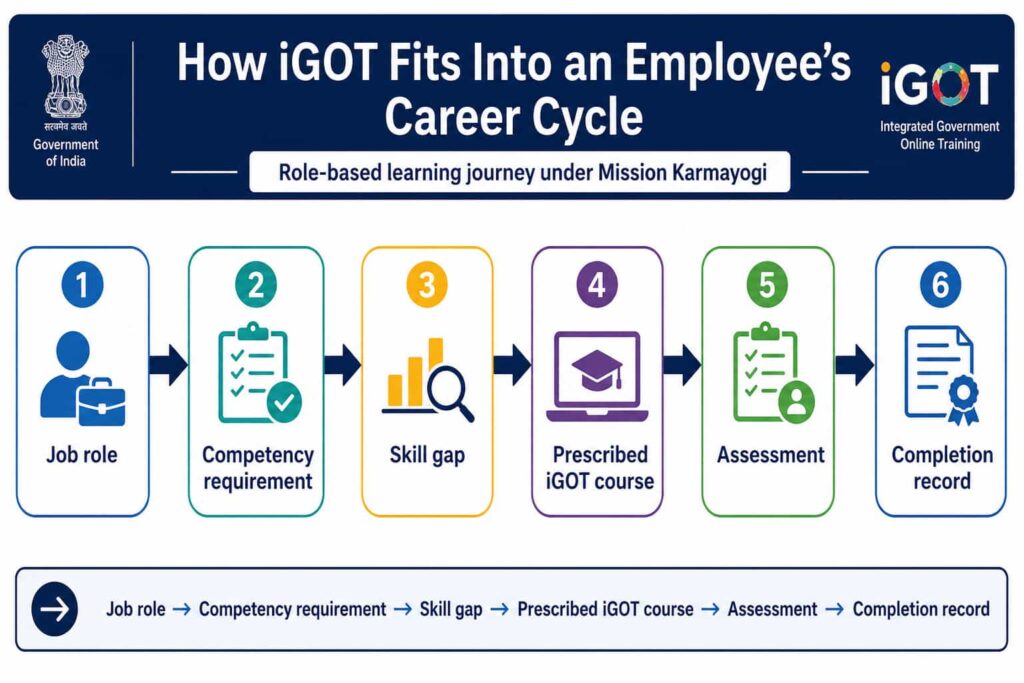
The iGOT Karmayogi platform acts as the digital learning layer of Mission Karmayogi.
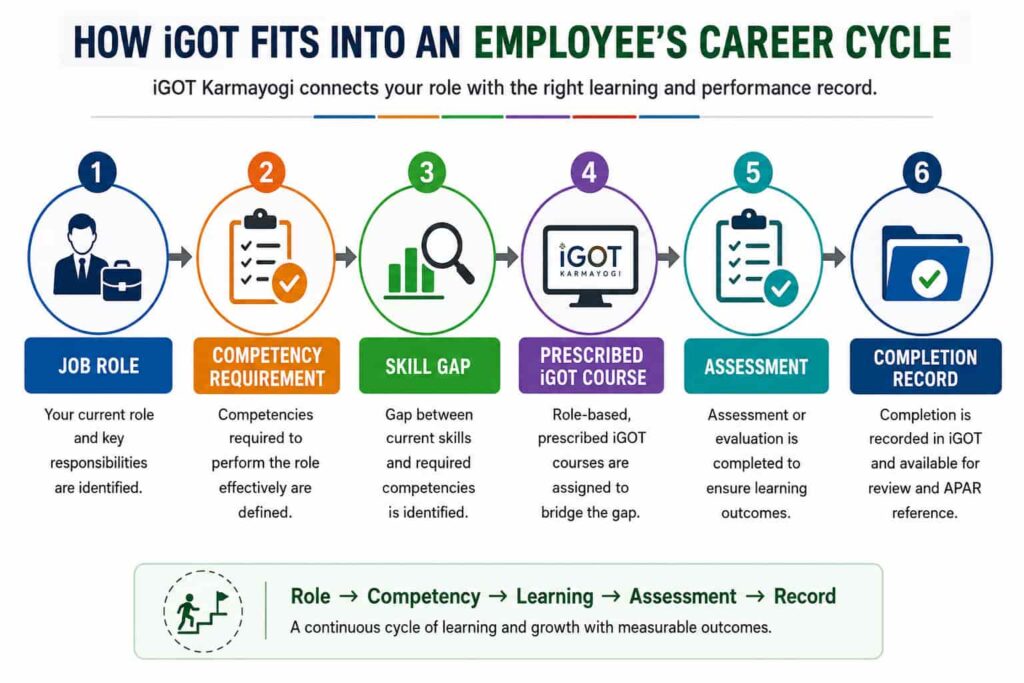
A simplified employee journey can be understood as:
Job role
↓
Competency requirement
↓
Prescribed iGOT learning
↓
Course and assessment
↓
Completion record
This is different from simply browsing the portal and completing courses at random.
The key word for employees is:
Prescribed
What is the connection between iGOT and APAR?
This is one of the most important developments for Central Government employees.
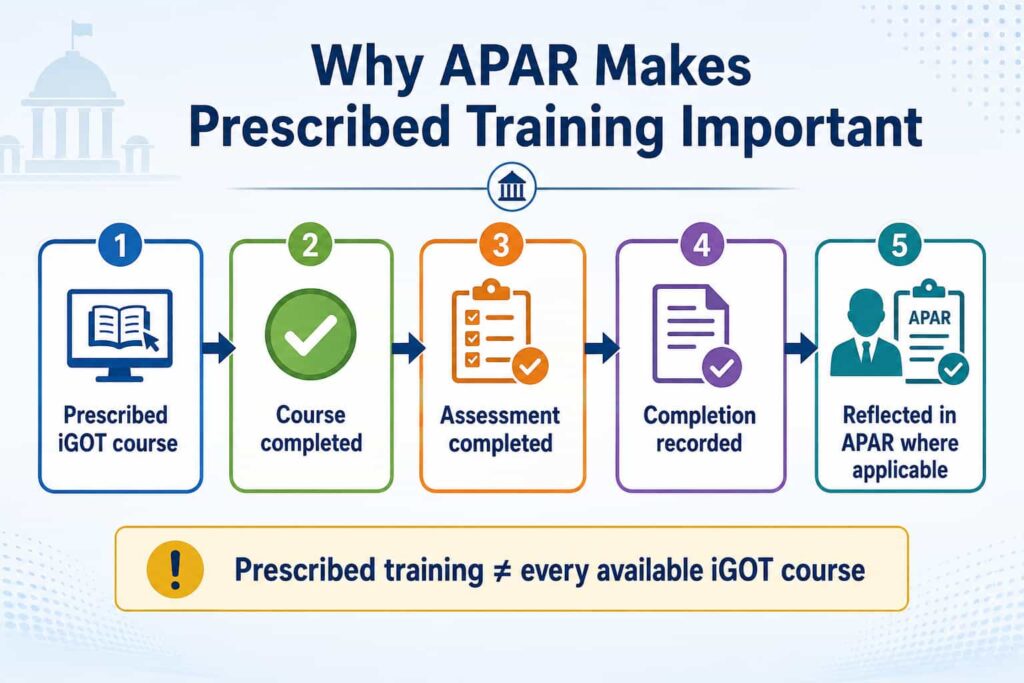
An official Government reply dated 5 August 2026 states that from the reporting year 2025-26 onwards, Central Government employees and All India Services officers are required to complete prescribed iGOT courses annually, with the relevant completion information being captured in their Annual Performance Appraisal Reports (APARs).
This does not mean every course available on iGOT becomes compulsory.
The platform currently contains more than 5,600 courses, but employees should focus on the courses and assessments prescribed under their applicable departmental or role-based framework.
What employees should understand?
Prescribed course → important
Required assessment → important
Completion status → important
Every course on iGOT → not automatically mandatory
How large has Mission Karmayogi become?
The scale of the platform helps explain why Mission Karmayogi is becoming increasingly important in Government HR reform.
According to the 12 August 2026 Lok Sabha reply:
| Mission Karmayogi metric | Latest figure |
|---|---|
| Registered users | 1.7 crore+ |
| Courses | 5,600+ |
| Course completions | 14.42 crore+ |
| Learning content | 6,953 hours |
| Languages | 23 |
The registered-user figure covers a much wider Government ecosystem than only Central Government employees.
Users include personnel from:
- Central Government;
- States and Union Territories;
- urban local bodies; and
- rural local bodies.
Therefore:
1.7 crore registered users does not mean 1.7 crore Central Government employees.
Similarly, 14.42 crore course completions means total courses completed—not 14.42 crore individual employees.
What kinds of skills is the Government trying to build?
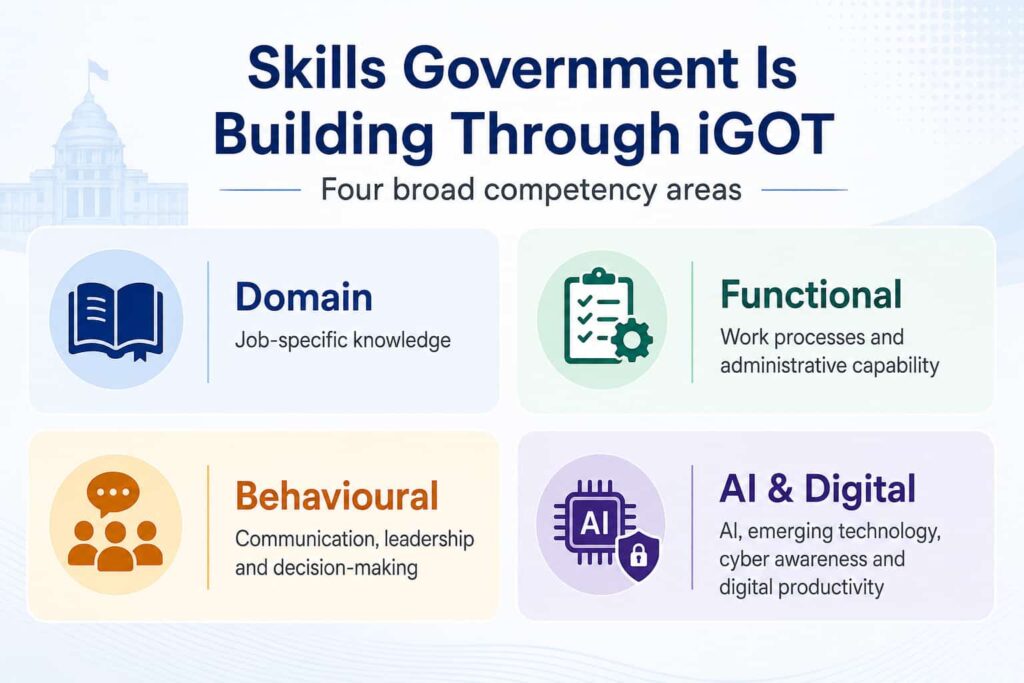
Mission Karmayogi broadly focuses on three competency areas.
Domain competencies
Knowledge directly connected with an employee’s specific area of work.
Functional competencies
Skills required to perform Government functions effectively.
Behavioural competencies
Capabilities related to communication, leadership, decision-making, teamwork and professional conduct.
In addition, the Government is rapidly expanding learning around AI and emerging technologies.
A 5 August official update said iGOT had 218 courses related to AI and emerging technologies, covering areas such as digital productivity, public health, agriculture, cyber security and other technology-led functions.
This shows that the training system is also being adapted for a Government workplace that is becoming increasingly digital.
What should a Central Government employee do?
Employees do not need to worry about all 5,600+ available courses.
A more practical approach is:
Check assigned training
Find out which courses have been prescribed for your role, cadre or department.
Check the applicable timeline
Complete prescribed learning within the period communicated by the competent authority.
Complete required assessments
Some learning requirements may include assessments in addition to course completion.
Verify your iGOT record
Ensure the prescribed course and assessment are correctly shown as completed.
Follow departmental APAR instructions
The exact implementation may depend on the employee’s Ministry, Department, cadre or applicable instructions.
What should employees NOT assume?
Mission Karmayogi is important, but several claims should be avoided.
Completing any iGOT course guarantees promotion
No.
The official updates do not establish automatic promotion simply because an employee completes an online course.
Completing a course automatically gives a salary increase
No.
Mission Karmayogi is a training and competency-building initiative, not an automatic increment scheme.
Every iGOT course affects APAR
No.
The relevant official language concerns prescribed courses and assessments.
Mission Karmayogi decides the 8th Pay Commission fitment factor
No.
Mission Karmayogi and the 8th Central Pay Commission are separate exercises.
The 8th CPC deals with pay, allowances, pension and related service matters, while Mission Karmayogi focuses on capacity building and competency development.
Why the 1.7 crore milestone matters?
The number itself is impressive, but the larger significance is structural.
Mission Karmayogi shows three major changes in Government employee development:
Training is becoming digital
Employees can access learning through a common Government platform.
Training is becoming role-based
The emphasis is shifting toward competencies required for specific responsibilities.
Training is entering the performance ecosystem
Prescribed annual iGOT learning is now relevant to the APAR framework for Central Government employees and AIS officers.
That makes Mission Karmayogi more than a training portal.
It is increasingly becoming part of the Government’s broader human-resource and capacity-building architecture.
Final takeaway
Mission Karmayogi has now reached 1.7 crore+ registered users and 14.42 crore+ course completions, but those figures are only one part of the story.
For an individual Government employee, the more important development is the growing connection between:
Role → Competency → Prescribed Learning → Assessment → Performance Framework
Employees should therefore focus less on the total number of courses available and more on which training has actually been prescribed for their job and whether it has been completed correctly.
Mission Karmayogi does not automatically decide promotion, salary or 8th CPC benefits.
Its real significance lies elsewhere:
It is changing how Government employees are trained, upskilled and prepared for their roles.
Sources:-
Press Information Bureau — Parliament Question: Mission Karmayogi, 12 August 2026
Press Information Bureau — Mission Karmayogi & iGOT Digital Capacity Building, 5 August 2026
Press Information Bureau — Mission Karmayogi and APAR Update, 23 July 2026


Leave a Reply