


A Defence Salary Account may work like any normal bank account for salary credit, ATM withdrawals and online transactions. But its real value can become important when a soldier or family needs benefits linked to an Indian Army–bank MoU, particularly Personal Accident Insurance (PAI) or compensation benefits.
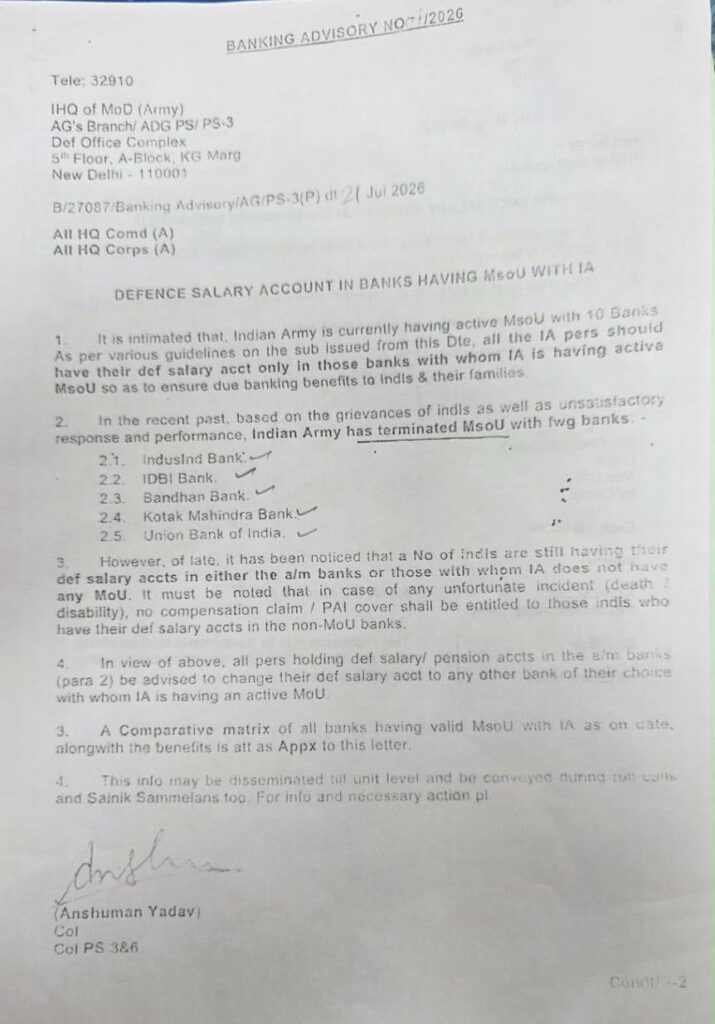
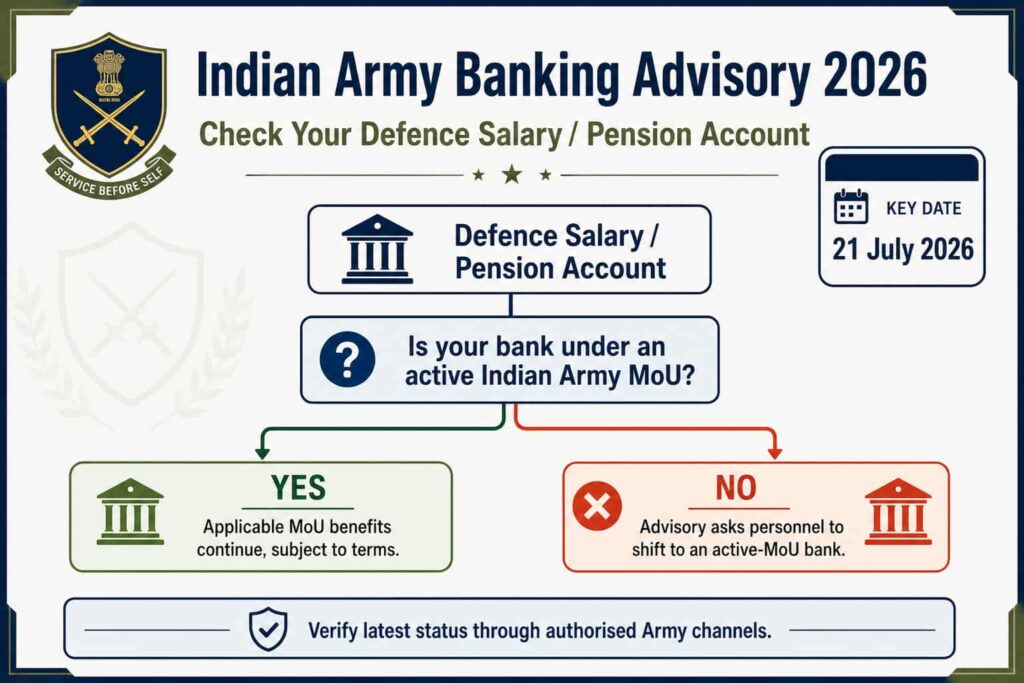
A Banking Advisory dated 21 July 2026, circulated in the name of IHQ of MoD (Army), AG’s Branch / ADG PS / PS-3, advises Army personnel to ensure that their Defence Salary or Pension Account is maintained with a bank having a current active MoU with the Indian Army.
The advisory states that Army MoUs with five banks have been terminated and warns that personnel keeping Defence Salary Accounts with non-MoU banks may not remain eligible for benefits arising specifically from the Army-bank MoU.
Verification note: The photographed advisory is consistent with known Army banking arrangements, but the exact 21 July 2026 circular has not been located on a publicly indexed official Army or PIB webpage. Personnel should confirm the latest position through their unit, formation or authorised Army channel before changing accounts.
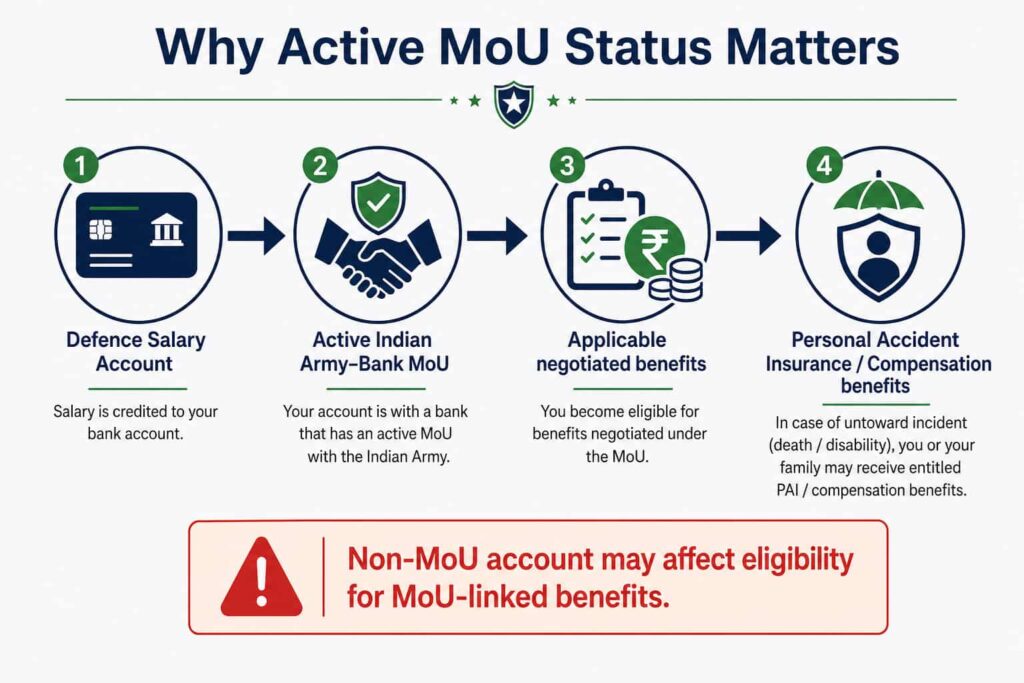
Why should Army personnel check their bank MoU status?
The advisory’s most important warning relates to death or disability.
According to the document, if an individual maintains a Defence Salary Account with a bank that does not have an active Indian Army MoU, compensation claims or Personal Accident Insurance cover available under the Army-bank MoU may not be admissible.
That distinction matters.
A salary can continue reaching a bank account normally while the account holder may still not meet the conditions for a specific Army-negotiated insurance benefit.
For families, discovering this only after an unfortunate incident could create a serious problem.
What does the 21 July 2026 advisory say?
The document is titled Banking Advisory No. 1/2026 and is addressed to Army Commands and Corps Headquarters.
It states that the Indian Army currently has active MoUs with 10 banks and advises personnel to maintain Defence Salary Accounts with banks having a valid Army MoU.
It also asks affected personnel holding Defence Salary/Pension Accounts to shift to another bank of their choice having an active Army MoU.
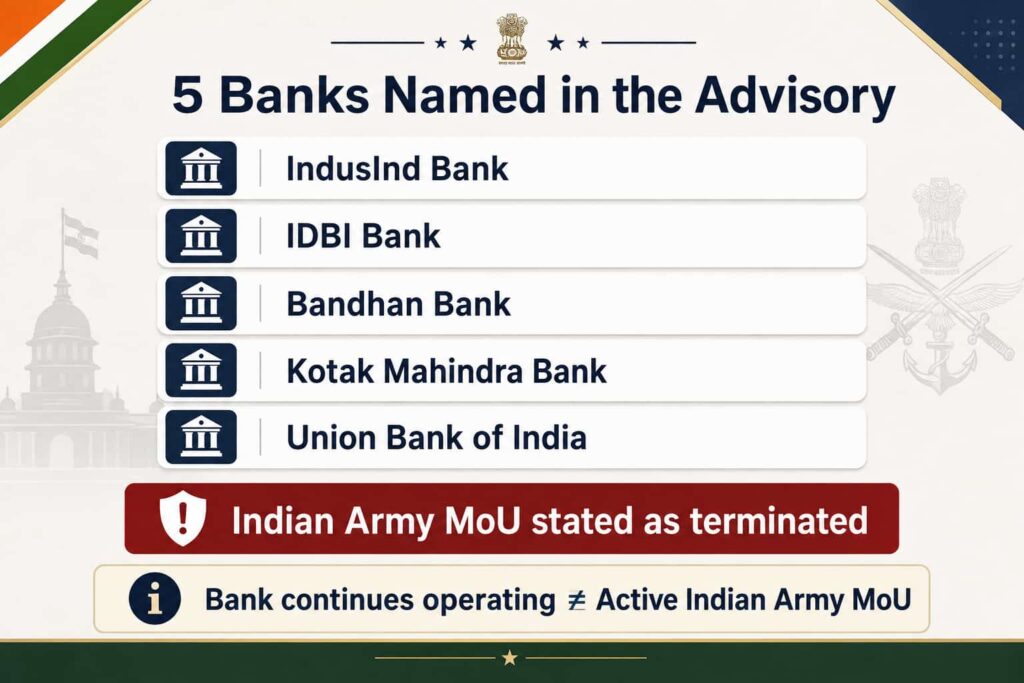
Which five banks are named in the advisory?
The document states that Indian Army MoUs have been terminated with:
| Bank | Status stated in advisory |
|---|---|
| IndusInd Bank | MoU terminated |
| IDBI Bank | MoU terminated |
| Bandhan Bank | MoU terminated |
| Kotak Mahindra Bank | MoU terminated |
| Union Bank of India | MoU terminated |
The advisory attributes the decision to grievances from individuals and concerns over response and performance.
However, one point must be understood clearly:
Termination of an Army MoU does not mean the bank itself has been banned.
A “Defence Account” name alone may not be enough
This is an important practical point.
A bank may offer a product marketed for:
- defence personnel;
- uniformed services;
- pensioners; or
- salary-account customers.
But the product name alone should not be treated as proof that the account is covered under a current Indian Army MoU.
Personnel should separately check:
- whether the bank has an active Army MoU;
- whether their account is correctly classified under the applicable Defence Salary/Pension package;
- what PAI or compensation benefit applies to their category; and
- whether additional eligibility conditions must be satisfied.
Salary credit ≠ automatic MoU eligibility
Receiving salary in an account and qualifying for every negotiated Army banking benefit are not necessarily the same thing.
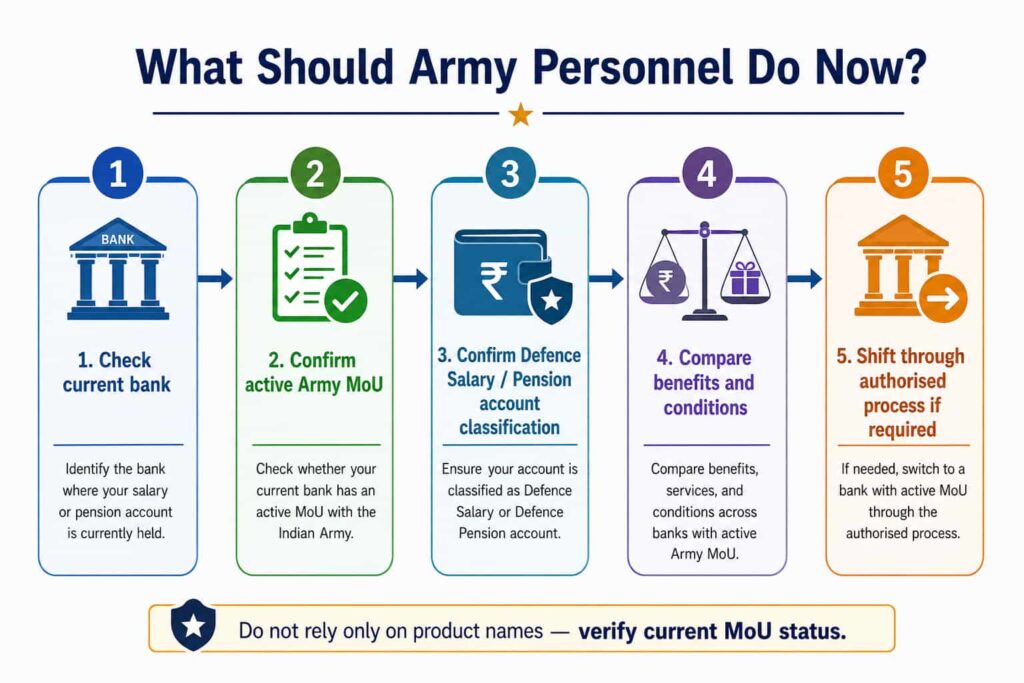
What should Army personnel do now?
The advisory should not trigger panic or an immediate unverified bank switch.
A safer process is:
1. Check your existing bank
Identify where your Defence Salary or Pension Account is currently maintained.
2. Confirm the current Army MoU
Verify whether that bank has a valid Indian Army MoU as of now.
3. Confirm account classification
Make sure your account is actually mapped to the appropriate Defence Salary or Pension category, rather than functioning as an ordinary savings account.
4. Compare benefits
Before changing banks, compare the applicable:
- Personal Accident Insurance;
- disability cover;
- compensation benefits;
- pensioner benefits; and
- eligibility conditions.
5. Follow the authorised process
Serving personnel should follow applicable unit, pay or administrative instructions when changing the salary account.
Are these five banks completely banned for Army personnel?
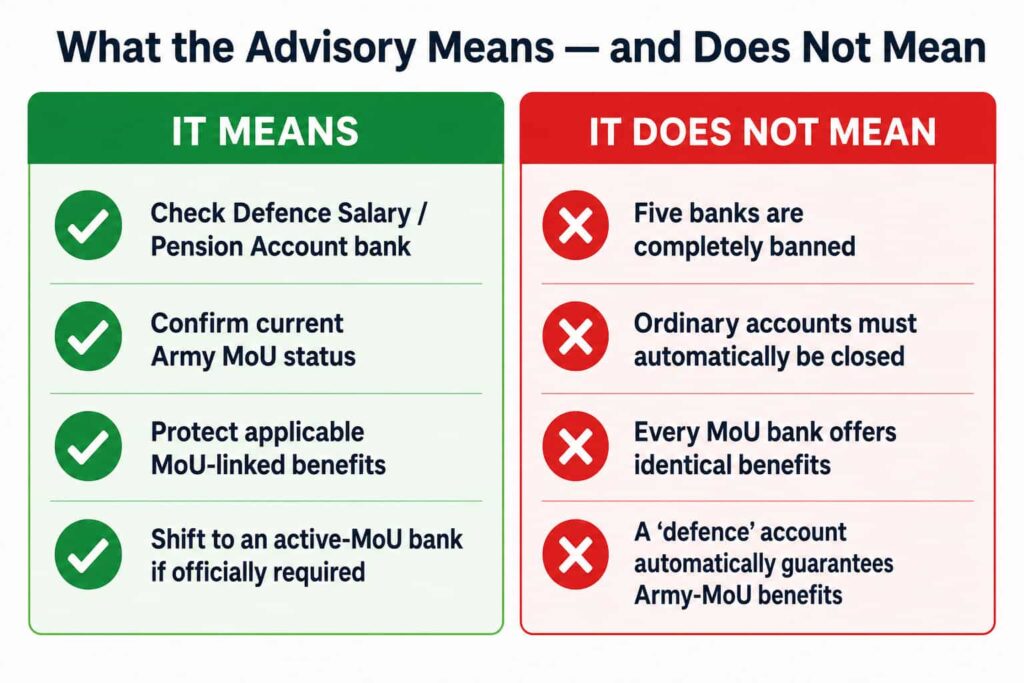
No.
The advisory does not say personnel must stop every banking relationship with the five institutions.
It does not automatically require closure of:
- ordinary savings accounts;
- fixed deposits;
- loans;
- credit cards; or
- other personal banking products.
The specific concern is the use of these banks for a Defence Salary/Pension Account where Army-MoU-linked benefits are expected.
Which are the 10 banks currently having valid Army MoUs?
The photographed advisory says that a comparative matrix of all banks having valid Army MoUs, along with applicable benefits, was attached as an appendix.
That appendix is not available with the photographed page.
Therefore, personnel should be cautious about relying on unofficial social-media lists claiming to show the “10 approved Army banks”.
The correct reference should be the latest comparative matrix or authorised Army instruction.
This is especially important because MoUs can be renewed, modified or terminated over time.
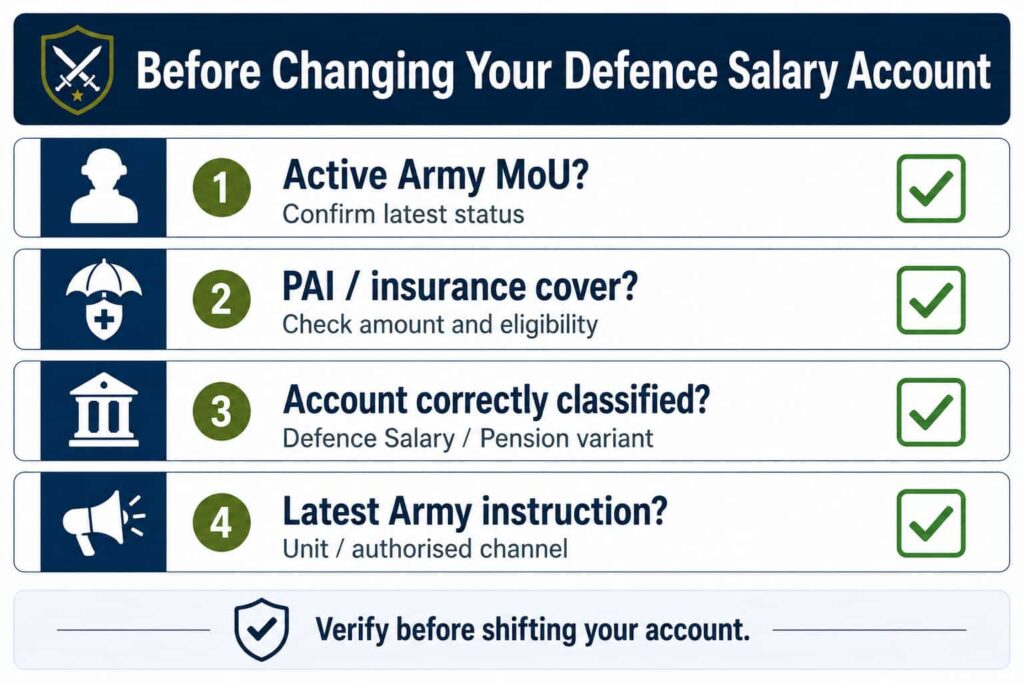
Before changing your bank, verify these four things
A Defence Salary/Pension Account should not be moved only because another bank appears to offer a larger headline insurance amount.
The actual benefit can depend on eligibility and account status.
Why this matters more to the family than to the bank account holder?
Most personnel may never need to use the Personal Accident Insurance benefit attached to their salary account.
But when an unfortunate incident involving death or disability occurs, the claim can become financially important for the family.
That is why the advisory asks for this information to be disseminated down to unit level, including during roll calls and Sainik Sammelans.
The purpose appears clear:
Check eligibility while everything is normal—not after a claim becomes necessary.
Quick facts
| Question | Answer |
|---|---|
| Advisory date | 21 July 2026 |
| Active Army MoUs mentioned | 10 banks |
| Banks whose MoUs are stated as terminated | 5 |
| Main accounts concerned | Defence Salary / Pension Accounts |
| Main benefit risk highlighted | MoU-linked PAI / compensation |
| Are the five banks completely banned? | No such blanket ban is stated |
| Should personnel shift accounts without verification? | No |
| Best source for current status | Latest authorised Army instruction / comparative matrix |
Final takeaway
The real message of the Indian Army Banking Advisory 2026 is not simply that five bank MoUs have ended.
The more important message is:
Army personnel should know exactly what benefits their Defence Salary or Pension Account is actually entitled to.
According to the advisory, the MoUs with IndusInd Bank, IDBI Bank, Bandhan Bank, Kotak Mahindra Bank and Union Bank of India have been terminated.
Personnel maintaining affected Defence Salary/Pension Accounts have been advised to move to a bank having an active Army MoU.
But before changing any account, personnel should verify:
Current MoU status → Account classification → PAI eligibility → Benefit conditions → Latest Army instructions
Because when it comes to compensation or Personal Accident Insurance, the most important time to verify your banking status is before the benefit is needed.
Sources:-
Indian Army Banking Advisory No. 1/2026 — Ref. B/27087/Banking Advisory/AG/PS-3(P), dated 21 July 2026.
Document provided with this report. The exact circular has not been located on a publicly indexed official Army/PIB page.
State Bank of India — Defence Salary Package
Latest unit/formation/authorised Indian Army banking instructions should be treated as the final reference for current MoU status and applicable benefits.


Leave a Reply