

CSD beneficiaries looking for Old Monk, Antiquity Blue, Royal Challenge or McDowell’s No. 1 Celebration Rum should understand an important supply update issued on 11 August 2026.
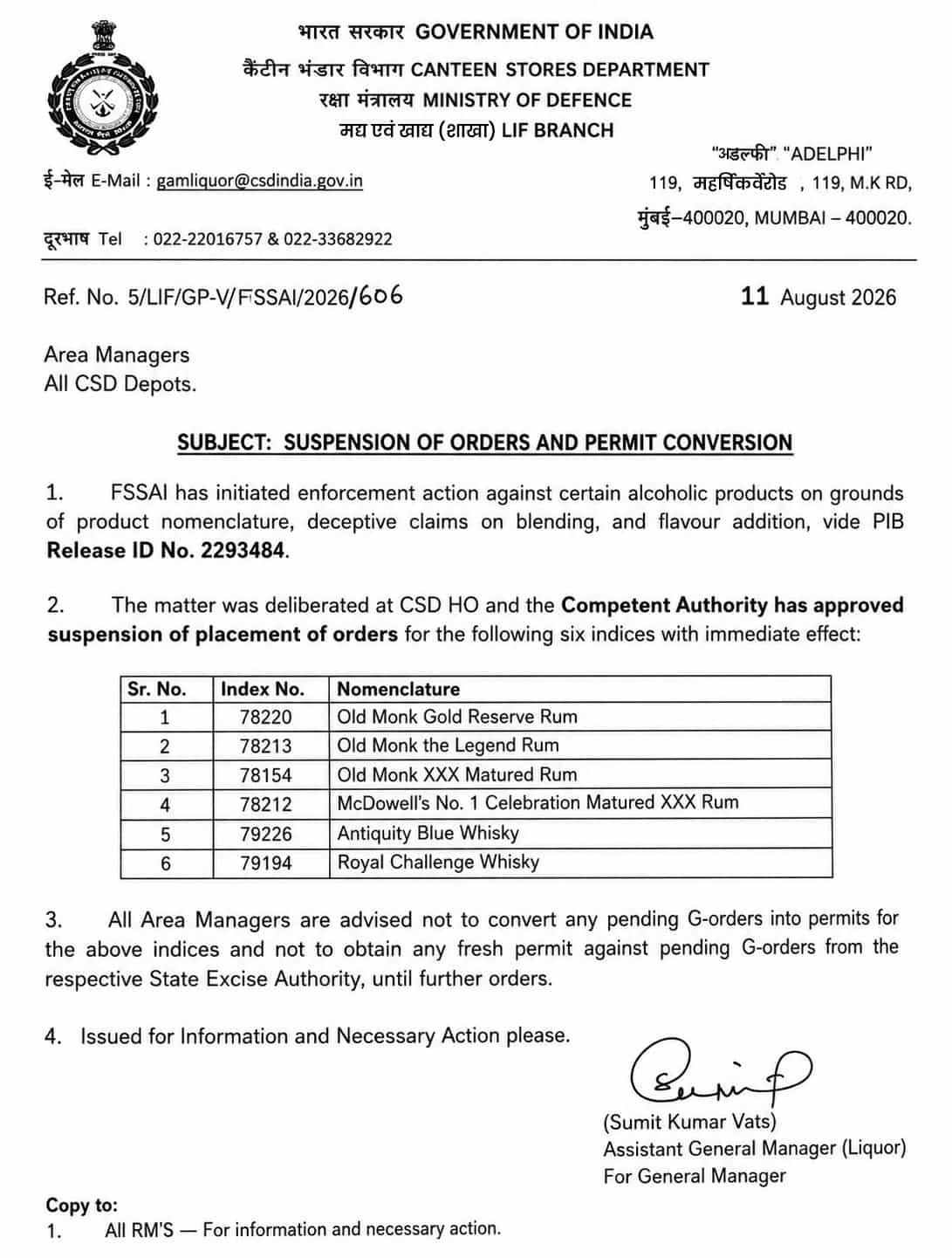
The Canteen Stores Department (CSD), Ministry of Defence has suspended fresh order placement for six specified liquor indices following FSSAI enforcement action.
The instruction also stops the conversion of pending G-orders into permits and says fresh permits should not be obtained against those pending orders until further orders.
For a CSD user, the practical question is not simply whether these products have been “banned”.
The more accurate question is:
Can fresh supply of these six indices continue moving through the CSD order and permit system?
At present, the 11 August instruction has interrupted that process.
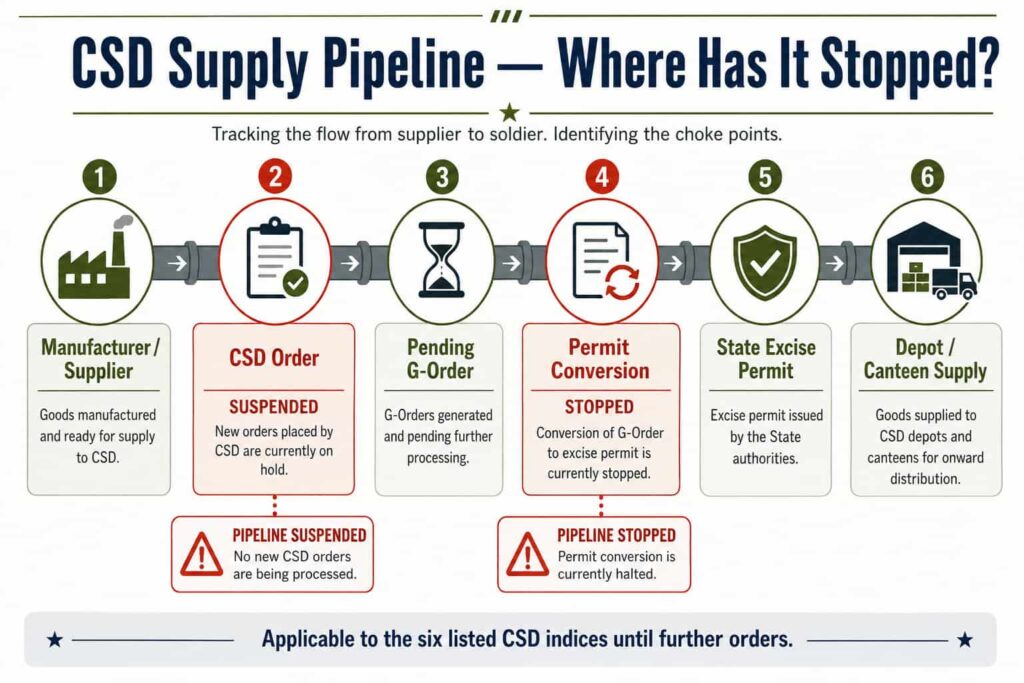
Which six CSD liquor products are affected?
The CSD letter identifies the following products:
| CSD Index | Product | Current status in 11 August letter |
|---|---|---|
| 78220 | Old Monk Gold Reserve Rum | Orders suspended |
| 78213 | Old Monk The Legend Rum | Orders suspended |
| 78154 | Old Monk XXX Matured Rum | Orders suspended |
| 78212 | McDowell’s No. 1 Celebration Matured XXX Rum | Orders suspended |
| 79226 | Antiquity Blue Whisky | Orders suspended |
| 79194 | Royal Challenge Whisky | Orders suspended |
The suspension applies until further orders.
That wording is important because it does not establish permanent removal of these products from CSD.
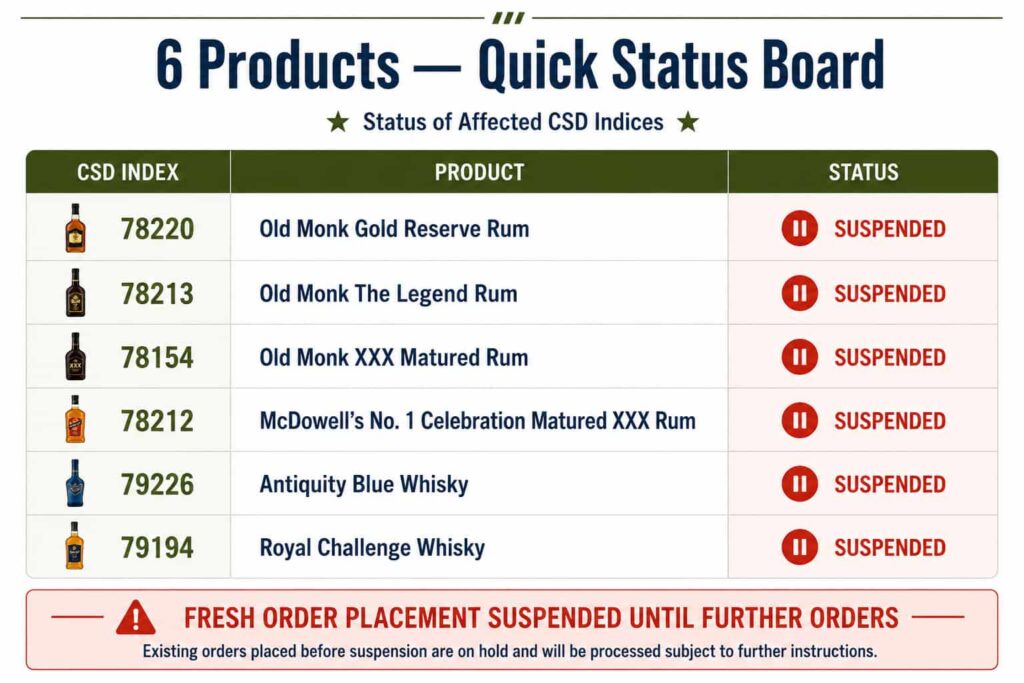
What exactly changes in the CSD supply process?
The CSD letter contains three operational instructions.
Fresh orders
CSD Area Managers have been directed to stop placing orders for the six listed indices.
Pending G-orders
Pending G-orders for these products should not be converted into permits.
Fresh permits
Area Managers should also not obtain fresh permits against those pending G-orders from the respective State Excise Authorities.
So the immediate impact is on the future procurement and permit movement of these products within the CSD system.
Does existing CSD stock have to disappear immediately?
This is where the letter needs to be interpreted carefully.
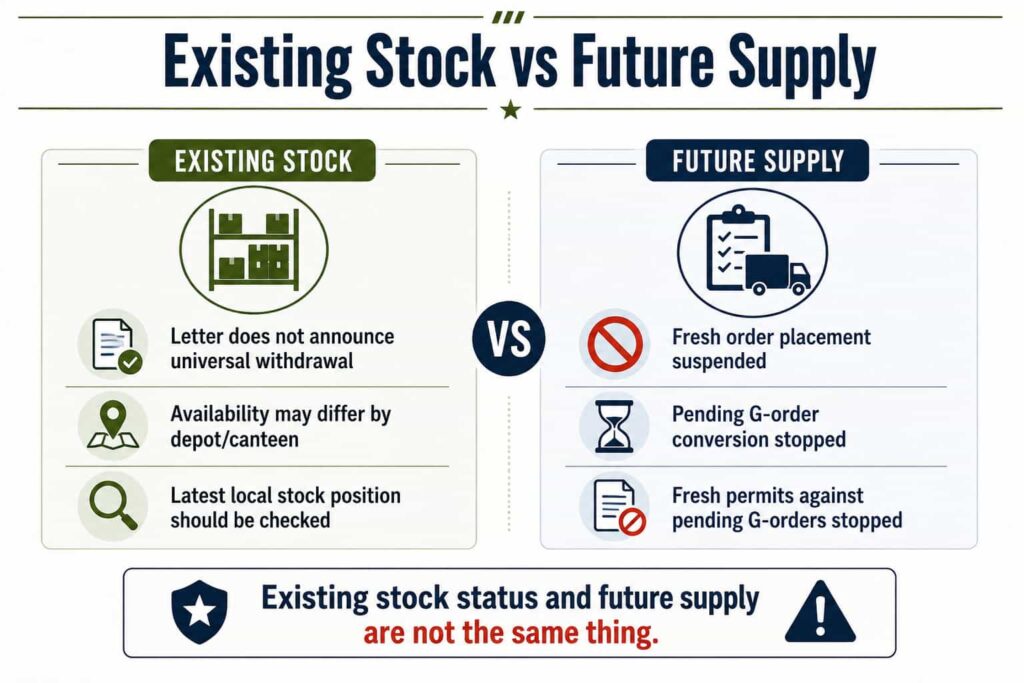
The 11 August document does not itself direct every CSD outlet to withdraw all existing bottles from sale.
It does not state that:
- all existing stock must be recalled;
- every bottle already at a depot must be destroyed;
- all previously processed permits stand cancelled; or
- the products have been permanently removed from CSD.
Therefore, the order suspension should not automatically be interpreted as zero stock at every CSD canteen from 11 August.
Actual availability can depend on existing stock, local depot position and any subsequent CSD or regulatory instructions.
Why did CSD take action on these products?
The CSD letter specifically cites PIB Release ID 2293484, an official FSSAI statement concerning enforcement action against certain alcoholic beverages.
According to FSSAI, the regulatory issues involved areas such as:
- product nomenclature;
- laboratory findings;
- use of externally added identical or artificial flavour in affected samples;
- blending and age-related claims; and
- accurate disclosure of the true nature of the product to consumers.
The same six products listed in the CSD letter also appear in the FSSAI enforcement context.
This explains why the CSD action is not a normal stock-management decision. It follows a broader food-standard and regulatory compliance issue.
Is flavouring itself banned in alcoholic beverages?
No. That would be too broad an interpretation.
The FSSAI issue concerns compliance with the applicable alcoholic-beverage standards and how certain products were manufactured, described and labelled.
The official FSSAI position does not mean that every use of permitted flavouring in every alcoholic beverage is prohibited.
For CSD beneficiaries, however, the important practical point remains simpler: CSD has acted on six specific indices, not on the entire liquor category.
Is this a permanent CSD ban?
No permanent ban is stated in the 11 August CSD letter.
The document uses the language:
“suspension”
and
“until further orders.”
That means the current position is an interim operational restriction.
It should not be reported as:
“Old Monk permanently banned in CSD”
or
“Antiquity Blue and Royal Challenge removed forever.”
Those claims are not supported by this letter.
What should a CSD beneficiary check before visiting a canteen?
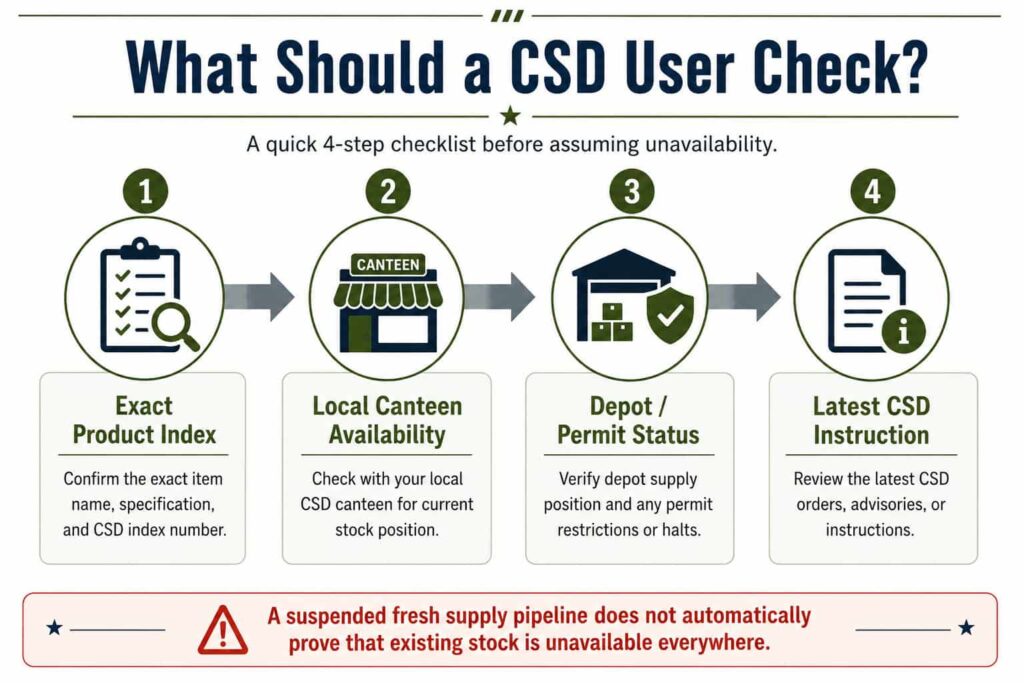
A beneficiary interested in one of these products should check four things.
1. Exact CSD index
Different variants of the same brand may have different CSD index numbers. The present instruction identifies six specific indices.
2. Local stock availability
Since the letter does not itself announce universal withdrawal of existing stock, actual availability can differ.
3. Latest depot or canteen status
A local CSD outlet may receive operational instructions based on depot stock, permits and subsequent directions.
4. Any new CSD circular
The present suspension remains valid until further orders, which means a later CSD instruction can change the status.
What could happen next?
The CSD document does not predict the final outcome.
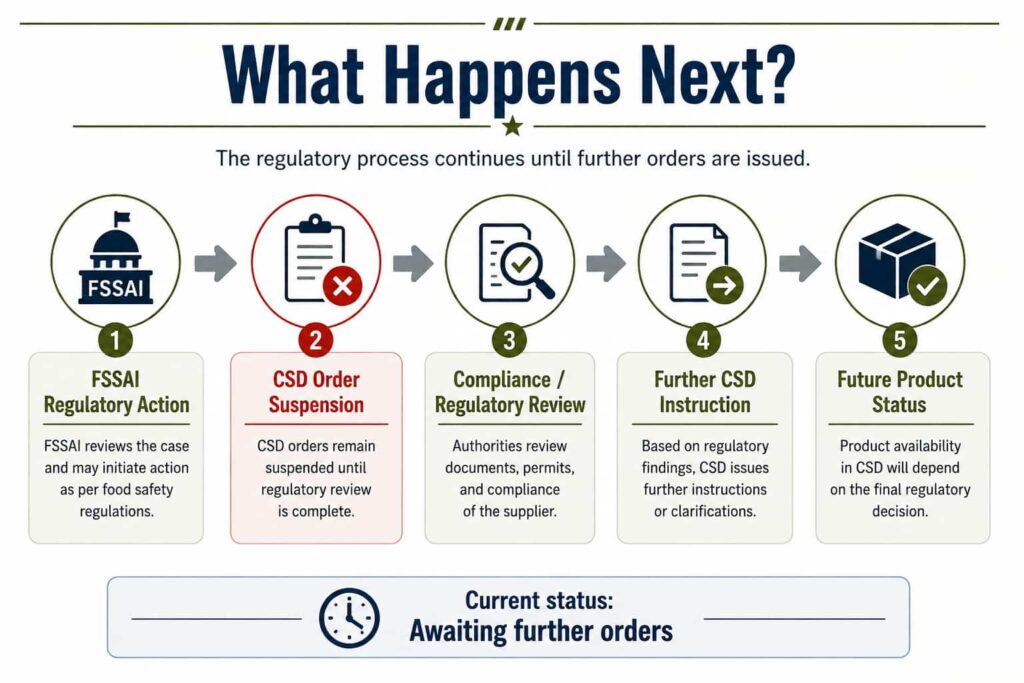
From the present record, the situation can move forward only through further regulatory and administrative action.
The current stage is:
FSSAI enforcement action
↓
CSD suspends orders and permit conversion
↓
Compliance / regulatory position develops
↓
Further CSD instruction awaited
A future CSD communication could continue, modify or withdraw the present restriction depending on subsequent developments.
Until such an order appears, the correct status remains:
Suspended until further orders
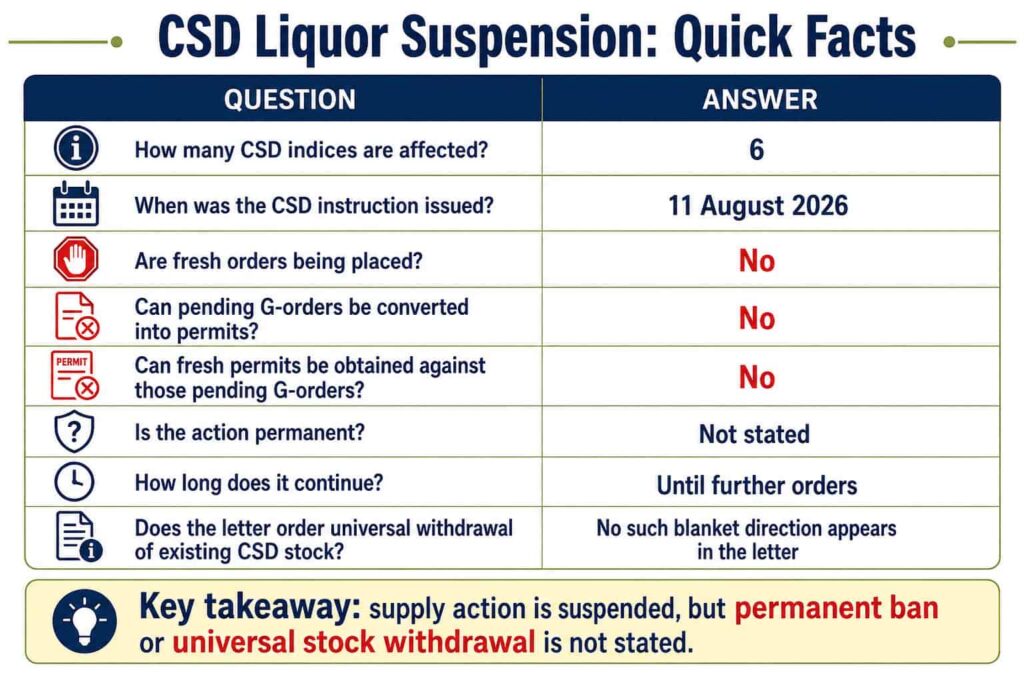
CSD liquor suspension: Quick facts
| Question | Answer |
|---|---|
| How many CSD indices are affected? | 6 |
| When was the CSD instruction issued? | 11 August 2026 |
| Are fresh orders being placed? | No |
| Can pending G-orders be converted into permits? | No |
| Can fresh permits be obtained against those pending G-orders? | No |
| Is the action permanent? | Not stated |
| How long does it continue? | Until further orders |
| Does the letter order universal withdrawal of existing CSD stock? | No such blanket direction appears in the letter |
Why this matters to CSD users?
For beneficiaries, the distinction between stock availability and supply continuity is important.
A product may still be visible somewhere because stock already exists, while at the same time its future replenishment pipeline has been interrupted.
That is why the 11 August CSD action should be understood primarily as a supply and permit restriction, rather than being reduced to the word “ban”.
Final takeaway
The latest CSD liquor supply update dated 11 August 2026 affects six indices covering selected variants of Old Monk, McDowell’s No. 1 Celebration, Antiquity Blue and Royal Challenge.
For these indices:
- fresh order placement has been suspended;
- pending G-orders should not be converted into permits;
- fresh permits against those pending G-orders should not be obtained; and
- the restriction remains in force until further orders.
The action follows FSSAI enforcement concerning alcoholic-beverage standards and product compliance.
For CSD beneficiaries, the most accurate interpretation is:
Future supply of these six indices has been interrupted, but the letter does not itself declare a permanent ban or universal recall of all existing CSD stock.


Leave a Reply