

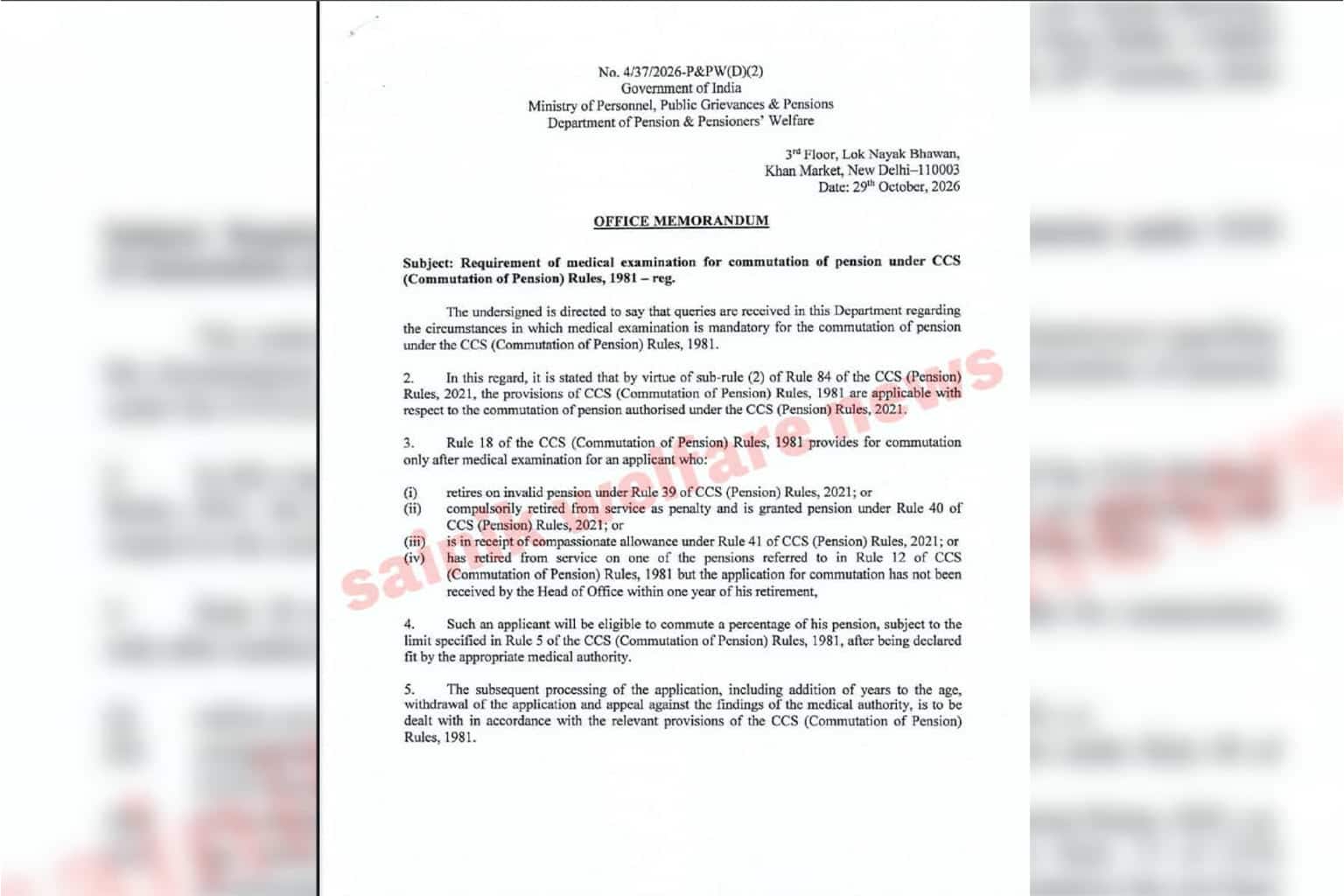
Download the official document
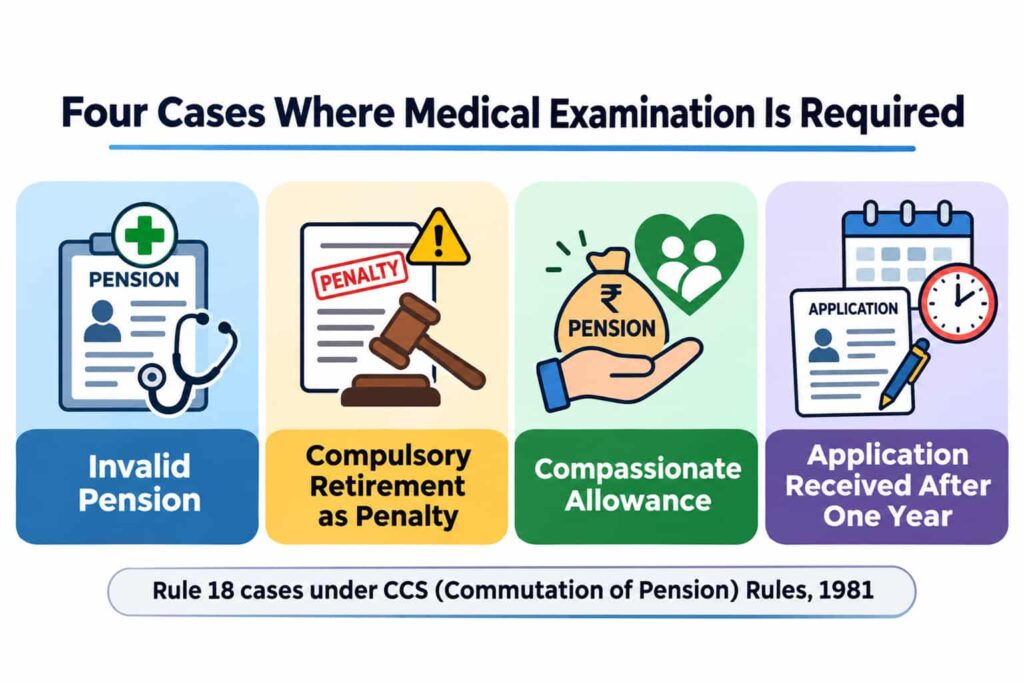
Not every Central Government pensioner is required to undergo a medical examination before commuting pension. The requirement applies only in specified situations under the CCS (Commutation of Pension) Rules, 1981.
The Department of Pension & Pensioners’ Welfare has reiterated the applicable position regarding commutation after medical examination. Rule 18 identifies specific categories of pensioners who can commute the permissible portion of pension only after being declared medically fit by the appropriate medical authority. The official rule covers cases involving invalid pension, compulsory retirement as a penalty, compassionate allowance and certain delayed commutation applications.
For pensioners, the practical question is therefore not simply whether a medical examination exists under the rules. The important question is whether their particular retirement or commutation situation falls within one of these categories.
Case 1: Retirement on Invalid Pension
The first category covers a Government servant who retires on invalid pension under the applicable pension rules.
Invalid pension is connected with retirement arising from a condition that makes the employee permanently incapable of continuing in service under the relevant rules. Where a pensioner falls within this category, commutation is processed through the medical-examination route provided under Rule 18.
The medical examination in this situation is therefore not an optional administrative step. It forms part of the prescribed commutation process for this category.
Case 2: Compulsory Retirement as a Penalty
The second category applies where a Government employee has been compulsorily retired from service as a disciplinary penalty and pension has been granted under the applicable pension provisions.
Such a pensioner does not follow the ordinary no-medical-examination route for commutation. Rule 18 specifically places compulsory retirement granted as a penalty within the category requiring examination by the appropriate medical authority before the permissible portion of pension can be commuted.
This distinction matters because compulsory retirement arising from disciplinary action should not be confused with normal superannuation or another routine form of retirement.
Case 3: Pensioner Receiving Compassionate Allowance
The third category concerns a person receiving compassionate allowance.
Compassionate allowance can arise in circumstances where normal pension has not been granted but an allowance is sanctioned under the relevant pension rule. Rule 18 specifically includes recipients of compassionate allowance among the pensioners whose commutation requires medical examination.
The pensioner must therefore satisfy the prescribed medical process before commutation can proceed.
Case 4: Commutation Application received after one year
The fourth category is especially important because it can affect an otherwise normal pensioner.
Where a pensioner belongs to a category ordinarily eligible to commute pension without medical examination under Rule 12, but the commutation application is not received by the Head of Office within one year of retirement, Rule 18 moves the case into the medical-examination route.
The crucial point is the date on which the application reaches the Head of Office. Pensioners should therefore avoid treating the date on which the form was merely signed or prepared as sufficient proof of timely submission.
Does medical examination mean pension commutation has been rejected?
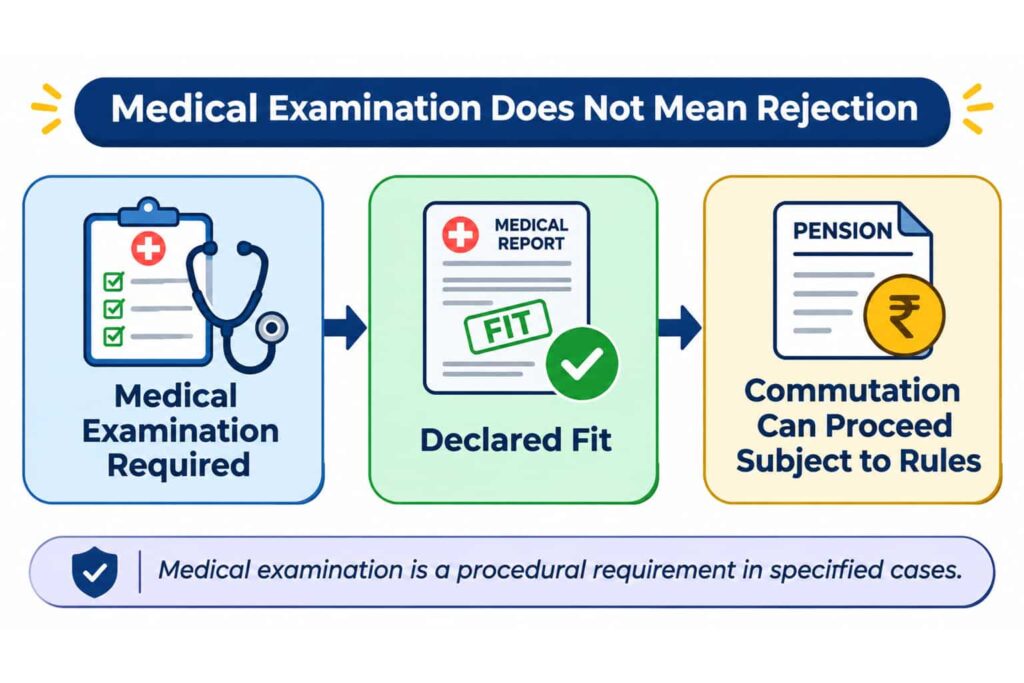
No. Requiring a medical examination does not by itself mean that the pensioner has lost the right to commute pension.
Rule 18 states that a pensioner covered by these categories remains eligible to commute the permissible percentage of pension, subject to the limit prescribed under Rule 5, after being declared fit by the appropriate medical authority.
This distinction is important. A medical examination is a condition for processing commutation in these cases; it is not an automatic rejection of the application.
Once the appropriate medical authority declares the pensioner fit and the other applicable requirements are satisfied, the commutation case can move forward according to the rules.
What happens after the pensioner submits the application?
For a pensioner covered under Rule 18, the application is submitted to the Head of Office in the prescribed form. The rules require the Head of Office to acknowledge receipt and forward the application for further processing.
The Accounts Officer completes the relevant portion of the form and returns it so that arrangements can be made for examination by the appropriate medical authority. The rules therefore create a defined administrative sequence rather than leaving the pensioner to arrange the medical process independently.
For the pensioner, keeping a copy of the application and acknowledgement is useful because it establishes when the commutation request entered the official process.
Why the one-year deadline deserves special attention?
Among the four categories, the one-year rule is the most likely to affect an ordinary retiring employee.
A pensioner who would otherwise qualify for commutation without medical examination can create an avoidable additional requirement simply by allowing the prescribed period to expire.
The important date is the date of receipt of the application by the Head of Office. This is why affected pensioners should submit the application well before the deadline and preserve an acknowledgement or other official evidence showing the date of receipt.
The purpose of this distinction is practical: an application submitted within the normal permitted period and an application made after the period are processed through different routes under the commutation rules.
A Separate Rule applies in certain pending-proceedings cases
Pensioners should not confuse the ordinary one-year rule with the separate clarification concerning employees whose departmental or judicial proceedings continued after retirement.
In those specific Rule 8 cases, final pension may be authorised only after the proceedings are concluded. The separate DoPPW clarification issued in October 2026 explains that the relevant one-year period can begin from the date of the pension-authorising order issued after conclusion of the proceedings rather than automatically from the original retirement date.
That situation is different from an ordinary Rule 12 pensioner who simply delays submitting the commutation application after retirement.
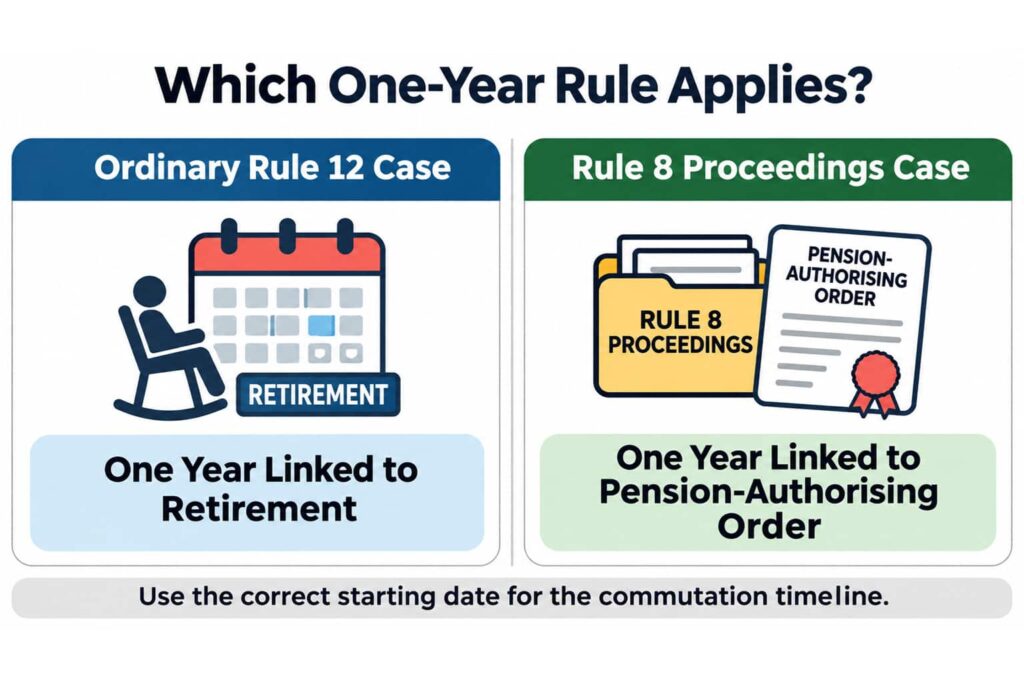
Keeping these two situations separate prevents a pensioner from applying the wrong deadline to his or her case.
Can a pensioner apply after the one-year period?
Yes. Crossing the one-year period does not automatically extinguish the right to pension commutation.
Instead, the mode of processing changes. A pensioner who falls within the delayed-application category under Rule 18 becomes eligible to commute the permissible portion after being declared fit by the appropriate medical authority.
The practical consequence is therefore an additional medical requirement, not an automatic permanent loss of the commutation facility.
Does the clarification change the maximum commutation percentage?
The medical-examination clarification should not be read as creating a new percentage of pension that can be commuted.
Rule 18 itself says that an eligible applicant may commute a percentage of pension subject to the limit specified in Rule 5 after being declared medically fit.
Therefore, the medical requirement and the maximum permissible commutation limit are separate issues.
Does it change the restoration period?
No change in the restoration period should be inferred merely from this medical-examination clarification.
The subject of the clarification is the category of pensioners who require medical examination before commutation. It does not, by itself, announce a new restoration period for commuted pension.
This is important because discussions about commutation often mix together three separate matters: eligibility to commute, requirement of medical examination and restoration of the commuted portion.
Does this automatically apply to armed forces pensioners?
No automatic extension should be assumed.
The clarification discussed here relates to the CCS (Commutation of Pension) Rules, 1981 and the corresponding Central Civil Services pension framework. DoPPW is the nodal department dealing with pension policy for the relevant Central Government civilian pensioners.
Armed Forces pensioners are governed under separate defence pension regulations. A defence pensioner should therefore check the applicable defence pension and commutation provisions rather than treating a CCS rule as automatically applicable.
Source
1. Department of Pension & Pensioners’ Welfare — Office Memorandum
OM Number: 4/37/2026-P&PW(D)(2)
Date: 29 October 2026
Subject: Requirement of medical examination for commutation of pension under CCS (Commutation of Pension) Rules, 1981.
2. Department of Pension & Pensioners’ Welfare
3. CCS (Commutation of Pension) Rules, 1981
Government of India Pensioners’ Portal
4. Related DoPPW Clarification — Commutation Under Rule 8
Office Memorandum No. 4/37/2026-P&PW(D)(4), dated 29 October 2026.



Leave a Reply