


The debate around the 8th Central Pay Commission is often reduced to one question: What will be the fitment factor?
For Armed Forces personnel, however, the issue is much wider than multiplying existing basic pay by a common number.
A soldier may serve in high-altitude areas, remain separated from family for long periods, face repeated transfers and retire much earlier than many civilian employees. These service conditions affect income, family life, career continuity and financial security after retirement.
The 8th Central Pay Commission was constituted on 3 November 2025. Its official memorandum process specifically invited submissions from Defence Forces personnel, pensioners and service associations. The memorandum window closed on 15 June 2026.
The important question is therefore not whether military personnel should receive an arbitrary advantage. It is whether their distinct service conditions will be measured accurately and supported with evidence.
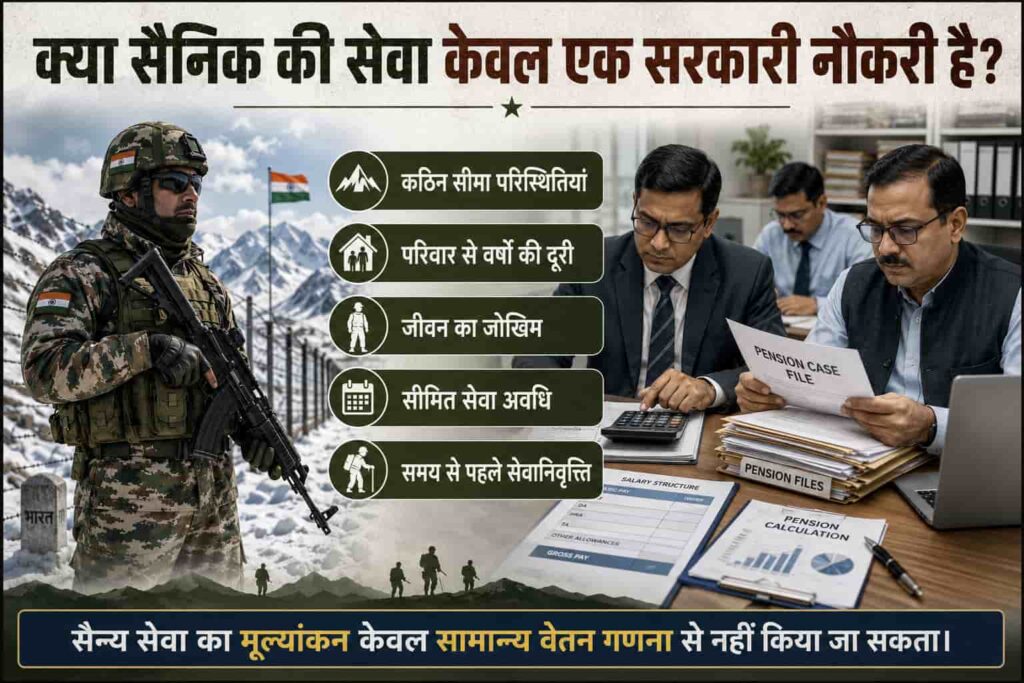
Why is military service different from ordinary government employment?
Both military and civilian employees serve the Government. That does not mean their employment conditions are identical.
A conventional government position generally offers a comparatively predictable workplace, fixed office routine and longer career span. Military personnel may face:
- deployment in border and operational areas;
- high-altitude, desert, maritime or difficult terrain;
- exposure to injury and operational danger;
- prolonged separation from spouses, children and parents;
- repeated postings across the country;
- restrictions arising from military discipline;
- premature retirement at relatively younger ages for many ranks.
These differences do not automatically determine a particular salary increase. They do establish why a defence-pay assessment cannot rely only on a generic comparison of basic pay.
The Seventh Central Pay Commission itself treated Military Service Pay, or MSP, as compensation for the distinctive elements of military service and recommended separate rates for different defence categories.
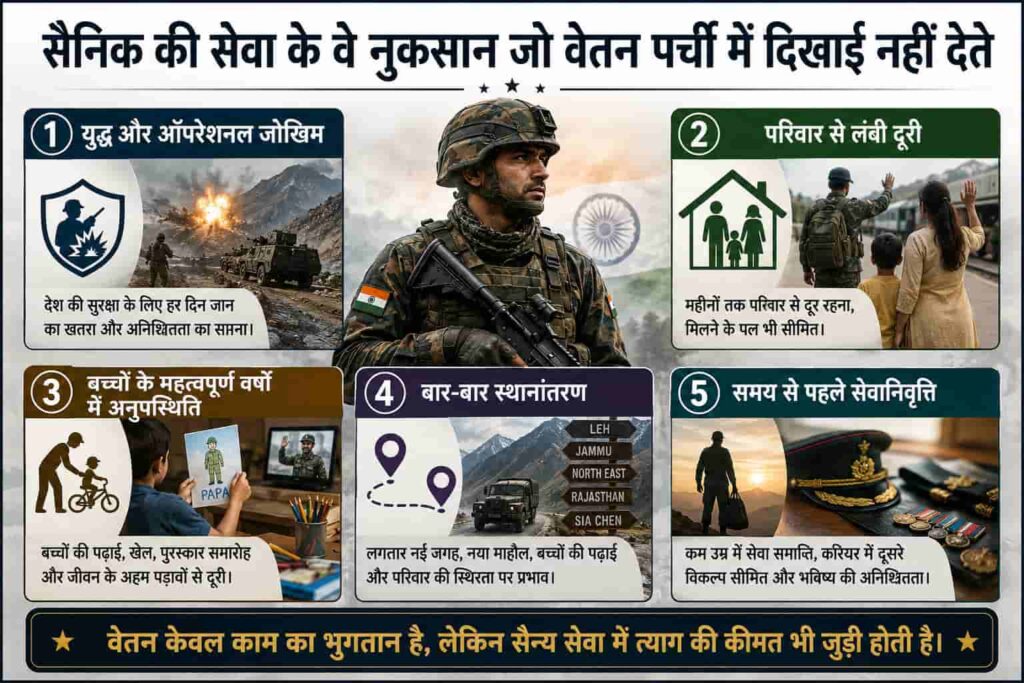
What costs of military service are missing from a salary slip?
A monthly salary statement can record basic pay, allowances and deductions. It cannot fully record the personal cost of service.
Operational risk
Some military appointments expose personnel to hostile action, accidents, extreme weather and dangerous terrain.
Risk is not uniform across every posting, but it is an inseparable feature of the institution. A meaningful pay review should examine how risk and hardship allowances reflect actual deployment conditions.
Long separation from family
Personnel may spend extended periods away from their families because of field tenures, sea duty, exercises, training and operational commitments.
The financial consequences can include:
- maintaining two establishments;
- additional travel expenditure;
- childcare pressure;
- dependence on relatives;
- disruption to a spouse’s employment;
- reduced ability to manage family emergencies personally.
Absence during important family years
Military duties can keep parents away during:
- children’s early education;
- examinations;
- medical emergencies;
- family ceremonies;
- major developmental years.
These losses are difficult to quantify, but their effect on morale and retention should not be ignored.
Frequent transfers
A posting change does not only mean moving luggage.
It can affect:
- children’s schools;
- spouse employment;
- accommodation;
- access to medical care;
- family support networks;
- personal financial planning.
Early end to military service
Many personnel leave uniformed service while they are still supporting children, repaying loans or building retirement savings.
A shorter service career can mean:
- fewer years of stable earnings;
- earlier dependence on pension;
- need for a second career;
- difficulty translating military qualifications into civilian employment.
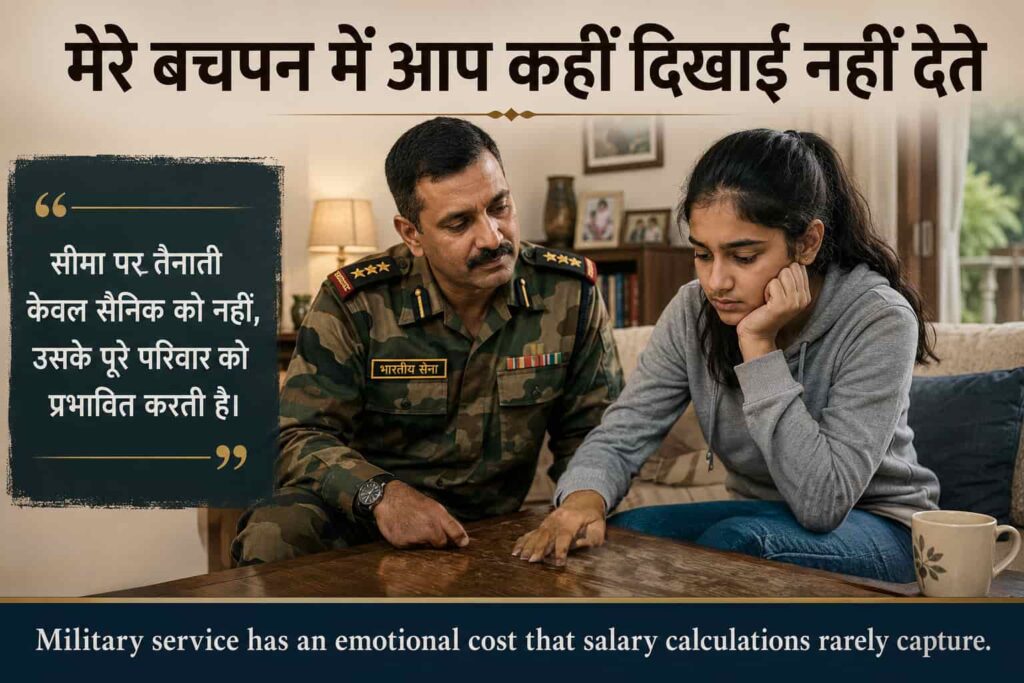
How does military service affect the entire family?
The consequences of deployment are not limited to the person wearing the uniform.
When one parent is posted away, the spouse may become solely responsible for:
- children’s education;
- medical decisions;
- elderly parents;
- household finances;
- relocation;
- emergencies;
- official paperwork.
Children may experience repeated school changes or long absences of a parent. Spouses may have to limit their own careers because a stable employment location is difficult to maintain.
For this reason, an Armed Forces submission before the Pay Commission should not examine only the employee. It should also assess the financial and social impact of service on the family.
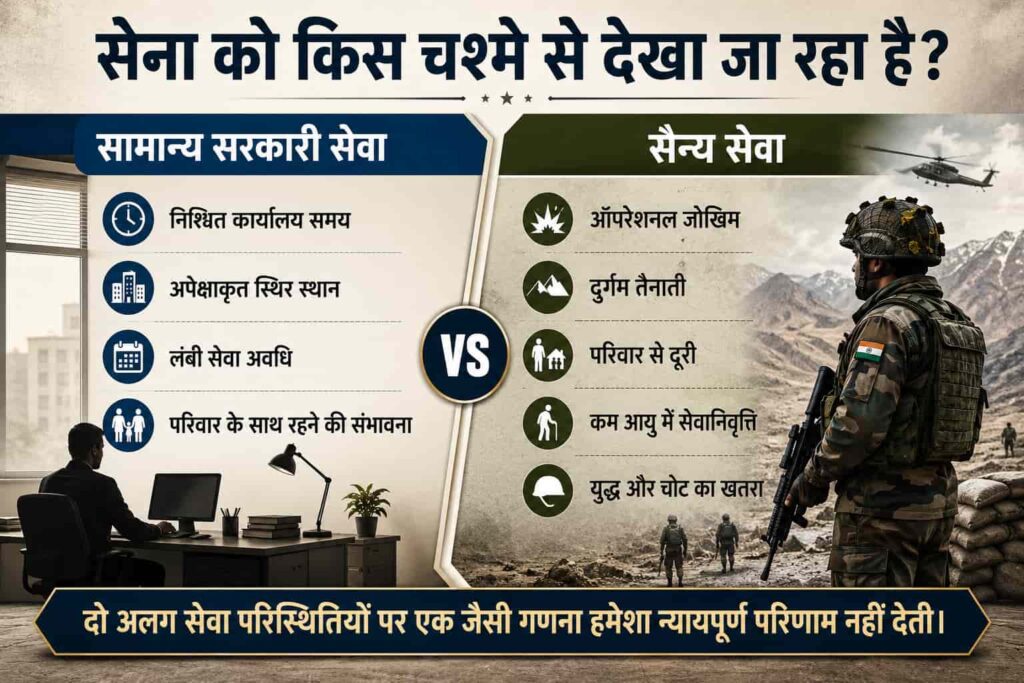
Why can one formula not produce a fair result for every service?
A common fitment factor may be useful for revising basic pay across a large workforce. It does not by itself settle questions related to:
- military risk;
- rank structure;
- command responsibility;
- early retirement;
- pension adequacy;
- hardship compensation;
- disability;
- family separation;
- resettlement.
Two employees can have comparable basic pay while facing very different conditions of work.
A sound pay policy should therefore distinguish between:
- general pay revision, which may apply widely; and
- service-specific compensation, which addresses the special conditions of a particular institution.
The earlier pay framework already recognised this principle through MSP, separate defence pay matrices and specialised allowances. The Government also revised aspects of the Defence Pay Matrix after considering the Seventh CPC recommendations.
Is a fitment factor of 3.0 officially confirmed?
No.
The official 8th CPC website does not currently publish an approved fitment factor, minimum basic pay or revised defence pay matrix.
Figures such as 2.57, 2.86, 3.0 or higher circulating in public discussion are demands, projections or analytical assumptions unless supported by an official Commission recommendation or government order.
A fitment factor affects the conversion of existing basic pay into a revised structure. It does not automatically determine the exact rise in gross or in-hand salary because other components may also change, including:
- dearness allowance treatment;
- revised allowances;
- taxation;
- pension contribution;
- service-specific payments;
- deductions.
The responsible approach is to treat every proposed figure as an estimate until the Commission submits its recommendations and the Government takes a decision.
Why does military pension need a separate examination?
Pension is particularly important in the Armed Forces because many personnel complete their uniformed career earlier than typical civilian employees.
A pension review should examine:
- qualifying service;
- rank and length of service;
- pension parity;
- disability and invalidment;
- family pension;
- premature retirement;
- financial obligations at the time of discharge;
- opportunities for post-service employment.
The Seventh CPC’s defence-pension framework included Military Service Pay where admissible while calculating notional pay for pension revision, demonstrating that military compensation and pension cannot always be examined in complete isolation.
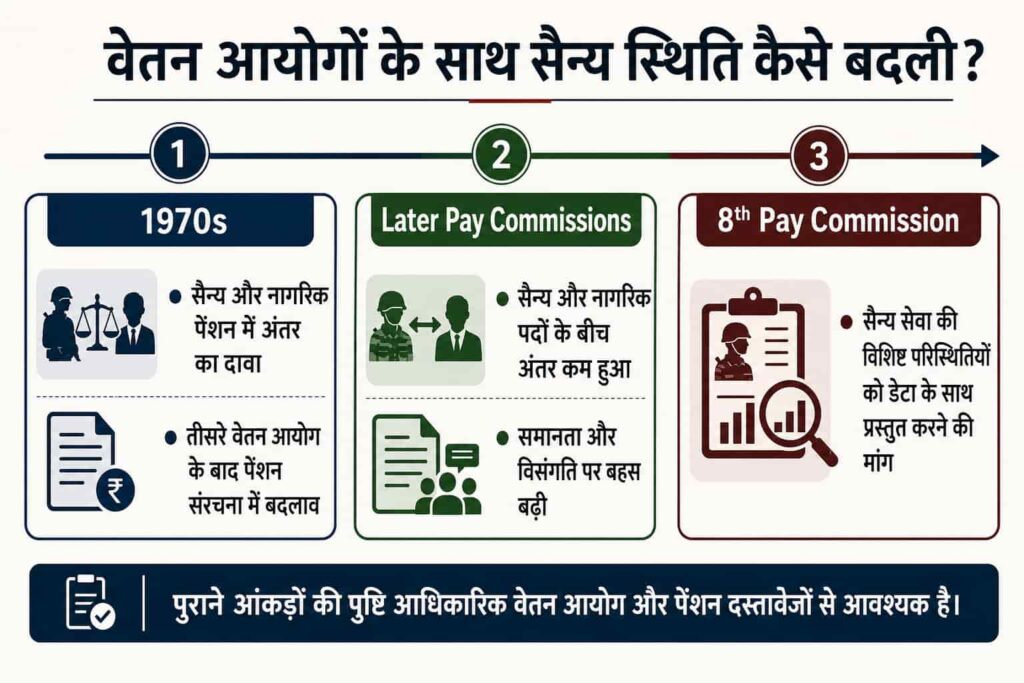
How has the military-pay debate developed over time?
Military and civilian pay comparisons are not new.
Earlier Pay Commissions considered differences involving:
- rank equivalence;
- pension structure;
- service length;
- military allowances;
- defence pay matrices;
- retirement conditions.
The Seventh CPC recommended MSP rates of:
- ₹15,500 per month for service officers;
- ₹10,800 for Military Nursing Service officers;
- ₹5,200 for JCOs and other ranks;
- ₹3,600 for non-combatants enrolled in the Air Force.
These figures are historical 7th CPC recommendations and should not be presented as proposed 8th CPC rates.
The Government later made changes to parts of the Defence Pay Matrix, including extending stages and revising the Index of Rationalisation for particular levels.
The lesson is clear: military pay is not decided by a single headline number. It involves basic pay, matrix design, MSP, allowances, pension and service conditions.
What should the Armed Forces place before the 8th Pay Commission?
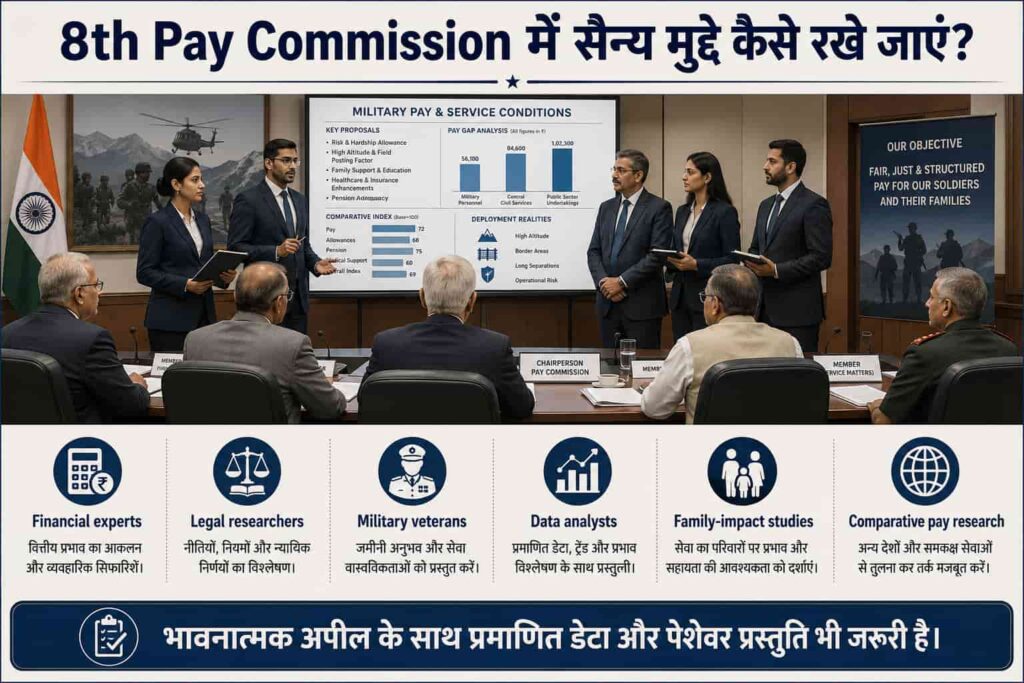
An emotional appeal can explain hardship, but a Pay Commission requires structured evidence.
A strong military representation should combine personal experience with verified data.
Deployment data
Submissions should show:
- duration of field tenures;
- frequency of difficult postings;
- average separation from family;
- high-altitude exposure;
- operational and non-operational cycles.
Career-length analysis
The Commission should be given rank-wise information on:
- average retirement age;
- promotion opportunities;
- career stagnation;
- number of personnel retiring at each stage;
- earning years lost compared with longer government careers.
Family-impact studies
Evidence should measure:
- school disruption;
- spouse employment loss;
- cost of maintaining separate households;
- travel expenditure;
- impact of relocation;
- access to healthcare and family support.
Comparative pay research
Comparisons should be made carefully with:
- other Central Government services;
- CAPFs;
- public-sector institutions;
- military systems in comparable countries.
Comparisons must use similar responsibility, service conditions and career length rather than job titles alone.
Pension and rehabilitation evidence
The presentation should cover:
- pension adequacy at younger retirement ages;
- employment after military service;
- recognition of military skills;
- retraining;
- disability support;
- family pension;
- resettlement outcomes.
Why are veterans valuable beyond security-guard jobs?
Another important issue begins after retirement.
Military personnel develop skills in:
- leadership;
- logistics;
- planning;
- training;
- crisis response;
- safety;
- discipline;
- equipment management;
- administration;
- team coordination.
Yet many veterans struggle to translate military designations into language understood by private employers.
For example:
| Military capability | Civilian application |
|---|---|
| Unit leadership | Operations management |
| Logistics and supply | Supply-chain supervision |
| Safety procedures | Workplace safety management |
| Training junior personnel | Corporate or technical training |
| Security planning | Risk and security consultancy |
| Crisis response | Emergency and continuity planning |
Resettlement policy should therefore help veterans demonstrate their abilities through recognised certifications, career counselling and industry partnerships.
A fair military-compensation framework is not limited to salary while serving. It should also examine the transition into productive second careers.

What should the 8th CPC examine for Armed Forces personnel?
A comprehensive review should consider the following areas together:
Basic pay and defence pay matrix
The Commission should study whether military rank progression, responsibility and career span are reflected accurately in the pay structure.
Military Service Pay
MSP should be examined in relation to:
- operational liability;
- military discipline;
- restricted rights;
- mobility;
- family separation;
- shorter careers.
Risk and hardship allowances
Allowances should correspond to actual severity, duration and conditions of deployment.
Housing and family support
The review should assess:
- availability of accommodation;
- separated-family arrangements;
- education support;
- travel;
- medical access;
- cost of repeated relocation.
Pension and disability protection
The framework should provide clarity, consistency and timely support for:
- service pension;
- disability pension;
- family pension;
- invalidment;
- battle and operational casualties.
Resettlement
Retiring personnel should receive practical assistance in converting military experience into recognised civilian skills.
Frequently asked questions
Has the 8th Pay Commission announced a fitment factor for soldiers?
No. No final fitment factor has been officially announced on the Commission’s website.
Will military and civilian employees receive the same fitment factor?
No final recommendation is available. A common factor may be considered for broad pay revision, while military-specific matters can still be addressed through a separate matrix, MSP, allowances or other provisions.
Is Military Service Pay part of basic pay?
Under the Seventh CPC framework, MSP was a separate service-specific payment. Its future treatment will depend on the recommendations of the 8th CPC and the Government’s decision.
Can emotional hardship determine salary?
Personal accounts explain the effect of service, but policy decisions require verifiable data, financial analysis and clearly defined service comparisons.
Are Armed Forces personnel covered by the 8th CPC process?
Yes. The official memorandum process invited submissions from Defence Forces personnel, pensioners and service associations. The submission window closed on 15 June 2026.
Has a new defence pay matrix been published?
No new 8th CPC defence pay matrix has been officially published.
Conclusion
The Armed Forces pay debate should not be reduced to a viral fitment-factor number.
Military service includes circumstances that ordinary pay calculations may not fully capture:
- operational danger;
- difficult terrain;
- separation from family;
- frequent relocation;
- limited career length;
- premature retirement;
- complex pension and resettlement needs.
This does not mean that every demand should be accepted without examination. It means the examination should use the right evidence.
The strongest case before the 8th Pay Commission will combine:
- verified service data;
- financial calculations;
- family-impact research;
- pension analysis;
- operational realities;
- practical resettlement proposals.
Military service should be valued neither through emotion alone nor through a generic salary formula. It should be assessed through evidence that reflects the complete cost and responsibility of serving in uniform.





Leave a Reply