

For many Central Government employees and pensioners, most 8th Pay Commission discussions still revolve around one question: what might finally happen to salary, pension and benefits. But before any final recommendation comes, there is another stage that matters just as much. It is the stage where concerns are formally submitted, recorded and presented before the Commission.
That is why the Bhubaneswar notice matters.
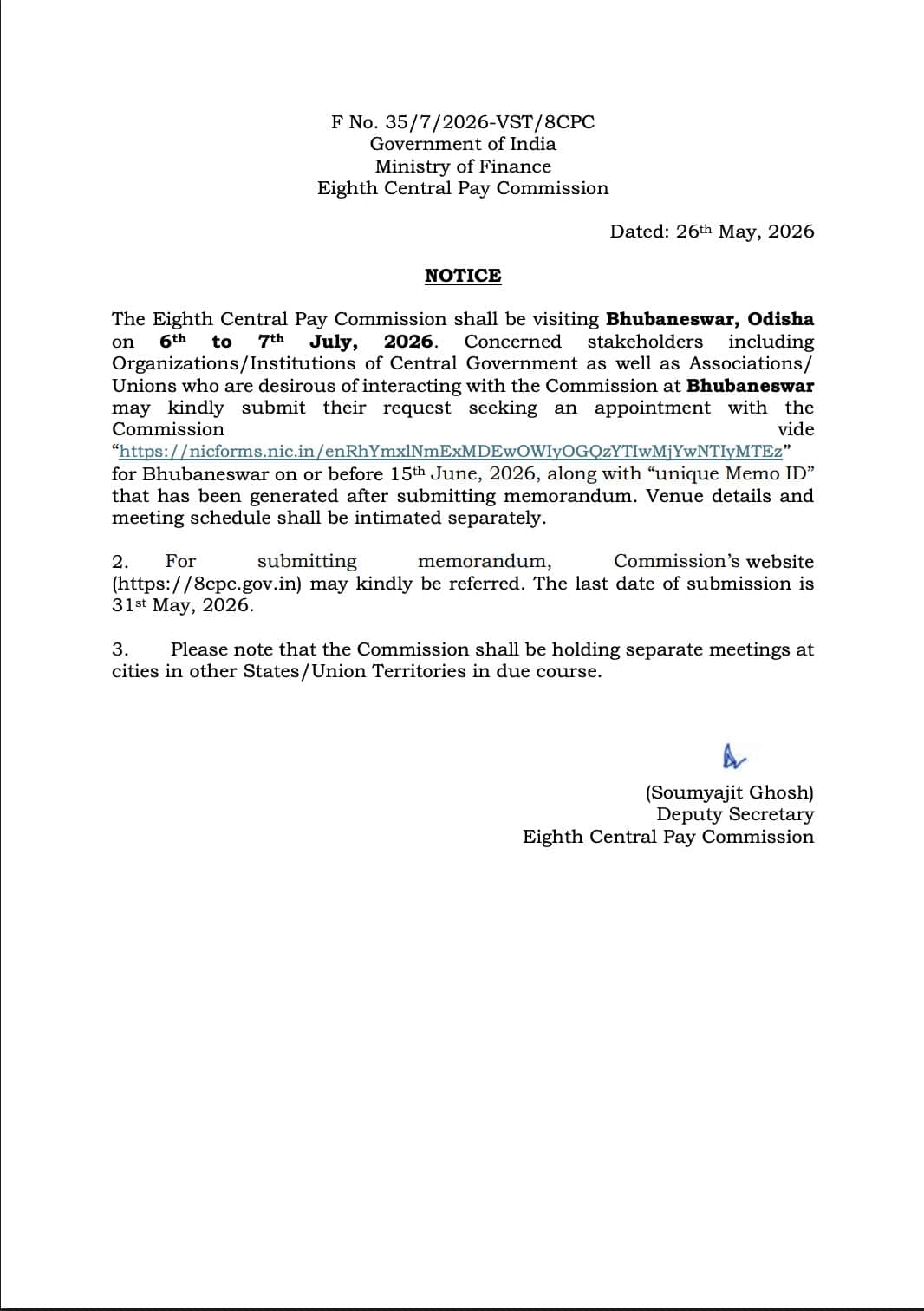
Based on the official notice shared, the 8th Central Pay Commission will visit Bhubaneswar, Odisha on 6 and 7 July 2026. The notice says that concerned stakeholders, including Central Government organisations, institutions, associations and unions that want to interact with the Commission at Bhubaneswar, may submit a request seeking appointment. But this is not an open-ended invitation. It comes with conditions, deadlines and a clear procedural requirement.
And that procedural requirement is the real story.
The notice makes it clear that anyone seeking an appointment for the Bhubaneswar interaction must do so on or before 15 June 2026. It also says that the request must be submitted along with the unique Memo ID generated after submitting the memorandum. In simple terms, a stakeholder cannot just decide to attend and expect to be heard. First, the memorandum has to be filed. Then the Memo ID has to be generated. Then the appointment request has to be made in time.
That sequence is extremely important.
Many employee groups spend months discussing their demands informally. They talk about fitment factor, pension revision, allowances, pay anomalies, service conditions, promotion issues and retirement benefits. But an issue discussed in a meeting hall, office room or WhatsApp group is not the same as an issue entering the Commission’s official process. The Bhubaneswar notice is a reminder that only those who follow the formal route will stand a better chance of getting their concerns into the system properly.
This is what makes the notice more than an ordinary schedule update.
On the surface, it looks like a city visit announcement. In reality, it is a participation alert. It tells employee bodies and stakeholder groups that the consultation process is active, structured and moving ahead city by city. It also shows that the Commission is not functioning only through online submissions. It is creating windows for direct interaction, but only for those who complete the required steps first.
The notice also repeats another major deadline that should not be ignored.
It says the last date for submission of memorandum is 31 May 2026. This means the Bhubaneswar interaction process is directly linked to that earlier deadline. If a stakeholder misses the memorandum submission stage, the Memo ID itself may not be available. And if the Memo ID is not there, the appointment request may not carry the necessary official basis.
That is why this notice should create urgency, not curiosity.
For associations, unions and institutions in Odisha and nearby regions, this is a real opportunity. A Pay Commission interaction is not a routine administrative meeting. It is one of the few moments when structured concerns can be presented during a live consultation phase. A regional meeting can help bring local, service-specific and category-specific issues into sharper focus. Sometimes national discussions become too broad. But a state-level interaction can give space to practical concerns that affect real employees and pensioners on the ground.
Those concerns may vary widely.
Some groups may want to raise minimum pay and fitment factor. Some may focus on pension parity, family pension, gratuity or commutation. Others may bring issues related to cadre restructuring, allowances, service conditions, stagnation, medical access or retirement-linked hardship. The exact issue may differ from one department or association to another. But the principle remains the same. If the concern is genuine and important, the consultation stage is the moment to place it properly.
That is why waiting passively is a mistake.
In many pay commission cycles, people spend more time speculating about future benefits than participating in the process that shapes those benefits. They look for rumours, expected figures and headline-driven predictions. But official notices like this one quietly reveal what actually matters right now. The process is open, but it is not casual. The Commission is inviting interaction, but only through a formal channel. In that sense, the Bhubaneswar notice is not about travel. It is about seriousness.
There is also a wider message in the final line of the notice.
It says the Commission will hold separate meetings in cities in other states and Union Territories in due course. That means Bhubaneswar is not the end of the outreach pattern. It is part of a larger consultation journey. For readers outside Odisha, this should be read as an early signal. More such windows may open elsewhere too. And when they do, the same rule will likely apply: proper submission, proper documentation and proper follow-up.
That makes this notice relevant even beyond Odisha.
For the average employee or pensioner, the biggest lesson is simple. The 8th Pay Commission process is not only about waiting for recommendations from Delhi. It is also about making sure issues reach the Commission in time, in the right format and through the official route. If that does not happen, then even the strongest grievance can remain outside the discussion.
This is especially important for associations and organised bodies.
A well-prepared representation can often carry more weight than scattered complaints. A properly written memorandum with clear issue-wise points, supported by facts and backed by the required Memo ID, is always stronger than emotional general demands. The Bhubaneswar notice should therefore push associations to act with discipline. Verify the issue, submit the memorandum, preserve the Memo ID, and then apply for the appointment within the prescribed time.
The practical takeaway is very clear.
If a stakeholder wants to interact with the Commission in Bhubaneswar, there are three things that must not be missed. First, the memorandum must be submitted by 31 May 2026. Second, the unique Memo ID generated after that submission must be kept ready. Third, the appointment request for Bhubaneswar must be sent by 15 June 2026. Without these steps, expectation alone will not open the door.
In the end, this notice matters because it separates casual interest from official participation.
The 8th Pay Commission will eventually make recommendations that affect lakhs of employees and pensioners. But before that stage comes, there is a narrower and more immediate question: who is making sure their issue is officially heard. The Bhubaneswar notice is a reminder that the consultation phase is live, and those who move on time may gain a voice in the process. Those who delay may only be left reacting later.

Leave a Reply