


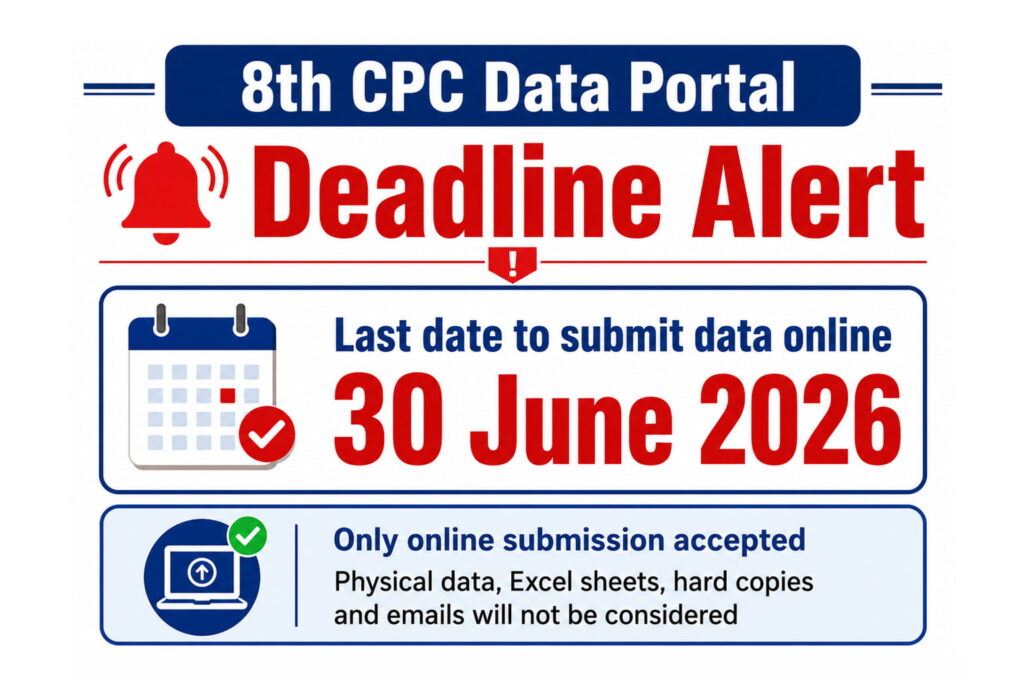
8th CPC Online Data Portal is active for official data submission by Ministries, Departments, Organisations and Offices. The last date is 30 June 2026, and only online data will be accepted.
The 8th Central Pay Commission has moved into an important administrative stage.
The Commission is now collecting official data from Ministries, Departments, Organisations and Offices through the 8CPC Online Data Portal. The official portal says the last date for data submission is 30 June 2026.
This update matters because Pay Commission recommendations are not prepared only on the basis of demands, expectations or public discussion. Before recommendations on pay, pension, allowances and service conditions can be framed, the Commission needs official departmental data.
That is why the present data-collection phase should be seen as a serious milestone in the 8th CPC process.
What has the 8th CPC officially said?
The official 8CPC Online Data Portal states that the Commission has extensive data requirements.
It also says that links and formats seeking data are being shared separately with Ministries, Departments, Organisations and Offices.
The most important point is the deadline.
The last date for submission of data is 30 June 2026.
The portal also makes it clear that physical data, standalone Excel sheets, hard copies, emails and other offline submissions will not be considered or entertained by the Commission.
In simple language, this means the Commission wants official data through a structured online route only.
Why this is not a salary-hike announcement?
This update should not be misunderstood.
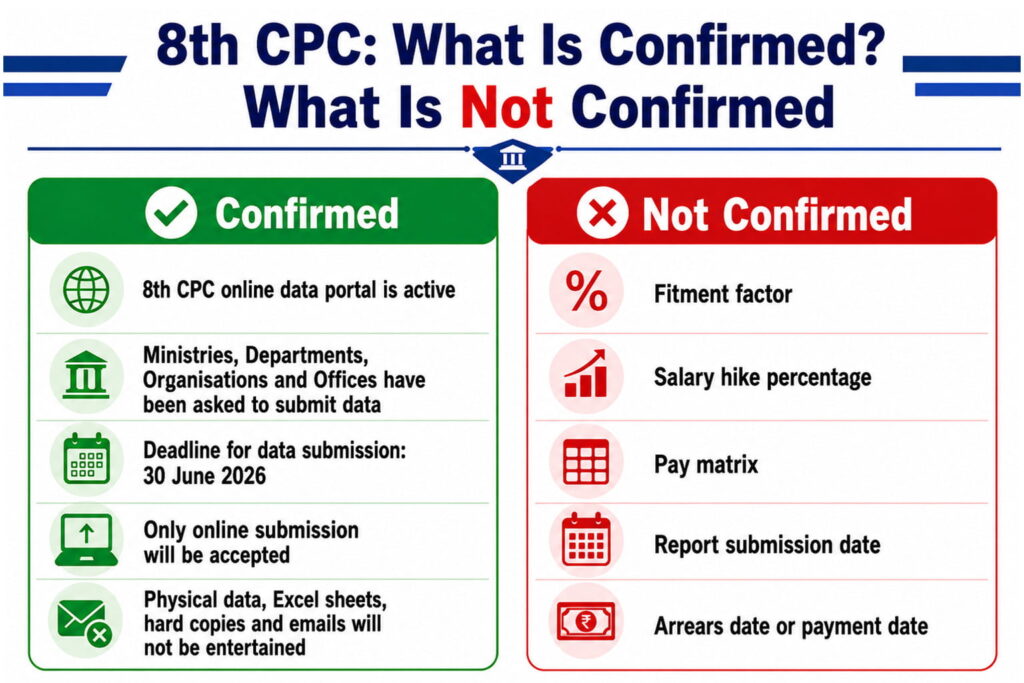
The official source does not say that the fitment factor has been decided. It does not announce a salary hike percentage. It does not give a new pay matrix. It does not confirm arrears. It does not give a final report date.
The confirmed news is limited but important: the Commission is collecting official data online from government bodies by 30 June 2026.
This is a process update, not a final recommendation update.
How has the 8th CPC process moved so far?
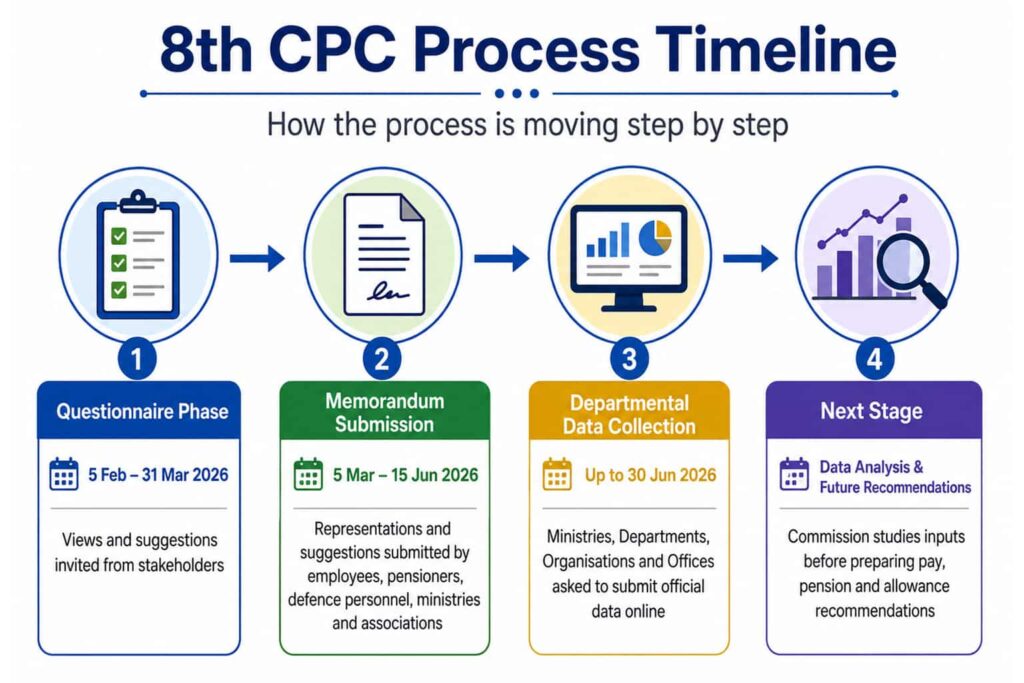
The 8th CPC process has already passed through two major input stages.
First, the Commission invited views through an online questionnaire hosted on the MyGov portal. That phase ran from 5 February 2026 to 31 March 2026. It was meant to collect structured responses from employees, pensioners, associations, researchers, academicians, Ministries, Departments, State/UT governments and individuals.
Second, the Commission invited memoranda, representations and suggestions from major stakeholders. This phase ran from 5 March 2026 to 15 June 2026. It included Central Government employees, Defence Forces personnel, pensioners, service associations, Ministries, Departments, Union Territories and other stakeholder groups.
Now, the third important stage is active: departmental data submission through the 8CPC Online Data Portal.
Why departmental data matters?
A Pay Commission cannot work only with demands.
Employee unions may submit demands. Pensioners may raise concerns. Defence personnel may highlight service conditions. Departments may place their administrative issues. But final recommendations need to be examined against numbers.
That is where departmental data becomes important.
This data can help the Commission understand employee strength, sanctioned posts, vacancies, pay levels, cadre structure, promotion patterns, pension liability, allowance expenditure and workload requirements.
Without this data, any recommendation would remain incomplete.
With this data, the Commission can compare demands with administrative reality.
How the data collection process works?
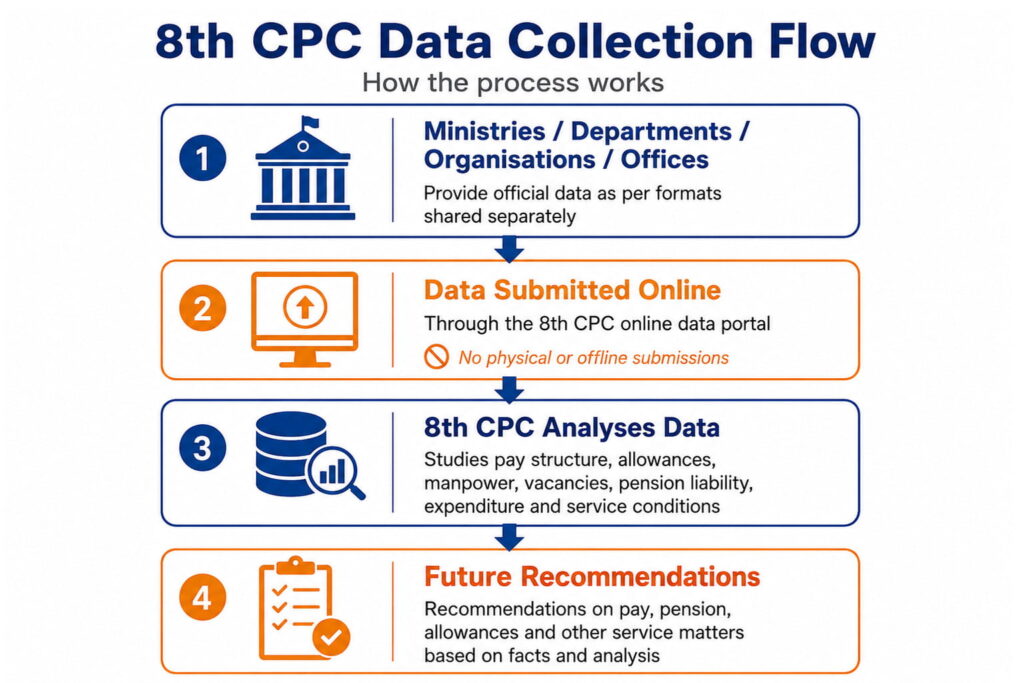
The current data flow is simple.
Ministries, Departments, Organisations and Offices receive the required format or link separately.
They submit official data through the 8CPC Online Data Portal.
The Commission studies the submitted information.
After analysis, this data can become part of the foundation for future recommendations on pay, pension, allowances and related service matters.
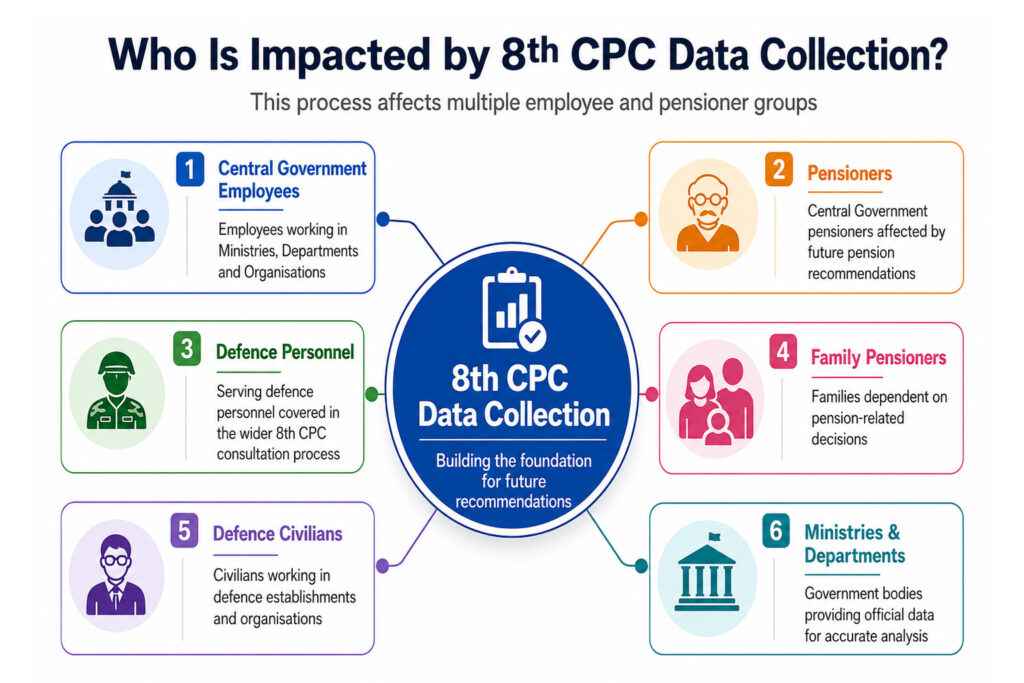
Who may be affected by this data collection?
The data is being submitted by government bodies, not individual employees.
But the impact of this data may later be felt by multiple groups because the Commission’s recommendations will concern pay, pension and service conditions.
The groups that may be indirectly affected include:
Central Government employees
Central Government pensioners
Family pensioners
Defence personnel
Defence civilians
Employees working in Ministries, Departments and Organisations
The important distinction is this: individuals are not submitting data in this stage. Ministries and Departments are submitting official information.
Why online-only submission is important?
The 8th CPC has followed a clear digital-first approach in all major stages.
Questionnaire responses were taken online through MyGov.
Memoranda and representations were also invited through the online system.
Now, departmental data is also being collected through the online portal.
This shows that the Commission wants standardised, traceable and structured inputs instead of scattered paper submissions.
Online-only submission also reduces confusion. It helps the Commission receive data in prescribed formats and makes later analysis easier.
Why 30 June 2026 is important?
The date 30 June 2026 is important because it is the official last date for online data submission by Ministries, Departments, Organisations and Offices.
This does not mean the report will come immediately after 30 June.
It means the Commission wants the required official data by that date so it can move ahead with analysis.
After data submission, the Commission may still need time for examination, comparison, clarification, calculations and formulation of recommendations.
So readers should understand the date correctly.
It is a data submission deadline, not a salary revision announcement date.
What kind of data may be useful for the Commission?
The official portal does not publicly release all detailed formats shared with Ministries and Departments.
But based on the nature of Pay Commission work, such data may include:
staff strength
vacant posts
existing pay levels
cadre structure
promotion timelines
allowance expenditure
pension liability
family pension details
department-wise salary cost
retirement trends
workload indicators
regional deployment
technology impact on manpower
This type of information helps the Commission judge how pay and pension recommendations may affect both employees and government expenditure.
Why employees and pensioners should follow this update?
For employees and pensioners, this stage is important because it shows that the 8th CPC work is moving through formal channels.
Public demands and memoranda have already been submitted. Now, the Commission is collecting official departmental data.
Future recommendations are expected to be shaped by both stakeholder inputs and factual government data.
That is why employees should not only follow fitment-factor rumours. They should also track process updates like data collection, official meetings, memoranda, questionnaire stages and final report developments.
What should not be spread as rumour?
Many misleading claims usually circulate whenever a Pay Commission update appears.
Readers should avoid spreading these claims unless confirmed officially:
Fitment factor finalised
Minimum pay decided
Salary hike percentage approved
New pay matrix released
Arrears date fixed
Pension revision finalised
Report submission date confirmed
Government approval given
None of these claims are confirmed by the current official data portal update.
The only confirmed point is that official data submission is being collected online, with 30 June 2026 as the deadline.
Why this update is still important?
Even though this is not a final pay announcement, it is still important.
Data collection is the stage where the Commission starts building its factual base.
A Pay Commission must balance many issues: employee expectations, pensioner concerns, defence service conditions, affordability, departmental workload, cadre problems and government finances.
The data collected now may help the Commission examine these issues with more accuracy.
In that sense, this stage is quiet but powerful.
It may not create instant excitement, but it can influence the quality of future recommendations.
What should Ministries and Departments remember?
The official portal clearly says offline submissions will not be considered.
That means Ministries, Departments, Organisations and Offices should submit the required data only through the prescribed online system.
Incomplete, late or offline data may not help the Commission.
For a process of this scale, accuracy and timely submission are important. Departmental data should be complete, verified and aligned with the prescribed format.
What should employees and pensioners do now?
Individual employees and pensioners do not need to submit data through this portal unless specifically asked through official channels.
They should instead do three things.
First, follow only official 8CPC website updates.
Second, avoid viral claims about fitment factor, arrears or pay matrix.
Third, understand that the Commission is still in a data-analysis journey, not in the final announcement stage.
If any employee association or pensioner body has already submitted memoranda, that phase is closed. The present stage is institutional data collection.
Comment
The 8th CPC Online Data Portal update may look technical, but it is one of the most important steps in the Pay Commission process.
Demands tell the Commission what people expect.
Data tells the Commission what the system actually looks like.
Both are necessary.
The questionnaire and memorandum stages gave the Commission public and stakeholder inputs. The current data portal stage gives it official numbers from government bodies.
This is why the 30 June 2026 deadline should be taken seriously.
The future of pay, pension and allowance recommendations will depend not only on arguments, but also on verified information.
Final takeaway
The 8th CPC has entered a key departmental data collection stage.
The official 8CPC Online Data Portal confirms that Ministries, Departments, Organisations and Offices have been asked to submit official data online by 30 June 2026.
Physical data, standalone Excel sheets, hard copies and emails will not be considered.
This is not a confirmation of fitment factor, salary hike, arrears or report date.
It is a procedural but important step towards building the factual base for future recommendations.
For Central Government employees, defence personnel, pensioners and family pensioners, the message is clear: the Commission’s work is moving forward, but final recommendations are still awaited.
The correct approach is to follow official updates, avoid rumours and understand the process stage by stage.
Sources:-
8th CPC Online Data Portal:
https://8cpc.gov.in/8cpc-online-data-portal/
8th CPC Questionnaire page:
https://8cpc.gov.in/8th-central-pay-commission/
8th CPC Memorandum Submission page:
https://8cpc.gov.in/8cpc-memorandum-submission/
StaffNews supporting report:
https://www.staffnews.in/2026/06/8th-cpc-intensifies-data-collection-exercise.html



Leave a Reply