


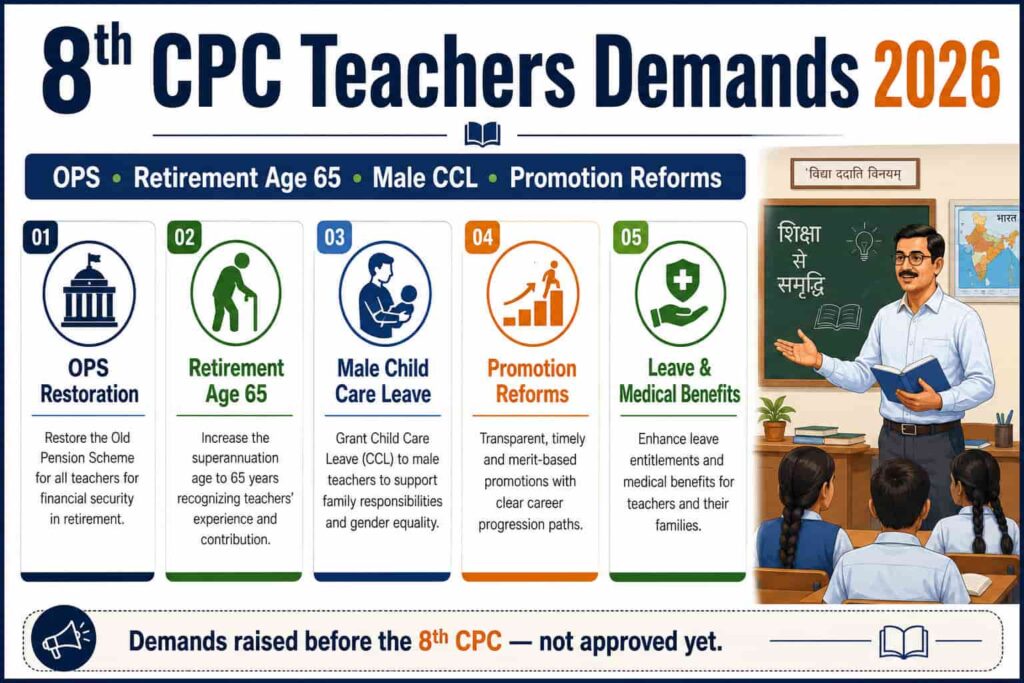
The 8th Central Pay Commission consultation process has entered an important phase for government school teachers. During the latest Delhi interaction, teachers’ representatives placed a wider set of service-related proposals before the Commission covering pension, retirement age, promotions, leave, medical facilities and Child Care Leave.
The development is important because the discussion is no longer limited to salary revision.
The teachers’ side is seeking changes across the entire service lifecycle — from appointment and career progression to retirement and post-retirement benefits.
However, one point must remain absolutely clear:
These are demands submitted before the 8th Pay Commission. They are not approved recommendations or government orders.
Why the latest teachers’ representation deserves attention?
The official 8th Central Pay Commission had scheduled stakeholder interactions in Delhi on 7 and 10 August 2026.
The teachers-related representation associated with this consultation has attracted attention because it combines several long-standing employee concerns under one broader reform agenda.
Instead of focusing only on basic pay or allowances, the demands cover:
- pension security;
- length of service;
- career progression;
- leave entitlements;
- medical support; and
- family-care provisions.
This makes the current representation much wider than a normal pay-revision memorandum.
What are teachers asking from the 8th CPC?
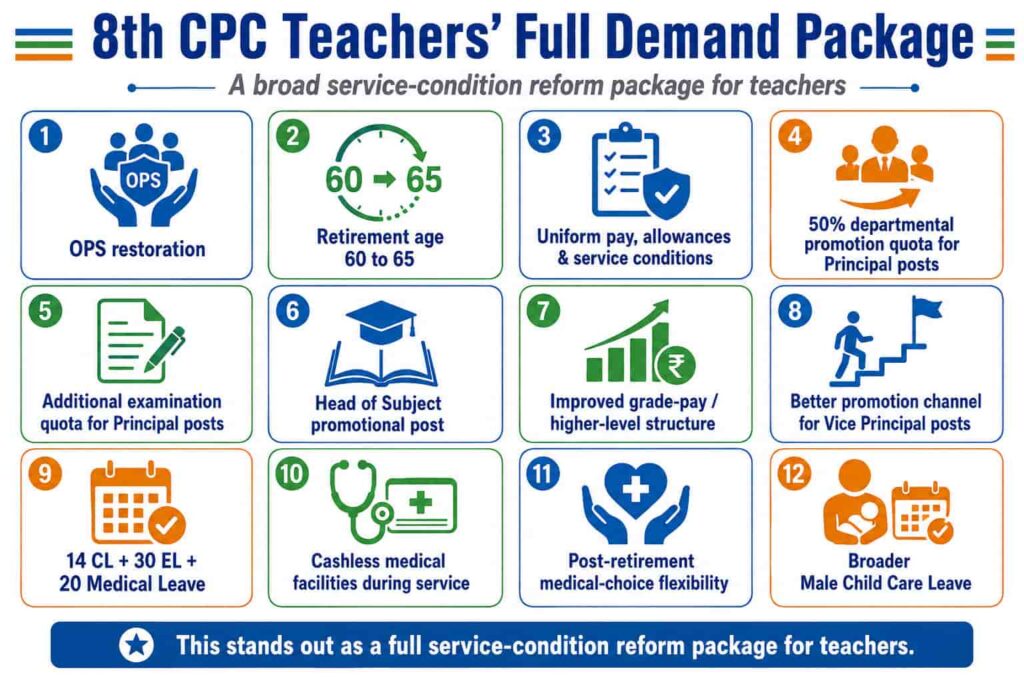
The reported proposals include:
- Restoration of the Old Pension Scheme
- Increasing retirement age from 60 to 65 years
- Greater uniformity in pay, allowances and service conditions
- 50% departmental promotion quota for Principal posts
- An additional examination-based quota for Principal promotion
- Creation of a Head of Subject promotional position
- Better financial progression for certain teaching and supervisory posts
- Improved promotional opportunities for Vice Principals
- 14 Casual Leaves, 30 Earned Leaves and 20 Medical Leaves
- Cashless medical facilities during service
- Greater post-retirement medical-choice flexibility in relevant systems
- Wider eligibility for Child Care Leave for male teachers
Taken together, these proposals indicate that teachers want the 8th CPC to examine not merely their salary but their complete service framework.
OPS remains one of the biggest pension issues
The demand for restoration of the Old Pension Scheme (OPS) continues to remain one of the most prominent employee-side issues before the new Pay Commission.
For teachers covered under pension systems introduced after OPS, the debate is fundamentally about retirement income certainty and long-term financial security.
But readers should distinguish between three very different stages:
Demand raised → Commission examines the issue → Government eventually decides
The present development is still at the first stage.
There is no order stating that OPS has been restored because of the latest meeting.
Retirement age 65: Why teachers are raising the parity argument?
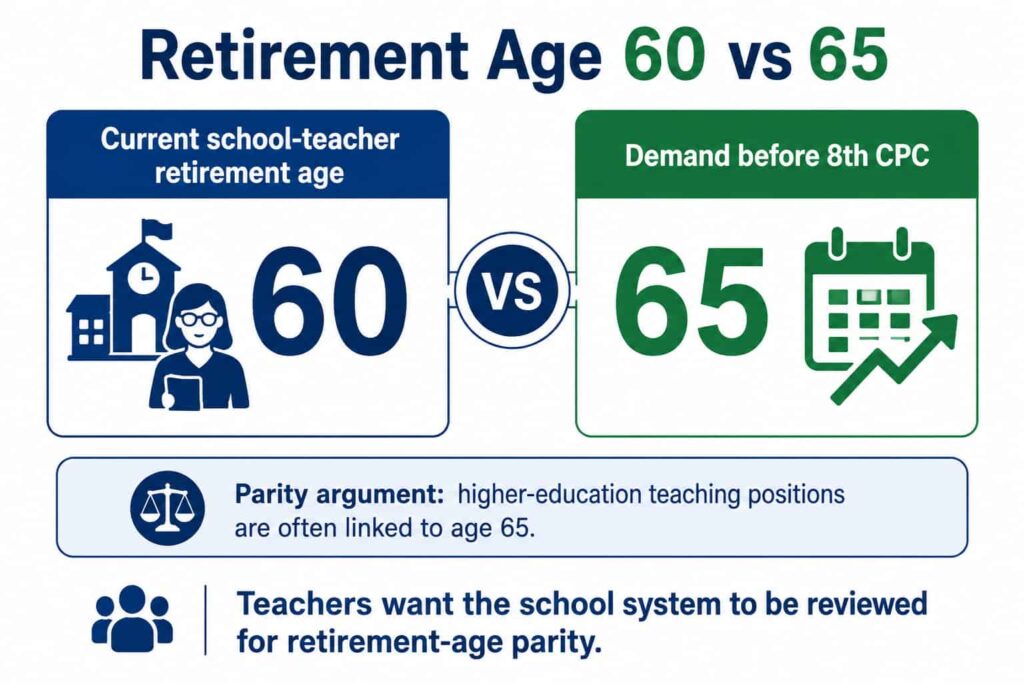
Another major demand is to increase the retirement age of school teachers from 60 years to 65 years.
One of the arguments behind this proposal is the difference between school-teaching service conditions and certain centrally funded higher-education teaching positions where the superannuation age has previously been raised to 65.
Teachers seeking the change are therefore presenting it partly as a service-parity issue.
There is, however, another side to the debate.
Increasing retirement age can affect:
- future recruitment vacancies;
- promotion opportunities for younger employees;
- establishment expenditure;
- pension outgo timelines; and
- workforce planning.
For this reason, any retirement-age proposal would require policy examination beyond simply accepting the number “65”.
Principal promotion structure could also come under focus
A particularly important part of the teachers’ representation concerns career progression.
The reported proposal seeks a 50% departmental promotion quota for Principal posts, along with an additional examination-based route.
The concern behind such proposals is straightforward: a teacher may spend decades in service, but if promotional channels remain narrow, career progression can become extremely slow.
The representation also includes proposals concerning:
- Head of Subject posts;
- higher-level financial progression;
- Vice Principal promotion opportunities; and
- clearer internal career pathways.
This part of the demand package may be especially important for mid-career teachers because it deals directly with progression rather than only retirement benefits.
14 CL + 30 EL + 20 Medical Leave proposed
The teachers’ side has also reportedly sought a revised leave structure consisting of:
14 Casual Leaves
30 Earned Leaves
20 Medical Leaves
This proposal should not be confused with an existing entitlement for every teacher.
It represents a demand for restructuring or improving leave benefits.
If examined by the Commission, issues such as existing vacation structures, institution type, teaching calendar and current service rules would also become relevant.
Male Child Care Leave: The most misunderstood part of the update
The Male Child Care Leave proposal needs careful explanation.
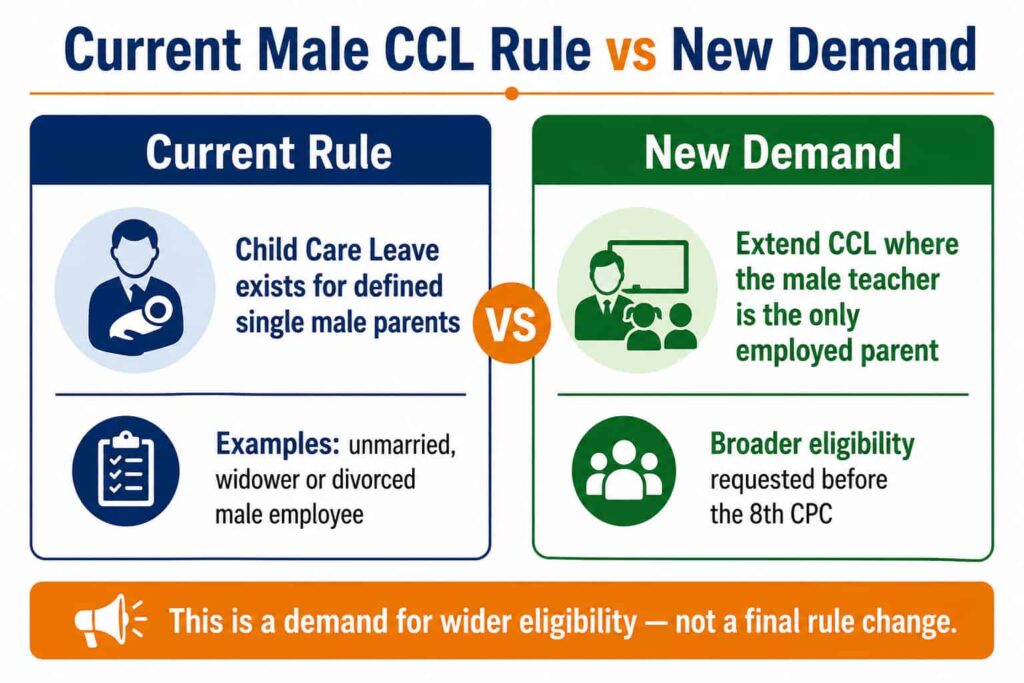
Under existing Central Government rules, Child Care Leave is already available to a defined category of single male government employees, including eligible unmarried, widower or divorced male employees.
So the latest teachers’ proposal is not simply asking the government to introduce Male CCL for the first time.
The reported demand seeks broader eligibility where the male teacher is the only employed parent.
That difference is important.
Existing position
Child Care Leave is available to eligible employees under the applicable rules, including specified categories of single male parents.
What teachers are reportedly seeking?
The teachers’ side wants the eligibility principle to extend further in situations where the male teacher bears the employment responsibility in the household.
Whether the Commission accepts this argument is a separate matter.
Medical benefits are also part of the representation
The demand package reportedly calls for cashless medical facilities during service.
For some Delhi-related categories, representatives have additionally sought greater flexibility over medical arrangements after retirement.
Medical benefits are increasingly becoming an important part of employee representations because healthcare expenditure continues after retirement while regular salary income stops.
The 8th CPC may therefore receive demands in which pay, pension and healthcare are treated as interconnected components of employee welfare.
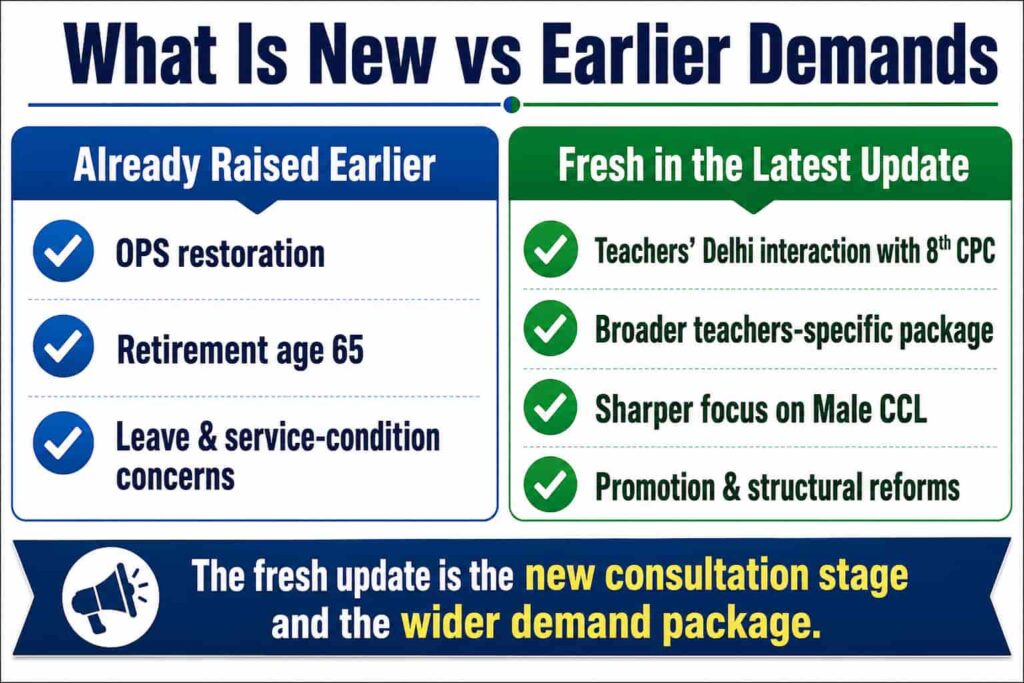
Are OPS and retirement age 65 new demands?
Not entirely.
Both subjects had surfaced in earlier representations associated with employee organisations.
That is why the latest development should be understood differently.
The significance of the August interaction lies in the fact that these issues are now being presented alongside:
- wider Male CCL eligibility;
- promotion restructuring;
- revised leave provisions;
- medical facilities; and
- uniform service conditions.
In other words, the story has moved from a few headline demands to a more comprehensive teachers’ service-reform proposal.
What has actually been approved so far?
This is where readers need to be particularly careful.
At present:
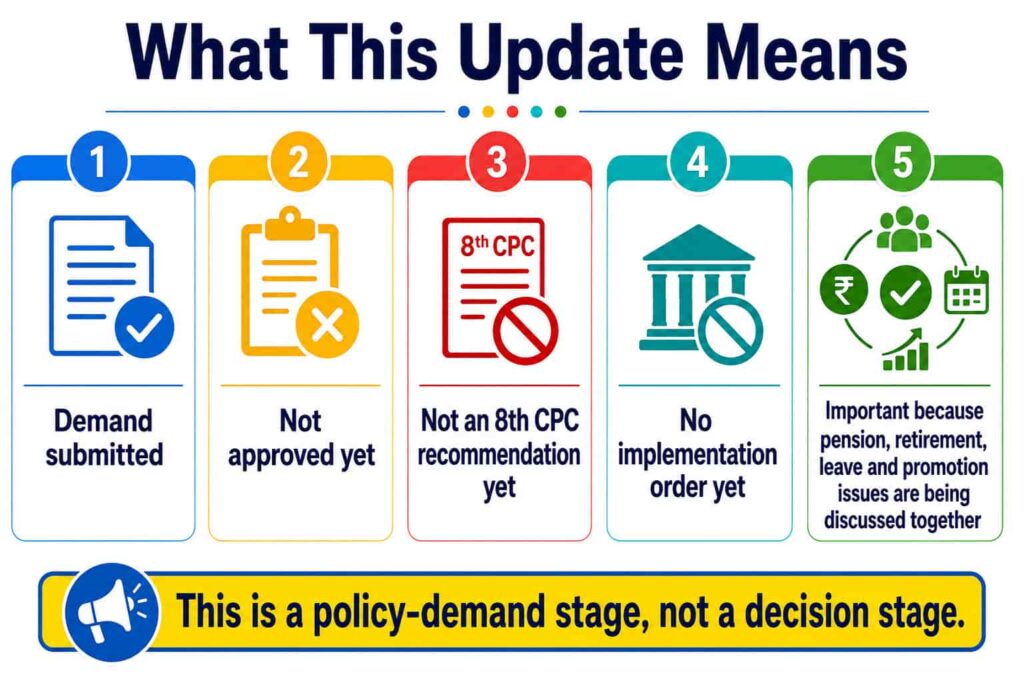
Teachers have presented demands.
But:
- OPS has not been restored through this interaction.
- Retirement age has not been increased to 65.
- Male CCL eligibility has not been expanded through a new order.
- Principal promotion quota has not been implemented.
- The proposed leave structure has not become a new rule.
A stakeholder submitting a proposal to a Pay Commission and the Government approving that proposal are two completely different events.
Why this matters beyond teachers?
Although this particular representation is teacher-focused, the broader significance reaches other Central Government employees as well.
The 8th CPC is receiving stakeholder views across different services and employee categories.
If different groups increasingly ask the Commission to examine issues such as:
pension + medical benefits + leave + career progression + retirement conditions
then the eventual discussion around the 8th Pay Commission may become considerably broader than simply deciding a fitment factor and revising basic pay.
That does not mean every demand will be accepted.
It means the scope of stakeholder expectations is expanding.
What should employees watch next?
Three developments will matter from here:
First: Whether the 8th CPC publishes any further record or summary connected with stakeholder consultations.
Second: Whether teachers’ organisations release detailed representations or clarifications regarding the proposals placed before the Commission.
Third: What ultimately appears in the recommendations of the 8th CPC.
Until one of these stages produces an official recommendation or government decision, employees should treat the current points as proposals under consideration, not as new service rules.
Final takeaway
The latest teachers’ interaction with the 8th Pay Commission is significant because it has brought several employee issues into one discussion.
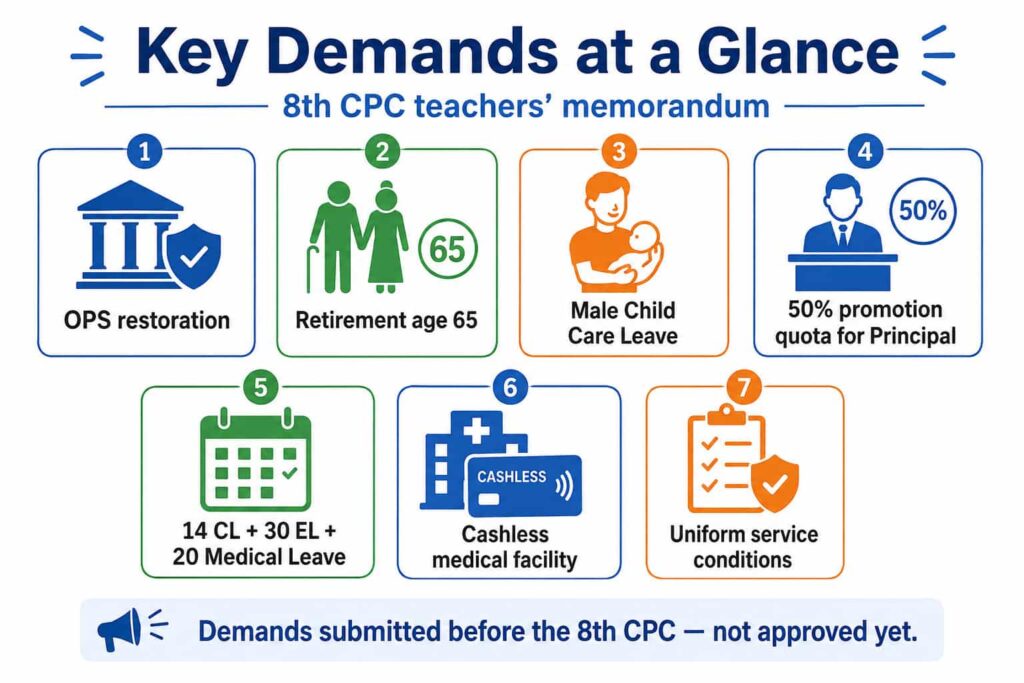
The major proposals include:
OPS restoration, retirement age 65, wider Male Child Care Leave, Principal promotion reforms, revised leave benefits, medical facilities and better career progression.
The biggest mistake would be to interpret these demands as approved benefits.
They are not.
What has changed is that the teachers’ side has now placed a much broader service-condition agenda before the 8th CPC, giving employees a clearer picture of what representatives want the Commission to examine.
The real decision will come only when the Commission makes recommendations and the Government takes a final view.
Sources
8th Central Pay Commission — Official Website
8th CPC — Official Delhi Interaction Notice for 7 & 10 August 2026
DoPT — Official Child Care Leave Rules
UGC — Official Pay and Retirement-Age Orders
Dr Manjeet Singh Patel — Participant Update on X
Economic Times — Detailed Report on Teachers’ 8th CPC Demands




Leave a Reply