

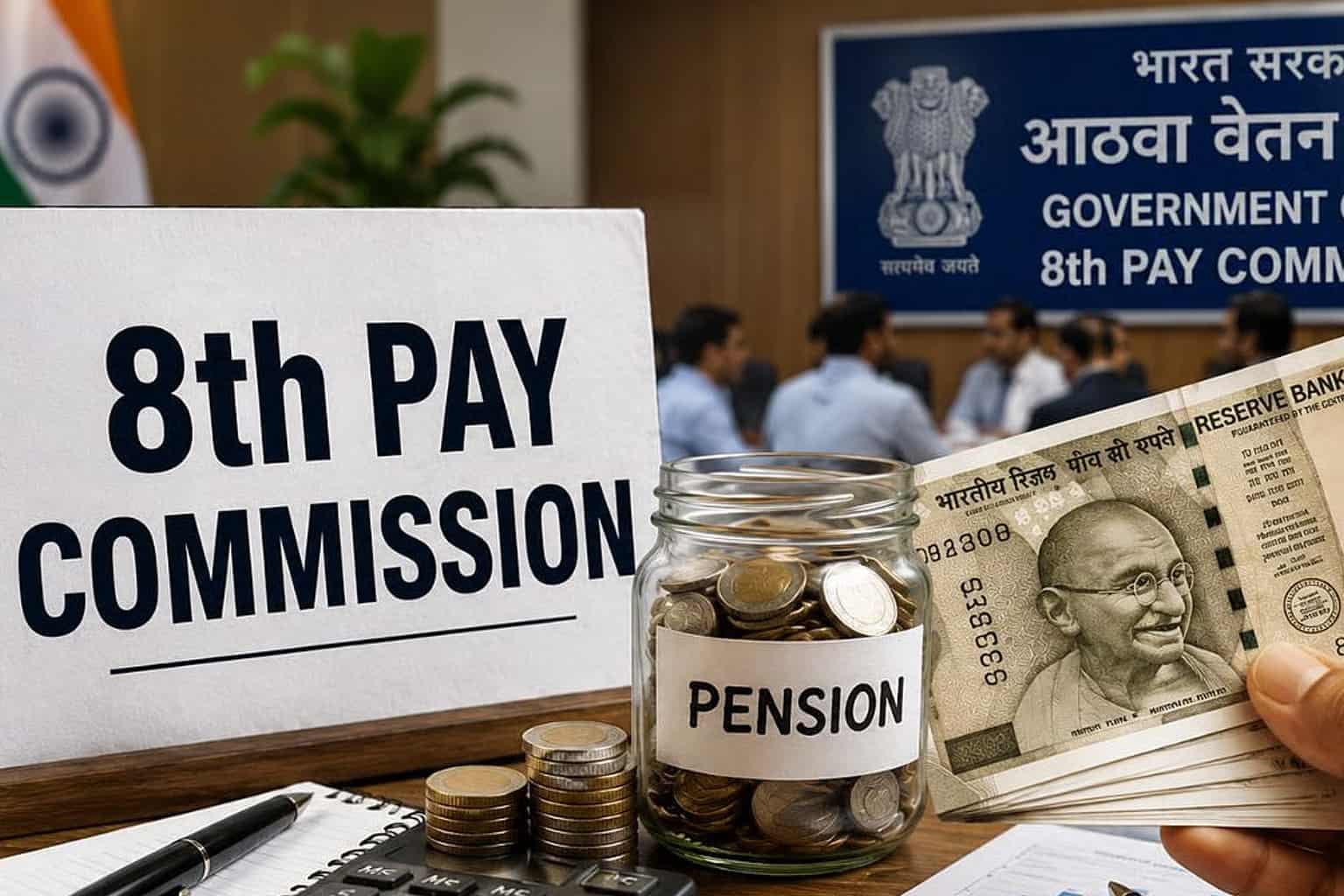
The debate around the 8th Central Pay Commission is not limited to a new pay matrix or fitment factor. For the defence community, the larger questions involve short service careers, operational risk, family separation, disability protection, pension security, medical care and post-retirement support.
A 35-point memorandum prepared by Sainik Welfare News brings these concerns together as a defence-welfare reform charter. The document is dated 20 April 2026, carries reference number SWN/8CPC/2026/101, and addresses issues affecting serving Armed Forces personnel, ex-servicemen, reservists, defence pensioners, family pensioners, widows and dependants.
These proposals are not approved benefits, government orders or final recommendations of the 8th Pay Commission. They represent stakeholder demands placed for consideration.
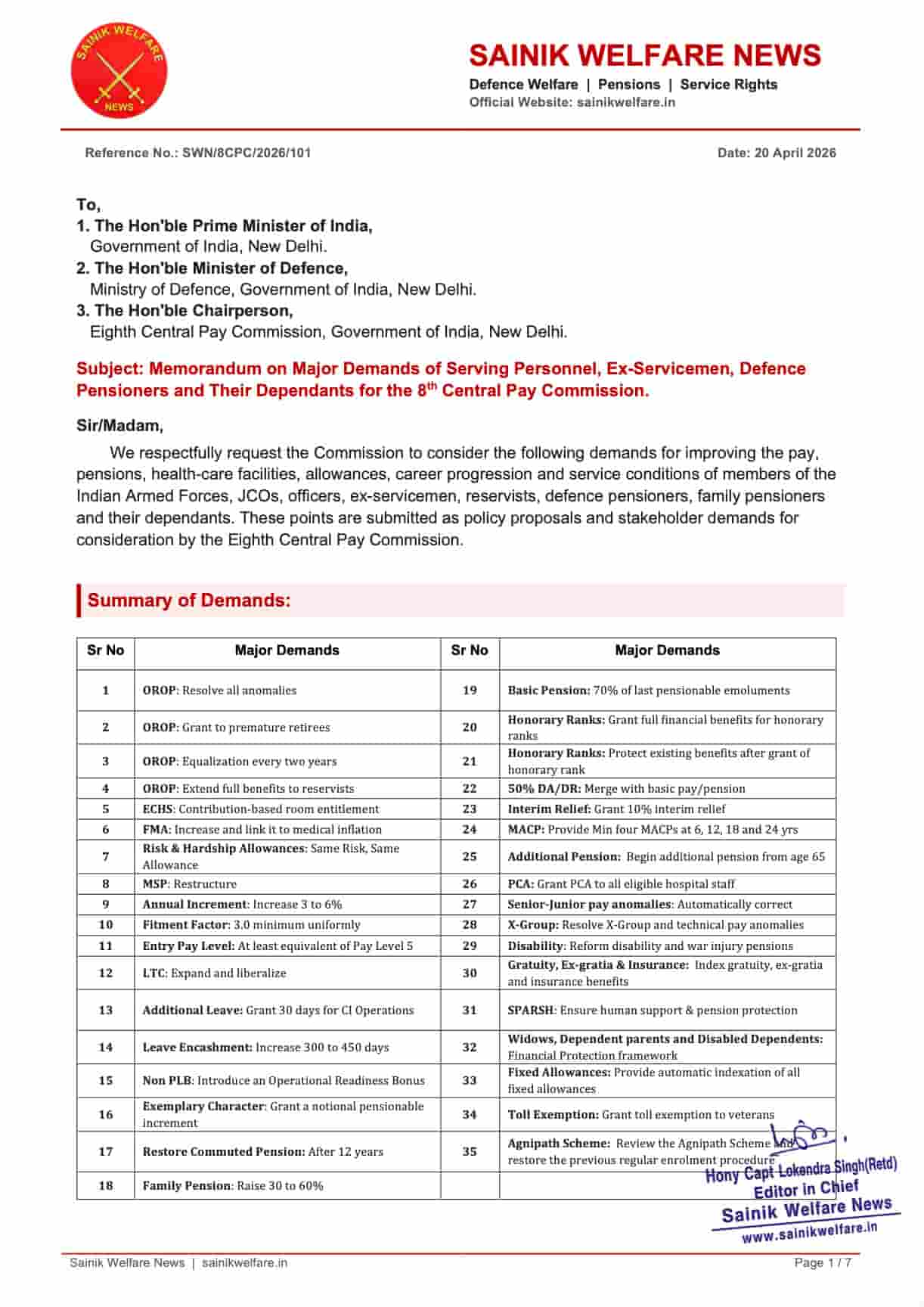
Document status: what readers should know first
The 8th Central Pay Commission invited memoranda and suggestions from Defence Forces personnel, pensioners, associations, unions and other eligible stakeholders through its consultation process.
The Sainik Welfare News article publicly lists the 35 proposals and identifies the memorandum reference. However, readers should distinguish between:
- A proposal submitted or prepared for consideration
- A recommendation accepted by the Pay Commission
- A final benefit approved by the Government
Until an official recommendation and government order are issued, none of these proposals creates a legal or financial entitlement.
Ten proposals with the biggest direct financial impact
| Proposal | Demand in the memorandum | Main beneficiaries |
|---|---|---|
| Fitment factor | Minimum 3.0 | Serving personnel and pensioners |
| Annual increment | At least 6% of Basic Pay | Serving personnel |
| Fixed Medical Allowance | ₹1,000 to ₹5,000 monthly | Eligible pensioners |
| Family pension | Ordinary rate from 30% to 60% | Family pensioners |
| Basic pension | 70% of last pensionable emoluments | Retiring personnel |
| Commuted pension | Restoration after 12 years instead of 15 | Pensioners |
| Leave encashment | Ceiling from 300 to 450 days | Retiring personnel |
| Career progression | Four MACPs at 6, 12, 18 and 24 years | Serving personnel |
| Additional pension | Start from age 65 instead of 80 | Pensioners and family pensioners |
| Interim relief | 10% if implementation is delayed | Employees and pensioners |
These demands could directly affect monthly income, retirement benefits, family protection and the long-term financial security of defence personnel.
OROP reforms should become more inclusive and automatic
The first set of proposals focuses on One Rank One Pension.
The memorandum seeks:
- Removal of pension differences caused by retirement date, rank, trade, group, qualifying service or incorrect pension tables
- OROP coverage for personnel who took premature retirement, voluntary retirement or early discharge
- Automatic pension equalisation at intervals not exceeding two years
- Full OROP protection for reservists who completed Colour Service and Reserve Liability
The central argument is that pension revision should depend on earned rank and qualifying service rather than repeated individual representations.
Incorrect fixation, omitted service and pension-table errors should be corrected automatically, with arrears and a fixed grievance-resolution timeline.
Medical entitlement should depend on need, not only rank
The health-related proposals go beyond an increase in Fixed Medical Allowance.
The memorandum recommends:
- Allowing ECHS beneficiaries to select a higher room category by paying an additional contribution
- Preventing room entitlement from delaying emergency treatment, ICU admission or surgery
- Increasing Fixed Medical Allowance from ₹1,000 to ₹5,000 per month
- Linking FMA with medical inflation
- Providing greater support to elderly, disabled, chronically ill and remotely located pensioners
- Granting Patient Care Allowance according to actual patient contact and infection exposure
- Strengthening disability and war-injury pension protection
The memorandum also seeks simpler disability appeals, reasoned Medical Board decisions and uniform broad-banding where disability is attributable to or aggravated by military service.
Military Service Pay and risk allowance should recognise different hardships
The memorandum treats Military Service Pay and Risk and Hardship Allowance as separate concepts.
Military Service Pay is intended to recognise the broader conditions of military service, including:
- Round-the-clock readiness
- Strict statutory discipline
- Frequent transfers
- Family separation
- Restrictions not ordinarily imposed on civilians
- Continuing exposure to operational risk
Risk and Hardship Allowance, on the other hand, should reflect actual danger, terrain, isolation and operational exposure.
The memorandum argues that personnel carrying out the same hazardous task at the same location should not receive widely different allowances merely because of rank.
Pay growth should not stop because promotions are limited
Several proposals address career stagnation, pay progression and leave benefits.
The memorandum seeks:
- A minimum annual increment of 6%
- An additional 1% stagnation increment after six years without promotion or MACP
- A minimum fitment factor of 3.0
- Entry pay for soldiers at least equivalent to Pay Level 5
- Qualification pay for technical and skilled personnel
- Training period to count as qualifying service
- More practical LTC rules for field and high-altitude personnel
- Additional annual leave for eligible Counter Insurgency deployment
- Leave encashment up to 450 days
- An Operational Readiness and Service Performance Bonus
- One additional pensionable increment for exemplary service at retirement
The proposal for four MACPs at 6, 12, 18 and 24 years is intended to provide regular financial progression where promotion opportunities are limited.
Pension security should begin earlier and protect the family
The pension demands are among the most financially significant parts of the memorandum.
They include:
- Restoration of commuted pension after 12 years instead of 15
- Ordinary Family Pension at 60%
- Basic pension at 70% of last pensionable emoluments
- Financial and pensionary benefits for honorary ranks
- Protection of existing trade, group and qualification benefits
- Merger of the prescribed portion of DA or DR after it reaches 50%
- Interim relief of 10% if the Commission’s report or implementation is delayed
- Four MACPs during service
- Additional pension beginning from age 65
The memorandum also proposes automatic family-pension revision and arrears, along with lifelong protection for permanently disabled children and wholly dependent family members.
Current position versus proposed change
| Issue | Existing position cited | Proposed change |
|---|---|---|
| Fixed Medical Allowance | ₹1,000 | ₹5,000 |
| Ordinary Family Pension | 30% | 60% |
| Commutation restoration | 15 years | 12 years |
| Leave encashment | 300 days | 450 days |
| Additional pension | Begins at age 80 | Begin from age 65 |
| Annual increment | Existing applicable rate | Minimum 6% |
| Career progression | Existing MACP structure | MACPs at 6, 12, 18 and 24 years |
These changes would require examination by the Pay Commission and final approval by the Government.
SPARSH must combine technology with human assistance
The memorandum does not reject digital pension administration. Instead, it argues that technology must be supported by accessible human assistance.
It proposes:
- A free SPARSH help centre in every district
- Face-to-face support for elderly pensioners
- A 30-day grievance-resolution timeline
- Written notice before pension is stopped
- A reasoned order before adverse action
- Automatic correction of pension and pay anomalies
- Faster widow and dependant claims
The document also seeks automatic correction where a junior draws higher pay than a senior because of promotion, MACP, fixation or a revised pay matrix.
Such corrections should be completed within 90 days without forcing the senior employee to file repeated representations.
Widows, disabled dependants and casualty families need a separate protection system
The memorandum proposes a comprehensive financial-security framework for:
- Widows
- Dependent parents
- Permanently disabled children
- Other eligible dependants
- Battle-casualty families
Widow claims should be fast-tracked, while repeated medical certification for permanently disabled dependants should be reduced.
The memorandum also seeks dedicated assistance for casualty families.
Death gratuity, operational casualty ex-gratia and insurance cover should be linked to inflation or DA and settled within 30 days. Delayed settlement should attract interest payable to the family.
Technical personnel and former X-Group members require separate attention
The memorandum calls for correction of pay and pension anomalies affecting former X-Group personnel and technical trades.
It argues that the pay structure should properly recognise:
- Technical qualifications
- Advanced training
- Professional skills
- Trade certification
- Specialist responsibilities
This proposal may be particularly relevant to personnel whose technical qualifications or trade responsibilities were not adequately reflected in pay or pension fixation.
Fixed allowances should not lose value because of inflation
Dress Allowance, Transport Allowance, Children Education Allowance, Hostel Subsidy, Patient Care Allowance, Nursing Allowance and other fixed payments can lose purchasing power over time.
The memorandum proposes linking such allowances to inflation and automatically revising them whenever DA rises by 50%.
This approach is intended to prevent fixed allowances from becoming outdated between Pay Commissions.
What has been proposed for veterans at toll plazas?
The memorandum seeks uniform toll exemption for ex-servicemen on National Highways and other government-controlled toll roads.
Instead of depending on manual identity checks at every toll plaza, it proposes a secure digital-verification system linking veteran credentials with FASTag or another authorised platform.
This is currently a policy demand. It should not be misunderstood as an existing universal toll exemption for all veterans.
What review has been demanded for the Agnipath Scheme?
The final proposal calls for a comprehensive review of the Agnipath recruitment model in consultation with:
- Service Headquarters
- Serving personnel
- Veterans
- Affected stakeholders
The memorandum proposes restoring the earlier regular enrolment process as the principal recruitment system, with normal tenure, pensionary protection and post-service safeguards.
Any short-term recruitment system, if retained, should operate only as a supplementary route.
This proposal does not mean that the Agnipath Scheme has been withdrawn or amended.
Which proposals require the strongest supporting evidence?
Some demands would have a substantial financial and administrative impact.
The following proposals would likely require detailed beneficiary data, calculations and comparisons with existing rules:
- Basic pension at 70%
- Ordinary Family Pension at 60%
- Annual increment of 6%
- Fitment factor of at least 3.0
- Four MACPs within 24 years
- Additional pension from age 65
- Restoration of regular recruitment as the principal system
These proposals would become stronger if supported by:
- Estimated number of beneficiaries
- Current annual expenditure
- Expected additional financial cost
- Comparison with civilian services
- Previous Pay Commission recommendations
- Parliamentary or judicial references
- A practical implementation roadmap
What this memorandum gets right?
The memorandum’s strongest feature is its wide scope.
It does not treat defence welfare as only a salary-revision issue. It connects:
- Operational service with compensation
- Short military careers with career progression
- Medical inflation with pensioner support
- Disability with long-term financial protection
- Digital pension administration with human assistance
- Family security with faster claim settlement
- Veteran recognition with practical benefits
This makes the memorandum relevant to serving personnel, veterans, pensioners, widows, disabled beneficiaries and dependants.
What would make the memorandum more authoritative?
The public presentation could be strengthened by adding:
- A downloadable copy of the complete memorandum
- A redacted official submission acknowledgement
- A partially masked Memo ID
- Existing-rule citations below every demand
- Beneficiary estimates
- Financial calculations
- Priority classification
- Proposed implementation timelines
- A status tracker showing submitted, discussed, accepted or pending
These additions would help readers distinguish between a broad demand, an evidence-backed proposal and an officially accepted recommendation.
Frequently Asked Questions
Have these 35 defence demands been approved?
No. They are stakeholder proposals. They are not government orders or final recommendations of the 8th Central Pay Commission.
What fitment factor has been proposed?
The memorandum proposes a minimum fitment factor of 3.0 for serving defence personnel and pensioners.
How much increase has been demanded in Fixed Medical Allowance?
The proposal seeks to increase FMA from ₹1,000 to ₹5,000 per month and link it with medical inflation.
What family-pension rate has been proposed?
Ordinary Family Pension has been proposed at 60% instead of 30%.
What is the demand regarding commuted pension?
The memorandum seeks automatic restoration after 12 years instead of 15 years.
When should additional pension begin?
The proposal seeks graded additional pension beginning from 65 years of age instead of 80.
What has been proposed for SPARSH pensioners?
The memorandum seeks a free help centre in every district, face-to-face assistance for elderly pensioners, written notice before pension stoppage and a 30-day grievance timeline.
Has any Agnipath change been approved through this memorandum?
No. The memorandum only demands a comprehensive review and restoration of regular enrolment as the principal recruitment route.
Conclusion
The 35-point defence welfare memorandum is best understood as a reform charter rather than a simple list of salary demands.
It brings together OROP corrections, medical support, Military Service Pay, career progression, pension security, widow protection, disability benefits, SPARSH assistance, veteran recognition and recruitment reform.
Its most significant proposals include:
- A 3.0 fitment factor
- A 6% annual increment
- ₹5,000 Fixed Medical Allowance
- 60% Ordinary Family Pension
- 70% basic pension
- Four MACPs
- Additional pension from age 65
- Commuted pension restoration after 12 years
If accepted, these proposals could substantially change defence pay, pension and family protection. However, every proposal remains subject to examination by the 8th Central Pay Commission and subsequent government approval.
The correct takeaway is:
The memorandum explains what sections of the defence community want considered. It does not confirm what the Pay Commission or Government will finally approve.


Leave a Reply