


The debate over the 8th CPC is no longer limited to fitment factor, salary revision or allowances. A major concern has emerged among Central Government pensioners over the wording of the Terms of Reference (ToR).
The concern is not that the Government has officially denied pension revision. In fact, Parliamentary replies have indicated that the 8th CPC is expected to make recommendations on pay, allowances and pensions.
The question being raised is different:
If pension is already within the Commission’s mandate, why are existing and pre-2026 pensioners not mentioned more explicitly in the ToR?
Why are the Terms of Reference important?
The Terms of Reference define the broad scope within which a Pay Commission examines issues and submits its recommendations.
This is why pensioners’ organisations are paying close attention to the exact language used in the 8th CPC ToR.
Their concern is that the revision of existing pension and family pension, particularly for those retiring before 1 January 2026, should be expressly mentioned rather than left open to interpretation.
What has the Government said in Parliament?
Questions relating to pension revision have been raised in both the Lok Sabha and Rajya Sabha.
The issues included whether pension revision would form part of the 8th CPC exercise and whether employees retiring on or before 31 December 2025 would be covered.
The Government’s response, as referred to in the discussions, has been reassuring: the Commission has been mandated to make recommendations relating to pay, allowances, pensions and associated matters.
This is important because it does not support the claim that pension has already been excluded from the 8th CPC.
Then why is a ToR amendment being sought?
The dispute is essentially about clarity rather than an announced exclusion.
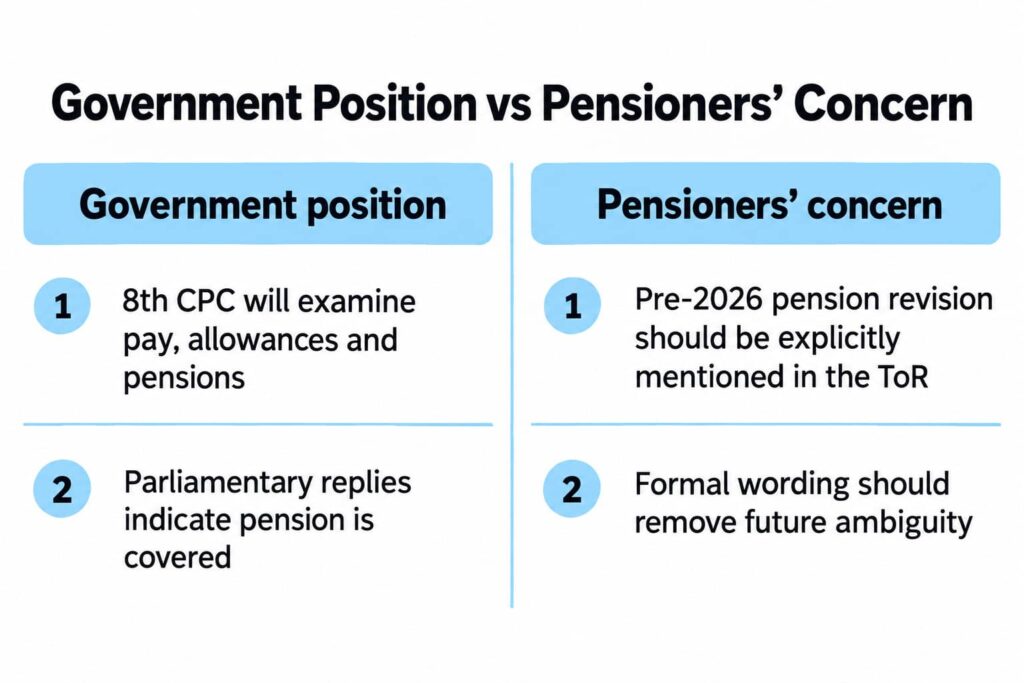
| Government position | Concern raised by pensioners |
|---|---|
| 8th CPC will examine pensions | Existing/pre-2026 pension revision should be explicitly written in the ToR |
| Parliamentary replies indicate pension is covered | Formal wording should leave no room for future interpretation |
| No official denial of pension revision | Pension and family pension revision should be clearly protected |
Pensioners’ groups therefore want a formal amendment or clarification stating that the Commission will examine the revision of pension and family pension of existing pensioners.
Why are pre-2026 pensioners at the centre of the debate?
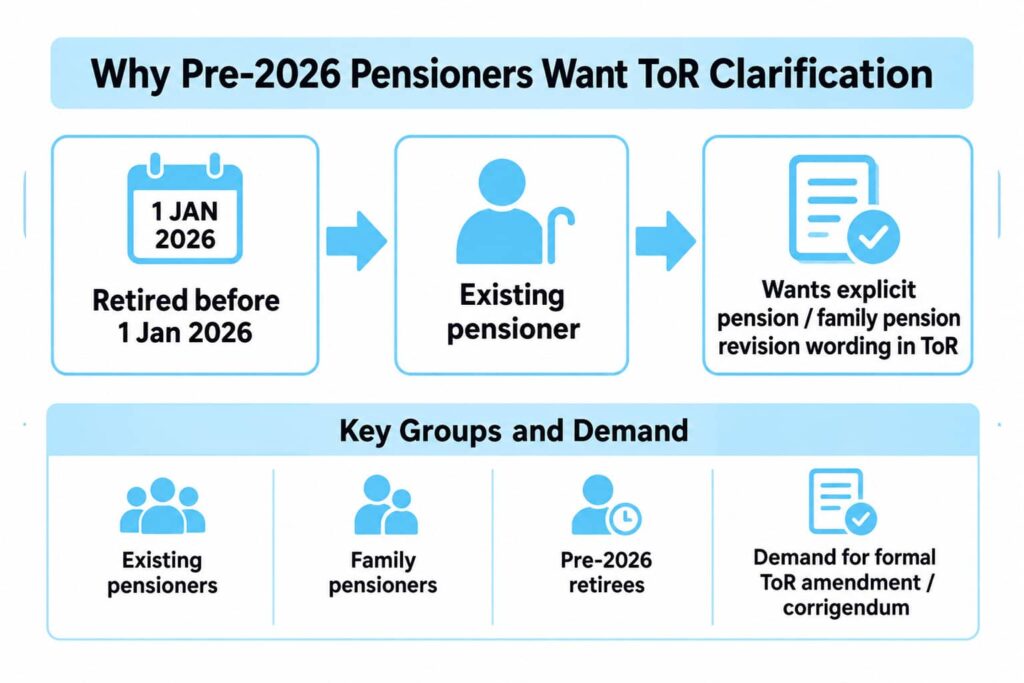
The main anxiety relates to people who retire before the likely implementation date of the new pay structure.
Their concern is whether they will receive the same pension-revision treatment once the 8th CPC recommendations are implemented.
The demand is therefore to expressly include wording covering:
existing pensioners, family pensioners and pre-1 January 2026 retirees.
No specific pension increase has been approved through this demand. The issue at this stage is the scope of the Commission’s mandate.
Representation seeking amendment of the ToR
A representation attributed to retired senior officer Loknath Mishra has also called for an urgent amendment to the 8th CPC ToR.
The argument refers to assurances given in Parliament during discussions connected with the Finance Act 2025, particularly regarding the protection of existing pensioners.
The representation broadly asks that the ToR be aligned with that assurance by expressly mentioning pension revision for pre-2026 pensioners.
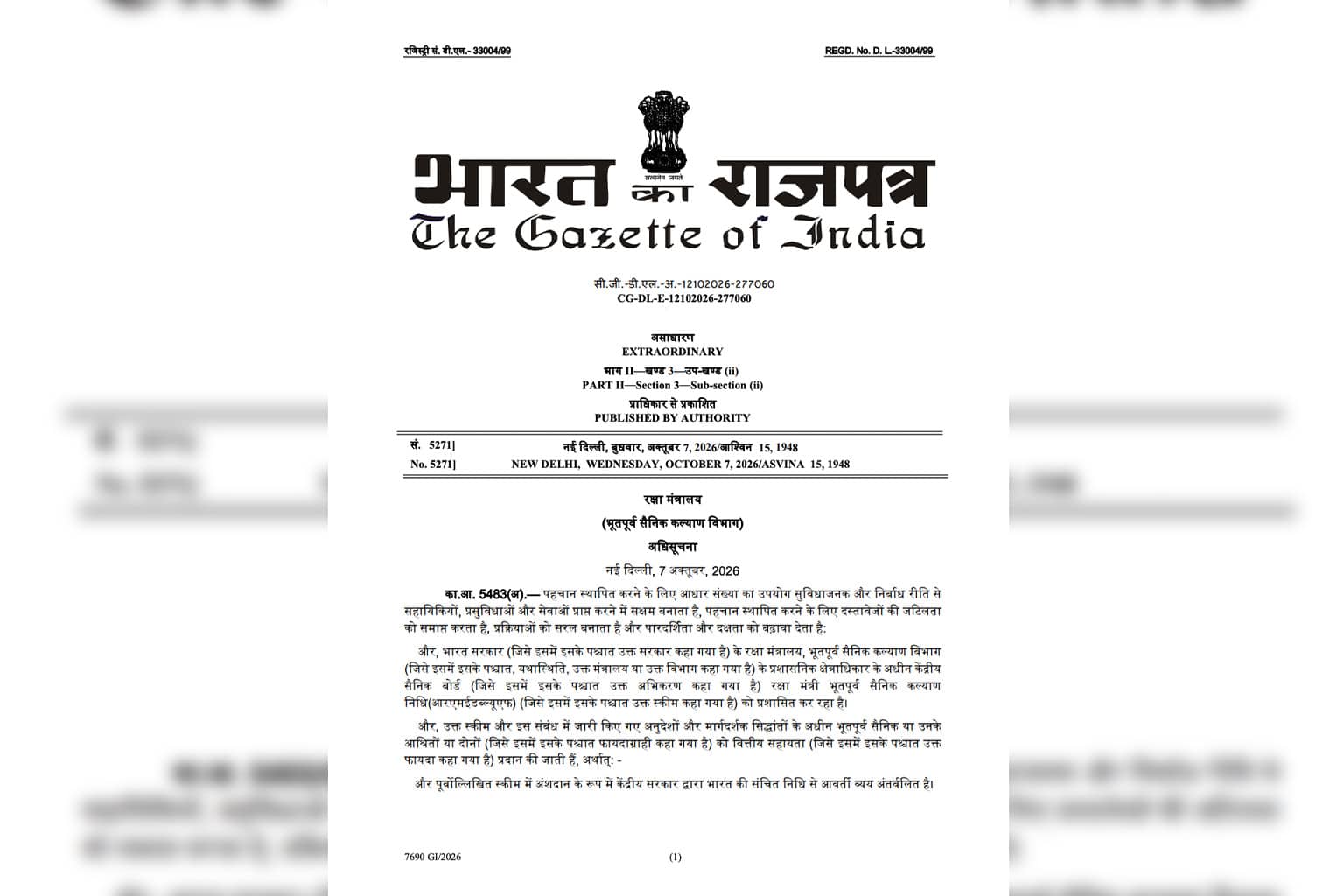
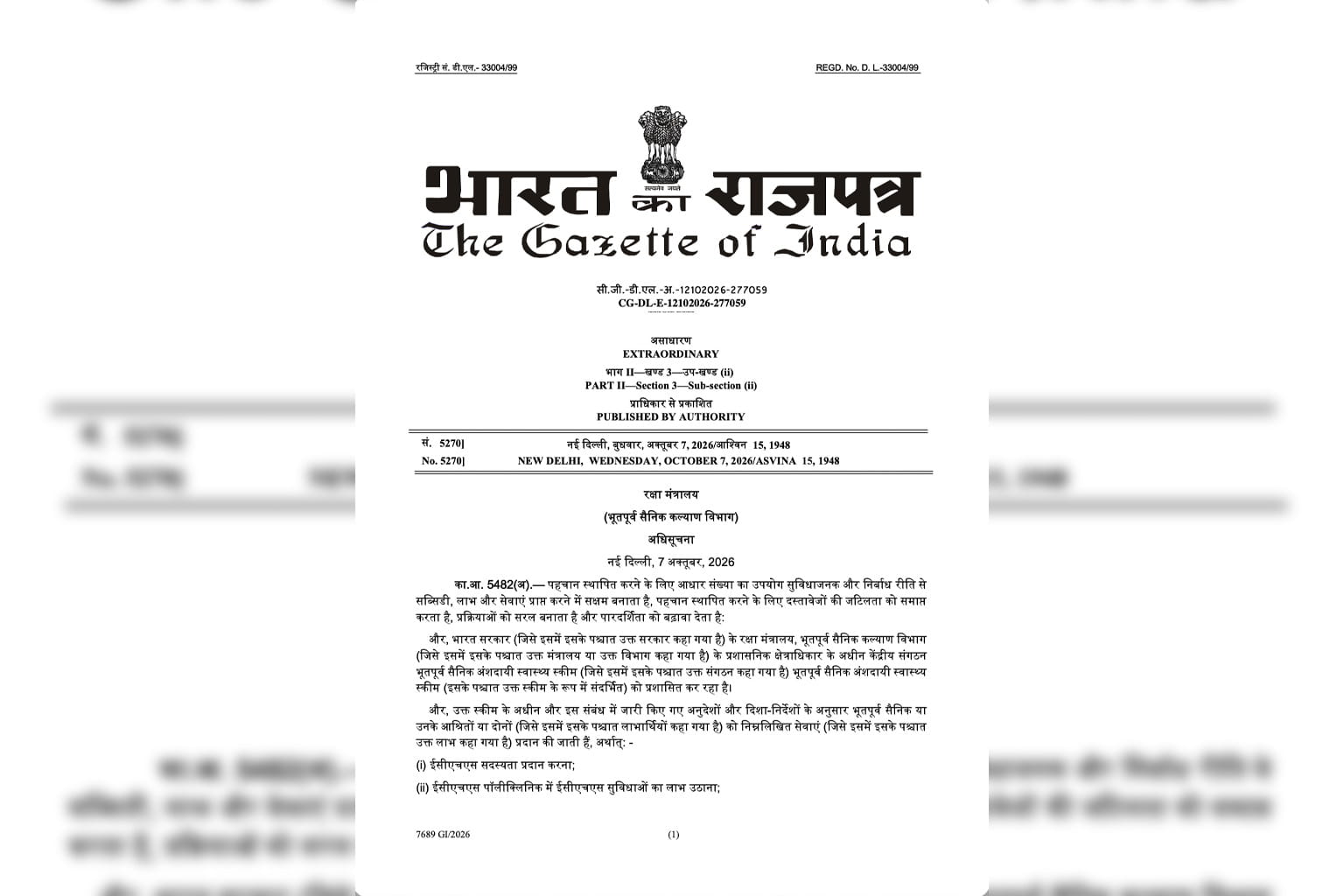
A Gazette corrigendum or formal amendment has been suggested as one way of removing the ambiguity.
Finance Act 2025 and the 8th CPC ToR are separate issues
This distinction is important.
The Finance Act provisions, statements made in Parliament and the Terms of Reference of the Pay Commission are separate legal and administrative instruments.
Therefore, the absence of particular wording in the ToR should not automatically be interpreted as cancellation of pension revision.
The argument being made by pensioner groups is that explicit language would prevent future disputes over interpretation.
Why is the Supreme Court also being mentioned?
Concerns over the wording and scope of the 8th CPC ToR have also been raised in proceedings involving a judges’ association.
However, the service conditions and pension framework applicable to judicial officers are not identical to those of ordinary Central Government pensioners.
The development is relevant mainly because it shows that questions around the ToR are being examined by more than one stakeholder group.
It should not be interpreted as a Supreme Court ruling that Central Government pension revision has been excluded.
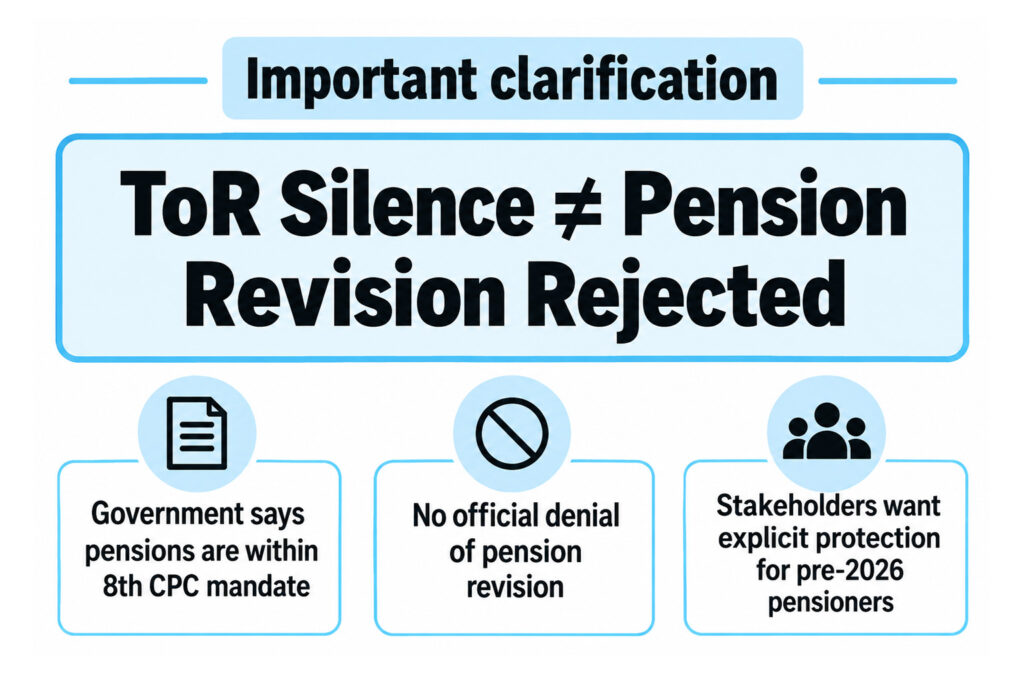
Important clarification
ToR silence ≠ Pension revision rejected
Government replies in Parliament indicate that pensions are within the 8th CPC mandate
Pensioner groups want explicit protection for pre-2026 pension and family pension revision
What happens next?
The key issue now is whether the Government decides to issue a clarification, corrigendum or amendment to the Terms of Reference.
Such a step could remove uncertainty for millions of pensioners and also give the 8th CPC an unambiguous mandate regarding existing pension and family pension revision.
Until then, two facts should be kept separate:
Pension revision has not been officially ruled out.
At the same time, stakeholders continue to demand clearer wording in the ToR for pre-2026 pensioners.
Conclusion
The present 8th CPC pension controversy is primarily about wording, legal certainty and future interpretation, not an official decision to deny pension revision.
The Government’s Parliamentary position indicates that pensions fall within the Commission’s work. Pensioners’ organisations, however, want that assurance reflected directly in the formal Terms of Reference.
That is why the current demand is simple: make the pension mandate explicit now, so that there is no dispute later.

Leave a Reply