

Click to download
The Indian Army is making important changes to how food supplies reach soldiers, particularly those deployed in difficult and remote locations.
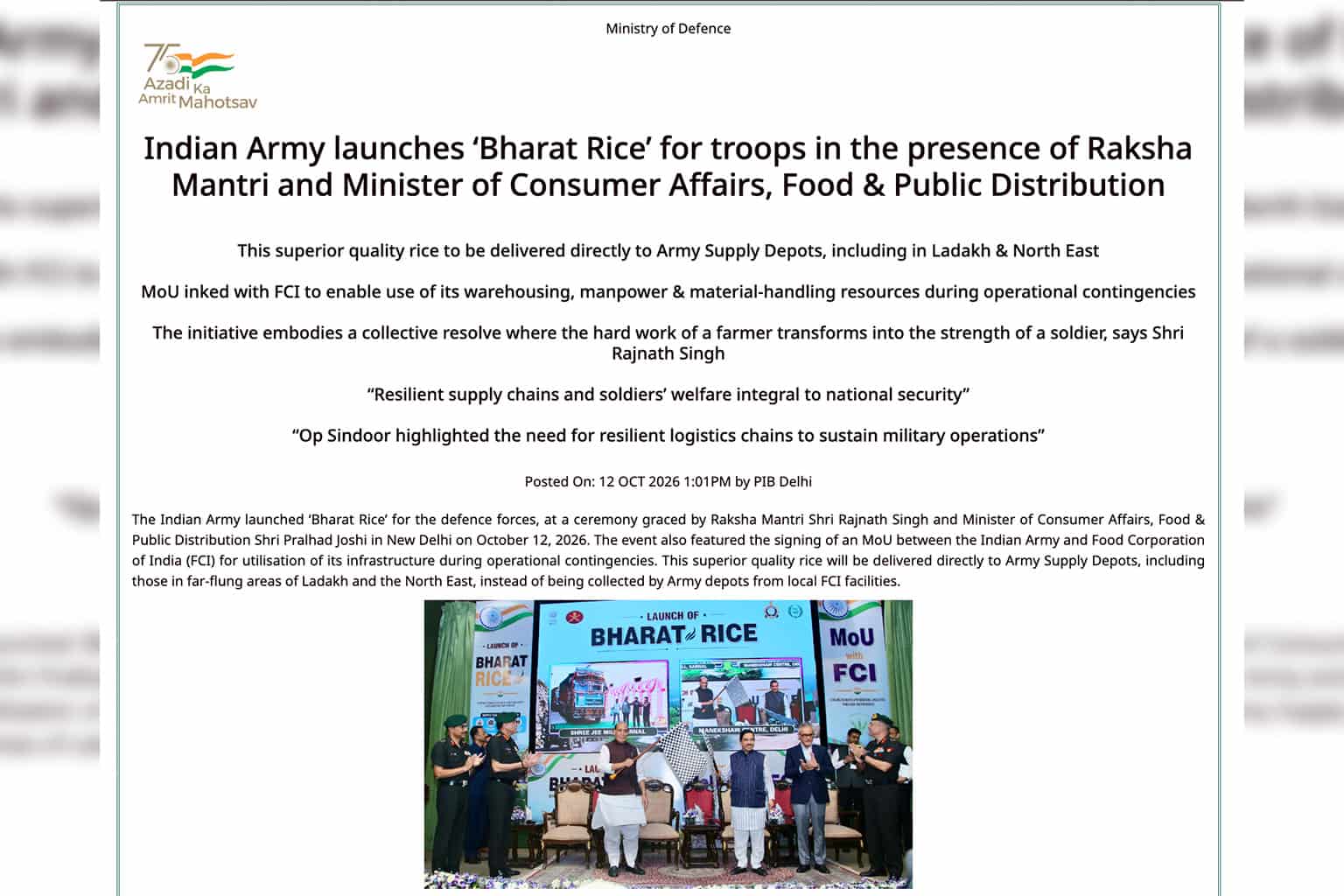
On 12 October 2026, the Army launched Bharat Rice, an initiative aimed at improving the quality of rice provided to troops. Alongside this, a five-year agreement with the Food Corporation of India (FCI) was signed to strengthen military logistics during operational emergencies.
The initiative focuses on two priorities: providing better food to soldiers and ensuring that essential supplies reach military locations efficiently.
What is Bharat Rice, and how will it benefit soldiers?
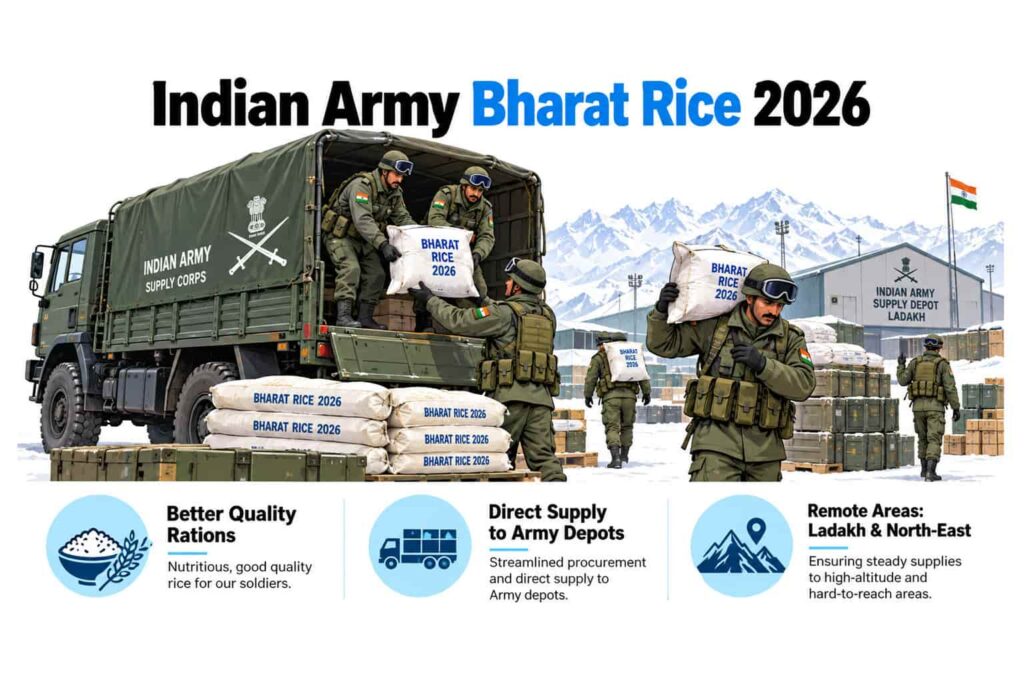
Bharat Rice is an initiative of the Indian Army’s Directorate General of Supplies and Transport, developed following feedback received from troops.
Under the new arrangement, rice will be processed according to prescribed defence specifications, with quality checks to ensure it is free from foreign matter and admixtures and contains minimal broken, damaged or discoloured grains.
The National Agricultural Cooperative Marketing Federation of India (NAFED) will handle the supply arrangement during financial year 2026–27.
The initiative follows approximately 18 months of coordination among the Indian Army, FCI, NAFED and the Department of Food & Public Distribution.
What changes in the Army’s rice supply system?
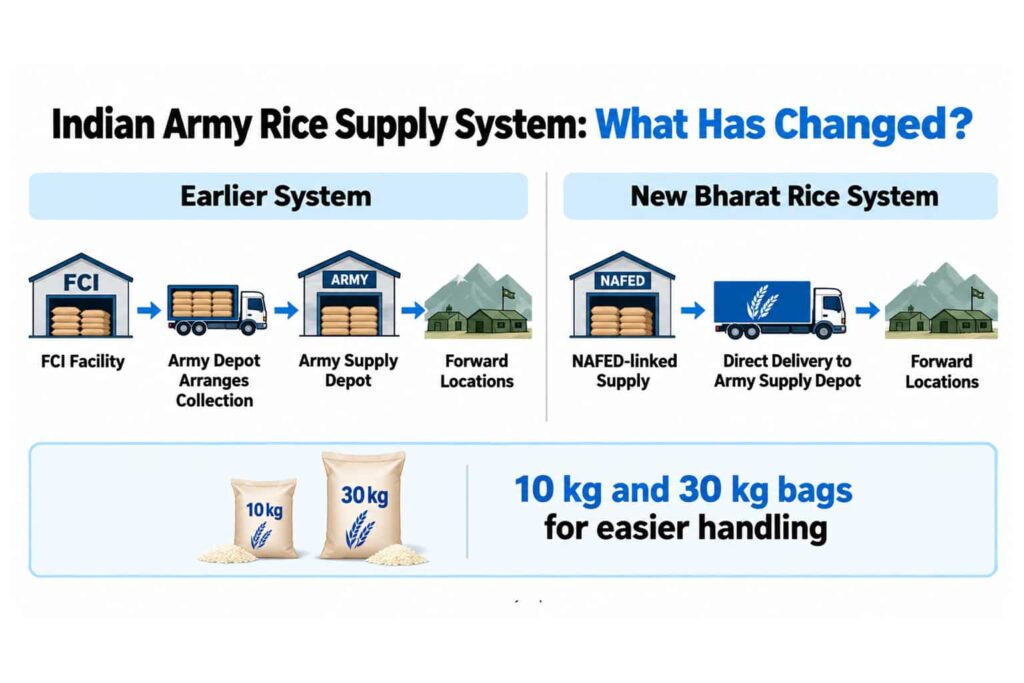
Previously, Army Supply Depots collected rice from their respective FCI facilities. Under the new system, Bharat Rice will be delivered directly to Army Supply Depots, including those in Ladakh and the North-East.
| Earlier arrangement | New arrangement |
|---|---|
| Rice collected from local FCI facilities | Direct delivery to Army Supply Depots |
| Army depots arranged collection | Supply arranged through NAFED |
| Additional collection logistics | Reduced collection responsibility for depots |
Another change concerns packaging. Bharat Rice will be supplied in 10 kg and 30 kg bags, making it easier to handle and transport supplies towards forward military posts.
These measures are intended to simplify food movement in regions where difficult terrain and long supply routes create logistical challenges.
Indian Army and FCI sign a five-year logistics agreement
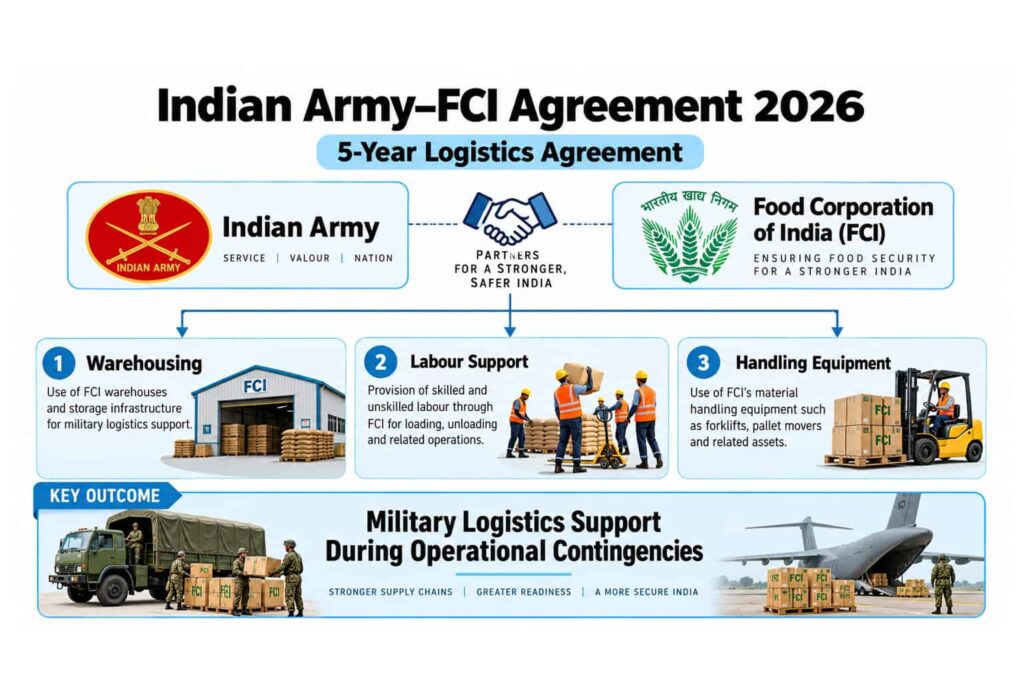
Apart from the rice initiative, the Indian Army has signed a Memorandum of Understanding with FCI to access identified civilian logistics resources during operational contingencies.
The agreement covers three important resources:
Warehousing: Additional storage facilities for military supplies.
Labour: Manpower support for logistics operations.
Material-handling equipment: Equipment needed to move and manage supplies.
The agreement is valid for five years and may be extended through mutual consent.
Coordination will take place between Army Supply and Transport formations and FCI’s regional and divisional offices. The arrangement will also be incorporated into military operational logistics plans.
This will help the Army access additional storage capacity, mobilise resources quickly, disperse supplies and position essential rations, stores and equipment closer to operational areas when required.
How is Operation Sindoor connected with the FCI agreement?
According to the Ministry of Defence, Operation Sindoor highlighted the importance of reliable logistics during military contingencies, particularly when operations begin with limited warning and continue for extended periods.
Defence Minister Rajnath Singh also emphasised the need to prepare for situations where the available warning time may be short.
The Army–FCI agreement aims to strengthen this preparedness by making additional logistics infrastructure available during emergencies.
Importantly, the government’s reference to Operation Sindoor concerns the broader logistics arrangement. It does not establish that Bharat Rice itself was introduced because of the operation.
What other improvements are planned for Army rations?
The Ministry of Defence has also highlighted additional measures relating to military food supplies.
These include enhanced rations for Agniveer recruits and greater commonality in ration scales across the Army, Navy and Air Force.
The government has also proposed introducing organic rations. However, their implementation has not yet been confirmed in this announcement.
The official release does not specify the total quantity of Bharat Rice to be procured, its financial cost, depot-wise delivery schedules or a deadline for completing distribution across Army locations.
Why is this development important?
Food quality and dependable transportation are essential parts of military preparedness, especially for soldiers serving at high-altitude and remote posts.
Bharat Rice aims to improve an everyday ration item while simplifying its supply to Army depots. The FCI agreement addresses a different requirement: access to additional logistics resources during emergencies.
Together, these measures represent an effort to strengthen soldier welfare and operational readiness, ensuring better food supplies during routine deployments and stronger logistical support when military requirements increase.
Official sources
1. Press Information Bureau — Ministry of Defence, 12 October 2026
Read the official PIB announcement on Bharat Rice and the Army–FCI agreement
2. DD News — 12 October 2026
Read the report on Bharat Rice and the five-year FCI logistics agreement

Leave a Reply