


A defence career does not end with retirement.
It changes form.
For a soldier, sailor, air warrior, JCO, NCO or officer, life after uniform can become a second professional chapter. But that chapter does not become successful only because the person has served in the Armed Forces.
It becomes successful when the veteran understands one thing clearly:
The civilian world does not hire a uniform. It hires a clear skill.
This is where many defence personnel struggle after retirement. They know they are capable. They know they have handled pressure. They know they can lead people, manage resources and deliver work with discipline.
But when asked what kind of job they want, many answer:
“I can do anything.”
That answer may sound confident, but in the civilian job market it often becomes weak.
A company does not want to hear that a candidate can do everything. It wants to understand where he can create the most value.
Why the second career needs clarity?
During service, defence personnel learn adaptability.
They may handle administration in one posting, stores in another, training in another, security in another and operations somewhere else. This wide exposure is valuable.
But after retirement, the market works differently.
Civilian employers usually search for a specific role. They want a logistics manager, facility supervisor, compliance officer, security head, training coordinator, warehouse controller, operations manager, administration lead or technical supervisor.
If a veteran presents himself as a general all-rounder, the employer may respect his service but still remain unsure about where to place him.
This is why clarity matters.
The right question is not:
“Which job is available?”
The right question is:
“What is the strongest problem I can solve for an organisation?”
Defence experience is valuable, but it must be translated
Military experience has real market value.
The problem is that many veterans explain it in military language, while civilian employers think in business language.
A veteran may say:
“I handled unit stores.”
But a company understands better if he says:
“I managed inventory, stock accountability, material movement, documentation and audit readiness.”
A veteran may say:
“I was looking after men.”
But a company understands better if he says:
“I supervised teams, maintained discipline, handled manpower planning and ensured task completion under pressure.”
A veteran may say:
“I was posted in operations.”
But a company understands better if he says:
“I coordinated time-sensitive activities, monitored information flow, responded to incidents and supported decision-making in a controlled environment.”
The experience is the same.
Only the language changes.
That language change can decide whether a resume is ignored or shortlisted.
Rank gives respect, but skills create opportunities
Rank is important. It represents service, responsibility and years of commitment.
But civilian hiring does not work only on rank.
An employer wants to know:
What did you manage?
How many people did you lead?
What kind of systems did you handle?
What risk did you control?
What resources were under your responsibility?
What results can you bring to the organisation?
A retired defence person should not reduce his profile to a designation. He should explain the value behind that designation.
For example, a retired JCO with experience in administration, discipline and manpower coordination may be a strong fit for facility management, institutional administration or operations supervision.
A retired logistics professional may be useful in warehousing, transport, supply chain, fleet movement or procurement coordination.
A retired instructor may be suitable for training, skill development, school administration, corporate learning or leadership programmes.
The career path becomes clear when the role value is identified.
The hidden strength of routine military duties
Many defence personnel underestimate routine duties because they performed them as part of service life.
But the civilian market may see strong value in the same duties if they are explained properly.
A canteen responsibility can become retail operations experience.
A mess responsibility can become hospitality and service-management experience.
A stores responsibility can become inventory and audit-control experience.
A transport responsibility can become fleet and logistics experience.
A training responsibility can become learning and development experience.
A documentation responsibility can become compliance and records-management experience.
A security responsibility can become risk, access-control and incident-response experience.
The mistake is not in the experience.
The mistake is in presenting it too casually.

Do not enter the market with one generic resume
A common mistake after defence retirement is creating one resume and sending it everywhere.
That does not work well.
A resume for a security role should not look exactly like a resume for a logistics role.
A resume for facility management should not look exactly like a resume for training.
A resume for administration should not look exactly like a resume for supply chain.
The veteran must first decide the target role, then shape the resume around that role.
A focused resume says:
“I understand this field.”
A scattered resume says:
“I am trying everywhere.”
The first one builds trust.
The second one creates doubt.
How to identify your strongest civilian profile?
Before applying for jobs, a veteran should sit with paper and answer a few honest questions.
Which duties did I handle most confidently during service?
Which responsibilities did seniors trust me with repeatedly?
Which tasks gave me measurable experience?
Where did I manage people, resources or risk?
Which civilian industry can use this background?
What certification or training can strengthen my profile?
Which role can I explain clearly in an interview?
This self-assessment is more important than applying quickly.
A well-prepared veteran may get fewer interviews but better-quality interviews.
An unprepared veteran may apply to many jobs and still feel stuck.
Strong civilian areas for defence veterans
Defence personnel can fit into many industries, but the best fit depends on background and preparation.
Some common areas include:
Corporate security and risk management
Facility management
Logistics and supply chain
Transport and fleet supervision
Warehouse operations
Administration and compliance
Training and skill development
Retail operations
Hospitality and institutional services
Aviation support roles
Technical maintenance supervision
Disaster response and emergency coordination
School, college or campus administration
Project coordination
Operations control
The right industry should be chosen based on service experience, education, age, location preference, family needs and salary expectation.
Why industry selection should come before job application?
Many veterans apply first and think later.
The better method is the opposite.
First select the industry.
Then select the function.
Then select the job title.
For example:
If the person has strong movement and stores experience, he can first select logistics as an industry, then supply chain as a function, then operations supervisor or warehouse manager as a role.
If the person has strong discipline, campus handling and administration experience, he can select education or facility management, then administration, then campus administrator or facility supervisor as a role.
If the person has handled training, instruction or coaching, he can select skill development, corporate training or institutional training as the industry, then choose trainer, training coordinator or learning supervisor as the role.
This approach prevents confusion.
The importance of civilian language in interviews
The interview is where many defence personnel need preparation.
They may have excellent experience, but they must explain it in a way the employer understands.
Instead of saying:
“I was responsible for troops and discipline.”
Say:
“I managed teams, maintained performance standards, handled attendance, ensured compliance and resolved operational issues.”
Instead of saying:
“I handled stores.”
Say:
“I was responsible for inventory accuracy, stock movement, issue control, documentation and audit preparedness.”
Instead of saying:
“I worked in operations.”
Say:
“I coordinated real-time activities, tracked information, supported decision-making and ensured timely execution.”
This does not reduce military dignity.
It makes military experience usable for civilian hiring.
When should planning begin?
Second-career planning should ideally begin 18 to 24 months before retirement.
This time should be used for:
skill mapping,
resume building,
LinkedIn profile creation,
certification if required,
industry research,
salary understanding,
networking,
interview practice,
DGR and NCS portal checking,
and document preparation.
Waiting until the last month creates pressure.
Pressure often leads to wrong choices.
A planned transition gives the veteran more control.
Common mistakes after defence retirement
Many veterans face difficulty because of avoidable mistakes.
They apply for every job without direction.
They use too much military terminology in resumes.
They depend only on personal contacts.
They ignore LinkedIn and professional networking.
They expect civilian organisations to automatically understand defence experience.
They do not prepare for interviews.
They compare every job with rank and service status.
They accept the first opportunity without checking long-term growth.
They do not upgrade skills where required.
These mistakes can be corrected with preparation.
Official platforms should not be ignored
Defence personnel should use trusted and official sources for second-career support.
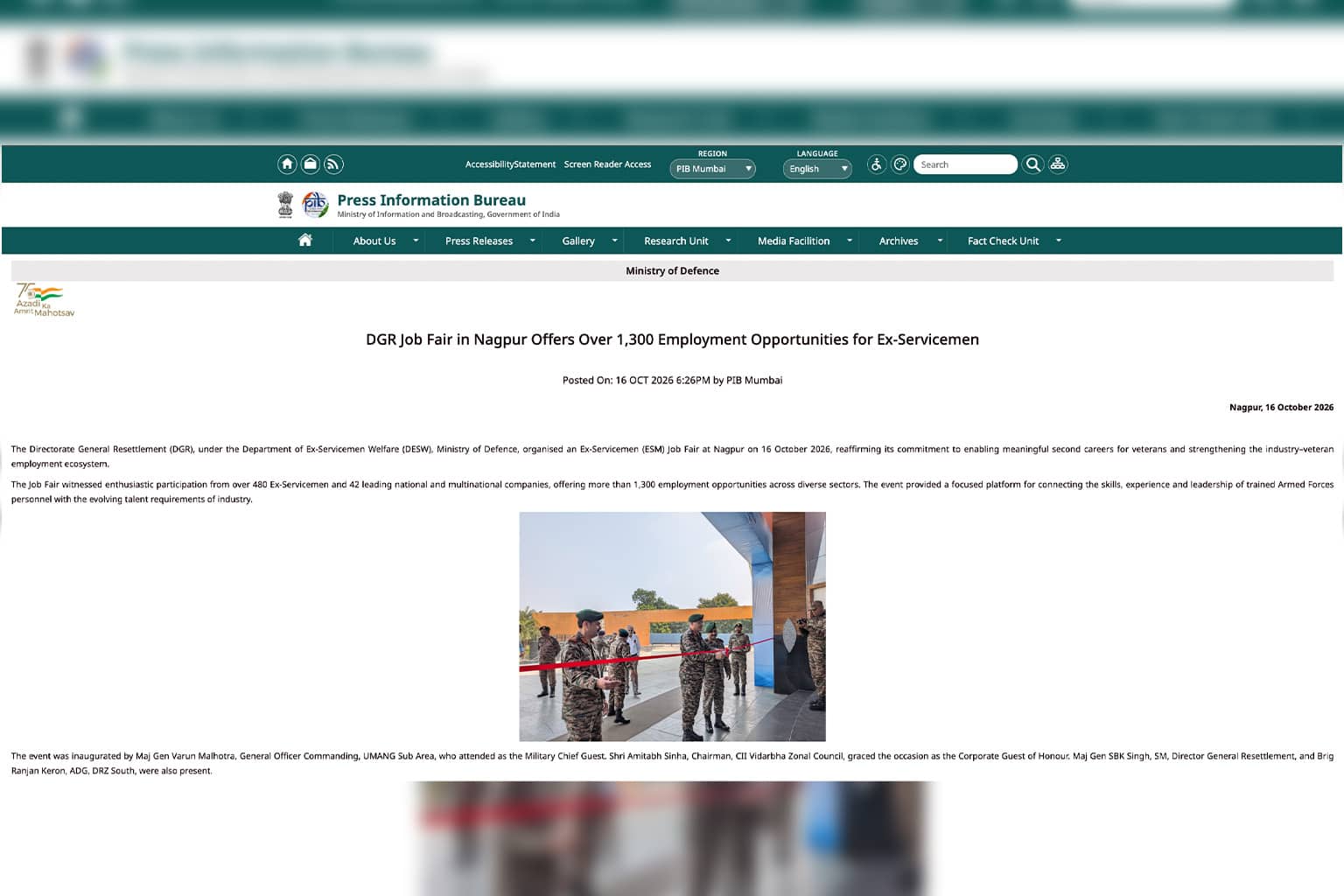
The Directorate General Resettlement is an important official platform connected with resettlement, job assistance, training and self-employment support for ex-servicemen.
The National Career Service also provides job-related services and has a route for ex-servicemen.
These platforms should be used along with personal networking, professional groups, LinkedIn, industry contacts and reliable recruiters.
No single platform can guarantee employment.
But official platforms can give structure and direction.
Family support also matters
Transition after retirement is not only professional.
It is emotional.
The person is moving from a structured military system to a civilian market where rules, language, salaries and expectations are different.
Family members should understand that a good second career may take time.
Immediate pressure can push the veteran into a role that does not match his real ability.
Support at home helps the person choose better, prepare better and adjust better.
What young defence aspirants should understand?
This subject is also useful for youth planning to join the Armed Forces.
A defence career builds discipline, courage, exposure and responsibility.
It can shape a person for life.
But every professional journey eventually needs self-awareness.
Whether a person serves for a short period or a long career, he should learn to understand his own strengths and communicate them clearly.
Military service can build the foundation.
The individual must build the next chapter.
Final view
A second career after defence is not about starting from zero.
It is about translating what already exists.
The Armed Forces give discipline, responsibility, leadership, integrity, teamwork and the ability to work under pressure.
But the civilian market needs these qualities in a focused professional form.
So after retirement, the best answer is not:
“I can do everything.”
The better answer is:
“This is my core strength, this is the role I am targeting, and this is the value I can bring.”
That clarity can change the entire journey after uniform.
Retirement may end military service, but it should not end professional growth.
With the right planning, the right language and the right direction, a defence veteran can build a second career with dignity, confidence and purpose.
Sources:-
Directorate General Resettlement official website:
https://dgrindia.gov.in/
DGR Job Assistance:
https://dgrindia.gov.in/Content1/job-assistance
Department of Ex-Servicemen Welfare — About DGR:
https://www.desw.gov.in/about-dgr
National Career Service — Jobs for Ex-Servicemen:
https://www.ncs.gov.in/jobs-for-ex-servicemen


Leave a Reply