

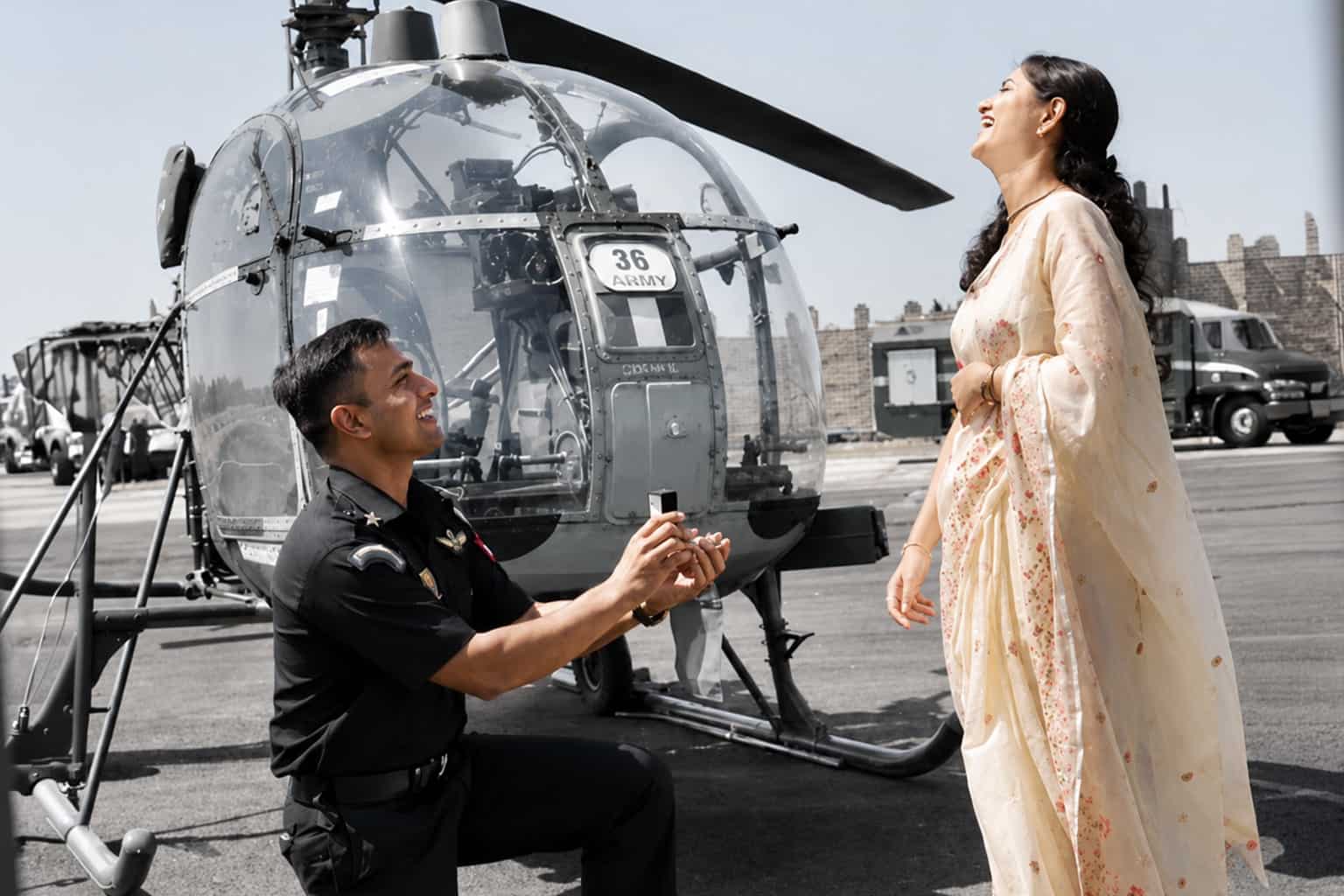
A proposal is a deeply personal moment.
But when it happens in uniform, at a military ceremony and near official equipment, it no longer remains only personal.
That is why the viral proposal by an Indian Army Captain after the passing-out parade at the Combat Army Aviation Training School in Nashik has become more than a social-media story.

For many people online, it looked like a heart-warming moment.
For the Army, as per reports, it raised a question of conduct, protocol and the dignity attached to the uniform.
This is where the story becomes important.
It is not about whether an officer can feel joy.
It is about how personal emotion is expressed when military symbols are present.
What happened at CAATS Nashik?
The incident took place after a passing-out parade at the Combat Army Aviation Training School, commonly known as CAATS, in Nashik.
Reports identified the officer as Captain Bharat Bhardwaj.
After the parade, he proposed to his partner in uniform. A military helicopter was visible in the setting. Family members, guests and fellow officers were also present, and the moment was recorded and shared widely.
Hindustan Times reported the proposal as an emotional moment after the aviation training event, noting that the officer wanted to make the day memorable for his fiancée as well.
From the outside, the video appeared simple: a young officer, a major professional milestone, family emotion and a personal commitment.
But in the Armed Forces, the setting changes the meaning of an action.
Why the Army reportedly took note?
ThePrint later reported that the Indian Army took cognisance of the viral video and sought the officer’s response.
According to defence sources cited in the report, the Army understood the personal emotion behind the proposal, but considered the occasion and location inappropriate.
The concern, as reported, was not merely that a proposal happened.
The concern was that it happened in uniform, in a formal military environment and in front of military equipment that should not become part of personal social-media content.
This distinction is important.
The Army’s reported concern appears to be about professional boundaries, not about opposing a personal relationship.
The uniform is not ordinary clothing
A uniform carries more than identity.
It carries discipline, service, hierarchy, sacrifice and institutional trust.
When a person wears uniform, even a personal act can be viewed through an official lens.
That is why the same proposal, if done in a private place after the ceremony, may not have created the same debate.
But when the act happened in uniform and near a military helicopter, it entered a different space.
In military life, symbols matter.
The parade ground matters.
The aircraft matters.
The uniform matters.
The public setting matters.
And now, the camera matters too.
A helicopter is not a social-media backdrop
One of the biggest lessons from this incident is about military equipment.
A helicopter may look impressive in a video, but it is not a decorative object.
It is a military asset.
It represents training, operational capability, national resources and professional responsibility.
When official equipment appears in personal viral content, it can create questions that may not be visible to civilian audiences.
For the public, it may look like a beautiful background.
For the institution, it may look like a boundary being crossed.
That is why this issue should be understood through military culture, not only through social-media emotion.
Why social media changed the scale of the incident?
A private moment can remain private.
A recorded moment can become public.
A viral moment can become institutional.
This is the reality of social media.
Today, a few seconds of video can travel far beyond the people present at the location. It can be interpreted, celebrated, criticised, politicised and misused.
For uniformed personnel, this creates a serious challenge.
A moment that feels harmless in the circle of family and friends can become a public document once posted online.
That public visibility is what often triggers institutional review.
The Army is built on discipline and controlled communication. Social media, by nature, is fast, emotional and uncontrolled.
This is the conflict at the centre of the Nashik proposal story.
This is not a scandal story
This incident should not be exaggerated.
Reports do not show that the officer acted with malicious intent.
No formal punishment has been confirmed in the sources.
No court-martial has been reported.
No serious security breach has been officially established in the reports available.
ThePrint reported that formal disciplinary action was unlikely and that the matter may be handled through counselling or sensitisation.
That makes the issue more of a conduct lesson than a major disciplinary scandal.
The correct way to understand it is:
a personal moment became a protocol issue because of where and how it happened.

Why the public reaction was divided?
The public reaction was predictable.
Some people saw the proposal as beautiful and emotional.
Some felt the Army was being too strict.
Some argued that the uniform must always be treated with restraint.
Some questioned whether military platforms should appear in personal content.
This difference exists because civilian life and military life operate on different expectations.
In civilian life, personal expression is often celebrated openly.
In military life, personal expression must remain within boundaries of service discipline.
Neither side is fully wrong.
The emotion was real.
The protocol concern was also real.
Why young officers need social-media sensitivity?
Young officers today serve in a very different media environment from earlier generations.
Every ceremony can be recorded.
Every family moment can become a reel.
Every personal act can reach millions.
That is why social-media discipline has become part of professional discipline.
A young officer may not intend to violate any rule, but the institution still has to protect standards.
The lesson is not that officers should have no personal life.
The lesson is that personal moments should not use military space, equipment or symbols in a way that creates avoidable controversy.
The difference between emotion and appropriateness
This story is not about whether the proposal was emotional.
It clearly was.
It is about whether the location was appropriate.
A deeply emotional act can still be poorly placed.
A sincere intention can still create a protocol issue.
A personal celebration can still cross an institutional line.
That is the balance needed in this case.
The officer’s happiness should not be mocked.
The Army’s concern should not be dismissed.
Both can be understood together.
Why passing-out parades carry special dignity?
A passing-out parade is not just a graduation event.
It marks the completion of hard training, the beginning of new responsibility and the public acceptance of military discipline.
Families attend with pride.
Officers celebrate a professional milestone.
The institution presents its standards before the public.
That is why the dignity of such occasions is closely guarded.
The ceremony belongs not only to one individual.
It belongs to the course, the unit, the training establishment and the service.
This is why personal acts inside such a setting are viewed differently.
What should not be wrongly reported?
This story should be written carefully.
Do not say the officer has been punished unless an official source confirms it.
Do not say the Army is against love or marriage proposals.
Do not say a security breach is confirmed.
Do not say a court-martial is likely.
Do not portray the officer as guilty of a serious offence unless official action says so.
Do not turn the story into mockery.
The safest language is:
The Army reportedly sought an explanation.
The concern appears to be about uniform conduct and use of military setting.
Formal disciplinary action has not been confirmed.
The issue is about protocol, dignity and social-media boundaries.
Why this story matters beyond one officer?
This incident matters because it reflects a new challenge for the Armed Forces.
Earlier, conduct inside military spaces remained largely within the institution.
Now, cameras can take those moments outside instantly.
This means every officer and jawan has to think not only about what is happening in front of them, but also about how it may appear when shared publicly.
Uniformed life now requires digital judgement.
The camera has become part of the environment.
Comment
The Army Captain’s viral proposal should not be reduced to either romance or punishment.
It is a more layered story.
A young officer wanted to mark an important day with a personal promise.
The public responded emotionally.
The Army reportedly viewed the same moment through the lens of discipline, location and uniformed responsibility.
That is the real issue.
In civilian life, the camera may make a moment memorable.
In military life, the camera can also make it accountable.
Final takeaway
The Nashik proposal was personal, but its setting made it institutional.
A proposal in uniform, after a passing-out parade and near a military helicopter carries a meaning beyond private emotion.
That is why the Army reportedly took note and sought a response.
The matter should not be exaggerated into a major scandal.
It should also not be dismissed as merely a harmless video.
The correct lesson is simple:
personal joy deserves respect,
but military spaces require restraint.
In uniform, even happiness must remember discipline.
Sources:-
ThePrint report:
https://theprint.in/defence/army-takes-cognisance-of-captain-proposal-viral-video-seeks-explanation/2949794/
Hindustan Times report:
https://www.hindustantimes.com/india-news/army-passing-out-parade-caats-nashik-surprise-proposal-captain-asks-partner-for-marriage-watch-101780395293761.html
Hindustan Times Trending report:
https://www.hindustantimes.com/trending/army-pilot-proposes-to-girlfriend-after-passing-out-parade-says-wanted-to-make-this-day-memorable-for-my-fianc-e-too-101780420163497.html
Moneycontrol report:
https://www.moneycontrol.com/defence/indian-army-seeks-captain-s-explanation-over-viral-proposal-in-front-of-military-helicopter-in-nashik-article-13940781.html




Leave a Reply