


A woman travelling in an electric car reportedly became stranded after the vehicle’s battery dropped to about 2% before she could reach a charging station.
She had approached an Indian Army jawan only to ask for directions. Instead, the soldier reportedly helped push the vehicle to the charging point, stayed nearby while it gained enough charge and ensured that the driver could safely resume her journey.
The incident has attracted attention because of the jawan’s conduct. However, it also carries a practical lesson for EV owners: charging arrangements should be made before the battery reaches a critically low level.
What reportedly happened?
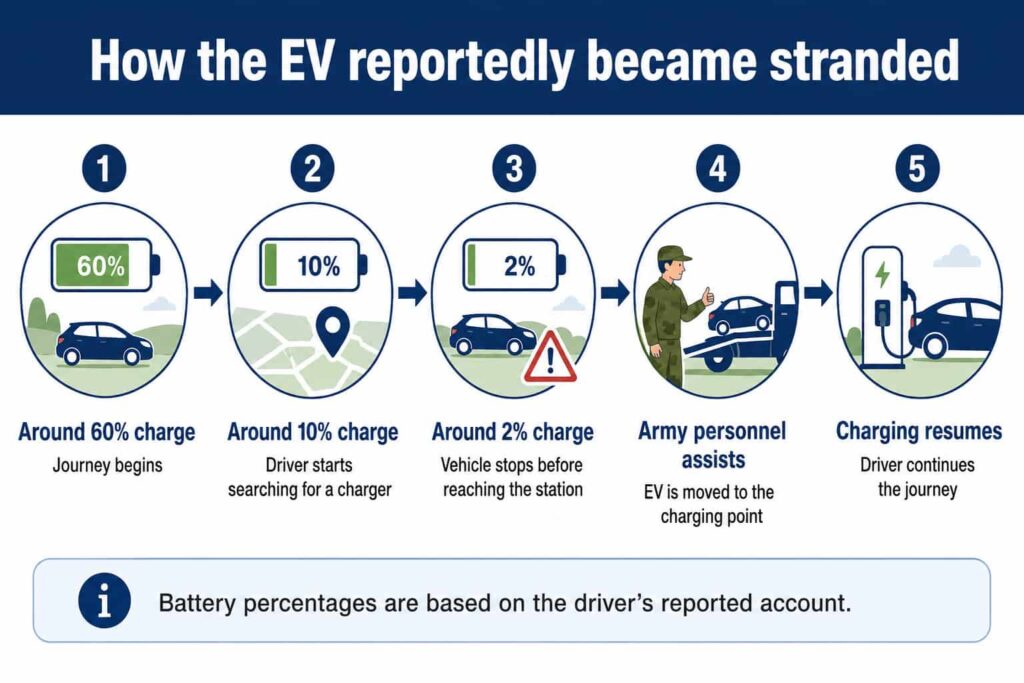
According to the driver’s social-media account, content creator Deepika Sharma began the journey with approximately 60% battery charge.
She later said that the remaining range had been miscalculated. When the battery fell to around 10%, she began looking for a charging station. The EV reportedly stopped at approximately 2%, before it could reach the charger.
The driver then approached an Army personnel, identified in reports as Mr Narendra, to ask for the location of the nearest charging point.
The jawan reportedly:
- helped push the EV towards the charger;
- walked alongside the vehicle while the driver steered;
- remained there for nearly 30 minutes;
- waited until the car had sufficient charge;
- helped ensure that she could continue safely.
Incident at a glance
| Point | Reported detail |
|---|---|
| Battery at the beginning | Around 60% |
| Search for charging reportedly began | Around 10% |
| Battery when the vehicle stopped | Around 2% |
| Person who helped | Indian Army jawan identified as Mr Narendra |
| Assistance provided | Helped move the EV to the charger |
| Additional support | Reportedly stayed until the driver could continue |
| Exact location | Not clearly established |
| Official Army statement | Not publicly located |
Why did the jawan’s gesture stand out?
The jawan reportedly did more than provide directions.
He physically assisted with moving the stranded vehicle and stayed until the driver was able to continue. That additional support turned an ordinary roadside problem into a widely shared human-interest story.
The incident is being appreciated as an example of:
- readiness to help;
- responsibility towards a stranded traveller;
- patience in difficult conditions;
- concern for personal safety beyond the immediate task.
The strongest part of the account is not simply that the car was pushed. It is that the jawan reportedly remained until the situation was safely resolved.
What is verified and what remains uncertain?
The story is based primarily on the driver’s Instagram account and circulating footage.
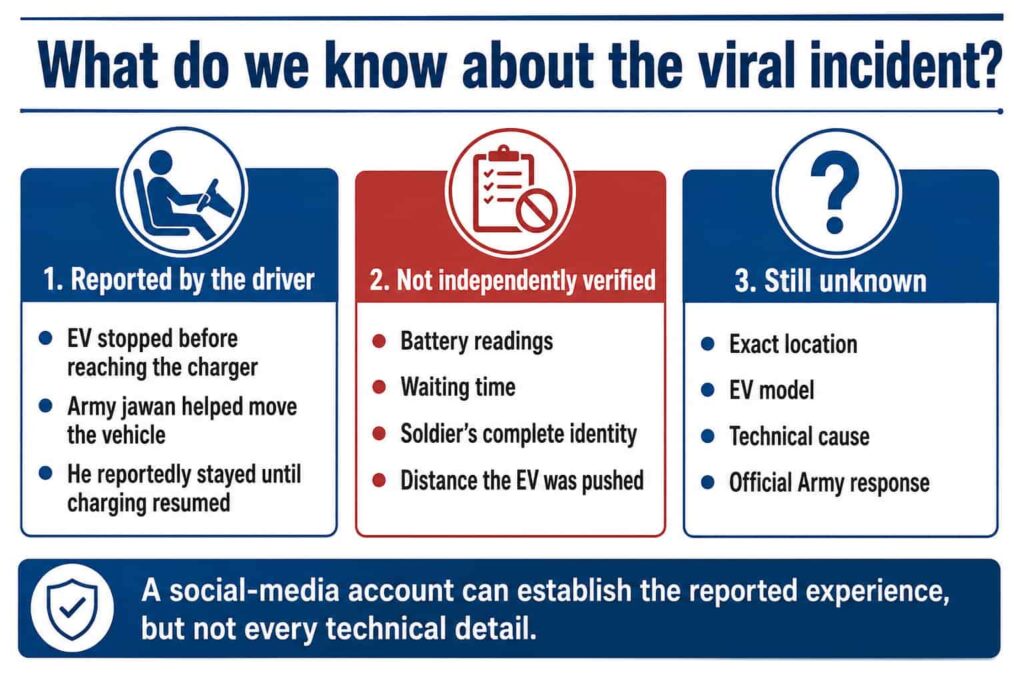
Supported by the reported account
- The EV became stranded.
- An Indian Army jawan assisted the driver.
- The car was moved towards a charging station.
- The soldier reportedly waited until charging had begun.
- The driver publicly thanked him.
Reported but not independently verified
- The exact battery percentages;
- the soldier’s full identity;
- the exact time he remained at the location;
- the complete distance for which the car was pushed;
- the reported temperature at the location.
Details not clearly available
- Exact place of the incident;
- EV manufacturer and model;
- journey distance;
- charging-station operator;
- battery-health information;
- vehicle diagnostic records;
- official statement from the Army.
Did the EV suddenly develop a fault?
There is no publicly available evidence showing that the vehicle suffered a battery defect or mechanical failure.
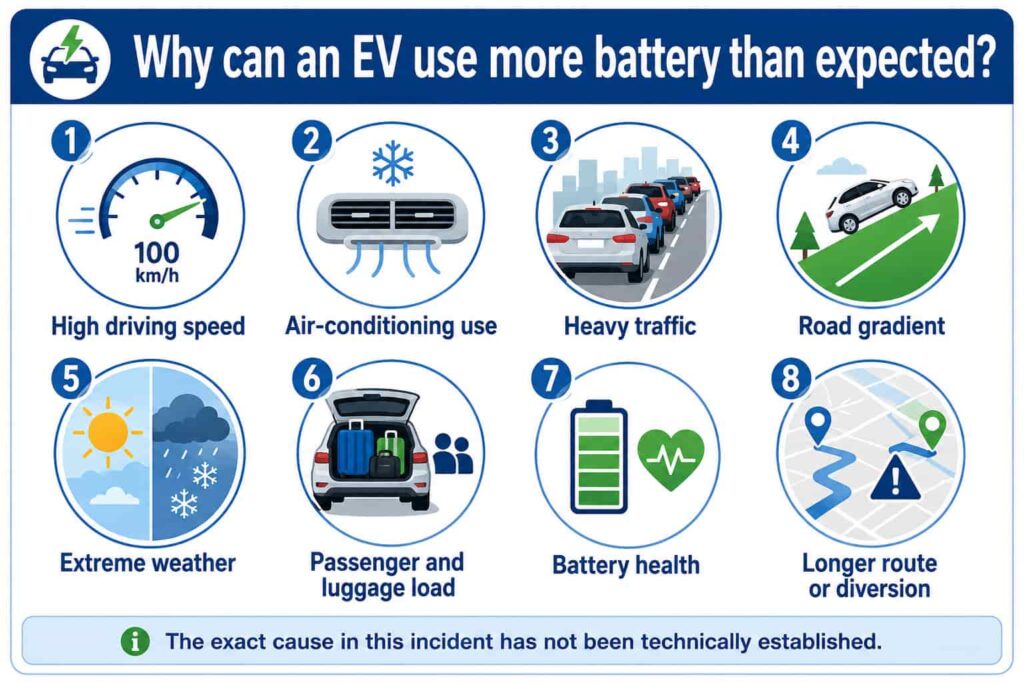
An EV may consume more energy than expected because of:
- journey length;
- speed;
- traffic congestion;
- air-conditioning use;
- uphill driving;
- high or low temperature;
- battery condition;
- passenger and luggage load;
- inaccurate range estimation;
- diversion from the planned route.
Without the vehicle’s diagnostic data, it would be misleading to blame the car, the battery manufacturer or the charging network.
The available account points more clearly towards a range-planning miscalculation than a proven technical defect.
The main EV lesson: Do not wait for the final few percent
According to the driver’s account, the search for a charger began when the battery had already fallen close to 10%.
At that stage, the available margin may be too small if:
- the nearest charger is farther than expected;
- navigation takes the driver to the wrong entrance;
- the charger is occupied;
- the station is offline;
- traffic causes additional consumption;
- the remaining-range estimate changes suddenly;
- the vehicle reduces performance at a low state of charge.
There is no single percentage suitable for every vehicle and every journey.
However, drivers should generally plan charging with enough reserve to reach an alternative station if the first option fails.
How should EV drivers plan a longer journey?
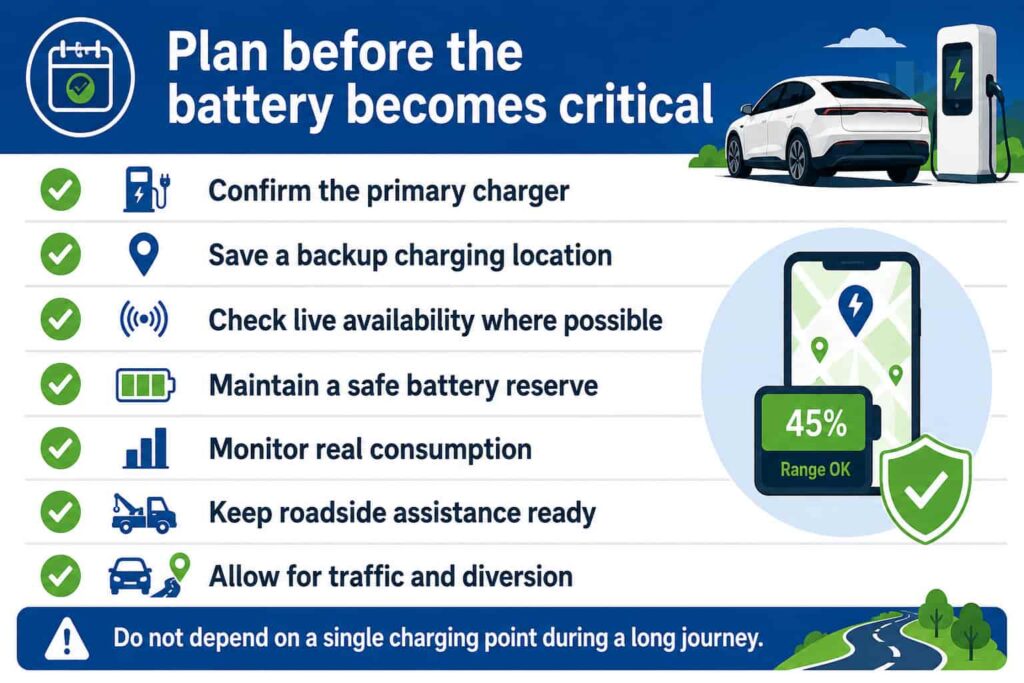
Before leaving, drivers should:
- Check the expected route and distance.
- Identify the main charging station.
- Save at least one backup charging point.
- Check recent charger reviews and operating status.
- Monitor actual battery consumption during the trip.
- Avoid relying only on the displayed estimated range.
- Consider traffic, weather and air-conditioning use.
- Keep roadside-assistance numbers available.
- Inform a family member when travelling through an unfamiliar route.
- Start looking for charging well before the battery becomes critical.
The safest plan is one that still works even when the preferred charger is unavailable.
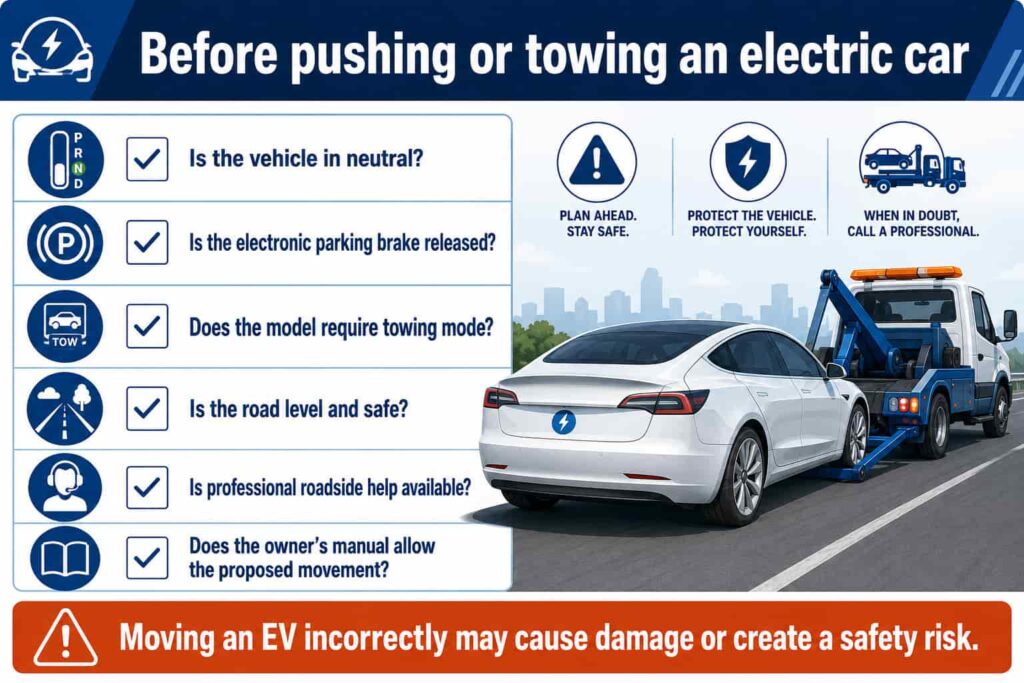
Is it safe to push a stranded EV?
Not every EV should be pushed or towed in the same manner.
Depending on the model:
- the vehicle may need to be placed in neutral;
- an electronic parking brake may need to be released;
- a special towing or transport mode may be required;
- the wheels may lock when the battery is fully depleted;
- improper towing may damage electric-drive components;
- the vehicle’s weight may make manual pushing unsafe.
Where circumstances permit, drivers should check the owner’s manual or contact roadside assistance before moving the vehicle.
The priority should always be personal safety, especially on highways, slopes or roads with fast-moving traffic.
What the viral story does not prove?
The incident does not establish that:
- electric cars are generally unreliable;
- the EV had a manufacturing defect;
- the battery failed without warning;
- the charging station was responsible;
- every stranded EV can safely be pushed;
- the Army officially recognised or rewarded the jawan;
- all reported battery percentages were independently checked.
It should be treated as a reported act of assistance, not as proof against electric mobility.
Final assessment
The viral account combines two distinct lessons.
The first concerns the Army jawan’s conduct. He reportedly helped a stranded driver, moved the EV towards a charger and stayed until she could continue safely.
The second concerns EV journey planning. Waiting until the battery reaches its final few percentage points can leave little room for a closed charger, traffic delay, route error or unexpected energy consumption.
The incident should therefore be remembered not only as a positive human gesture, but also as a reminder:
Plan charging early, keep a backup option and never allow the battery reserve to become the only thing standing between the vehicle and safety.
Sources:-
- The Economic Times — Army personnel helps woman whose EV ran out of charge
- Hindustan Times — Woman thanks Army personnel for helping with stranded EV
- NITI Aayog e-AMRIT — EV frequently asked questions
- NITI Aayog e-AMRIT — EV charging standards and specifications
- Ministry of Power — EV charging infrastructure guidelines




Leave a Reply