


For many Central Government employees, medical coverage is one of the most important parts of service security. Salary matters, pension matters, but when a parent falls sick or a dependent family member needs treatment, access to medical benefits becomes a deeply practical issue. That is why every clarification related to CGHS or CS(MA) Rules deserves careful attention.
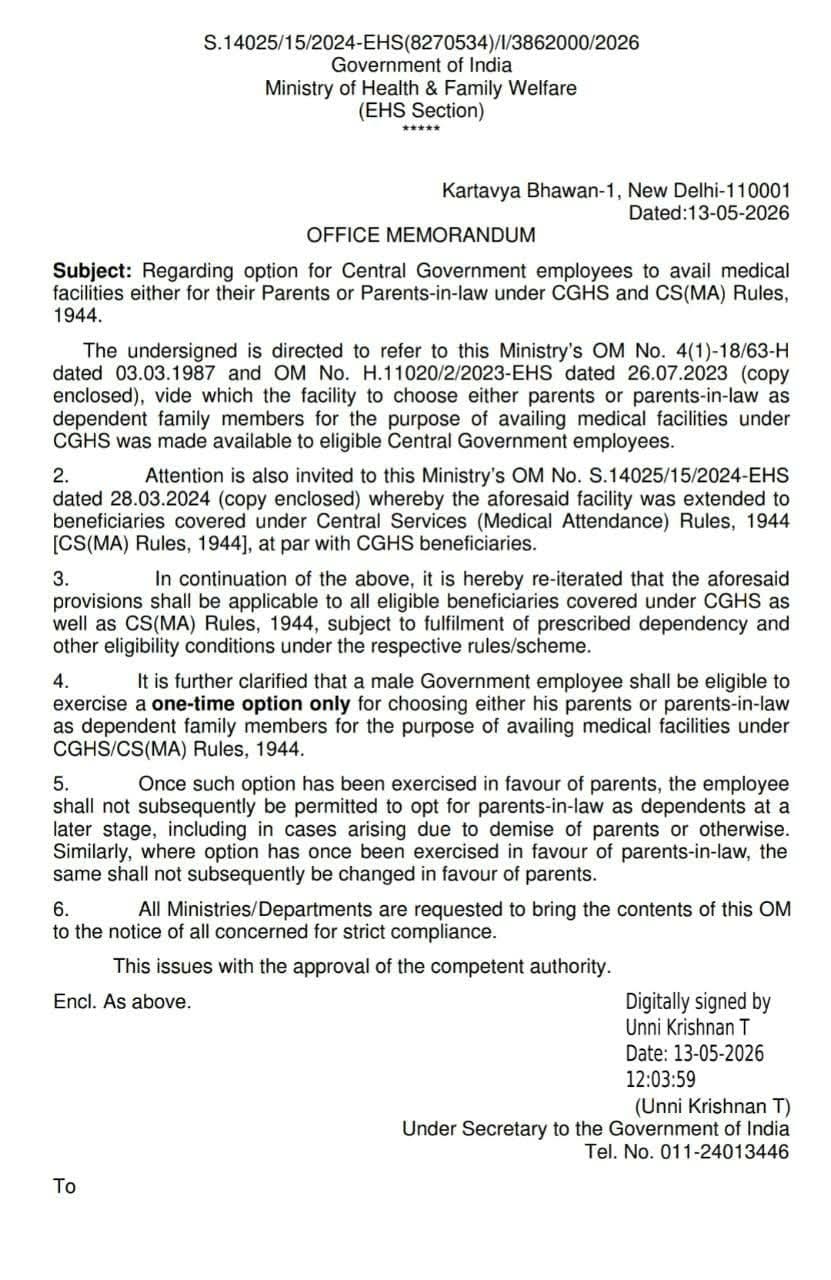
A recent Office Memorandum from the Ministry of Health and Family Welfare has done exactly that. It has brought fresh attention to the option available to government employees for covering either parents or parents-in-law as dependent family members for medical facilities under CGHS and the Central Services (Medical Attendance) Rules, 1944.
At first glance, some employees may feel this is just another administrative clarification. But it is much more important than that. The real message of the order is simple and serious: for a male government employee, the option to include either parents or parents-in-law is a one-time choice. Once the option is exercised, it cannot be changed in the future.
That is where the issue becomes important for families.
The clarification dated 13 May 2026 refers to earlier Ministry orders and explains that eligible beneficiaries under CGHS and CS(MA) Rules can avail medical benefits subject to dependency and other prescribed conditions. But the most important part is the finality of the choice. If a male employee opts for parents, he cannot later shift the benefit to parents-in-law. If he opts for parents-in-law, he cannot later move back and include parents instead.
This is the key point employees must understand before making any declaration.
Many people may wrongly think this is a brand new 2026 benefit. That is not the correct reading. The background to this issue is older. The option related to parents or parents-in-law was already discussed in earlier Ministry communications. Later, through subsequent orders, this facility was widened and clarified, including for male employees under CGHS. A similar approach was also extended to those covered under the CS(MA) Rules. So the 2026 clarification is not about starting a new benefit. It is mainly about making the consequence of the choice absolutely clear.
And that consequence is this: once you choose, there is no second chance later.
That makes the matter more serious than many short social media posts suggest.
In many families, this decision can be emotionally sensitive. A government employee may have elderly parents who need medical support. At the same time, the spouse may also have ageing parents with genuine health concerns. In Indian households, responsibility often extends to both sides of the family. But under this rule, the employee cannot keep both parents and parents-in-law as dependent parents for this purpose. One side has to be chosen, subject of course to the dependency and eligibility conditions under the applicable rules.
This is why the option should never be exercised casually.
Family conditions can change over time. A parent who is financially stable today may become dependent later. A parent-in-law who seems medically secure today may need support after a few years. Circumstances change, health changes, and family expectations also change. But the latest clarification says the option itself does not change later. Even if the chosen parents pass away, the benefit cannot then be shifted to the other side.
That is what makes this a long-term decision rather than a routine declaration.
Employees also need to understand that this is not an automatic right for everyone in every case. The order clearly says the benefit is subject to dependency and other eligibility conditions. This means an employee cannot simply include parents or parents-in-law on personal preference alone. The concerned family members must satisfy the prescribed conditions under CGHS or CS(MA) Rules.

This point is often missed in public discussion.
Many people read a headline and conclude that parents-in-law can now simply be added under CGHS. But the actual position is narrower and more rule-based. Eligibility remains important. Dependency remains important. Administrative procedure remains important. The latest clarification does not remove these requirements. It only tells employees that once the eligible option is chosen, it cannot later be reversed.
That is why employees should verify the position properly before acting.
CGHS remains one of the most important healthcare support systems for Central Government employees, pensioners and other eligible groups. For those covered under the scheme, inclusion of dependent family members can have a direct effect on treatment access, medical consultation, hospital support and reimbursement-related comfort. Similarly, CS(MA) Rules continue to matter for employees who are covered under that system instead of CGHS in the usual way.
This means the issue is not limited to one category of staff. It affects a broad section of Central Government employees.
A sensible employee should therefore approach the matter in three steps. First, confirm whether the parents or parents-in-law concerned actually satisfy the dependency and other eligibility conditions. Second, discuss the issue properly at home instead of making the choice under pressure or assumption. Third, verify the departmental process and keep all documents properly recorded before submitting the option.
This is not the kind of form that should be signed in a hurry.
Employees should also keep proper paperwork. That includes the relevant Office Memorandum, forms used for declaration, dependency documents, departmental approvals and any record connected with CGHS or CS(MA) entitlement. Medical benefits are closely tied to documentation, and incomplete records often create problems later when treatment, referral or claim-related issues come up.
The emotional side of this matter is also worth understanding. In many families, both the employee and the spouse may feel responsible toward their own parents. That is natural. But a scheme-based medical facility has to define one line somewhere. The latest clarification does not solve that emotional difficulty. It only confirms that once the employee makes the choice, the government will treat it as final.
This is exactly why awareness is necessary.
A rushed decision today may become a permanent problem tomorrow. An employee may assume the option can be revised later if family circumstances change. But the latest order removes that assumption. It tells employees clearly that the option is one-time and cannot be switched afterward.
That makes careful decision-making essential.
The safest approach is to rely only on official sources such as the relevant Office Memorandum, departmental guidance and CGHS-related instructions, rather than on forwarded messages or half-read headlines. Many people understand only the first line of a welfare update and miss the actual condition attached to it. In this case, the condition is more important than the headline itself.
The most important takeaway is simple. This is not just a new-looking medical facility clarification. It is a decision with long-term consequences for family healthcare coverage. The option may be useful, but it must be exercised only after understanding that it is final, conditional and not open to future change.
For Central Government employees, that means one thing above all: choose carefully.

Leave a Reply