

A serving defence person or veteran planning to buy an electric scooter through CSD may have seen claims that Central and State electric-vehicle subsidies are now available in addition to the normal CSD price benefit.
That is not the position confirmed by the Government so far.
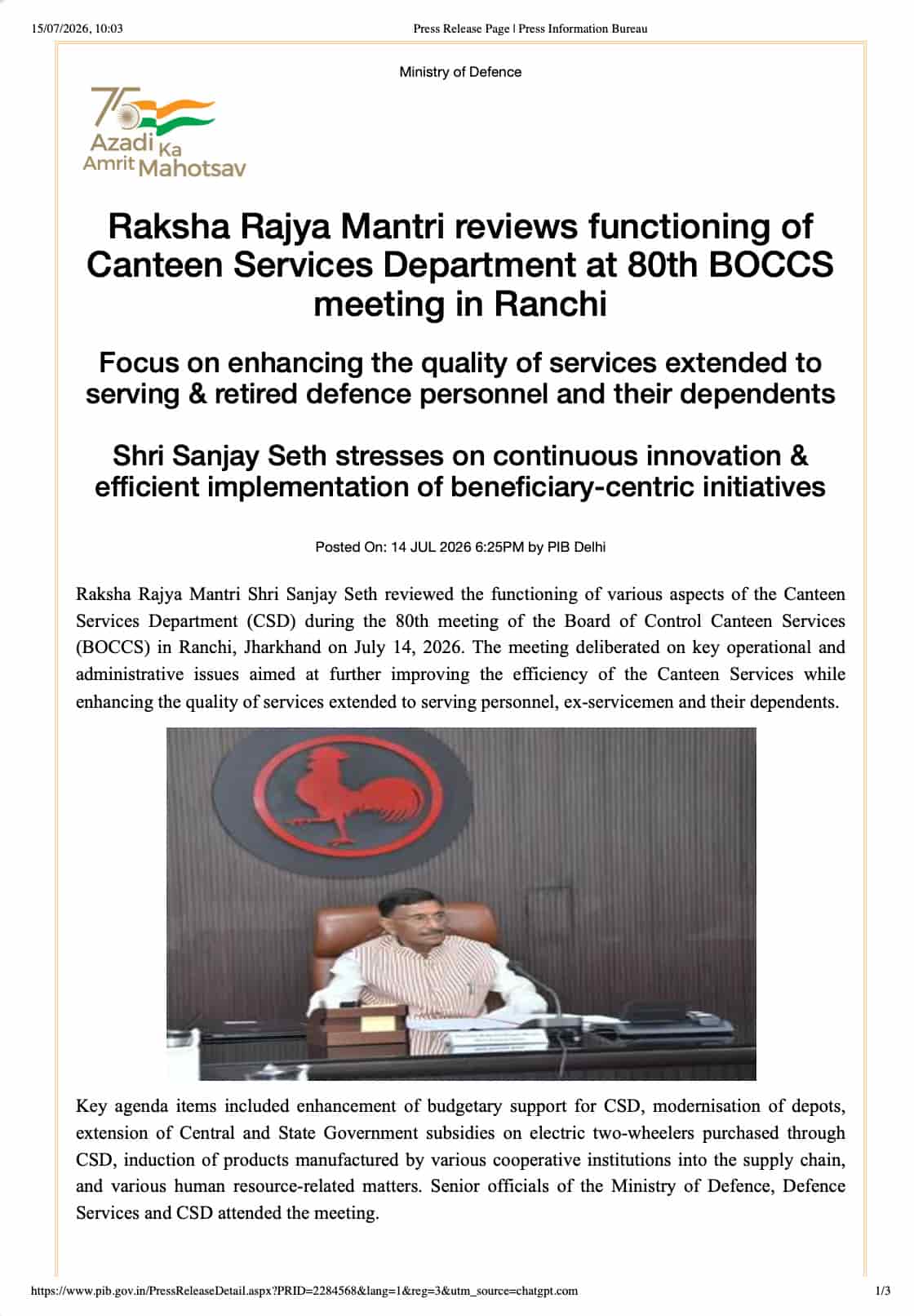
The subject was taken up at the 80th meeting of the Board of Control Canteen Services, held in Ranchi on 14 July 2026. The meeting examined whether existing Central and State incentives for electric two-wheelers could be extended to vehicles purchased through CSD.
However, the Ministry of Defence release records this as an issue considered during the meeting. It does not announce that a new subsidy has become claimable by CSD beneficiaries.
No amount, commencement date, approved scooter list or revised purchasing instruction was provided in the release.
Buyer’s position today: Calculate the purchase using the price and benefits officially available on the CSD AFD portal. Do not add an expected EV subsidy unless a formal order confirms it.
What exactly happened at the latest CSD review?
Raksha Rajya Mantri Sanjay Seth reviewed the functioning of the Canteen Services Department during the BOCCS meeting.
The discussion was broader than electric vehicles. It covered:
- financial support for CSD operations;
- modernisation of depots;
- the possible application of Central and State EV incentives to CSD electric two-wheelers;
- addition of products manufactured by cooperative organisations;
- human-resource matters;
- assistive devices for eligible defence beneficiaries with disabilities; and
- improvement in services for serving personnel, veterans and dependants.
The official objective was to improve operational efficiency and make CSD services more responsive to the defence community.
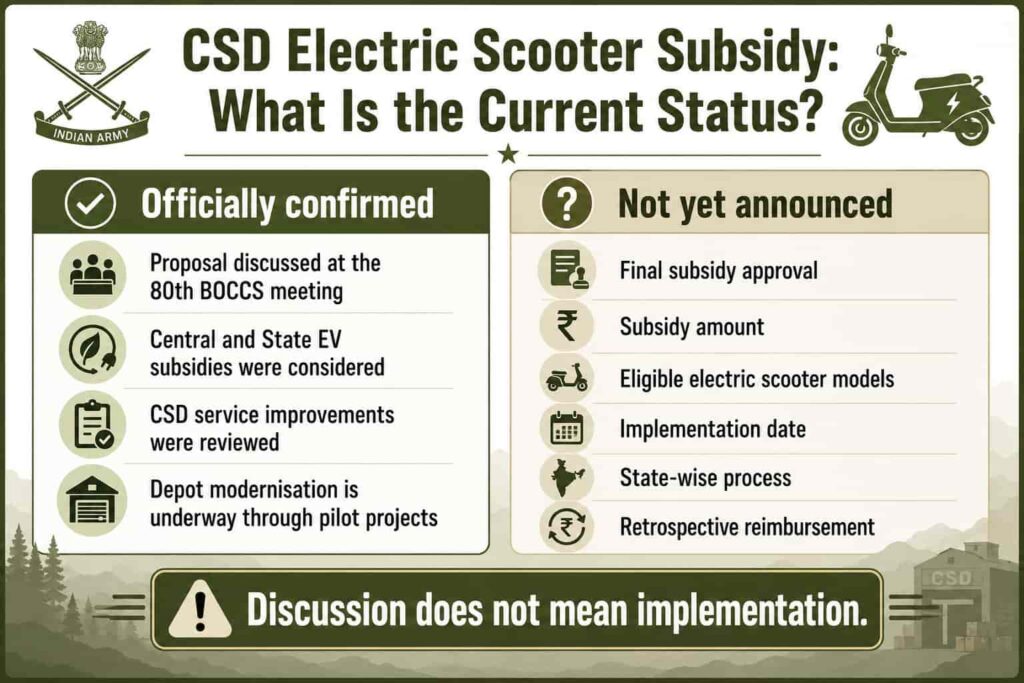
Is the CSD electric scooter subsidy available now?
No new CSD-specific electric-scooter incentive has been declared through the official release.
The announcement confirms that the matter was considered. It does not confirm that the benefit has been sanctioned or opened for applications.
Present status in simple terms
| Question from a buyer | Current position |
|---|---|
| Was the matter discussed by the Government? | Yes |
| Can a CSD buyer claim the new subsidy today? | Not announced |
| Has the amount been declared? | No |
| Have qualifying scooter models been listed? | No |
| Is there a starting date? | No |
| Has the AFD buying procedure been revised? | No revised process announced |
| Has any refund been announced for earlier purchases? | No |
| Will the benefit be identical in every State? | Not clarified |
The distinction is important because a review-meeting agenda does not automatically create a financial entitlement.
Before the proposal can become usable, the Government may have to settle issues involving eligibility, State policy coordination, invoicing, registration, dealers, portal integration and payment adjustment.
Why does a CSD purchase require a separate subsidy mechanism?
A normal retail electric-scooter purchase and a CSD vehicle purchase do not follow exactly the same route.
A civilian customer normally deals directly with the manufacturer or dealer. A CSD beneficiary must also satisfy the CSD entitlement and complete the AFD purchasing procedure.
A future EV benefit may require authorities to decide:
- whether the incentive will reduce the CSD price or dealer invoice;
- who will verify the beneficiary;
- whether the dealer will claim the amount;
- which State’s policy will apply;
- how registration details will be matched;
- whether the vehicle must meet a price ceiling;
- how the benefit will appear in the final invoice; and
- whether the AFD portal must generate additional documents.
Until these points are formally addressed, the discussion cannot safely be treated as an active price reduction.
Will every State offer the same benefit?
Probably not, unless the eventual order creates a uniform mechanism.
State EV policies can differ in several ways:
- amount of purchase incentive;
- eligible vehicle category;
- maximum vehicle price;
- road-tax treatment;
- registration charges;
- policy validity;
- available budget; and
- conditions for claiming the benefit.
A defence beneficiary may live in one State, use a depot in another and register the scooter elsewhere. A future order would have to explain which jurisdiction controls the State-level incentive.
Until such an order is released, buyers should not assume that one national subsidy figure will apply to all CSD purchases.
How should a two-wheeler be purchased through CSD at present?
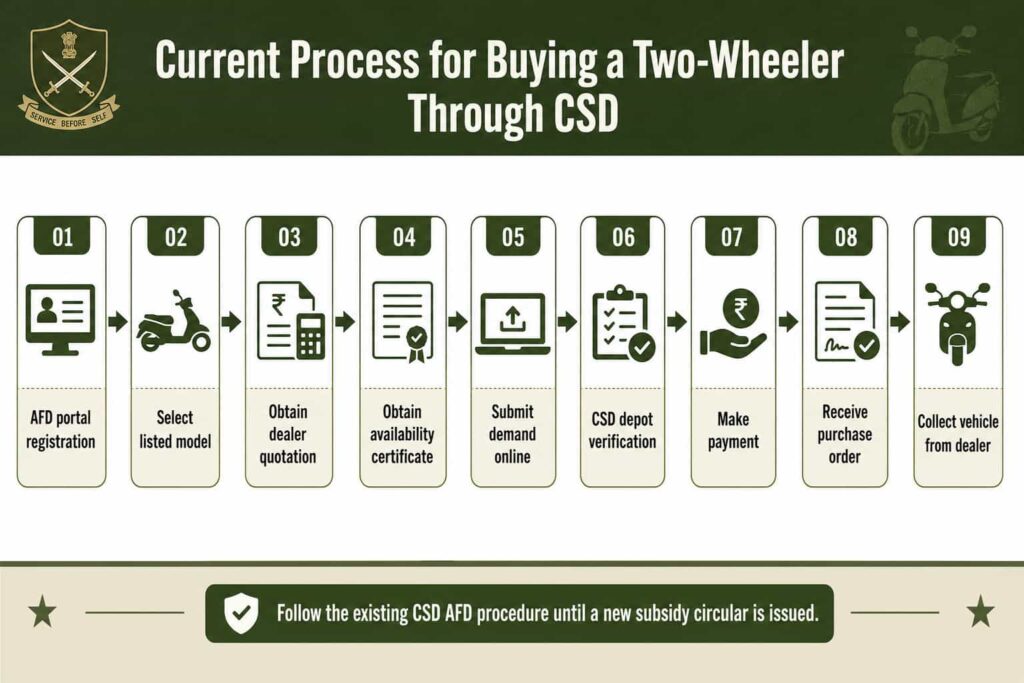
The existing AFD process continues unless CSD formally issues a revised procedure.
The broad workflow is:
- Register or log in on the authorised AFD portal.
- Confirm that the exact two-wheeler model and variant are listed.
- Check the applicable price and zone.
- Obtain a quotation from the authorised dealer.
- Obtain the required availability certificate.
- Select the correct dealer, depot and nominated URC.
- Upload the documents and submit the demand.
- Wait for eligibility and document verification.
- Make payment only through the authorised procedure.
- Download the purchase order or related authority.
- Complete delivery and registration formalities with the dealer.
The official portal, concerned depot and purchase instructions remain the final authority. A dealer or social-media post cannot replace those instructions.
Can every electric scooter sold in India be purchased through CSD?
No.
A scooter’s availability in the civilian market does not establish that it can be ordered through CSD.
The exact model and variant must appear on the authorised AFD portal. Availability may also depend on:
- the manufacturer’s CSD listing;
- the authorised dealer;
- depot and price zone;
- current monthly price;
- stock position; and
- the buyer’s entitlement.
If a future EV subsidy is introduced, a scooter may have to satisfy both systems:
- It must be eligible for purchase through CSD.
- It must qualify under the applicable EV-incentive rules.
No consolidated CSD list covering both conditions has been published through the latest announcement.
What price should a beneficiary calculate today?
The safest approach is to use only the amount currently confirmed through the official CSD process.
Before deciding whether a scooter is affordable, obtain a written breakup covering:
| Cost component | What the buyer should verify |
|---|---|
| Civilian ex-showroom price | Normal retail price |
| CSD price | Current portal-linked price |
| Manufacturer discount | Commercial offer, if any |
| Existing EV benefit | Only where formally applicable |
| Insurance | Premium and coverage |
| Registration | State-specific cost |
| Accessories | Optional or dealer-added items |
| Additional charges | Handling or other dealer costs |
This helps prevent a dealer discount from being described as a newly approved government subsidy.
What should buyers ask the dealer?
A beneficiary should ask for written answers to the following:
- Is the exact variant available through CSD?
- Does the quotation match the current AFD price?
- Is an availability certificate being issued?
- Does the quoted amount already include any existing incentive?
- Which charges are outside the CSD price?
- What is the registration amount?
- Is insurance included?
- Are accessories optional?
- Are any additional payments being requested?
- Will every amount appear on the final invoice?
Verbal assurances are difficult to prove later. A clear written quotation protects the buyer.
Should a buyer purchase now or wait?
There is no single answer for every beneficiary.
Buying now may be reasonable when:
- the scooter is required urgently;
- the model is already available through CSD;
- the present price is acceptable;
- the buyer is not depending on an additional subsidy; and
- all costs are confirmed in writing.
Waiting may be reasonable when:
- the expected subsidy is the main reason for buying;
- the purchase is not urgent;
- the desired model is not currently listed;
- the State incentive position is unclear; or
- the buyer wants to compare the existing price with any future benefit.
The BOCCS discussion is an encouraging policy signal. It is not a guarantee that implementation will happen immediately or that every model will qualify.
Can someone who already purchased an electric scooter claim a refund?
No such reimbursement has been announced.
The official release does not mention:
- repayment to earlier purchasers;
- revision of completed invoices;
- claims through CSD depots;
- transfer of subsidy to a beneficiary’s bank account; or
- adjustment against a future purchase.
An earlier buyer should not pay any agent who claims to process a retrospective EV subsidy.
Do not share:
- OTPs;
- portal passwords;
- Aadhaar authentication information;
- bank credentials;
- purchase orders; or
- original documents
with an unknown intermediary.
What is the position of CSD depot modernisation?
This part of the announcement is more advanced than the EV-subsidy proposal.
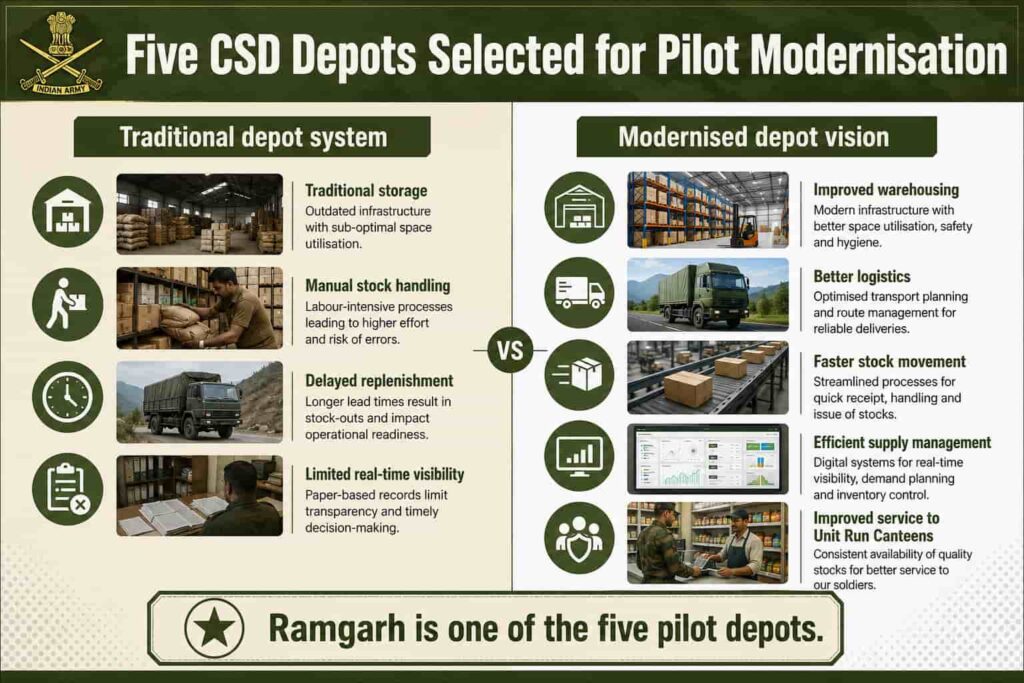
During the visit, the Raksha Rajya Mantri inspected CSD Depot Ramgarh, which is one of five pilot depots selected for modernisation.
The Government says efforts are underway to develop it into a modern warehousing and logistics facility. The project is expected to provide a model for phased upgradation of other CSD depots.
The release does not disclose:
- names of the other four pilot depots;
- total approved expenditure;
- completion schedule;
- detailed equipment specifications;
- vendors involved; or
- nationwide rollout dates.
Those details should not be inferred from the general announcement.
How might modernisation affect CSD beneficiaries?
The final value of depot modernisation will be measured through the experience of Unit Run Canteens and beneficiaries.
A better depot system could potentially support:
- more organised warehousing;
- improved stock monitoring;
- quicker replenishment;
- better transport planning;
- stronger inventory visibility;
- reduced manual errors;
- improved supply forecasting; and
- faster movement of goods.
For veterans and serving families, these operational improvements would matter if they result in:
- more consistent product availability;
- fewer avoidable shortages;
- quicker service;
- better complaint handling; and
- more reliable delivery to Unit Run Canteens.
These are expected advantages, not nationwide outcomes already guaranteed by the announcement.
What is changing in the CSD product range?
The meeting also reviewed the phased addition of products made by cooperative institutions.
The official release names organisations such as:
- Tribal Cooperative Marketing Development Federation of India;
- Khadi and Village Industries Commission;
- National Agricultural Cooperative Marketing Federation of India;
- National Cooperative Organics Limited; and
- other cooperative bodies.
Unlike the proposed electric-scooter incentive, this initiative is described as already progressing in phases.
The objective is to widen market access for artisans, tribal communities, farmers and cooperative organisations while increasing the share of Indian products in the CSD network.
What was discussed for defence beneficiaries with disabilities?
The meeting also considered the availability of assistive devices for eligible persons with disabilities among:
- serving defence personnel;
- ex-servicemen; and
- their dependants.
The announcement does not specify:
- the devices that may be offered;
- medical eligibility;
- purchase limits;
- prices;
- documentation;
- distribution channel; or
- launch date.
This should therefore be treated as a welfare measure under consideration, not as a benefit that can already be claimed.
Confirmed decisions and unanswered questions
What the official release confirms?
- The 80th BOCCS meeting was held on 14 July 2026.
- The CSD system and service delivery were reviewed.
- The possible extension of EV incentives to CSD electric two-wheelers was discussed.
- Ramgarh is one of five pilot modernisation depots.
- Work to improve Ramgarh’s warehousing and logistics capacity is underway.
- Cooperative-sector products are entering the CSD portfolio in phases.
- Assistive devices for eligible defence beneficiaries were considered.
- Additional budgetary and administrative matters were examined.
What has not been disclosed?
- final approval of a CSD EV subsidy;
- amount of the benefit;
- eligible models and variants;
- date from which it may apply;
- claim or invoice procedure;
- revised AFD instructions;
- State-wise implementation rules;
- refund for previous buyers;
- names of the other pilot depots; and
- completion timeline for nationwide modernisation.
Why does this matter to serving personnel and veterans?
Electric scooters can be useful for daily local travel because of their potentially lower running cost and reduced dependence on petrol.
For a retired person, they may also offer a convenient option for:
- nearby market visits;
- polyclinic travel;
- short urban journeys; and
- routine family use.
A properly designed EV incentive combined with the existing CSD buying route could improve affordability.
But the benefit will become meaningful only when buyers receive official clarity on:
- who qualifies;
- which vehicles are covered;
- how much will be deducted;
- where the vehicle must be registered;
- how the dealer will process it; and
- which documents must be submitted.
Until those instructions arrive, this should be viewed as a policy proposal with potential—not as a discount available at the billing counter.
Final takeaway
The latest CSD review contains several developments, but they are at different stages.
The phased addition of cooperative products is already underway.
CSD Depot Ramgarh has been selected as one of five pilot modernisation sites, and improvement work is being pursued.
Assistive devices for eligible defence beneficiaries were considered, but detailed rules were not issued.
The electric two-wheeler proposal has also entered official discussion. Yet the Government has not announced that CSD buyers can claim a new Central or State EV subsidy today.
For a buyer, the practical rule is straightforward:
Purchase according to the benefit visible and confirmed through the authorised CSD system—not according to a subsidy expected from a meeting discussion.
Before booking an electric scooter:
- verify the model on the official AFD portal;
- check the latest price;
- obtain a written quotation;
- separate discounts from government incentives;
- confirm insurance and registration costs;
- pay only through authorised channels; and
- preserve the complete transaction record.
Frequently asked questions
Has CSD approved a new electric scooter subsidy?
The Ministry of Defence release confirms that the proposal was discussed. It does not announce that the subsidy has become operational.
Is the subsidy amount known?
No amount has been declared through the latest announcement.
Which electric scooters will qualify?
No CSD-specific eligible-model list has been released under the proposal.
Can an eligible ex-serviceman buy an electric scooter through CSD?
A beneficiary may purchase an electric two-wheeler only if the exact model and variant are available through the authorised CSD AFD system and other entitlement conditions are met.
Has the current AFD procedure changed?
No revised subsidy-related purchase procedure has been announced.
Will buyers receive both Central and State benefits?
Both categories of incentives were discussed, but their application through CSD has not been explained.
Can a previous buyer claim reimbursement?
No retrospective reimbursement has been announced.
Should a buyer postpone the purchase?
A buyer who needs the vehicle immediately may assess the current confirmed CSD price. Someone purchasing mainly because of the proposed subsidy may prefer to wait for formal instructions.
Which CSD depot is being modernised?
Ramgarh is one of five pilot depots identified for modernisation.
Are products from cooperative institutions already being added?
Yes. Their phased induction into the CSD portfolio is described as ongoing.
Can assistive devices already be purchased as a new CSD benefit?
The matter was discussed, but no detailed operational scheme has been announced.
Sources:-
Official Ministry of Defence PIB release:
https://www.pib.gov.in/PressReleaseDetail.aspx?PRID=2284568&lang=1®=3

Leave a Reply