

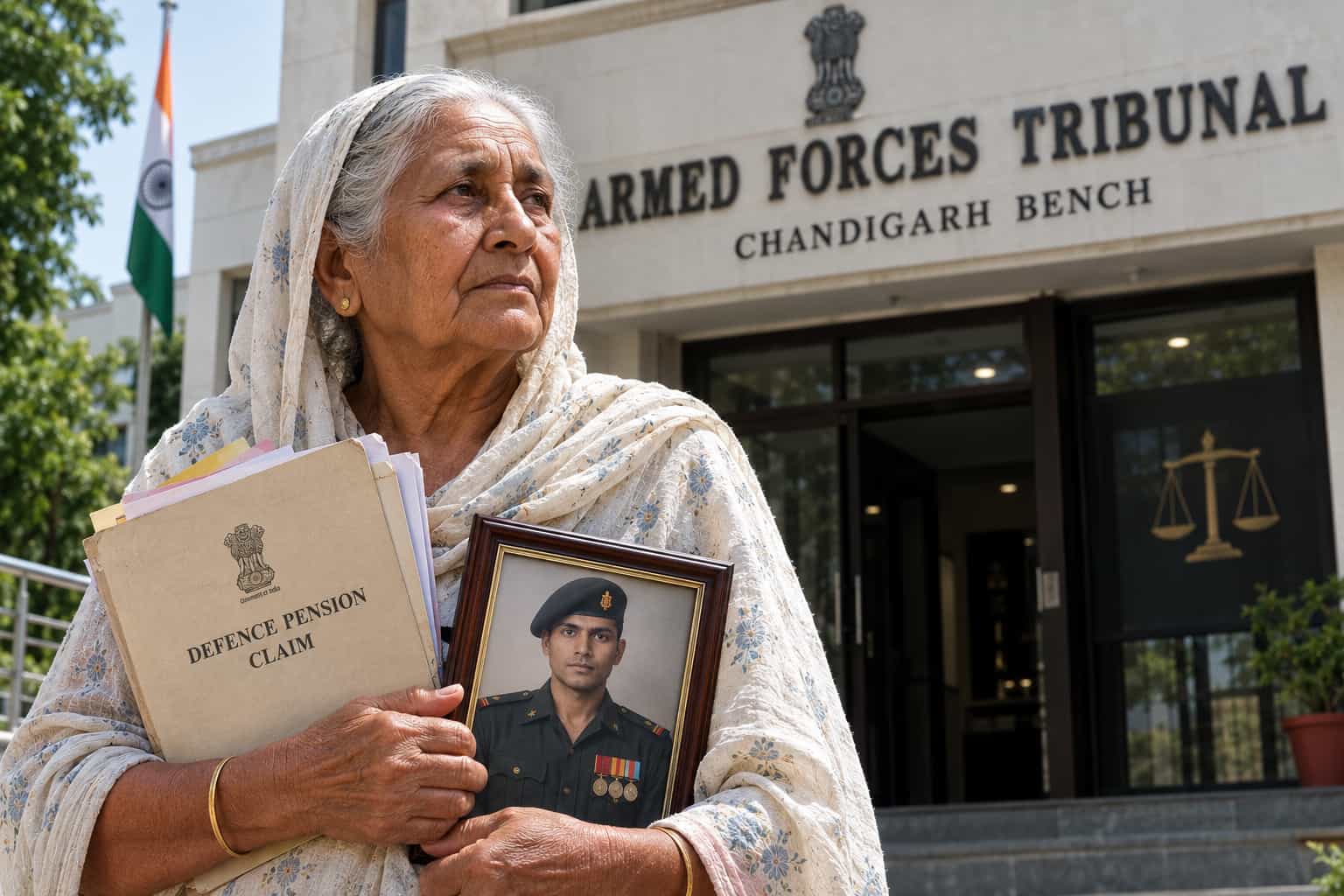
A defence pension dispute involving the widow of an Army veteran has drawn attention to the difficulties military families can face even after securing favourable legal relief.
The case concerns Gunner Darshan Singh, who was medically invalided out of the Indian Army in April 1993 after completing slightly more than nine years of service. His physical disabilities were reportedly accepted as attributable to military service. Despite this, the pension benefit connected with his service remained disputed for decades.
According to a report published by The Tribune on 11 July 2026, the Chandigarh Bench of the Armed Forces Tribunal granted pensionary benefits and arrears to his widow. The Tribunal also reportedly imposed ₹5 lakh in costs after observing that she had faced prolonged harassment and denial of her rightful claim.
This case is important not only because of the 33-year period mentioned in the headline. It also raises questions about military pension classification, implementation of Tribunal orders and administrative accountability.
Why is it described as a 33-year pension dispute?
The 33-year period is calculated from Darshan Singh’s medical invalidment in 1993 to the reported AFT relief in 2026.
However, this does not necessarily mean that his widow has been granted 33 years of ordinary family pension.
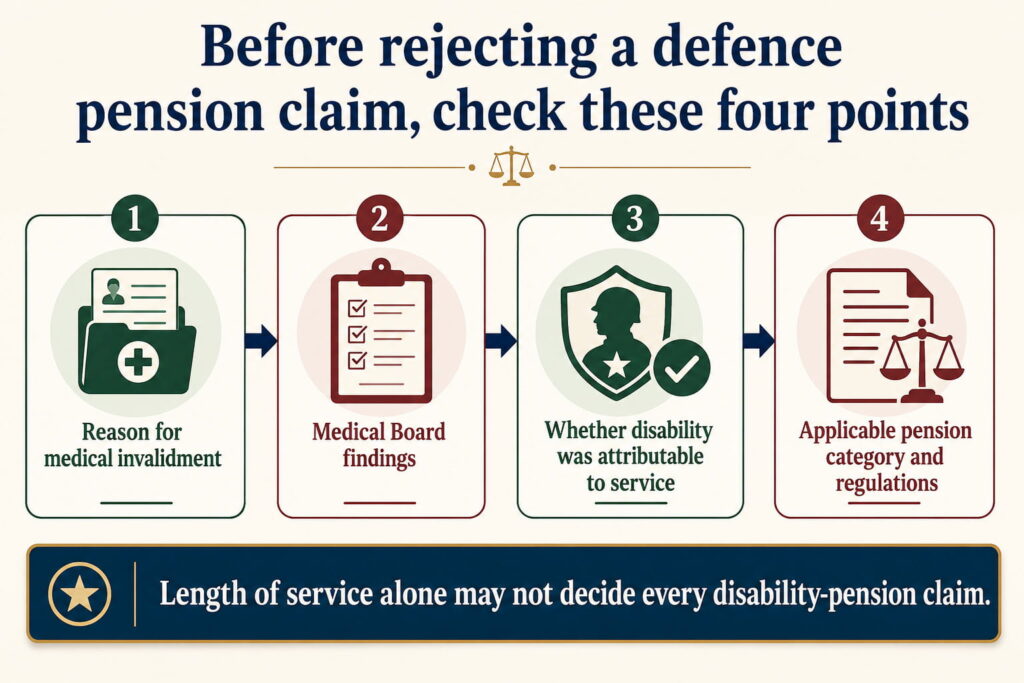
The financial relief may cover different benefits for different periods:
- pension arrears relating to Darshan Singh’s service element;
- amounts payable during his lifetime;
- ordinary family pension payable to his widow after his death;
- costs imposed because of delay and reported harassment.
The exact calculation can only be established from the complete signed AFT judgment and the subsequent pension-implementation order.
What happened after Darshan Singh left the Army?
Darshan Singh was medically invalided out of service in April 1993 because of physical disabilities.
Reports state that his disabilities were held attributable to military service. Despite this finding, he was not granted the pension benefit he claimed was due.
He later approached the Armed Forces Tribunal seeking the service element of pension from 1993.
The Tribunal reportedly accepted his claim in an earlier round of litigation. However, the payment of arrears remained restricted or disputed.
Darshan Singh passed away in November 2011, before the matter was finally resolved. His death did not automatically remove any pension entitlement that had accrued to him during his lifetime.
Why was the service element reportedly withheld?
The published report states that the pension authorities did not release the service element because Darshan Singh had not completed ten years of qualifying service.
This became one of the central issues in the dispute.
The authorities appear to have relied on the duration of service. The family’s case, however, was reportedly based on the fact that Darshan Singh’s disability had been accepted as attributable to military service.
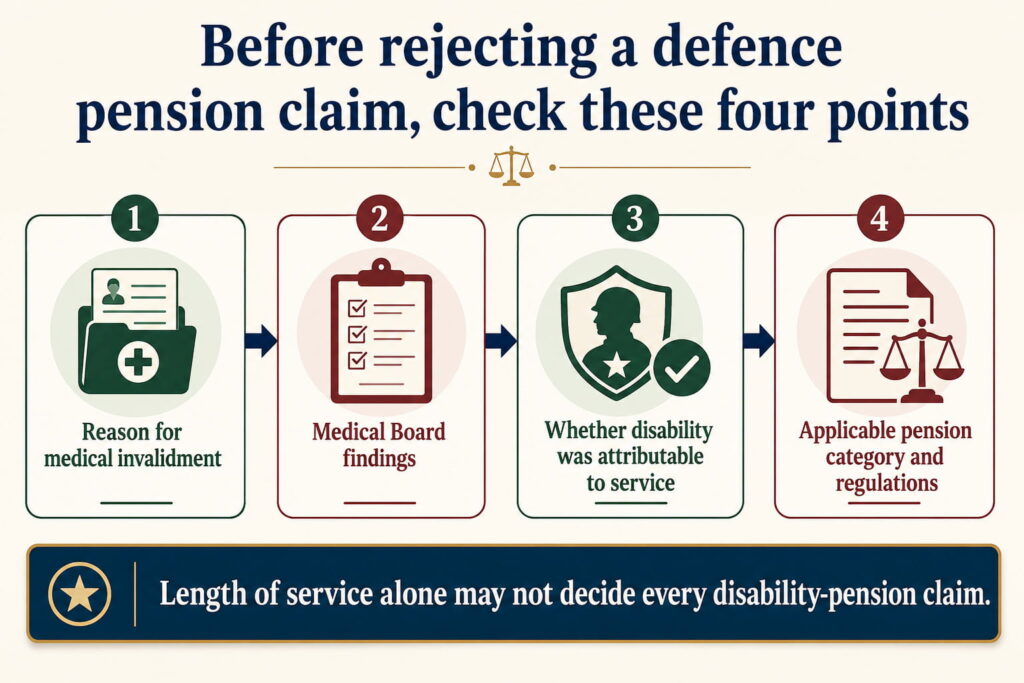
Military pension cases cannot always be decided by counting the total number of years served. The exact category of pension, reason for invalidment and findings of the Medical Board must be examined together.
Why pension classification matters?
Several defence pension benefits sound similar but operate under different conditions.
Disability pension
Disability pension generally relates to personnel released or invalided out due to a disability attributable to or aggravated by military service.
It may include:
- service element;
- disability element.
The service element relates to the individual’s service and reckonable emoluments. The disability element depends on the assessed degree of disability and the applicable pension rules.
Invalid pension
Invalid pension is a separate category. It generally relates to invalidment where the disability is classified as neither attributable to nor aggravated by military service, subject to the rules applicable at the relevant time.
The conditions governing invalid pension and disability pension are therefore not necessarily identical.
A ten-year service requirement cannot be considered in isolation. The disability classification, applicable pension regulations and nature of the claim must all be examined.
What happened to the widow’s family-pension claim?
After Darshan Singh’s death, his widow pursued ordinary family pension.
Her case was reportedly based on the argument that once her husband’s entitlement to the service element had been recognised, ordinary family pension became payable to her after his death.
The Tribunal reportedly noted that the authorities had processed her family-pension claim in 2022. According to the published account, this indicated acknowledgement of her eligibility.
The pension payable to Darshan Singh during his lifetime and the ordinary family pension payable to his widow after his death are separate benefits.
They may apply to different periods and require separate calculations.
Why is the reported 14-year non-implementation significant?
One of the most serious issues in the case is the allegation that an earlier Tribunal order remained unimplemented for approximately 14 years.
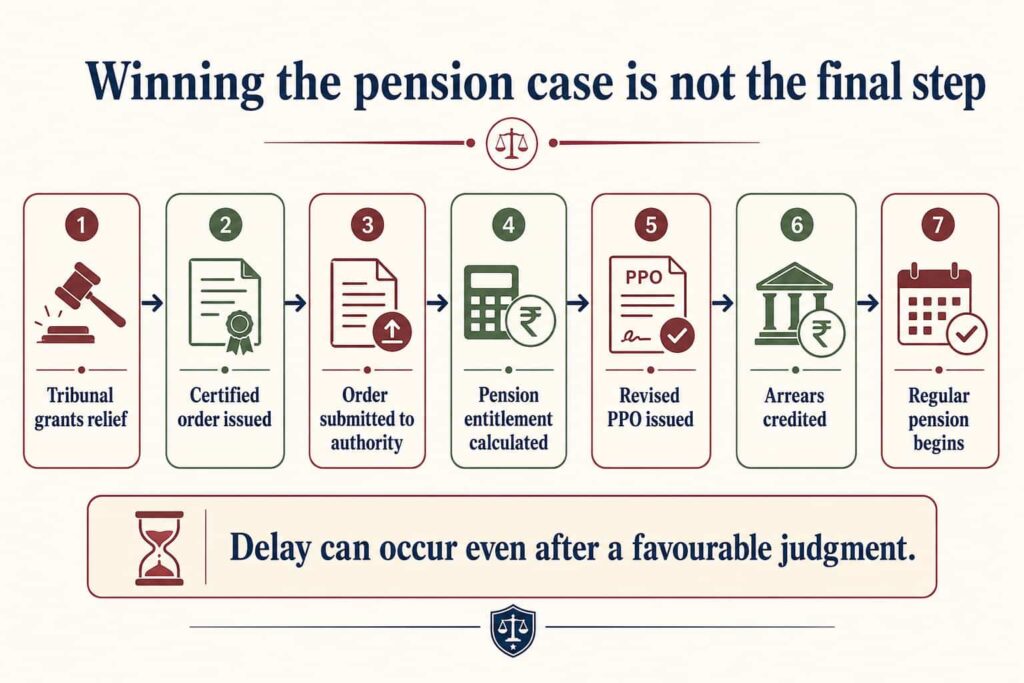
A favourable judgment does not provide complete relief unless the competent authorities act upon it.
After a Tribunal order, several steps may still be required:
- certified copy of the order;
- submission to the competent authority;
- verification of service and pension records;
- calculation of arrears;
- issue of a revised Pension Payment Order;
- transfer of arrears and commencement of regular pension.
Any delay at these stages can force an elderly veteran or widow into further correspondence and litigation.
For a military family, prolonged non-implementation may affect household income, medical treatment, financial independence and dignity.
Why did the AFT reportedly impose ₹5 lakh costs?
The Chandigarh Bench reportedly imposed ₹5 lakh in costs because of the prolonged delay, denial of pensionary benefits and hardship allegedly caused to the widow.
The reported reasons include:
- failure to implement an earlier order;
- withholding of the soldier’s service-element arrears;
- delay in granting ordinary family pension;
- repeated rejection of the claim;
- unnecessary hardship and further litigation.
The ₹5 lakh amount should currently be described as costs ordered or imposed by the Tribunal.
It should not be described as money already credited to the widow unless payment is confirmed through a revised PPO, official implementation order or statement from the family.
The complete judgment is also necessary to determine whether the costs are payable by the department, particular officials or another authority.
What do official AFT records establish?
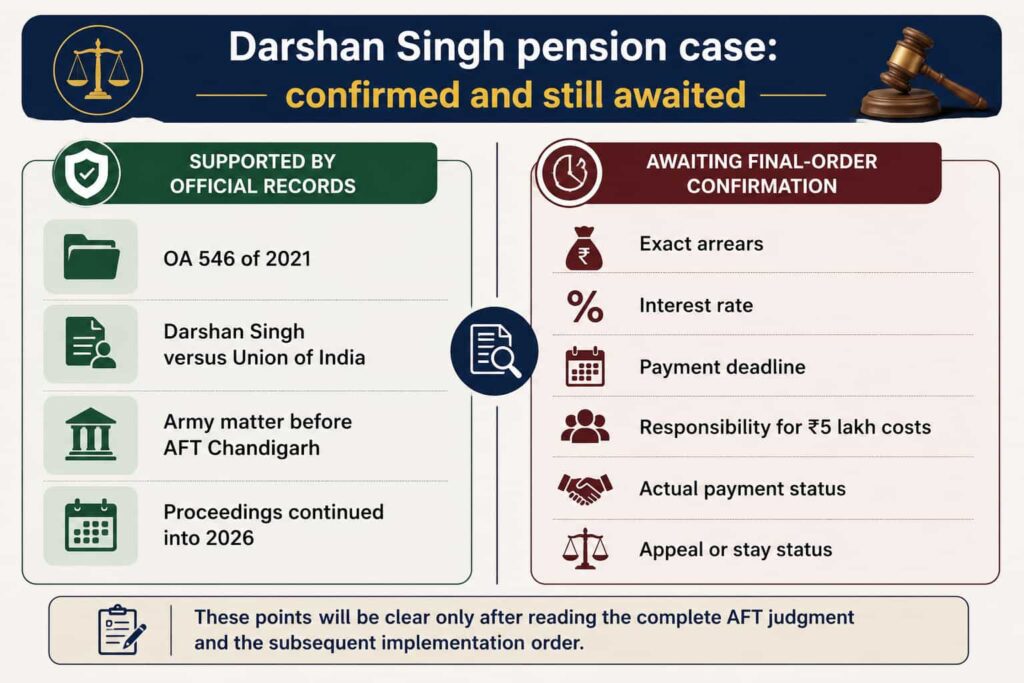
Official cause lists of the Armed Forces Tribunal, Regional Bench Chandigarh, contain the case:
OA 546 of 2021 — Darshan Singh versus Union of India and others
The matter is identified as an Army case and appears in official AFT listings during 2025. Connected proceedings also continued into 2026.
These records officially support the existence and continuation of the case.
A cause list, however, does not contain the Tribunal’s complete reasoning or final financial directions.
It cannot independently establish:
- total arrears payable;
- calculation period;
- applicable interest;
- deadline for implementation;
- authority responsible for the ₹5 lakh costs;
- status of appeal or stay;
- whether payment has already been made.
What should similarly placed military families do?
The Darshan Singh pension case offers practical lessons for other veterans and dependants.
Identify the correct pension category
A rejection citing inadequate qualifying service should be examined carefully.
The claim may relate to:
- service pension;
- disability pension;
- service element;
- disability element;
- invalid pension;
- ordinary family pension;
- special family pension.
Each benefit has different conditions.
Preserve Medical Board proceedings
In disability-pension disputes, medical documents are often central to the case.
Families should preserve:
- Invaliding Medical Board proceedings;
- Release Medical Board documents;
- disability-percentage assessment;
- attributability or aggravation finding;
- service medical records;
- discharge or invalidment order.
Retain all pension correspondence
Keep copies of:
- pension applications;
- rejection orders;
- appeals;
- Record Office correspondence;
- reminders and representations;
- Pension Payment Orders;
- revised PPOs;
- Tribunal and court orders.
Track implementation after winning a case
After obtaining a favourable judgment, the claimant should retain:
- certified copy of the order;
- proof of submission to the authority;
- acknowledgement or postal receipt;
- correspondence concerning implementation;
- revised pension-sanction documents;
- proof of arrears received.
Update family records
Ordinary family pension may be delayed when family details are incomplete or outdated.
Important documents include:
- marriage certificate;
- death certificate;
- family declaration;
- nomination details;
- Aadhaar and identity documents;
- bank details;
- next-of-kin records.
Does this decision apply to every short-service soldier?
No.
The reported order does not mean that every person medically discharged before completing ten years of service will automatically receive disability pension.
Entitlement depends on the individual case, including:
- reason for invalidment;
- nature and degree of disability;
- Medical Board findings;
- whether the disability was attributable to or aggravated by service;
- date of discharge;
- regulations applicable at that time;
- earlier court or Tribunal orders;
- eligibility of the claimant after the veteran’s death.
The Darshan Singh dispute may provide useful guidance, but every claimant must establish entitlement through their own service, medical and pension records.
What is confirmed and what still requires verification?
Supported by official records
- OA 546 of 2021 existed before AFT Chandigarh.
- The case was titled Darshan Singh versus Union of India and others.
- It concerned an Army matter.
- It appeared in official AFT cause lists.
- Connected proceedings continued into 2026.
Reported by the newspaper
- pensionary benefits and arrears were granted;
- an earlier order remained unimplemented for several years;
- the widow faced prolonged hardship;
- ₹5 lakh costs were imposed.
Awaiting confirmation from the final judgment
- exact amount of arrears;
- calculation period;
- applicable interest;
- implementation deadline;
- responsibility for ₹5 lakh costs;
- appeal or stay status;
- confirmation of actual payment.
The wider issue of administrative accountability
A defence pension is not a discretionary payment. Where entitlement exists under the applicable rules, it becomes an enforceable financial right.
Repeated rejection or delayed implementation can force elderly veterans and widows into years of avoidable litigation.
Such delays may affect:
- financial stability;
- medical expenses;
- household needs;
- legal costs;
- emotional well-being;
- trust in the pension system.
The reported imposition of ₹5 lakh costs gives this case wider importance. It suggests that the Tribunal considered not only the underlying pension entitlement but also the consequences of administrative delay.
For pension authorities, the case highlights the need to apply the correct pension rules, distinguish between different benefit categories and implement judicial orders within a reasonable period.
Conclusion
The Darshan Singh pension dispute is not merely a story about an Army widow securing relief after 33 years.
It is a case involving medical invalidment, disability attributable to military service, service-element pension, ordinary family pension and delayed implementation of legal directions.
Official AFT records support the existence of the proceedings before the Chandigarh Bench. The reported grant of pensionary benefits and ₹5 lakh costs comes from a credible newspaper report, while the complete signed judgment remains necessary to confirm the precise financial directions.
The broader lesson for military families is clear: understand the exact pension category, preserve every service and medical document, and continue tracking the implementation of favourable orders.
A pension recognised under law is a right. It should not take decades of repeated litigation before reaching an eligible veteran or dependant.
Sources:-
- The Tribune report published on 11 July 2026 concerning the Darshan Singh pension dispute and reported ₹5 lakh costs.
- Armed Forces Tribunal, Regional Bench Chandigarh, official cause list dated 7 April 2025.
- Additional AFT Chandigarh cause lists showing connected proceedings during 2025 and 2026.
- Department of Ex-Servicemen Welfare information on defence pension and family-pension categories.


Leave a Reply