


For an ex-serviceman working in security duty, salary clarity is not a small issue.
It affects the monthly budget at home, school fees, medical expenses, family savings and the confidence with which a veteran continues his second career after uniform.
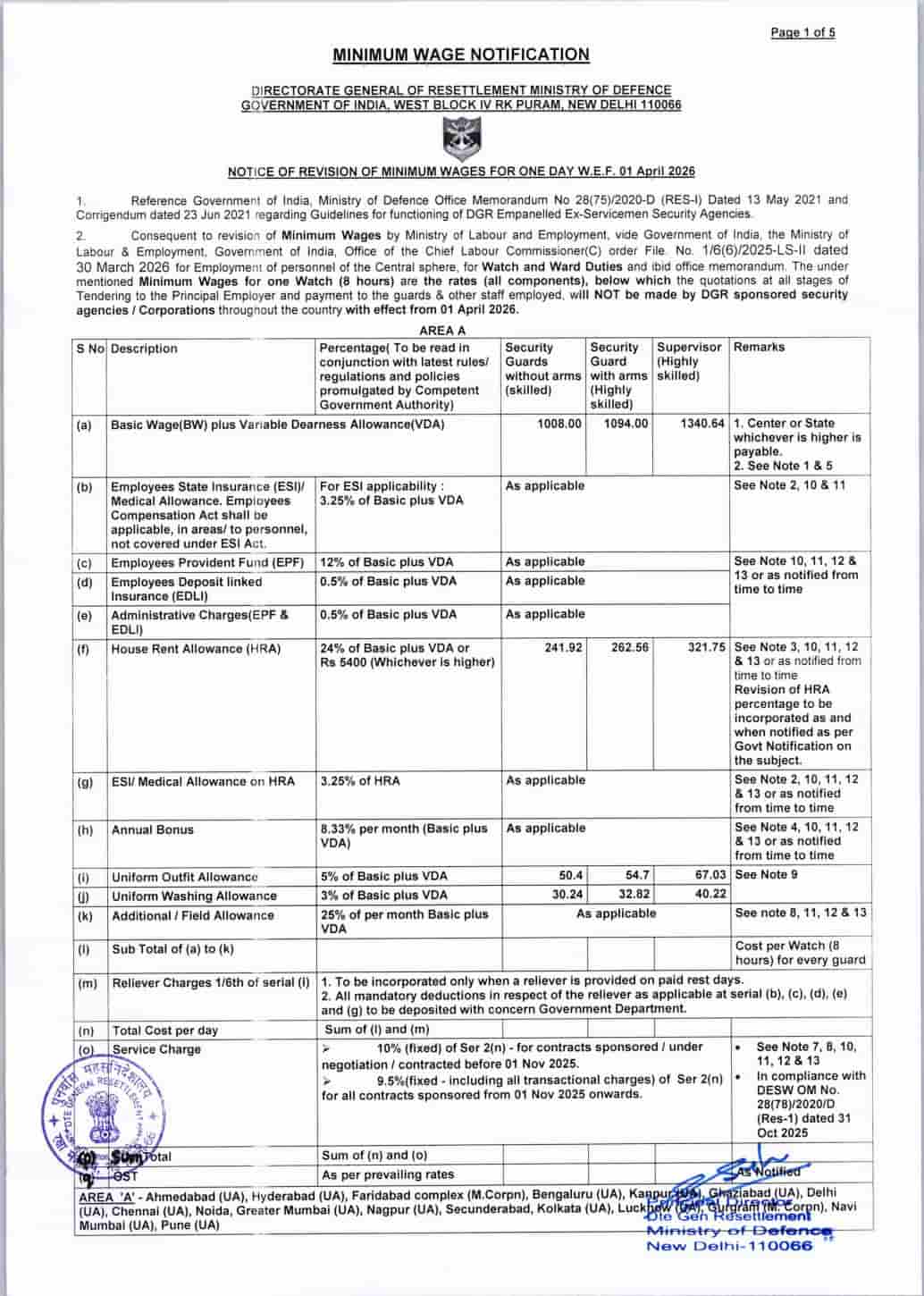
The revised DGR wage notification effective from 1 April 2026 is important for this reason. It gives a reference structure for DGR-linked security duties, especially where ex-servicemen are deployed through DGR-sponsored agencies or corporations.
But the notification should not be read like a simple one-line salary update.
The real question is not only “how much is the rate?” The real question is “how is the payment calculated?”
Why this update needs careful reading?
Many veterans receive wage information through screenshots, WhatsApp forwards or verbal updates from colleagues. That may create awareness, but it can also create confusion.
A wage notification has several layers. There is duty category. There is area classification. There is the 8-hour watch reference. There are statutory parts. There may be agency-level billing components. There may be employer-side charges. There may be deductions.
So a veteran should not compare only the final number with another person’s salary.
Two people may be working in different areas, different duty categories or different contract structures. Their payment may not match even if both are ex-servicemen security personnel.
First check the duty category
The first step is to know the exact category of deployment.
A person may be posted as:
Security guard without arms
Security guard with arms
Supervisor
These are not identical roles. An armed duty post carries a different level of responsibility and compliance expectation compared to an unarmed post. A supervisor role is also not the same as a guard role.
Before asking about the rate, the veteran should first confirm how his duty is officially shown in the agency or contract record.
This one detail can change the entire wage calculation.
Area classification can change the calculation
Location also matters.
DGR wage rates are linked with area classification. A duty location in one area category may not have the same wage reference as another location.
That is why a veteran posted at a PSU gate in one city should not immediately compare his payment with another veteran working in a different city.
The correct question is:
Which area category applies to my duty location?
Once the area is clear, the wage table becomes easier to understand.
8-hour watch should not be ignored
The DGR wage structure refers to one watch of 8 hours.
This line is very important.
Security duty on the ground can be arranged in different ways. Some locations may follow proper 8-hour shifts. Some may have reliever arrangements. Some may involve weekly rest. Some may have overtime conditions. Some contracts may calculate costs differently.
So the amount shown in the notification should not be blindly treated as automatic monthly take-home pay.
A veteran should check how many watches are counted, whether rest days are covered, whether any overtime applies, and how the final monthly amount is prepared.
Understand gross billing and actual salary
This is where many misunderstandings happen.
The figure billed to the principal employer may include several components. The amount received by the worker in hand may be different after statutory deductions and applicable adjustments.
The wage structure may include items such as Basic Wage plus VDA, HRA, EPF, ESI or medical allowance, EDLI, bonus, uniform-related allowance, washing allowance, additional or field allowance, service charge and GST wherever applicable.
Some of these may be direct employee-related amounts. Some may be statutory or employer-side components. Some may relate to agency billing.
That is why every ex-serviceman should ask for a clear wage breakup.
A proper wage slip or written breakup is better than any verbal explanation.
Why principal employers should also take this seriously?
This update is not only for veterans.
Principal employers using DGR-sponsored security services also have a responsibility to understand the latest wage structure.
If a contract is prepared without considering the applicable DGR wage notification, the final impact may fall on the ex-servicemen deployed at the site.
For a fair security arrangement, the employer, agency and deployed worker should all understand the wage basis.
Transparent contracts protect everyone.

What should veterans ask their agency?
A veteran should ask simple and practical questions.
What is my official duty category?
Is my post armed, unarmed or supervisory?
Which area category applies to my site?
Is my duty calculated on an 8-hour watch?
How many watches are counted in the month?
What is the Basic Wage plus VDA?
What are the statutory components?
What deductions are being made?
What is the employer billing amount?
What is my expected take-home amount?
Can I get the wage breakup in writing?
These questions are not arguments. They are basic wage-awareness questions.
Why old notifications can mislead?
DGR wage notifications are issued from time to time. Older PDFs and old screenshots often remain in circulation.
A veteran may unknowingly compare his current pay with an old notification or a wrong effective date.
For the April 2026 update, the effective date is important: 1 April 2026.
So before calculating anything, check the latest notification from the official DGR website.
Comment
This update should be used for awareness, not confusion.
The biggest mistake would be to treat one forwarded figure as final salary for every ex-serviceman security guard. That is not the correct way to read wage notifications.
The smarter approach is to understand the structure.
A veteran should know his duty category, area classification, 8-hour watch basis and statutory breakup. Once these points are clear, the wage discussion becomes more factual and less emotional.
For ex-servicemen, post-retirement dignity is not only about getting a job. It is also about understanding the value of that job correctly.
Final takeaway
The DGR wage rates effective from 1 April 2026 are important for ex-servicemen working in DGR-linked security arrangements.
But the notification should be read carefully. It is not only about one salary figure. It is about duty type, location category, 8-hour watch calculation, statutory benefits and the difference between billing amount and take-home salary.
Veterans should check the official DGR notification, ask for a written wage breakup and avoid depending only on WhatsApp screenshots.
A clear wage understanding helps ex-servicemen protect their income, dignity and second-career stability.
Sources:-
DGR Guidelines and Important Advisories page:
https://dgrindia.gov.in/content1/guidelines-and-important-advisories
DGR Revised Wage Notification w.e.f. 01 April 2026 PDF:
https://dgrindia.gov.in/writereaddata/media/documents/Wage%20Notification%20Apr%202026.pdf
DGR Security Agency page:
https://dgrindia.gov.in/Content2/schemes/security-agency




Leave a Reply