

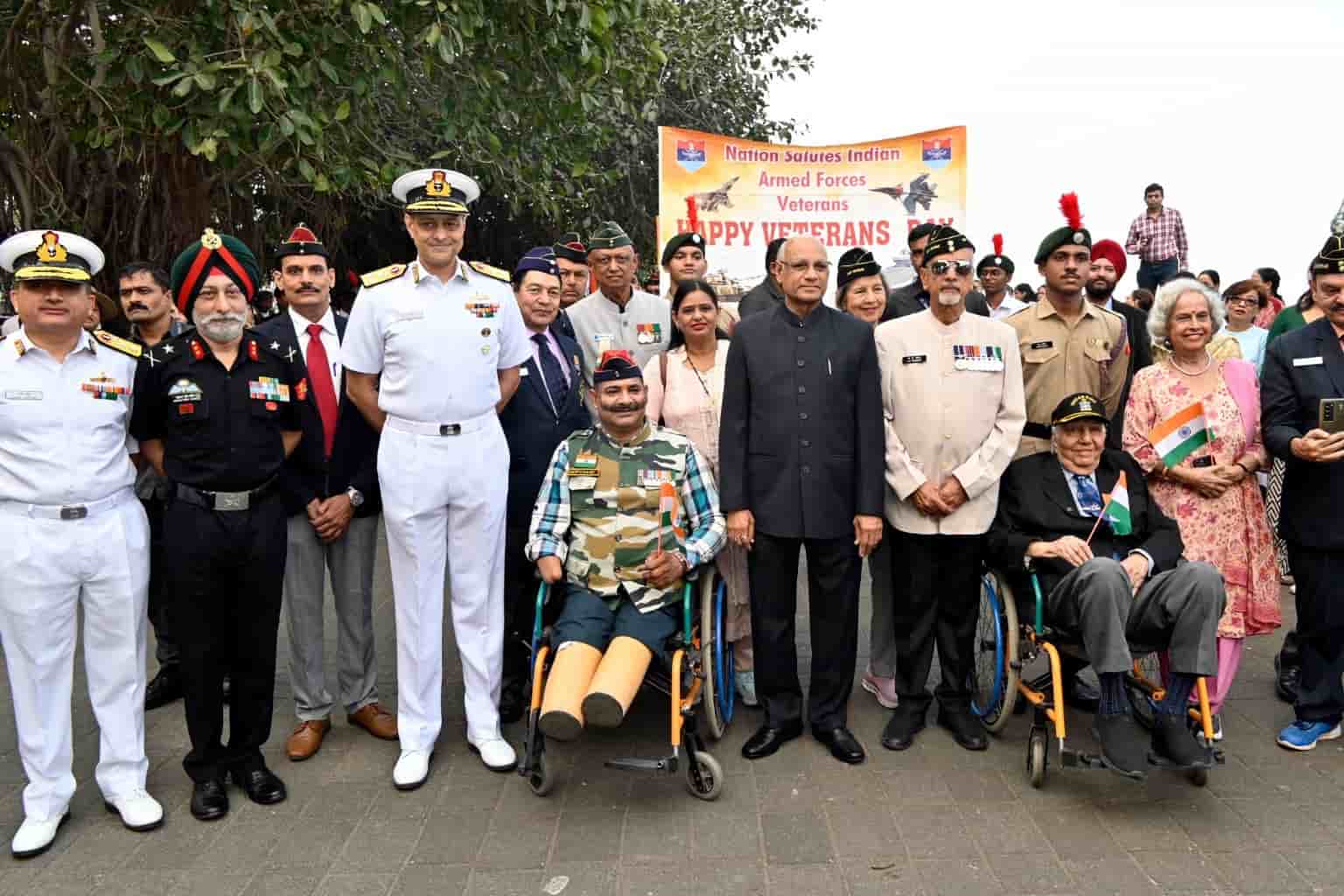
DoPT’s compendium on ex-servicemen reservation explains ESM quota in Central Government jobs, 10% and 20% reservation, age relaxation, education relaxation, fee exemption, roster rules and DGR vacancy intimation.
For many ex-servicemen, the challenge after leaving uniform is not only finding a government job.
The bigger challenge is understanding which reservation, age relaxation, educational relaxation and application benefits actually apply to them.
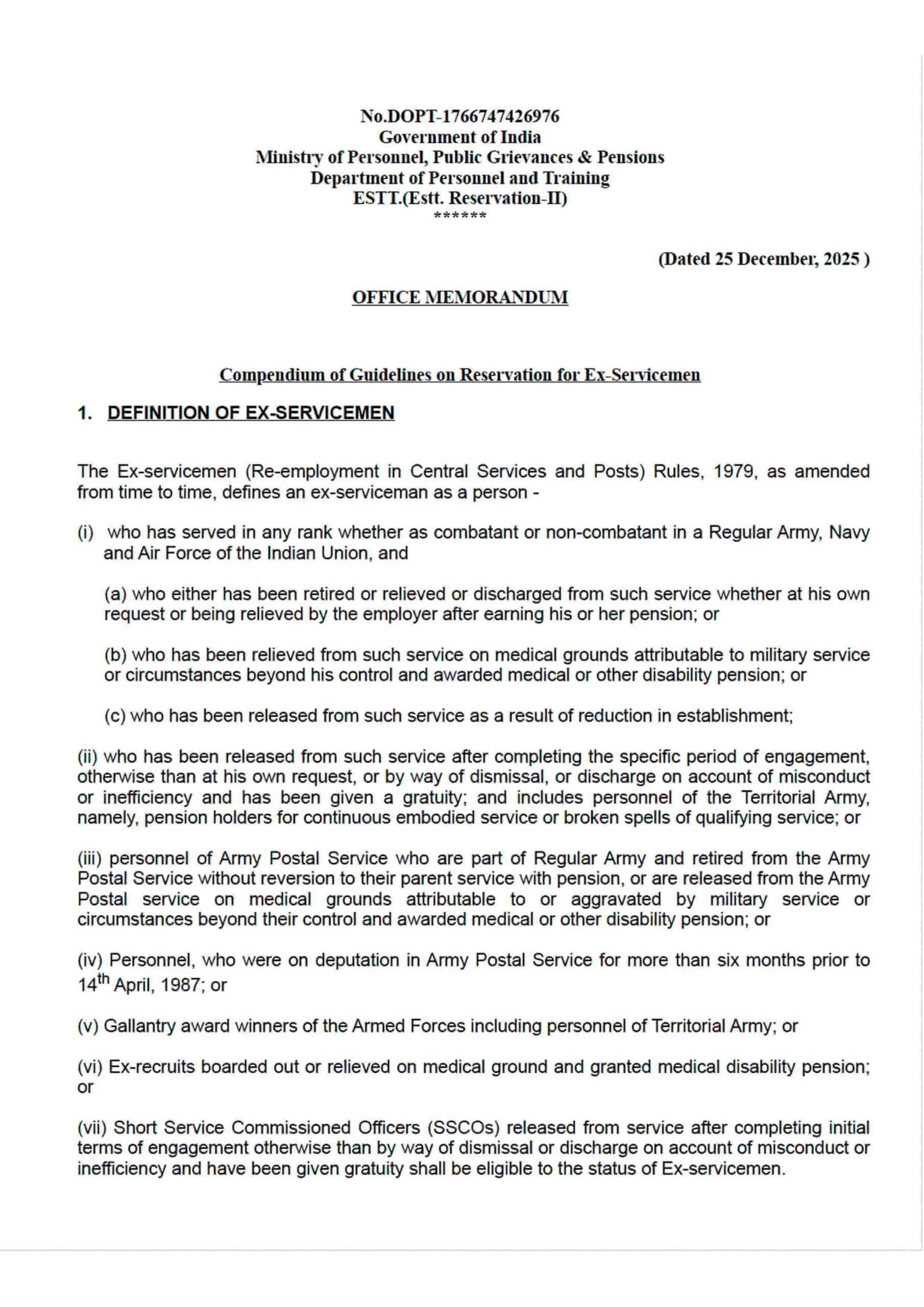
The Department of Personnel and Training has issued a Compendium of Guidelines on Reservation for Ex-Servicemen, dated 25 December 2025. This document brings together important rules related to ex-servicemen reservation in Central Government jobs.
This is not a new recruitment notice. It is a reference guide that helps ex-servicemen, serving personnel nearing release, recruitment agencies and departments understand how ESM reservation should work.
Why this DoPT compendium is important?
Government recruitment rules are often spread across multiple notifications and office memorandums. For a candidate, it becomes difficult to know which rule applies and where to check.
This compendium is useful because it places major ex-servicemen reservation guidelines in one document.
It explains who is treated as an ex-serviceman, where reservation applies, how many vacancies are reserved, how the roster works, what age relaxation is available, when education qualification may be relaxed and why vacancies should be notified to DGR and Sainik Boards.
For veterans applying for Central Government jobs, this is an important reference document.
Who is counted as an ex-serviceman?
The compendium refers to the Ex-servicemen (Re-employment in Central Services and Posts) Rules, 1979, as amended from time to time.
In simple words, ex-servicemen include persons who served in the Regular Army, Navy or Air Force and were retired, discharged or relieved after qualifying service, pension, medical release, disability pension, reduction in establishment or completion of engagement as per rules.
The definition also covers certain categories such as Territorial Army personnel, Army Postal Service personnel, gallantry award winners and ex-recruits boarded out on medical grounds with medical disability pension.
A key point is that Short Service Commissioned Officers released with gratuity after completing their initial terms of engagement, and not dismissed or discharged for misconduct or inefficiency, are also eligible for ex-servicemen status from 13 February 2020 or thereafter.
This definition is important because reservation benefits depend first on whether the person legally falls under the ex-servicemen category.
Where does ex-servicemen reservation apply?
The DoPT guidelines apply to Central Civil Services and posts. They also apply to posts up to the level of Assistant Commandant in para-military forces.
The compendium mentions forces such as BSF, CRPF, ITBP, CISF, Secretariat Security Force, Assam Rifles and Railway Protection Force.
This means the reservation framework is not limited to one department. It has a wider application across Central Government recruitment, subject to the specific rules of the post and recruitment method.
How much reservation is available for ex-servicemen?
The compendium explains the reservation percentage clearly.
| Recruitment area | Reservation for ex-servicemen |
|---|---|
| Posts up to Assistant Commandant level in para-military forces | 10% |
| Group C posts | 10% |
| Group D posts | 20% |
The vacancies include permanent vacancies filled initially on a temporary basis and temporary vacancies likely to continue for three months or more, if filled by direct recruitment.
This point is important because many candidates wrongly assume that ex-servicemen reservation applies only to permanent posts. The compendium makes it clear that certain temporary vacancies are also covered if they meet the conditions.
What does horizontal reservation mean?
Ex-servicemen reservation is horizontal in nature.
This is one of the most important points in the document.
Horizontal reservation means an ex-serviceman is adjusted within his own social category. For example, an SC ex-serviceman selected against an ex-servicemen vacancy is adjusted against the SC category. An OBC ex-serviceman is adjusted against OBC. A general-category ex-serviceman is adjusted in the general category.
This is different from vertical reservation categories like SC, ST and OBC.
For candidates, this distinction matters because it affects how vacancies are counted and how selected candidates are adjusted in the recruitment roster.
Disabled ex-servicemen get priority in additional vacancies
The compendium also gives an important welfare point.
If reservation for ex-servicemen is increased, the additional vacancies should first be used for disabled ex-servicemen. If those vacancies are not fully used, they can then be made available to other ex-servicemen.
This shows that the rules give special importance to those whose disability is linked with military service.
For war-disabled and service-disabled veterans, this is a significant part of the reservation framework.
Can departments fill ESM reserved vacancies with general candidates?
A department cannot casually fill an ex-servicemen reserved vacancy with a general candidate.
For posts filled otherwise than through open competitive examination, the appointing authority has to complete certain steps before doing so.
It must obtain a non-availability certificate from the Employment Exchange where applicable, verify non-availability of suitable candidates through Director General Resettlement, record the certificate and obtain Central Government approval.
This rule is important because it protects the purpose of ESM reservation.
It ensures that departments do not bypass ex-servicemen reservation without proper verification.
What happens if ESM vacancies remain unfilled?
For Group C and Group D Central Civil Services, if ex-servicemen reserved vacancies are not filled due to non-availability of eligible or suitable candidates, the vacancies can be carried forward to the next recruitment year.
The compendium says this can be carried forward for up to two recruitment years. After that, the reservation may lapse.
For Central Para Military Forces, if an ESM reserved vacancy remains unfilled due to non-availability of eligible or qualified candidates, it may be filled by candidates from the non-ex-servicemen category.
This distinction is important and should be understood before making any claim about unfilled vacancies.
Can serving personnel apply before retirement?
Yes, under certain conditions.
A candidate still serving in the Armed Forces may become eligible to apply for civil posts if he completes the prescribed period of Armed Forces service within one year from the last date of application.
The compendium also explains that if the selection process takes more than one year, the candidate should not be declared ineligible only because he got released after one year from the last date of application.
Such candidates may need to submit the required certificate and undertaking as per the prescribed format.
This is useful for serving personnel who are close to release and want to plan civil employment in advance.
What if an ex-serviceman already got one Central Government job?
This is a very important clarification.
If an ex-serviceman has already secured regular civil employment under the Central Government, he can still get age relaxation for another higher post or service under the Central Government.
However, he will not be eligible again for the benefit of ex-servicemen reservation.
There is one important exception. If he had applied for other vacancies before joining the first civil job, he may still claim reservation benefit for those earlier applications, provided he gives the required self-declaration to the employer.
This rule prevents repeated use of reservation after joining regular civil employment, while protecting applications already made before joining.
How does the 100-point roster work?
The compendium says government establishments must maintain a separate 100-point vacancy-based reservation roster for ex-servicemen.
For 10% reservation, the points earmarked for ex-servicemen are:
1, 11, 21, 31, 41, 51, 61, 71, 81 and 91.
For example, if 23 direct recruitment vacancies arise in a cadre, points 1, 11 and 21 would be reserved for ex-servicemen.
This system helps departments track reservation in a structured way instead of making random adjustments.
How does age relaxation work?
The compendium gives different age-relaxation rules depending on the type of post.
For Group B non-gazetted, Group C and Group D posts, an ex-serviceman can deduct the period of actual military service from his actual age. If the remaining age does not exceed the maximum age limit for the post by more than three years, he is treated as satisfying the age condition.
For Group A and Group B gazetted posts filled by direct recruitment otherwise than open All India Competitive Examination, upper age limit is relaxed by military service plus three years.
For Group A and Group B posts filled through All India Competitive Examination, ex-servicemen and commissioned officers with at least five years of military service may get a maximum age relaxation of five years, subject to release conditions.
In simple terms, age relaxation is a major benefit, but the exact relaxation depends on the post, recruitment method and service conditions.
Educational qualification relaxation
The compendium also explains education-related relaxation for certain posts.
For erstwhile Group D posts, ex-servicemen with at least three years of Armed Forces service may be exempted from minimum educational qualification.
For Group C posts, the appointing authority may relax minimum educational qualification in certain cases, especially where the prescribed qualification is middle school or lower.
A matriculate ex-serviceman with at least 15 years of service may be considered eligible for some Group C posts where graduation is prescribed, provided the work does not require technical or professional experience or where short on-the-job training is considered sufficient.
This does not mean education rules are automatically relaxed in every case. The post, qualification requirement and appointing authority’s satisfaction matter.
Vacancies must be shared with DGR and Sainik Boards
The compendium says reserved vacancies for ex-servicemen should be identified and notified to the Directorate General Resettlement, Rajya Sainik Boards and Zila Sainik Boards.
An advance notice of preferably three months should be given.
Vacancies should also be advertised through local newspapers so that ex-servicemen can apply directly to the recruitment agency.
This point is important because information access is often a major issue for veterans. If vacancies are not properly circulated, eligible ex-servicemen may miss opportunities.
Priority in appointment
The compendium explains that ex-servicemen are divided into priority and non-priority categories in a 50:50 ratio.
Priority is provided for disabled ex-servicemen where disability is attributable to military service. Officer cadets boarded out on medical grounds attributable to military training are also included under priority provisions.
This ensures that candidates who suffered disability linked with service are given structured consideration.
Relaxation of standard
If enough ex-servicemen candidates are not available on the basis of general standard, ex-servicemen may be selected under relaxed standard to fill reserved vacancies.
However, this relaxation should not affect the level of performance required for the job.
This means relaxation is not a compromise on basic job suitability. It is a controlled relaxation to ensure the reserved quota is not left unused when suitable candidates can perform the duties.
Fee exemption for ex-servicemen
The compendium clearly says ex-servicemen are exempted from payment of examination or application fee.
This is a direct practical benefit for candidates applying for Central Government posts.
However, candidates should still read each recruitment notification carefully because they may need to claim the exemption properly in the application form.
What should ex-servicemen check before applying?
Before applying for any Central Government job, ex-servicemen should check:
Whether the post has ESM reservation
Whether the recruitment is direct recruitment
Whether the post is Group C, Group D, Group B non-gazetted or another category
Whether the age relaxation rule applies
Whether educational relaxation is available
Whether they have already used ESM reservation after joining a civil post
Whether fee exemption is available
Whether their discharge, pension, gratuity or disability documents are ready
Whether the recruitment notification asks for specific certificate or undertaking
This checklist can prevent rejection at the application or document-verification stage.
Why this compendium matters for recruitment agencies?
This document is not useful only for candidates.
It is equally important for Ministries, Departments, attached offices, subordinate offices and recruiting agencies.
They must maintain rosters, notify vacancies, follow reservation rules, send periodic returns and appoint liaison officers for ex-servicemen reservation matters.
If departments do not follow the rules properly, ex-servicemen reservation may remain only on paper.
Comment
The DoPT compendium is important because it converts scattered rules into a single reference point.
For ex-servicemen, it gives clarity.
For serving personnel nearing release, it gives planning support.
For recruiting agencies, it gives procedural responsibility.
For welfare platforms, it gives an official base to explain ESM reservation without exaggeration.
This document should not be presented as a new benefit announcement. It should be used as a guide to help veterans understand their existing rights and recruitment relaxations.
Final takeaway
The DoPT Compendium of Guidelines on Reservation for Ex-Servicemen is a useful official reference for Central Government recruitment.
It explains who qualifies as an ex-serviceman, where reservation applies, how much reservation is available, how horizontal reservation works, how age and educational relaxation are given, and how vacancies should be notified.
The key points are clear.
Ex-servicemen reservation is horizontal.
Group C posts carry 10% reservation.
Group D posts carry 20% reservation.
Posts up to Assistant Commandant level in para-military forces carry 10% reservation.
Age relaxation depends on post and recruitment method.
Certain educational relaxations are available.
Ex-servicemen are exempted from examination or application fee.
Vacancies should be notified to DGR and Sainik Boards.
For veterans and serving personnel planning civil employment, the message is simple:
Do not depend only on social media summaries.
Read the recruitment notification.
Check the DoPT rules.
Keep service documents ready.
Claim reservation and relaxation correctly.
A government job opportunity is useful only when the candidate understands the rule before applying.
Sources:-
DoPT official OM page — Compendium of Guidelines on Reservation for Ex-Servicemen
https://doptcirculars.nic.in/OM/ViewOMNew.aspx?headid=6&id=600
2. DGR official PDF — Compendium dated 25 Dec 2025
https://dgrindia.gov.in/writereaddata/media/documents/Compendium%20of%20Guidelines%20on%20Reservation%20for%20ExServicemen%20dt%2025%20Dec%202025.pdf
3. DESW official page — Compendium of Guidelines on Reservation for Ex-Servicemen
https://desw.gov.in/en/circulars/compendium-guidelines-reservation-ex-servicemen
4. DoPT page — Policy of Reservation to Ex-Serviceman
https://dopt.gov.in/policy-reservation-ex-serviceman
5. DoPT FAQ PDF — Ex-servicemen reservation policy
https://dopt.gov.in/sites/default/files/FAQ_ExServiceman.pdf


Leave a Reply