


India’s defence strength does not depend only on missiles, aircraft, ships or tanks.
It also depends on something less visible but equally important: the speed at which a defence idea moves from research table to field trial, from trial to production, and from production to the Armed Forces.
This is why the Delegation of Financial Powers to DRDO 2026, also called DFP-2026, is an important reform.
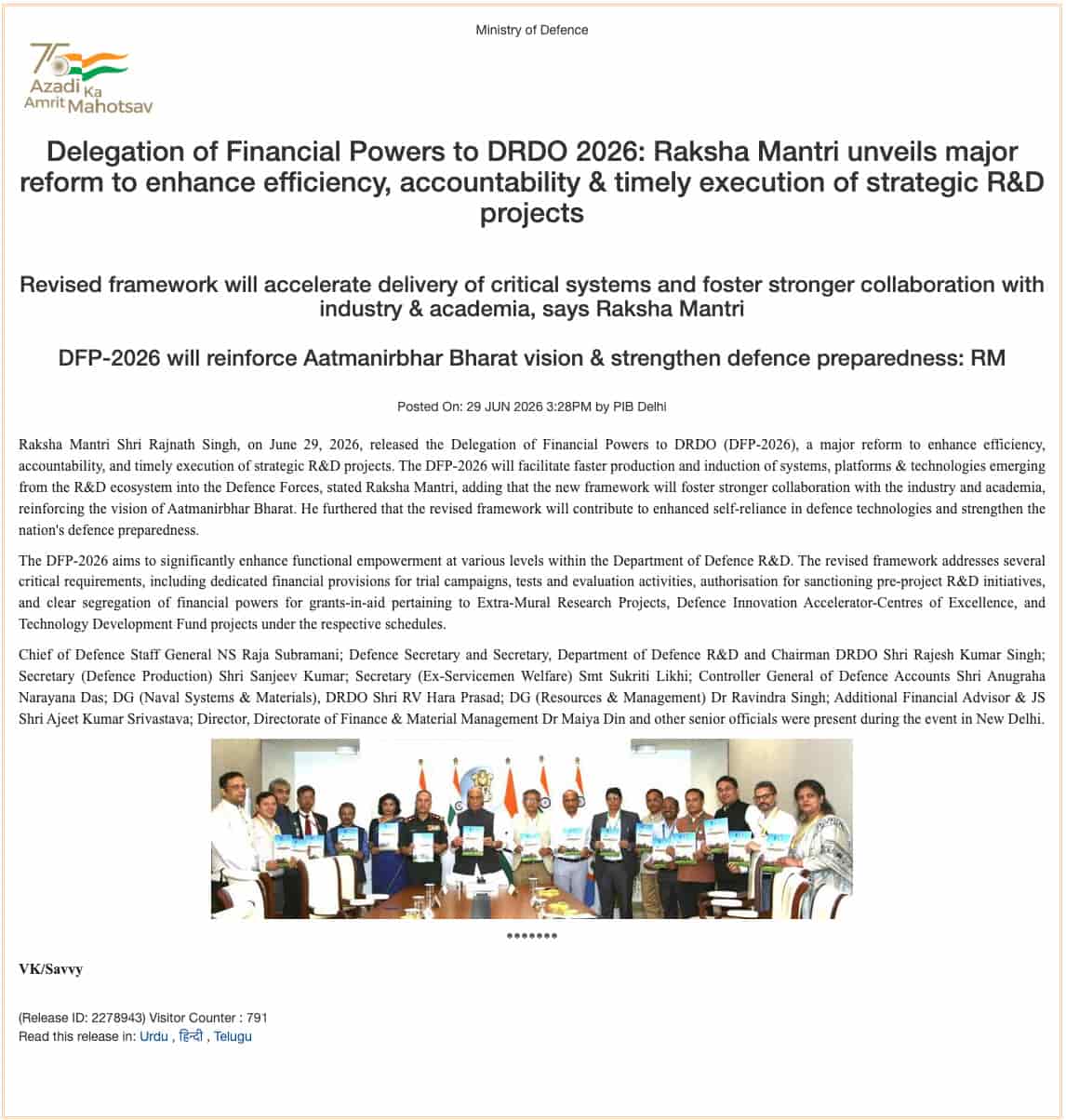
On 29 June 2026, Raksha Mantri Shri Rajnath Singh released the revised financial-power framework for DRDO. At first, this may look like an internal administrative update. But for India’s defence ecosystem, it carries a much wider meaning.
It is about reducing delay in strategic R&D projects.
It is about giving faster decision-making authority to the right levels.
It is about helping indigenous defence technologies move more efficiently towards the user forces.
And most importantly, it is about doing all this without removing accountability.
What exactly is DFP-2026?
DFP-2026 stands for Delegation of Financial Powers to DRDO 2026.
In simple words, it is a revised framework that decides how financial approval powers are delegated within the Department of Defence Research and Development and DRDO system.
This matters because DRDO projects are not ordinary purchases.
A defence R&D project may involve prototype development, specialised equipment, field trials, testing, evaluation, changes after user feedback, interaction with industry, academic research support and technology-development funding.
If every financial decision has to move slowly through multiple layers, the project loses time.
DFP-2026 tries to address this issue by improving functional empowerment at different levels inside the defence R&D structure.
Why this reform matters?
Defence technology is time-sensitive.
A system delayed by five years may become outdated before it reaches the field.
A prototype stuck in approval may miss the operational need.
A trial delayed due to small administrative bottlenecks may slow down the entire induction process.
This is why financial powers are not just a paperwork issue.
They can directly affect defence preparedness.
The new DFP-2026 framework is aimed at improving efficiency, accountability and timely execution of strategic R&D projects. It is also expected to help faster production and induction of systems, platforms and technologies emerging from India’s R&D ecosystem into the Defence Forces.
That is the real importance of this reform.
The key point: Trials and testing get special attention
The most important part of DFP-2026 is its focus on the stages where defence projects often face practical delays.
The revised framework includes dedicated financial provisions for:
trial campaigns,
tests,
evaluation activities,
pre-project R&D initiatives,
Extra-Mural Research Projects,
Defence Innovation Accelerator-Centres of Excellence,
and Technology Development Fund projects.
This is a crucial detail.
It shows that the reform is not only about increasing authority in a general way. It is targeted at the actual working stages of defence R&D.
For a missile, radar, drone, communication system, electronic warfare system or naval technology, trials and evaluations are not optional. They are the bridge between a laboratory claim and a field-ready capability.
If that bridge becomes faster and better managed, the Armed Forces may receive indigenous systems sooner.
What is the link with DRDO Procurement Manual 2025?
DFP-2026 should be understood together with the DRDO Procurement Manual 2025.
The Procurement Manual is the process document. It explains how procurement should be done, how quality and technical requirements should be met, and how public-procurement rules should be followed.
DFP-2026 is the financial delegation framework. It decides who can approve financial decisions and at what level.
So the relationship is simple:
DRDO Procurement Manual 2025 explains the procedure.
DFP-2026 strengthens the approval authority.
Together, they are designed to make the DRDO system faster, clearer and more accountable.
This combination is important because speed without process can create risk, while process without authority can create delay.
The defence system needs both: speed and discipline.

Why R&D procurement is different from normal procurement?
A normal procurement may involve buying an available item.
But defence R&D procurement is different.
A lab may need a specialised component for a prototype. A test team may need urgent material during field trials. A research project may need quick support from a private technology partner. A system under user evaluation may need modification based on operational feedback.
In such cases, delay can directly affect the development cycle.
That is why DRDO’s procurement and financial-power systems must be flexible enough for research, but strong enough to maintain transparency and accountability.
DFP-2026 appears to recognise this balance.
Industry and academia will matter more
The official announcement says the revised framework will foster stronger collaboration with industry and academia.
This is an important point.
Modern defence technology cannot be developed by government labs alone. It requires a wider ecosystem involving DRDO laboratories, private industry, startups, MSMEs, academic institutions, research centres and technology-development partners.
The DRDO Procurement Manual 2025 also supports this wider ecosystem by encouraging participation from Indian industry, including startups and MSMEs.
This means the reform is not only about internal DRDO speed.
It is also about making the defence R&D ecosystem more responsive.
If industry and academia can work with DRDO through clearer financial routes, India’s indigenous defence capability can grow faster.
Why startups and MSMEs should watch this closely?
India’s defence startup ecosystem has grown in areas such as drones, artificial intelligence, robotics, electronics, surveillance systems, materials, cyber technologies and unmanned platforms.
But startups often face one major challenge: long procurement and approval timelines.
When a small technology company is waiting for a project decision, payment milestone or trial support, delay can become a serious problem.
A stronger financial-delegation framework can help if it translates into faster approvals, clearer responsibilities and quicker movement of innovation-linked projects.
This is where Technology Development Fund projects and Defence Innovation Accelerator-Centres of Excellence become important.
DFP-2026 can become useful if it helps promising technologies move from proposal stage to prototype, from prototype to trial, and from trial to user adoption.
How this connects with DFPDS-2026?
DFP-2026 for DRDO should also be seen along with the revised Delegation of Financial Powers for Defence Services 2026, or DFPDS-2026.
DFPDS-2026 is related to the Defence Services. It enhances financial powers for field commanders and defence authorities, including medical and works projects. It also supports faster conclusion of contracts and execution of projects.
In simple terms:
DFPDS-2026 empowers the Armed Forces to procure and execute operational requirements faster.
DFP-2026 empowers DRDO to move R&D, trials, testing and innovation projects faster.
Together, they show a larger Ministry of Defence direction: decentralise decision-making, reduce bottlenecks and improve timely availability of defence resources.
The bigger picture: From lab to forces
The real question for the public is simple:
Will this reform help DRDO technologies reach the Armed Forces faster?
The answer depends on implementation.
On paper, DFP-2026 is designed to support faster production and induction of systems, platforms and technologies from the R&D ecosystem into the Defence Forces.
But no financial-power framework can automatically complete a project.
A defence system still needs sound design, successful trials, user acceptance, quality production, budget support and timely decision-making.
DFP-2026 can remove some approval delays.
It cannot replace engineering discipline, testing standards or operational evaluation.
So the correct understanding is:
DFP-2026 can improve the speed of the defence R&D pipeline, but the final result will depend on execution.
Accountability remains important
One important word in the official announcement is accountability.
This reform should not be misunderstood as permission for uncontrolled spending.
Delegation of financial powers means authority is given to appropriate levels. It does not mean rules disappear.
Procurement records, financial propriety, technical evaluation, competition, transparency and audit requirements remain important.
In defence, speed is necessary. But speed without accountability can damage trust.
The stronger model is fast decision-making with clear responsibility.
That is what DFP-2026 aims to support.
Why this matters for Aatmanirbhar Bharat?
Aatmanirbhar Bharat in defence is not only about manufacturing weapons in India.
It is about building the complete capability chain.
That chain includes research, design, testing, trials, industry participation, technology funding, production readiness and induction into the Services.
If any part of this chain is slow, the final capability is delayed.
DFP-2026 tries to strengthen the R&D side of this chain.
DFPDS-2026 strengthens the user and procurement side.
The DRDO Procurement Manual 2025 strengthens the procedural side.
Together, these reforms show that India is trying to make defence self-reliance more practical, not just aspirational.
What this means for the Armed Forces?
For the Armed Forces, the benefit could be significant if the reform works as intended.
Faster R&D decisions can mean faster trials.
Faster trials can mean quicker improvements.
Quicker improvements can mean earlier user confidence.
Earlier user confidence can support faster induction.
In a changing security environment, this matters.
The Services need technologies that can respond to new threats: drones, electronic warfare, cyber-linked systems, long-range precision weapons, surveillance platforms, autonomous systems and advanced communication networks.
A slow R&D pipeline cannot support a fast-changing battlefield.
DFP-2026 is therefore not only an administrative reform. It is linked with operational preparedness.
What should not be misunderstood?
This reform does not mean DRDO has received unlimited spending powers.
It does not mean defence rules have been removed.
It does not mean every DRDO project will now automatically finish faster.
It does not mean private companies will get orders without procedure.
It does not mean trials, testing and evaluations will be bypassed.
It means financial authority has been revised to improve timely execution while maintaining accountability.
That distinction is important.
What is still not clear?
The official PIB release gives the broad purpose and key areas of DFP-2026, but it does not provide the full financial schedules, approval limits or detailed authority matrix.
So the exact impact will become clearer only after the full DFP-2026 document or detailed schedules are studied.
For now, the safe conclusion is that the policy direction is clear: DRDO is being given more functional financial empowerment for strategic R&D work, especially trials, testing, evaluation, pre-project initiatives and innovation-linked grants.
Why this reform should be watched closely
Some defence reforms are visible immediately.
A new ship is commissioned. A missile is tested. A fighter is inducted.
But some reforms work quietly in the background.
Financial delegation is one of them.
If implemented properly, it can reduce delay in projects that citizens may not see today but the Armed Forces may depend on tomorrow.
The success of DFP-2026 will not be judged by the release of the document.
It will be judged by whether systems move faster from concept to operational use.
Final takeaway
The Delegation of Financial Powers to DRDO 2026 is an important reform in India’s defence R&D ecosystem.
Its purpose is to improve efficiency, accountability and timely execution of strategic projects. It focuses on financial empowerment for trials, testing, evaluation, pre-project R&D, Extra-Mural Research, Defence Innovation Accelerator-Centres of Excellence and Technology Development Fund projects.
When read together with the DRDO Procurement Manual 2025 and DFPDS-2026 for the Defence Services, the message becomes clear:
India is trying to speed up the defence capability pipeline from both sides.
DRDO must move technologies faster from research to validation.
The Armed Forces must be able to procure and execute requirements faster.
Industry, startups, MSMEs and academia must become stronger partners.
And all of this must happen with accountability.
That is the real meaning of DRDO Financial Powers 2026.
It is not just a government document.
It is an attempt to make India’s defence innovation system faster, more responsive and more ready for future warfare.
Sources:-
PIB / Ministry of Defence — Delegation of Financial Powers to DRDO 2026:
https://www.pib.gov.in/PressReleasePage.aspx?PRID=2278943&lang=1®=48
DRDO Procurement Manual 2025:
https://www.drdo.gov.in/drdo/sites/default/files/form_formats/DRDO_ProcurementManual2025Latest.pdf
PIB / Ministry of Defence — Delegation of Financial Powers for Defence Services 2026:
https://www.pib.gov.in/PressReleasePage.aspx?PRID=2268807
Official DFPDS-2026 PDF — Ministry of Defence:
https://mod.gov.in/sites/default/files/DFPDS-2026_0.pdf





Leave a Reply