

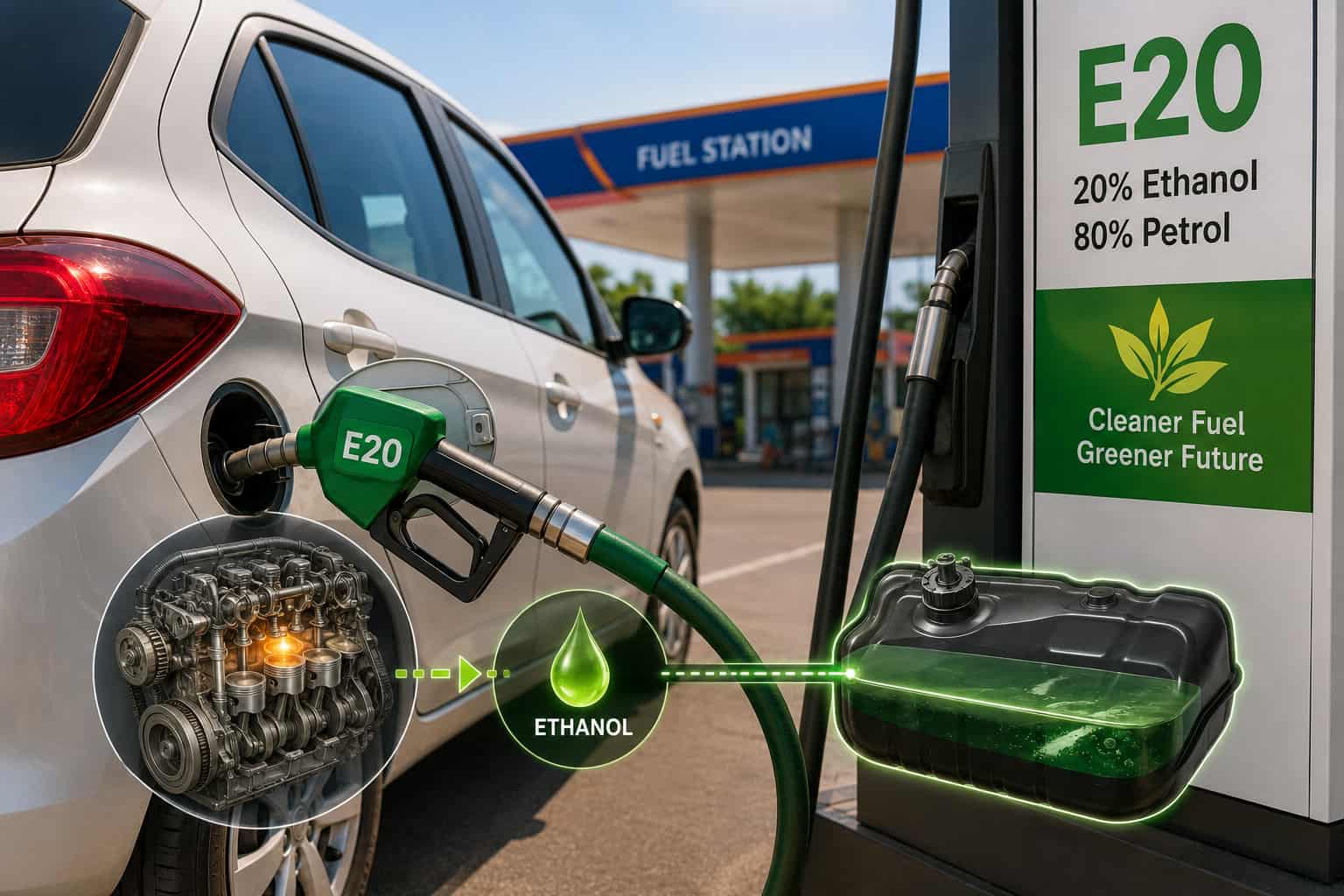
E20 petrol is now part of everyday motoring in India, but many vehicle owners remain uncertain about its effect on mileage, old engines and fuel-system components.
Social-media posts often present two extreme positions. One side claims that ethanol-blended petrol is destroying engines, while the other suggests that E20 has no disadvantage for any vehicle.
Neither position explains the complete picture.
A detailed Sainik Welfare News discussion with a retired Indian Air Force officer examined ethanol blending, engine technology, moisture, flex-fuel systems and the fears circulating among vehicle owners. The conversation presented ethanol as an important energy-security tool but also acknowledged that mileage, maintenance and vehicle compatibility cannot be ignored.
The practical truth is that E20 performance depends on the vehicle’s model year, fuel-system materials, engine calibration, maintenance history and manufacturer approval.
What does E20 petrol actually contain?
E20 is a blended automotive fuel consisting of approximately:
- 20% ethanol
- 80% petrol
Ethanol is a renewable alcohol-based fuel. In India, it may be produced from sugarcane-derived feedstock, maize, damaged grains and certain agricultural residues.
The number following the letter “E” indicates the approximate percentage of ethanol in the fuel.
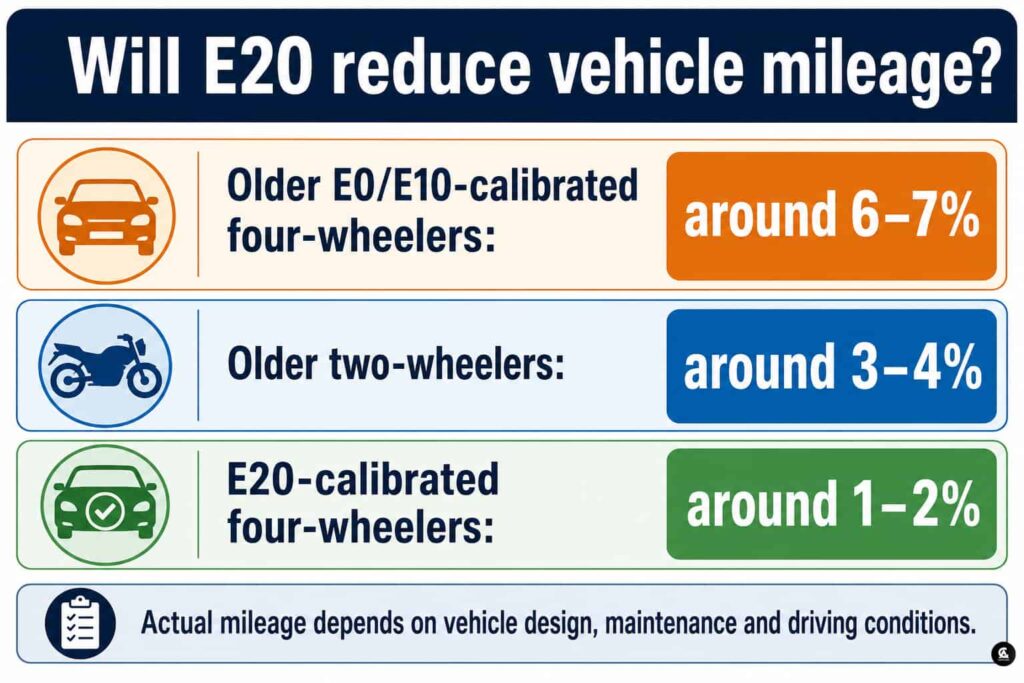
| Fuel grade | Ethanol content | Petrol content | Suitable vehicle |
|---|---|---|---|
| E10 | 10% | 90% | E10-compatible petrol vehicle |
| E20 | 20% | 80% | E20-compatible vehicle |
| E85 | Up to around 85% | Remaining petrol | Certified flex-fuel vehicle |
The difference between E20 and E85 is substantial. A standard E20-compatible vehicle should not be assumed capable of using E85.
Why did India move towards ethanol blending?
India imports a large proportion of its crude-oil requirement. This makes the country vulnerable to:
- international oil-price fluctuations;
- conflict in major producing regions;
- shipping-route disruptions;
- foreign-exchange pressure;
- sudden fuel-supply uncertainty.
Ethanol offers a domestically produced blending component that can replace a portion of imported petrol.
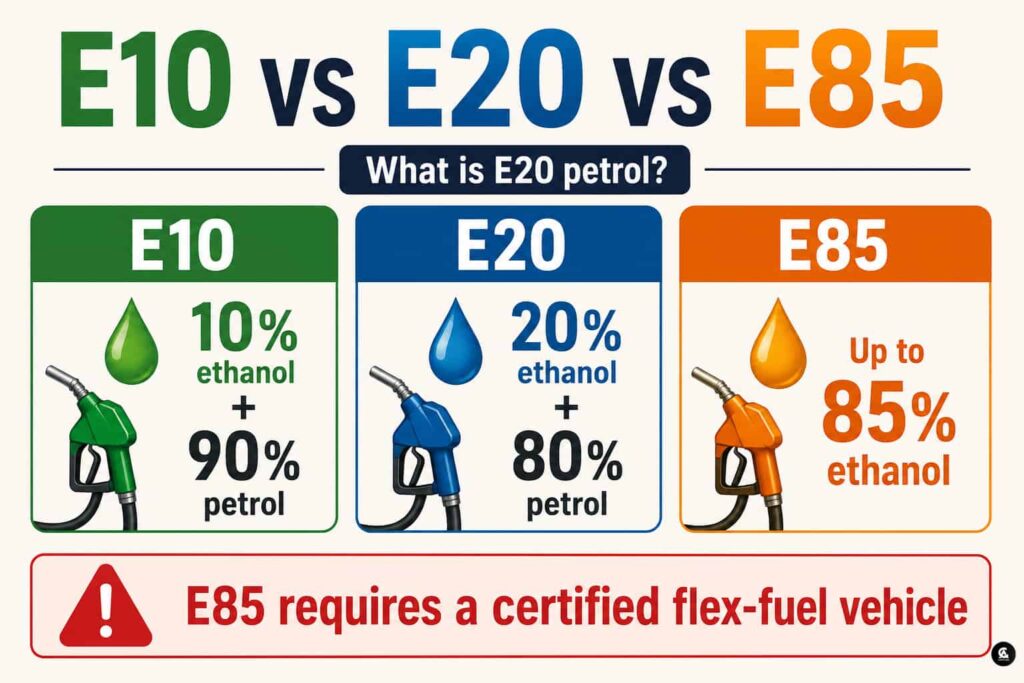
The policy chain is straightforward:
Agricultural feedstock
→ Ethanol production
→ Blending with petrol
→ Reduced crude-oil requirement
→ Foreign-exchange savings
→ Greater demand for farm produce
Ethanol blending is therefore connected with much more than vehicle emissions. It is also associated with national energy security, agricultural markets and the domestic biofuel industry.
Potential advantages of ethanol blending
Ethanol-blended petrol may help India:
- reduce dependence on imported petroleum;
- diversify its transport-fuel supply;
- create additional demand for sugarcane and maize;
- use damaged or surplus grains under approved policies;
- support distilleries and biofuel infrastructure;
- reduce selected tailpipe pollutants;
- protect the economy during international fuel disruptions.
However, ethanol production must also be evaluated for water consumption, crop selection, transport distance and lifecycle emissions. The environmental benefit can vary according to how the ethanol is produced.
Will E20 petrol reduce vehicle mileage?
A small reduction in mileage is possible because ethanol contains less energy per litre than conventional petrol.
This does not mean that a fuel containing 20% ethanol will automatically reduce mileage by 20%.
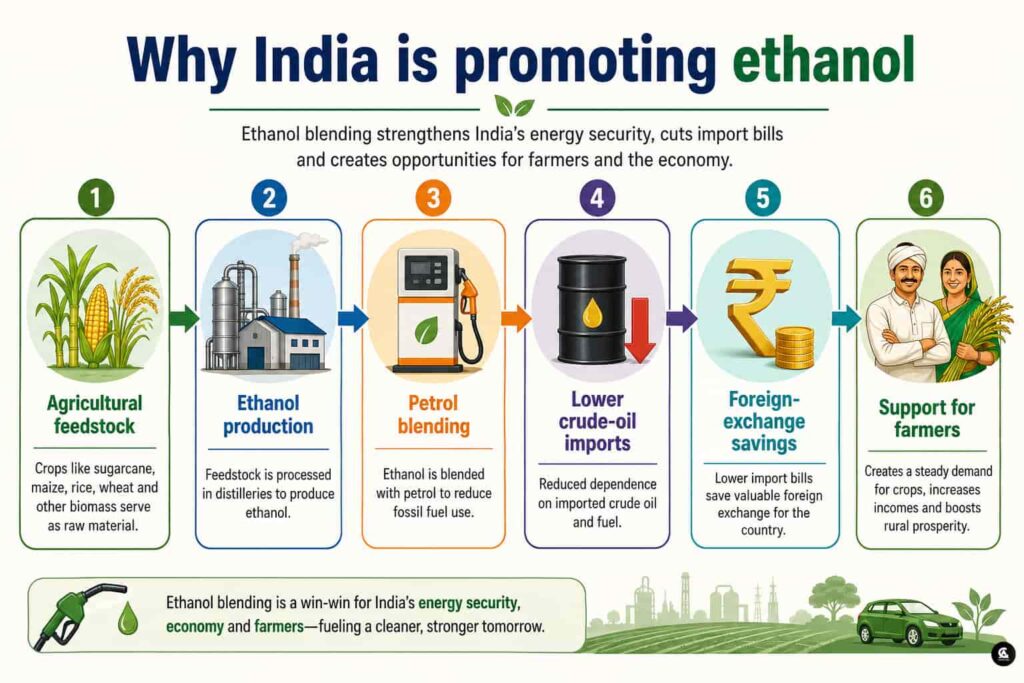
Indicative estimates in the NITI Aayog ethanol roadmap suggested:
| Vehicle category | Indicative mileage effect |
|---|---|
| Older E0 or E10-calibrated four-wheelers | Around 6–7% reduction |
| Older two-wheelers | Around 3–4% reduction |
| Four-wheelers calibrated for E20 | Around 1–2% reduction |
These are broad technical estimates rather than guaranteed results for every car or motorcycle.
Why does mileage differ between vehicles?
The actual result depends on:
- engine compression and calibration;
- fuel-injection mapping;
- model year;
- vehicle weight;
- tyre pressure;
- traffic and road conditions;
- air-conditioner usage;
- engine condition;
- driving behaviour;
- quality of servicing.
An E20-calibrated vehicle can manage the blend more efficiently than an older vehicle designed around lower ethanol content.
How should mileage be measured?
Owners should avoid comparing one short journey with another.
A better method is to:
- fill the tank using the same fuel grade;
- reset the trip meter;
- follow a similar driving pattern;
- repeat the process across several full tanks;
- calculate an average rather than relying on the dashboard display alone.
Low tyre pressure, clogged filters, poor injectors and heavy traffic can also reduce mileage. Ethanol should not be blamed before these factors are checked.
Does ethanol’s higher octane number mean it contains more energy?
No.
Octane rating and energy content describe different fuel properties.
Octane rating indicates resistance to engine knocking. A higher-octane fuel can tolerate greater compression before uncontrolled combustion occurs.
It does not mean the fuel contains more energy per litre.
Ethanol has a high octane rating, which can benefit engines designed to use its anti-knock characteristics. But ethanol’s energy density is lower than petrol.
This explains why:
- ethanol can support efficient high-compression engine designs;
- yet a non-optimised vehicle may deliver fewer kilometres per litre.
Using octane number as a direct measurement of fuel energy is technically incorrect.
Is E20 safe for old cars?
Vehicle age alone does not provide the answer.
Two cars manufactured in the same year may use different fuel hoses, seals, injectors and engine-control systems.
Compatibility depends on components such as:
- rubber hoses;
- O-rings and seals;
- fuel-pump materials;
- injector components;
- metal fuel lines;
- fuel tank construction;
- engine-control software;
- manufacturer-approved ethanol percentage.
An older vehicle may continue operating on E20 without an immediate failure, but that does not automatically mean it is officially optimised or certified for the blend.
The most reliable E20 compatibility check
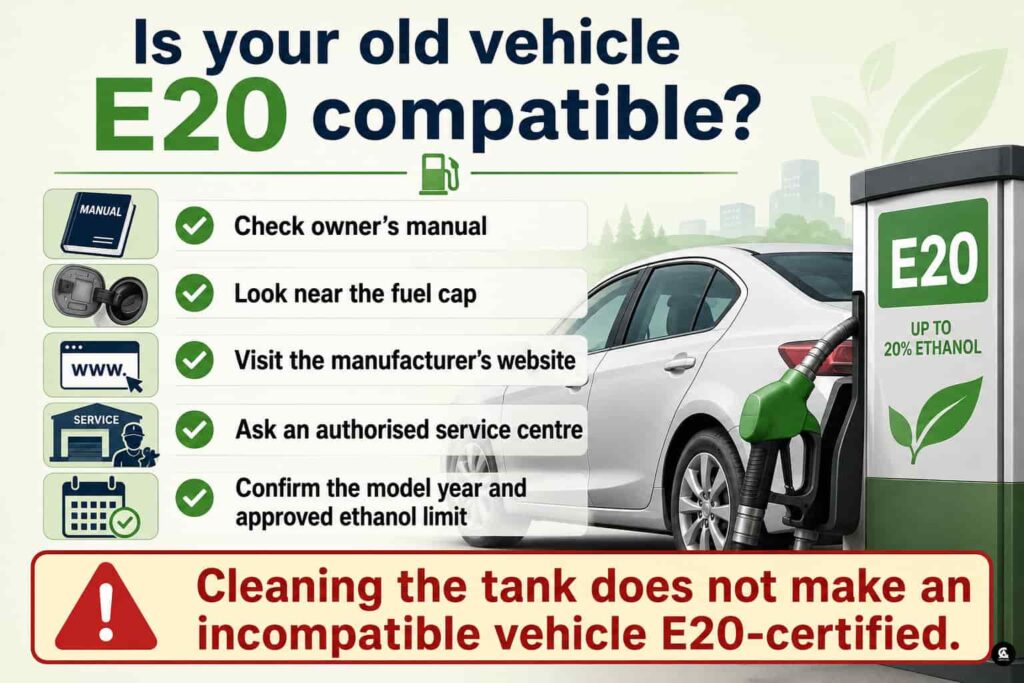
Owners should verify the vehicle through five sources:
- Read the owner’s manual.
- Inspect the label near the fuel-filler cap.
- Check the manufacturer’s official website.
- Contact an authorised service centre.
- Confirm the exact model year and approved ethanol limit.
A general statement such as “all cars after a certain year are safe” may overlook model-specific differences.
Should an old fuel tank be cleaned?
Fuel-tank cleaning can be useful where an old vehicle contains:
- rust;
- dirt;
- sludge;
- degraded fuel;
- moisture;
- deposits accumulated over many years.
Ethanol has solvent properties and may loosen some pre-existing deposits in an old fuel system. Those particles can then reach the fuel filter.
Replacing an old or clogged fuel filter may therefore be sensible maintenance.
But tank cleaning has an important limitation:
It does not change the vehicle’s rubber components, metal compatibility, fuel injection or ECU calibration.
Cleaning a tank cannot convert an incompatible vehicle into an officially E20-certified model.
Why is water discussed so often with ethanol fuel?
Ethanol has an affinity for water.
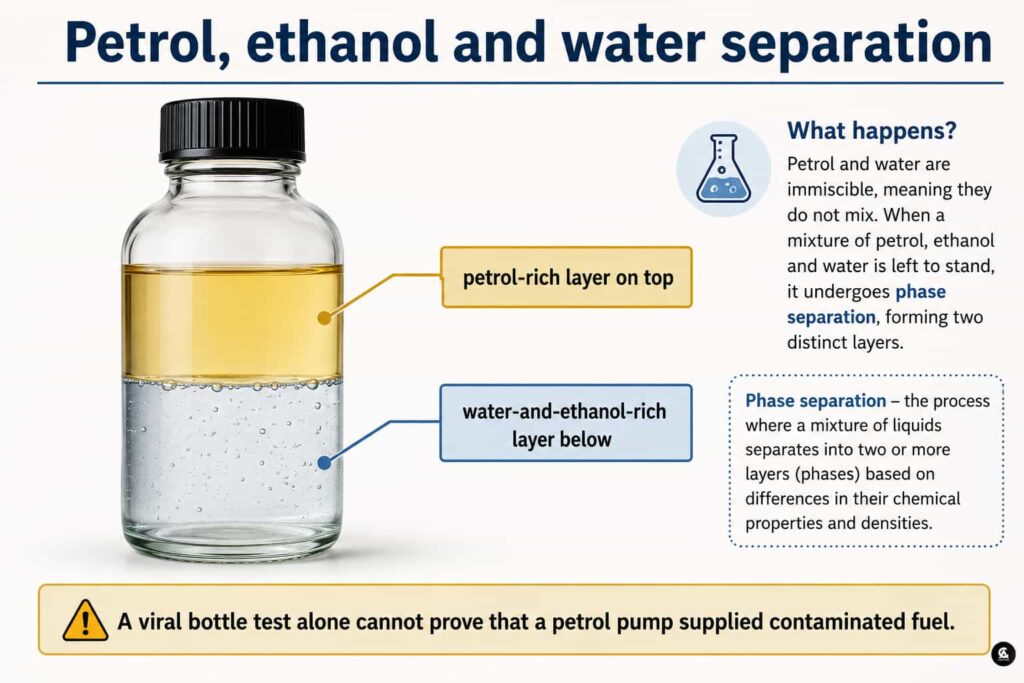
A small amount of moisture may remain dissolved in an ethanol-petrol blend. If the quantity of water becomes too high, the fuel can separate into different liquid layers.
This is known as phase separation.
In a simplified example:
- the petrol-rich liquid remains in the upper portion;
- the water-and-ethanol-rich mixture settles below.
Phase separation can be influenced by:
- the quantity of water;
- ethanol percentage;
- ambient temperature;
- storage duration;
- container condition;
- quality of fuel handling.
Does a viral bottle test prove petrol-pump contamination?
No. It may indicate a possible issue, but it does not establish where or how the contamination occurred.
Before trusting a viral clip, several questions must be answered:
- Was the bottle clean and dry?
- Was the sample collected directly from the nozzle?
- Was the collection recorded continuously?
- Was water added during or after filming?
- How long was the bottle left standing?
- Was the sample sealed?
- Was it tested by an authorised laboratory?
A two-layer bottle can demonstrate phase separation, but it cannot by itself prove that a particular fuel station supplied adulterated or water-contaminated petrol.
What should a vehicle owner do after suspected bad fuel?
If a vehicle begins stalling, misfiring or refusing to start soon after refuelling:
- Stop driving when it is safe.
- Keep the fuel receipt.
- Record the petrol-pump name and nozzle number.
- Inform the station manager.
- Contact the oil company’s customer-care service.
- Take the vehicle to an authorised workshop.
- Photograph or record the drained fuel.
- Obtain a written diagnostic report.
- Preserve a sealed sample where legally and technically possible.
A contaminated sample and an E20-compatibility issue are not necessarily the same problem.
How is an E20 vehicle different from a flex-fuel vehicle?
The two categories should not be confused.
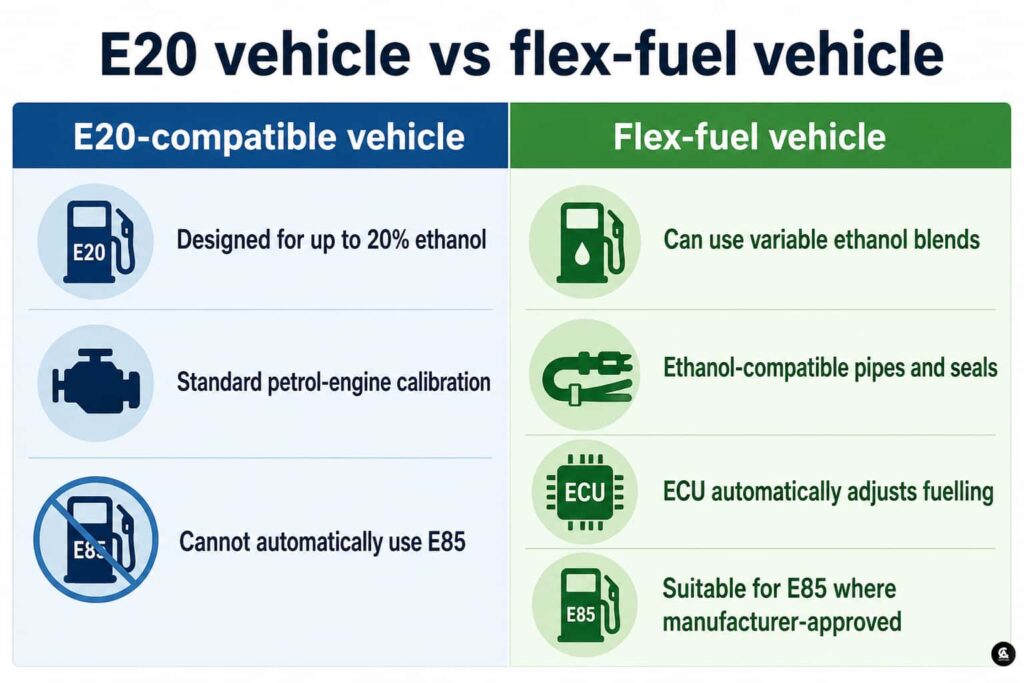
E20-compatible vehicle
An E20-compatible vehicle is generally:
- designed for petrol containing up to 20% ethanol;
- fitted with materials suitable for the approved blend;
- calibrated for conventional petrol-engine operation;
- not automatically approved for E85.
Flex-fuel vehicle
A certified flex-fuel vehicle is designed to operate on a wider range of ethanol-petrol mixtures.
It may include:
- ethanol-resistant hoses and seals;
- compatible fuel pumps and injectors;
- blend-detection capability;
- specialised ECU software;
- automatic fuel-injection adjustment;
- ignition timing suitable for different ethanol levels.
The ECU can change fuelling according to the blend detected in the tank.
Flex-fuel vehicles do not necessarily require the same manual switching mechanism used in petrol-CNG vehicles.
Can E85 be filled into a normal E20 car?
Not unless the manufacturer has officially approved the vehicle for E85.
Using E85 in a vehicle designed only for regular petrol or E20 could lead to:
- difficult cold starting;
- incorrect air-fuel ratio;
- check-engine warnings;
- reduced power;
- unstable running;
- damage to incompatible components;
- fuel-pump or injector problems.
The presence of an E20 sticker does not indicate E85 compatibility.
Common E20 myths and facts
Myth: E20 will reduce mileage by exactly 20%
Fact: Mileage impact varies according to engine design and calibration. The indicative reduction is generally much lower than 20%.
Myth: Every old car will immediately suffer engine damage
Fact: Compatibility varies by model, year, materials and manufacturer specification.
Myth: E20 and E85 are nearly the same fuel
Fact: E85 contains far more ethanol and requires a certified flex-fuel vehicle.
Myth: Higher octane means higher energy per litre
Fact: Octane measures knocking resistance, not total energy content.
Myth: Any separated bottle sample proves petrol-pump fraud
Fact: Controlled sampling and testing are required before reaching that conclusion.
Myth: Tank cleaning converts an old vehicle into an E20-compatible model
Fact: Cleaning may improve maintenance but does not change the manufacturer’s approved specification.
Practical advice for vehicle owners
Vehicle owners should take a cautious but evidence-based approach:
- check the owner’s manual and fuel-cap label;
- confirm compatibility for the exact model year;
- follow the manufacturer’s service schedule;
- replace fuel filters when required;
- use established fuel stations;
- preserve refuelling receipts;
- investigate sudden warning lights or mileage changes properly;
- compare mileage across several full tanks;
- never use E85 unless the vehicle is officially flex-fuel compatible.
A sudden mileage decline may also be caused by low tyre pressure, injector problems, clogged filters, traffic, air-conditioner use or aggressive driving.
Fuel should not be blamed without proper diagnosis.
Conclusion
E20 petrol is an important part of India’s strategy to reduce crude-oil dependence, strengthen domestic fuel production and support agricultural feedstocks.
Consumers nevertheless have valid questions about mileage, older vehicles, fuel labelling and moisture contamination.
The accurate position lies between two extreme claims:
E20 does not automatically destroy every engine, but it may not affect every vehicle in exactly the same way.
Its real-world impact depends on vehicle age, fuel-system materials, manufacturer approval, engine calibration and maintenance.
Owners should rely on model-specific guidance and technical evidence—not fear, viral claims or blanket assurances—before reaching a conclusion.




Leave a Reply