


The Government of India is examining why pensioners repeatedly have to approach courts and tribunals over matters such as delayed payments, family pension, arrears and differing interpretations of pension rules.
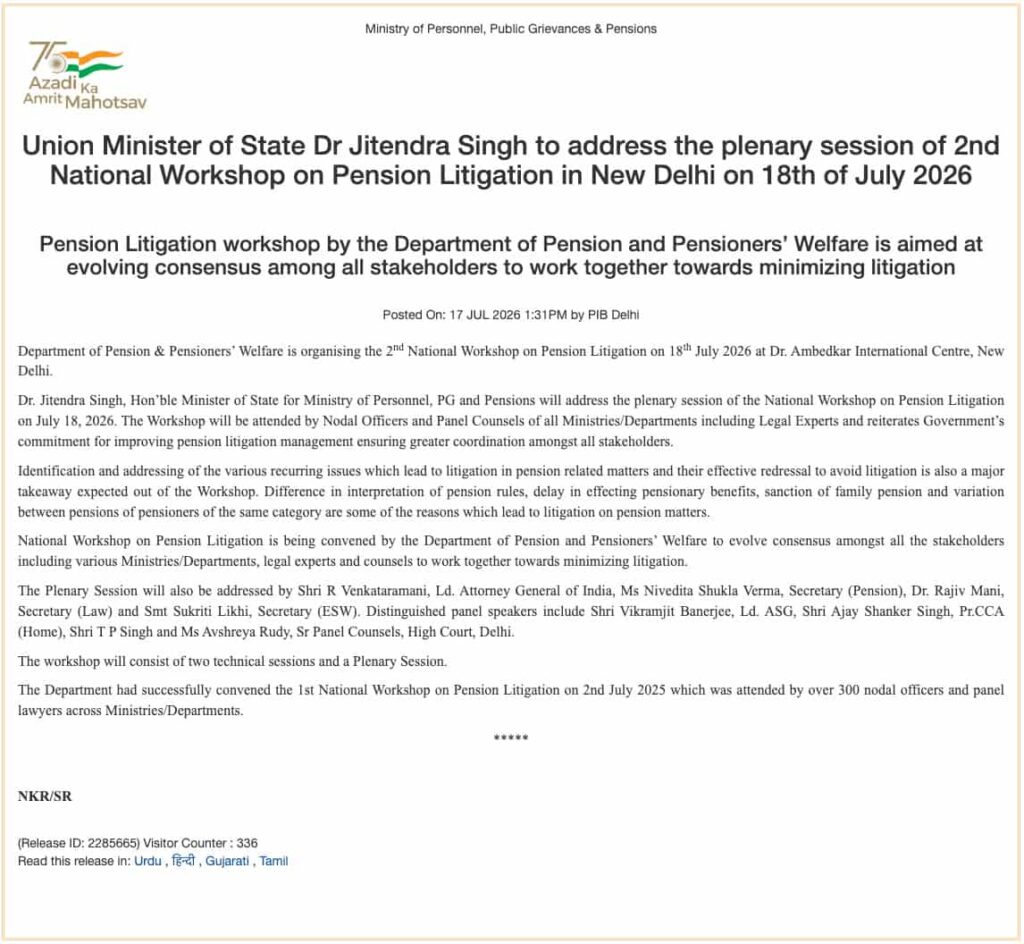
The Department of Pension and Pensioners’ Welfare is holding the second National Workshop on Pension Litigation on 18 July 2026 at the Dr Ambedkar International Centre in New Delhi. The programme includes two technical sessions and a plenary session involving ministry officials, government panel lawyers and legal experts.
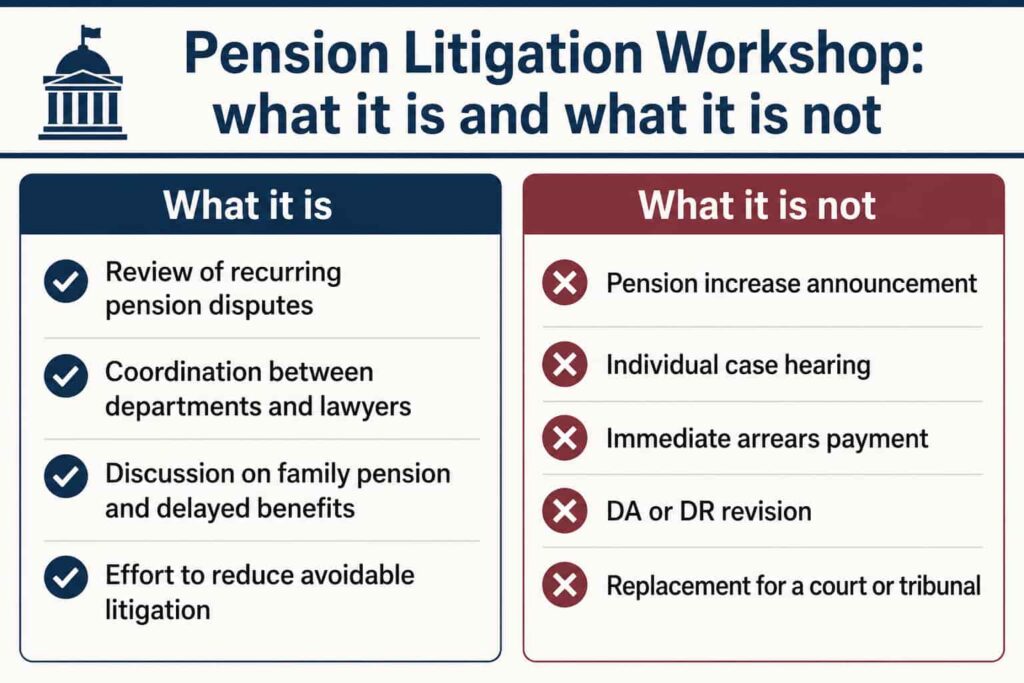
The workshop is important, but it must be understood correctly. It is not a court hearing, Pension Adalat or announcement of new pension benefits. Its purpose is to identify recurring administrative and legal problems and explore how similar disputes can be prevented or resolved more efficiently.
Why is the government reviewing pension court cases?
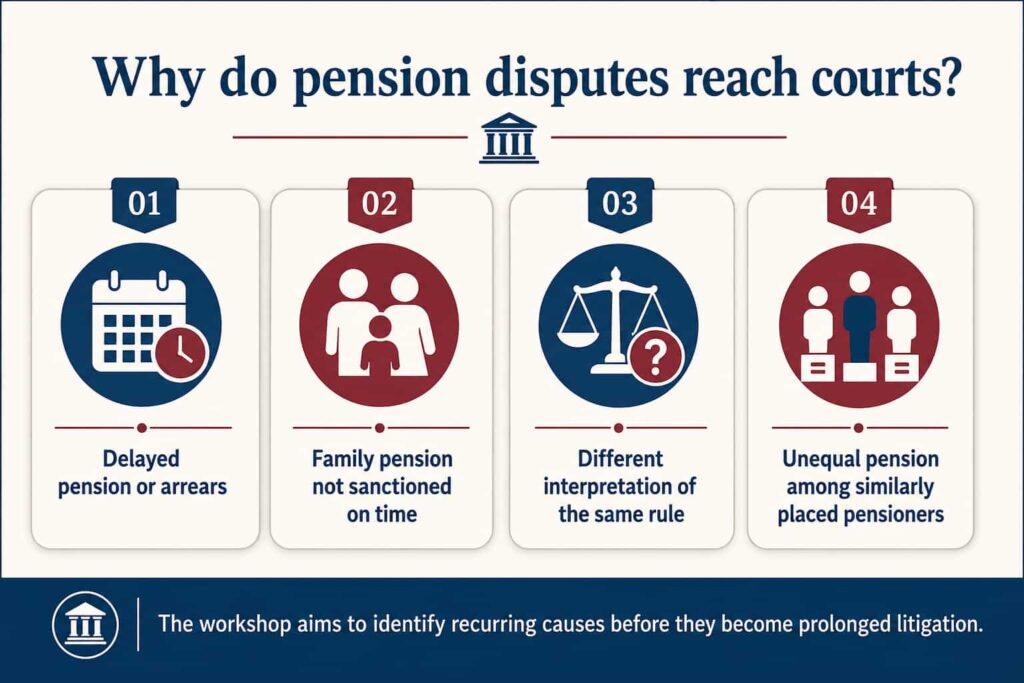
The official announcement identifies four recurring reasons behind pension litigation:
- different interpretations of pension rules;
- delays in releasing pensionary benefits;
- delays in sanctioning family pension;
- variations in pension among pensioners belonging to the same category.
These disputes may begin as administrative problems but can eventually reach the Central Administrative Tribunal, High Courts, the Armed Forces Tribunal or the Supreme Court.
A pensioner may approach a court when the department rejects the claim, applies a rule differently, delays implementation or fails to resolve the matter through normal grievance channels.
Will officials examine individual court cases?
Officials may discuss important judgments, recurring categories and examples of pension litigation. However, the workshop will not remove individual cases from courts or decide them at the conference.
Every pending matter will continue before the concerned court or tribunal unless it is separately settled, withdrawn or resolved through the prescribed legal process.
The workshop’s objective is broader: to understand why the same types of pension disputes keep returning and how departments, pension authorities and government lawyers can handle them more consistently.
What happened at the first pension litigation workshop?
The first National Workshop on Pension Litigation was held on 2 July 2025 and was attended by more than 300 nodal officers and panel lawyers from different ministries and departments.
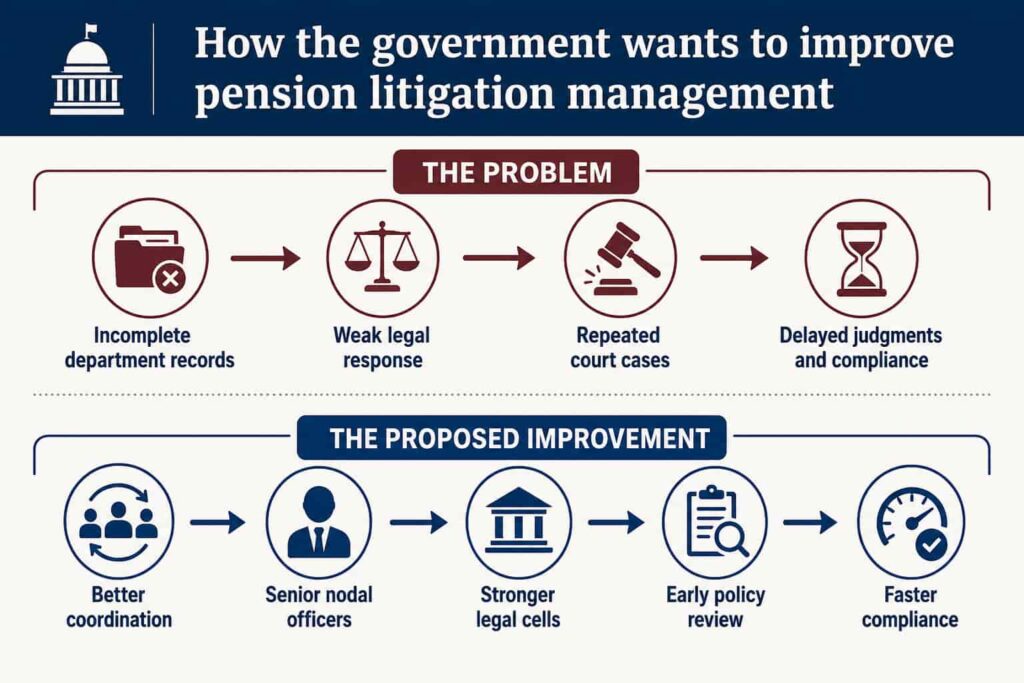
The official address delivered at that workshop revealed several weaknesses in the government’s handling of pension cases:
- panel lawyers sometimes did not receive complete case details;
- departments had limited time to prepare replies;
- contempt matters were taken up at the last moment;
- different ministries needed better coordination;
- dedicated legal cells required strengthening;
- senior nodal officers were needed to monitor litigation;
- an alternative dispute-resolution mechanism for pension cases was considered necessary.
The earlier workshop also emphasised that important adverse judgments involving pension policy should be referred to the Pension Department at the first appeal stage, instead of waiting until the second appeal.
Why family pension is an important part of the discussion?
Family pension cases often affect widows, elderly dependants and families who may not have the resources to pursue long legal proceedings.
The government’s own records show that family pension has already been a major grievance area. Between 2017 and 2025, 19 Pension Adalats reportedly resolved about 18,500 cases, with special attention to family pension matters. A separate family-pension campaign conducted in July 2024 reportedly resolved nearly 2,000 grievances.
These figures show that many pension problems can be addressed administratively when records are reviewed and responsible departments coordinate properly.
The current workshop may therefore focus on preventing avoidable family pension disputes from remaining unresolved until the claimant is forced to approach a court.
Why defence pensioners should follow this development?
The Secretary of the Department of Ex-Servicemen Welfare is among the senior officials scheduled to address the workshop. This indicates that defence pension litigation will form part of the broader discussion.
Defence pension disputes can involve:
- disability pension;
- ordinary or special family pension;
- service-element claims;
- pension calculation differences;
- delayed implementation of Armed Forces Tribunal orders;
- disagreements between Record Offices and pension authorities.
However, the official announcement does not say that any specific defence pension case will be individually decided at the workshop.
What changes may emerge from the workshop?
The official pre-event release does not announce any final decision. Based on the identified problems and the roadmap discussed at the first workshop, possible follow-up measures may include:
- uniform guidance for recurring pension-rule disputes;
- earlier review of judgments involving policy questions;
- improved coordination between ministries and legal counsels;
- monitoring of court and tribunal orders;
- reduction of unnecessary government appeals;
- stronger dedicated legal cells;
- faster handling of family-pension and arrears disputes;
- improved use of the LIMBS litigation-monitoring platform;
- development of alternative mechanisms for resolving suitable pension disputes.
These are possible outcomes inferred from the stated objectives and earlier workshop discussions. They should not be treated as confirmed government decisions until formal instructions are issued.
What will not happen automatically?
The workshop does not automatically mean that:
- pension rates will increase;
- new arrears will be sanctioned;
- DA or DR will be revised;
- pending cases will be withdrawn;
- every court order will be implemented immediately;
- all pensioners in similar cases will receive identical relief;
- individual grievances will be settled during the event.
The official PIB announcement is about consultation and litigation management. It contains no new financial benefit, pension revision or payment order.
Why implementation matters as much as winning a case?
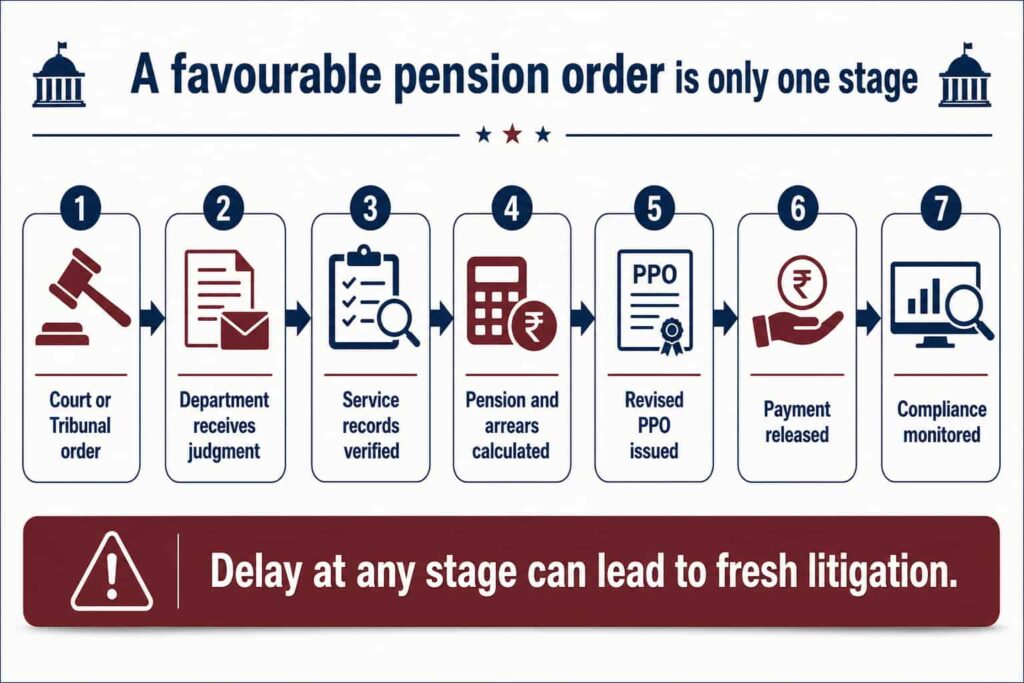
Many pension disputes do not end when a court or tribunal grants relief. The department may still need to:
- receive the certified order;
- verify the claimant’s records;
- calculate pension and arrears;
- issue or revise the Pension Payment Order;
- release payment;
- begin regular pension disbursement.
Weak monitoring during these stages may lead to further litigation or even contempt proceedings.
The first workshop specifically emphasised better monitoring of compliance and avoiding contempt cases through improved coordination and technology.
What should pensioners watch for next?
The most important development will be any official post-workshop release containing:
- recommendations;
- action points;
- new instructions;
- standard operating procedures;
- changes in litigation policy;
- directions on family pension or delayed compliance.
At the time of writing, the government has issued the official announcement for the workshop, but a final report or post-event decision has not yet been made publicly available.
Pensioners should therefore avoid social-media claims suggesting that the workshop has already approved a pension increase, arrears package or automatic settlement of pending cases.
Conclusion
The second National Workshop on Pension Litigation is a significant administrative initiative because it focuses on a problem pensioners have faced for years: similar disputes repeatedly reaching courts because rules are interpreted differently, benefits are delayed or departments fail to coordinate.
The workshop will not decide individual cases or announce an immediate pension increase.
Its real purpose is to improve the system behind pension litigation—how departments interpret rules, prepare court cases, communicate with legal counsels and implement judgments.
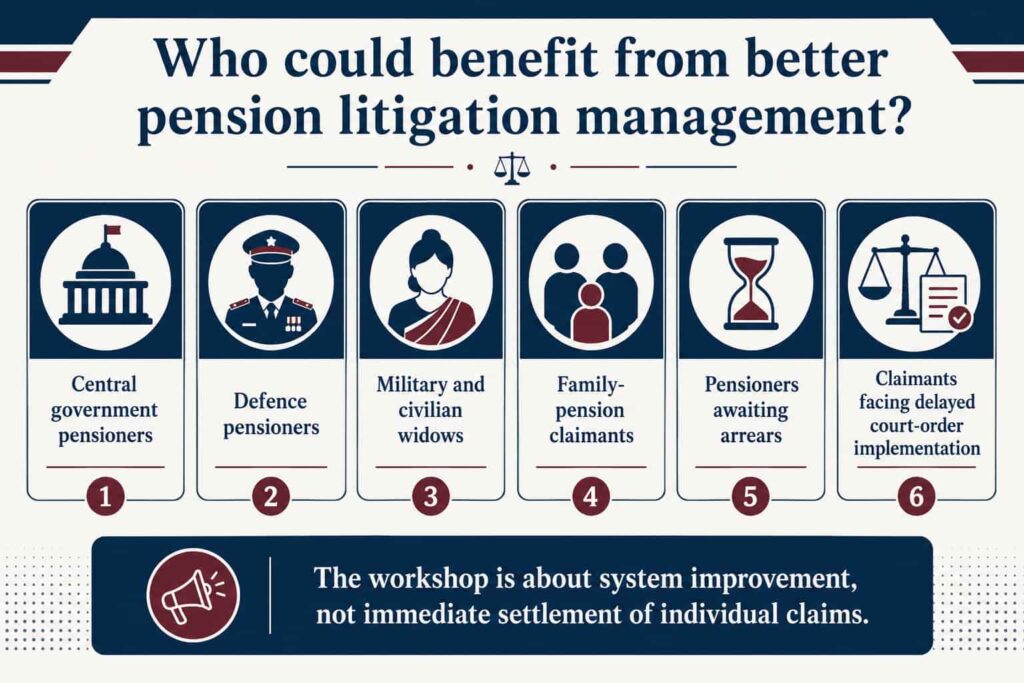
For central government pensioners, defence pensioners and family-pension claimants, the workshop becomes meaningful only if its discussions are followed by clear instructions and measurable action.
The next major update will therefore not be the workshop itself, but the official decisions or reforms issued after it.
Sources:-
- Primary source — 2nd National Workshop on Pension Litigation, 18 July 2026
Open the official PIB announcement
This confirms the workshop date, venue, participating officials and issues under discussion, including delayed pension benefits, family pension, differing interpretations of rules and pension variations.
- Official PDF — Secretary’s address at the first Pension Litigation Workshop, 2 July 2025
Open or download the official workshop PDF
This document explains the earlier workshop’s findings, including incomplete case information, late handling of contempt matters, stronger legal cells, senior nodal officers, alternative dispute resolution and improved compliance monitoring.
- Official PIB background — first National Workshop and pension-litigation reforms
Open the official PIB report
This provides government background on the first workshop and measures aimed at improving pension-litigation management.
- Department of Pension and Pensioners’ Welfare portal
Open the official Pensioners’ Portal
Use this portal to check official pension rules, Office Memorandums, circulars, grievance facilities and future workshop documents.



Leave a Reply