

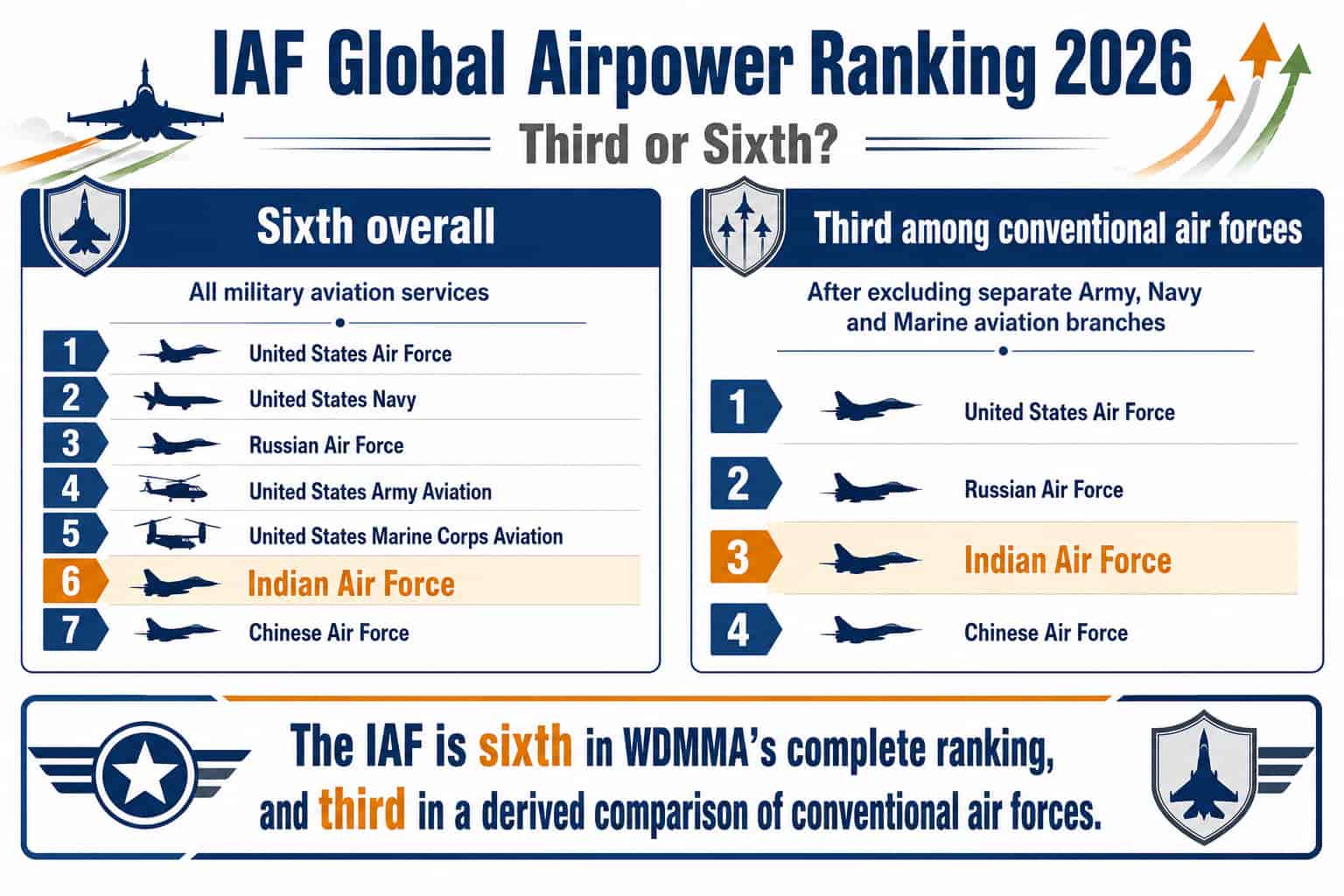
The Indian Air Force has attracted widespread attention after being placed ahead of China’s People’s Liberation Army Air Force in the WDMMA Global Air Powers Ranking 2026.
Some news reports have described the IAF as the world’s third-most powerful air force, while others have correctly referred to it as the sixth-ranked military aviation service.
These two claims may appear contradictory, but they originate from the same ranking table.
The difference lies in what is being counted.
WDMMA places the Indian Air Force sixth when all major military aviation services are included. However, when the separate aviation branches of the United States Navy, Army and Marine Corps are removed, the IAF becomes third among conventional national air forces, behind only the United States Air Force and Russian Air Force.
Therefore, the most accurate description is:
According to WDMMA’s independent 2026 assessment, the Indian Air Force is sixth among all listed military aviation services and third in a derived comparison of conventional air forces.
It is equally important to understand that this is an independent private ranking, not an official assessment issued or endorsed by the Indian Air Force or the Ministry of Defence.
IAF Global Airpower Ranking 2026 at a glance
| Indicator | WDMMA assessment |
|---|---|
| IAF position in the complete ranking | 6th |
| Derived position among conventional air forces | 3rd |
| IAF TruVal Rating | 69.4 |
| IAF aircraft assessed | 1,716 |
| Chinese Air Force position | 7th |
| Chinese Air Force TruVal Rating | 63.8 |
| Chinese aircraft assessed | 3,733 |
| Pakistan Air Force position | 18th |
| Military aviation services assessed | 129 |
| Countries represented | 103 |
The figures are based on WDMMA’s publicly available database and methodology. They should not be presented as official fleet-strength or readiness figures released by the respective governments.
What position does WDMMA officially give the Indian Air Force?
In WDMMA’s complete ranking, the leading military aviation services are listed as follows:
| Rank | Military aviation service | TruVal Rating |
|---|---|---|
| 1 | United States Air Force | 242.9 |
| 2 | United States Navy | 142.4 |
| 3 | Russian Air Force | 114.2 |
| 4 | United States Army Aviation | 112.6 |
| 5 | United States Marine Corps Aviation | 85.3 |
| 6 | Indian Air Force | 69.4 |
| 7 | Chinese Air Force | 63.8 |
This table establishes that the IAF’s published WDMMA position is sixth.
The organisation does not limit its comparison to conventional air forces. It separately evaluates major Army, Navy, Marine and Air Force aviation branches.
That approach explains why three United States military aviation branches appear above India in addition to the United States Air Force.
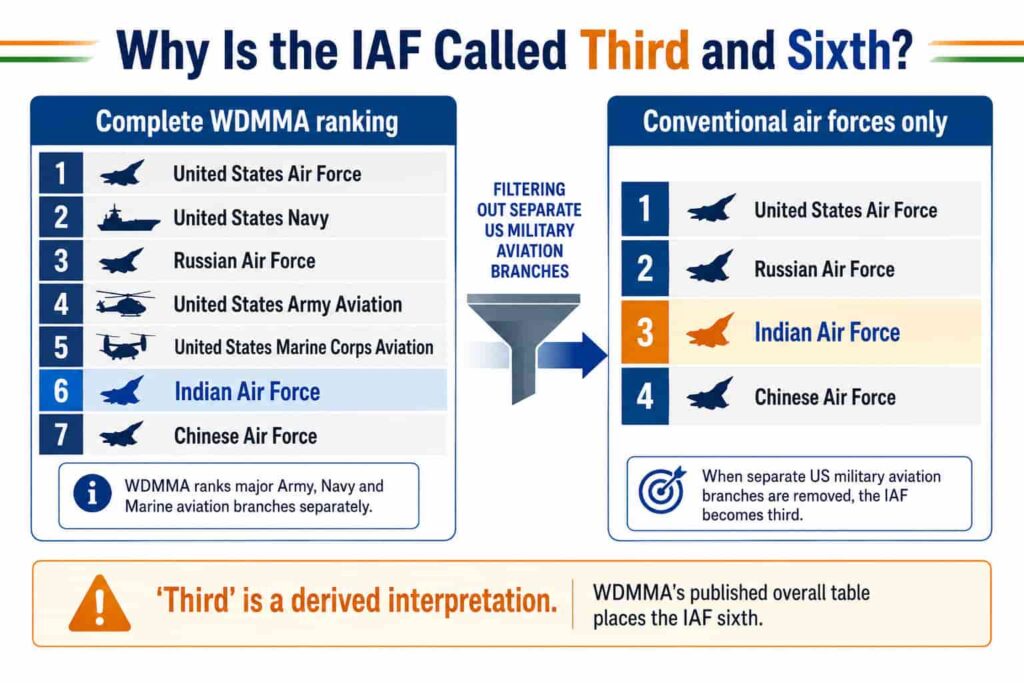
Why is the IAF called third by some media reports?
The third-place claim is a derived interpretation, not the literal position shown in WDMMA’s full table.
When separate United States military aviation branches are removed, the comparison becomes:
- United States Air Force
- Russian Air Force
- Indian Air Force
- Chinese Air Force
In this narrower comparison, the IAF is third.
This interpretation is understandable because readers normally think of an “air-force ranking” as a comparison between national air forces. However, WDMMA’s published ranking is broader and includes military aviation services outside conventional air forces.
The difference can therefore be explained simply:
| Comparison method | IAF position |
|---|---|
| All military aviation services included | 6th |
| Conventional air forces compared separately | 3rd |
A headline saying “IAF is third among conventional air forces” is accurate when the methodology is explained.
A headline saying “IAF has officially been declared the world’s third-most powerful air force” is misleading because:
- WDMMA’s complete table places the IAF sixth;
- third place is obtained through a filtered comparison;
- WDMMA is not an official government ranking body;
- and no official IAF or Ministry of Defence endorsement has been located.
Why has WDMMA placed India ahead of China?
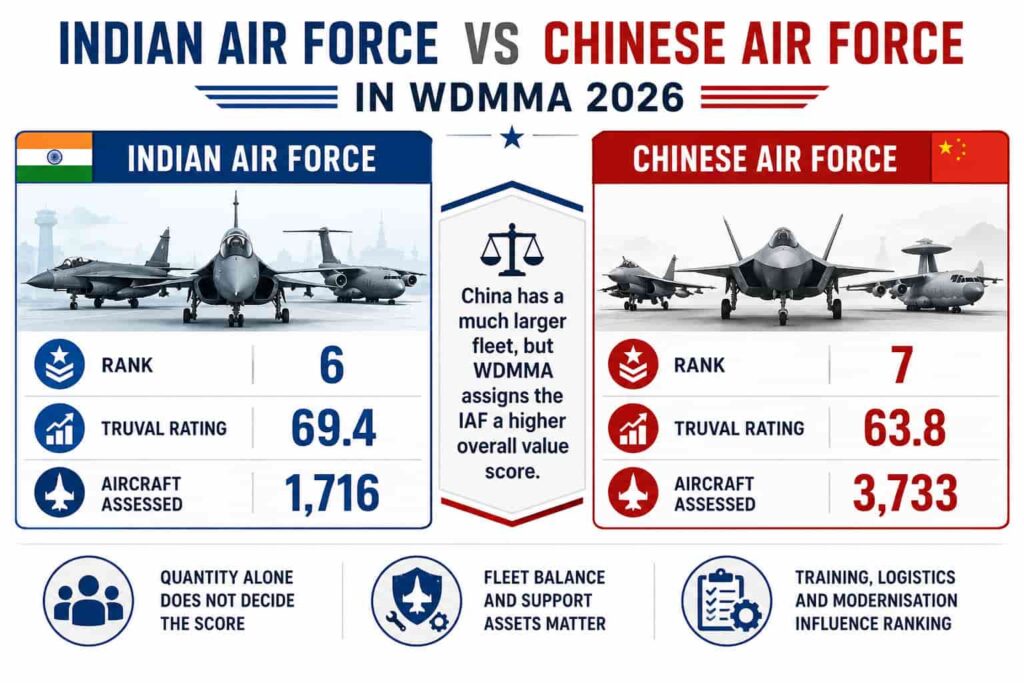
One of the most discussed results is that the Indian Air Force is placed ahead of China despite the Chinese Air Force having a substantially larger assessed aircraft inventory.
According to WDMMA:
| Indicator | Indian Air Force | Chinese Air Force |
|---|---|---|
| Overall position | 6 | 7 |
| TruVal Rating | 69.4 | 63.8 |
| Aircraft assessed | 1,716 | 3,733 |
China is credited with 2,017 more aircraft, yet its final rating is lower.
This is because WDMMA does not calculate airpower by aircraft quantity alone.
Its rating model reportedly considers the composition, balance and wider operational value of an aviation service. A large inventory may not automatically produce a high score if the model identifies limitations in fleet balance, support assets, training, logistics or other capability areas.
Does the WDMMA ranking prove that the IAF is stronger than China?
No single public ranking can conclusively establish which air force would be stronger in an actual military confrontation.
WDMMA’s result shows that its assessment model gives the Indian Air Force a higher overall value score. It does not establish that India leads China in every area of airpower.
Real combat capability would depend on factors that cannot be fully measured through a public aircraft database, including:
- aircraft serviceability on the day of operations;
- pilot experience and flying hours;
- missile and precision-weapon stocks;
- electronic-warfare capability;
- radar and satellite coverage;
- command-and-control networks;
- integrated air-defence systems;
- location and protection of airbases;
- maintenance and repair capacity;
- wartime logistics;
- geography and operational objectives;
- and coordination with land, naval and space assets.
A ranking can offer a useful comparison framework, but it cannot predict the result of an air campaign.
What is the WDMMA TruVal Rating?
WDMMA uses a proprietary score called the TruVal Rating, commonly abbreviated as TVR.
The purpose of this score is to look beyond the number of aircraft and assess the broader fighting value of a military aviation service.
The organisation says its model considers factors such as:
- fighter and combat-aircraft composition;
- offensive and defensive capability;
- logistical support;
- training aircraft;
- transport fleets;
- special-mission platforms;
- close-air-support capability;
- modernisation;
- aircraft on order;
- domestic aerospace capability;
- force balance;
- and operational experience.
This reflects an important reality of modern air warfare: fighters cannot operate effectively without a wider support system.
A capable air force also needs:
- airborne early-warning aircraft;
- refuelling tankers;
- transport aircraft;
- trained air and ground crews;
- secure communications;
- electronic warfare;
- radar networks;
- adequate munitions;
- maintenance infrastructure;
- protected airbases;
- and a dependable industrial supply chain.
However, WDMMA does not publicly disclose the precise mathematical weight assigned to each factor. The final score cannot therefore be independently reproduced or fully audited from the information available on its website.
What does WDMMA report about the IAF inventory?
WDMMA assesses the Indian Air Force inventory at approximately 1,716 aircraft.
Its public fleet page divides the assessed inventory broadly as follows:
| Category | WDMMA figure |
|---|---|
| Combat and attack aircraft | 542 |
| General-support aircraft | 800 |
| Training aircraft | 374 |
| Future procurement | 349 |
These figures show why aircraft totals alone provide an incomplete picture.
An air force’s effective strength depends not only on frontline fighters such as Rafale, Su-30MKI, Mirage 2000 and Tejas, but also on:
- transport aircraft;
- helicopters;
- trainers;
- surveillance platforms;
- refuelling aircraft;
- communication systems;
- and maintenance and logistics support.
Nevertheless, public fleet figures should be treated cautiously because aircraft deliveries, retirements, upgrades and serviceability levels may change faster than open-source databases are updated.
Why is the IAF’s ranking still significant?
Even after using the technically correct sixth-place description, the assessment remains notable.
WDMMA places the Indian Air Force ahead of several major aviation services, including the air forces of:
- China;
- Japan;
- Israel;
- France;
- the United Kingdom;
- South Korea;
- and Pakistan.
It also places India immediately after aviation services belonging to the United States and Russia in the top six.
Under WDMMA’s model, this reflects the value attached to India’s:
- combat experience;
- diverse fighter fleet;
- transport capability;
- helicopter strength;
- training ecosystem;
- operational reach;
- and future procurement plans.
The result is positive, but it should be reported with context rather than converted into an absolute declaration of military superiority.
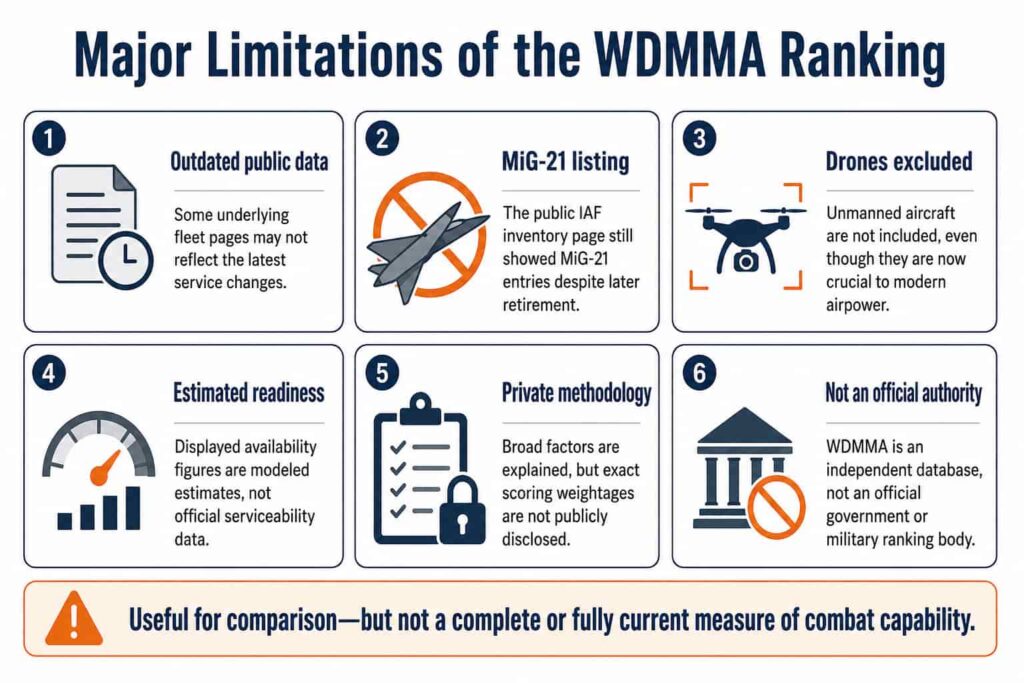
What are the major limitations of the WDMMA ranking?
A balanced review must examine the weaknesses of the assessment, not only the favourable result for India.
Some of the underlying public data may be outdated
WDMMA’s Indian Air Force inventory page carries an earlier update date even though the ranking is presented as a 2026 assessment.
The page also continued to show MiG-21 entries despite the aircraft type’s subsequent retirement from IAF service.
This indicates that some platform-level information may not fully reflect the latest deliveries, retirements or fleet-status changes.
A ranking can therefore display a current year while parts of its source database remain older.
Drones and unmanned aircraft are excluded
WDMMA says it does not currently include unmanned aerial vehicles because public reporting standards vary significantly between countries.
This is a major limitation.
Drones and unmanned systems now contribute to:
- intelligence and surveillance;
- reconnaissance;
- target acquisition;
- electronic warfare;
- precision strike;
- loitering-munition attacks;
- logistics;
- and battlefield damage assessment.
Excluding unmanned systems means the ranking does not capture the complete aviation capability of India, China or other major military powers.
Readiness and availability figures are estimates
Aircraft inventory and operational readiness are not the same.
A country may possess a large number of aircraft on paper, but only a portion may be available at a given time because of maintenance, upgrades, repairs, spare-part shortages or training requirements.
Public databases do not have access to confidential daily serviceability figures.
Any displayed readiness level should therefore be treated as an estimate or modelled assumption, not official operational data from the Indian Air Force.
The complete methodology is private
WDMMA describes the broad factors used in its TruVal Rating but does not publicly disclose the exact formula and scoring weights.
Readers can understand the general logic, but independent analysts cannot fully reconstruct the final rating.
It is not an official military authority
WDMMA is an independent aviation database and analytical website.
It is not an official ranking organisation belonging to:
- the Indian Air Force;
- the Ministry of Defence;
- the United States Department of Defense;
- NATO;
- or any international military authority.
Its own disclaimer states that publicly compiled data may not always be complete, accurate or current.
Is there an official IAF or Ministry of Defence report?
No public Indian Air Force, Ministry of Defence or PIB release has been identified as officially endorsing the WDMMA 2026 ranking.
The ranking’s original source is WDMMA itself.
Therefore, professional reporting should say:
“According to WDMMA’s independent 2026 ranking…”
It should not say:
“The Indian government has officially ranked the IAF third in the world.”
The absence of an official endorsement does not make the WDMMA assessment meaningless. It simply means the source must be attributed correctly.
What does the ranking indicate about India’s regional position?
Under WDMMA’s methodology, the Indian Air Force is placed ahead of the Chinese Air Force and the Pakistan Air Force.
The Pakistan Air Force is listed at rank 18, significantly below the IAF’s sixth position.
However, WDMMA also evaluates Indian Army Aviation and Indian Naval Aviation separately.
This means the table is a ranking of individual military aviation services, not a combined country-level comparison of every aircraft operated by all branches of the Armed Forces.
The same separation applies to the United States, China and several other countries.
What should India strengthen beyond global rankings?
A positive ranking may generate pride and public interest, but national airpower cannot be strengthened through rankings alone.
The more important question is whether the Indian Air Force has the equipment, force multipliers, readiness and industrial support needed for sustained operations.
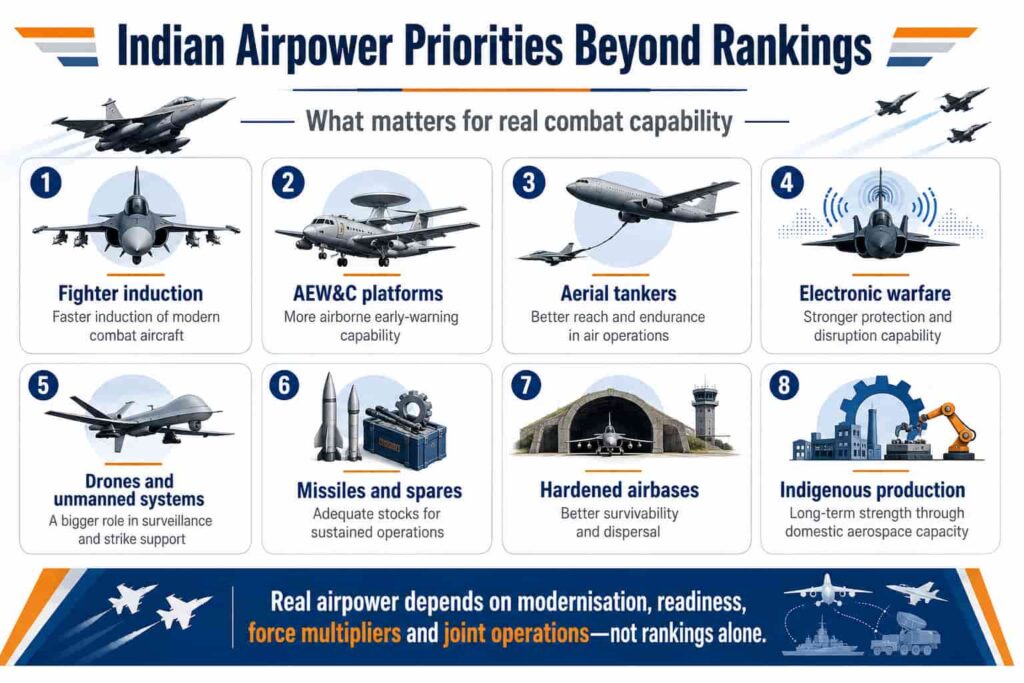
Faster induction of modern fighters
The IAF requires timely induction of modern combat aircraft to replace ageing platforms and maintain adequate squadron strength.
This includes timely domestic production, delivery and operationalisation of indigenous and imported platforms.
More airborne early-warning platforms
Airborne Early Warning and Control aircraft extend radar coverage, improve situational awareness and help coordinate air operations over large distances.
Such platforms are essential force multipliers in contested environments.
Additional aerial-refuelling tankers
Aerial refuelling increases fighter endurance, operational range and mission flexibility.
More tankers would allow combat aircraft to remain airborne longer and operate at greater distances from their home bases.
Stronger electronic-warfare capability
Modern conflicts increasingly depend on controlling the electromagnetic spectrum.
Electronic-warfare platforms can protect aircraft, disrupt enemy sensors and communication, and support offensive operations.
Greater use of drones and unmanned systems
Unmanned platforms are becoming central to surveillance, reconnaissance and strike operations.
India’s airpower development must include drones, loyal-wingman concepts, loitering munitions and other autonomous systems.
Adequate stocks of missiles and spares
Aircraft numbers have limited value without sufficient weapons, maintenance supplies and replacement components.
Sustained operations require dependable stocks of air-to-air missiles, precision weapons, spares and consumables.
Hardened and dispersed airbases
Protected aircraft shelters, alternative operating locations and rapid-repair capability improve survivability during conflict.
Dispersal makes it more difficult for an adversary to disable a large part of the air force through attacks on a limited number of bases.
Stronger indigenous production
Long-term airpower depends on the ability to design, produce, upgrade and maintain aircraft and weapons within the country.
Indigenous production reduces dependence on foreign supply chains and improves strategic autonomy during crises.
Deeper joint-service integration
Future conflicts will require coordinated operations across the Air Force, Army, Navy, space, cyber and electronic-warfare domains.
The speed at which information can be collected, shared and converted into action may be as important as the number of aircraft available.
Is the “IAF world No. 3” headline accurate?
The answer depends on how it is written.
Accurate with explanation:
The IAF is third among conventional air forces in a derived comparison based on WDMMA’s 2026 table.
Most accurate formulation:
The IAF is sixth in WDMMA’s complete military aviation ranking and third after separate Army, Navy and Marine aviation branches are excluded.
Misleading formulation:
The Indian Air Force has officially been declared the world’s third-most powerful air force.
The third statement is misleading because the ranking is independent, the overall table places India sixth, and no official government endorsement has been identified.
Final assessment
The WDMMA Global Air Powers Ranking 2026 gives the Indian Air Force a strong independent assessment.
It places the IAF:
- sixth among all listed military aviation services;
- third in a derived comparison of conventional air forces;
- ahead of China’s Air Force;
- and well ahead of the Pakistan Air Force.
The ranking also reinforces an important principle: aircraft numbers alone do not determine airpower.
Fleet balance, training, logistics, surveillance, refuelling, modernisation, industrial capacity, weapons and operational experience all influence combat effectiveness.
At the same time, the ranking should not be treated as an official declaration or a definitive measurement of wartime superiority. Some public fleet data may be outdated, drones are excluded, readiness figures are estimated, and the full scoring formula is not publicly available.
The most accurate conclusion is:
WDMMA ranks the Indian Air Force sixth in its complete 2026 table and ahead of China. The frequently reported third position is obtained only after excluding separate Army, Navy and Marine aviation branches from the comparison.
The assessment is significant, but the real test of airpower will always be readiness, modernisation, logistics, force multipliers and the ability to sustain operations—not a ranking alone.
Frequently asked questions
What is the Indian Air Force’s WDMMA rank in 2026?
WDMMA places the Indian Air Force sixth among all military aviation services in its complete table.
Why is the IAF also being called third?
The IAF becomes third when separate United States Navy, Army and Marine Corps aviation branches are excluded and only conventional air forces are compared.
Is the IAF ranked ahead of China?
Yes. WDMMA places the Indian Air Force sixth with a TruVal Rating of 69.4 and the Chinese Air Force seventh with a rating of 63.8.
Does China have more aircraft?
Yes. WDMMA assesses the Chinese Air Force at 3,733 aircraft, compared with 1,716 for the IAF.
Why does India receive a higher score?
WDMMA considers factors such as fleet balance, training, logistics, support aircraft, modernisation, future procurement and operational experience rather than aircraft quantity alone.
Is WDMMA an official government organisation?
No. It is an independent military aviation database and analytical platform.
Has the Ministry of Defence officially endorsed the ranking?
No public Indian Air Force, Ministry of Defence or PIB release officially endorsing the WDMMA ranking has been identified.
Does the ranking include drones?
No. WDMMA currently excludes UAVs and drones because of inconsistent public reporting.
Can the ranking predict the outcome of an India-China conflict?
No. It does not fully measure confidential serviceability, weapons, intelligence, geography, electronic warfare, cyber capability, air-defence integration or wartime mobilisation.
Sources:-
WDMMA Global Air Powers Ranking 2026
https://www.wdmma.org/ranking.php
WDMMA Indian Air Force inventory page
https://www.wdmma.org/indian-air-force.php
WDMMA disclaimer and data limitations
https://www.wdmma.org/disclaimer.php
Indian Express report on the complete WDMMA table
https://indianexpress.com/article/trending/top-10-listing/global-air-powers-ranking-2026-united-states-air-force-tops-list-indian-air-force-at-no-6-10775617/
The Week report on the India-China comparison
https://www.theweek.in/news/defence/2026/07/08/iaf-more-powerful-than-chinese-air-force-5-wdmma-air-powers-rankings-2026-findings.html
Times of India report on the third-versus-sixth interpretation
https://timesofindia.indiatimes.com/defence/news/iaf-ranks-3rd-in-global-airpower-outflanks-china-for-5th-time-since-2022-but-critical-gaps-still-remain/articleshow/132304986.cms




Leave a Reply