

India’s coastline does not sleep.
Every day, the sea carries trade, fishing activity, merchant movement, security challenges, environmental risks and distress situations. Protecting this vast maritime space requires not only large warships, but also fast, responsive and reliable patrol vessels that can operate close to the coast and respond quickly.
That is why the commissioning of ICGS Akshay is important
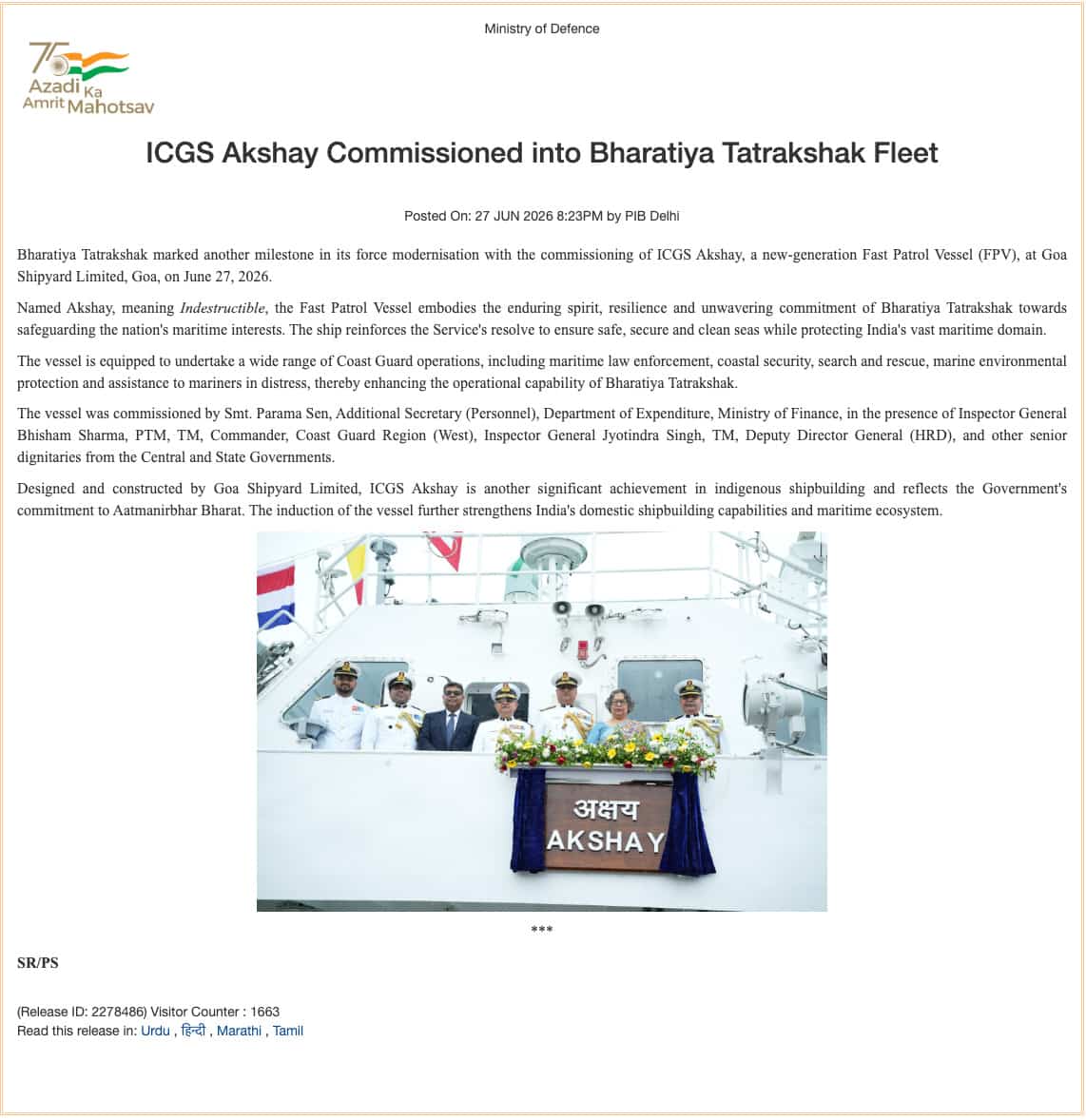
The Indian Coast Guard, also known as Bharatiya Tatrakshak, has commissioned ICGS Akshay, a new-generation Fast Patrol Vessel, at Goa Shipyard Limited, Goa. The vessel adds strength to India’s coastal security network and reflects the growing role of indigenous shipbuilding in maritime safety.
This is not just a ship-commissioning update.
It is a story of Coast Guard modernisation, Aatmanirbhar Bharat, coastal surveillance and India’s continuing effort to keep its seas safe, secure and clean.
What happened in Goa?
ICGS Akshay was commissioned into the Bharatiya Tatrakshak fleet at Goa Shipyard Limited on 27 June 2026.
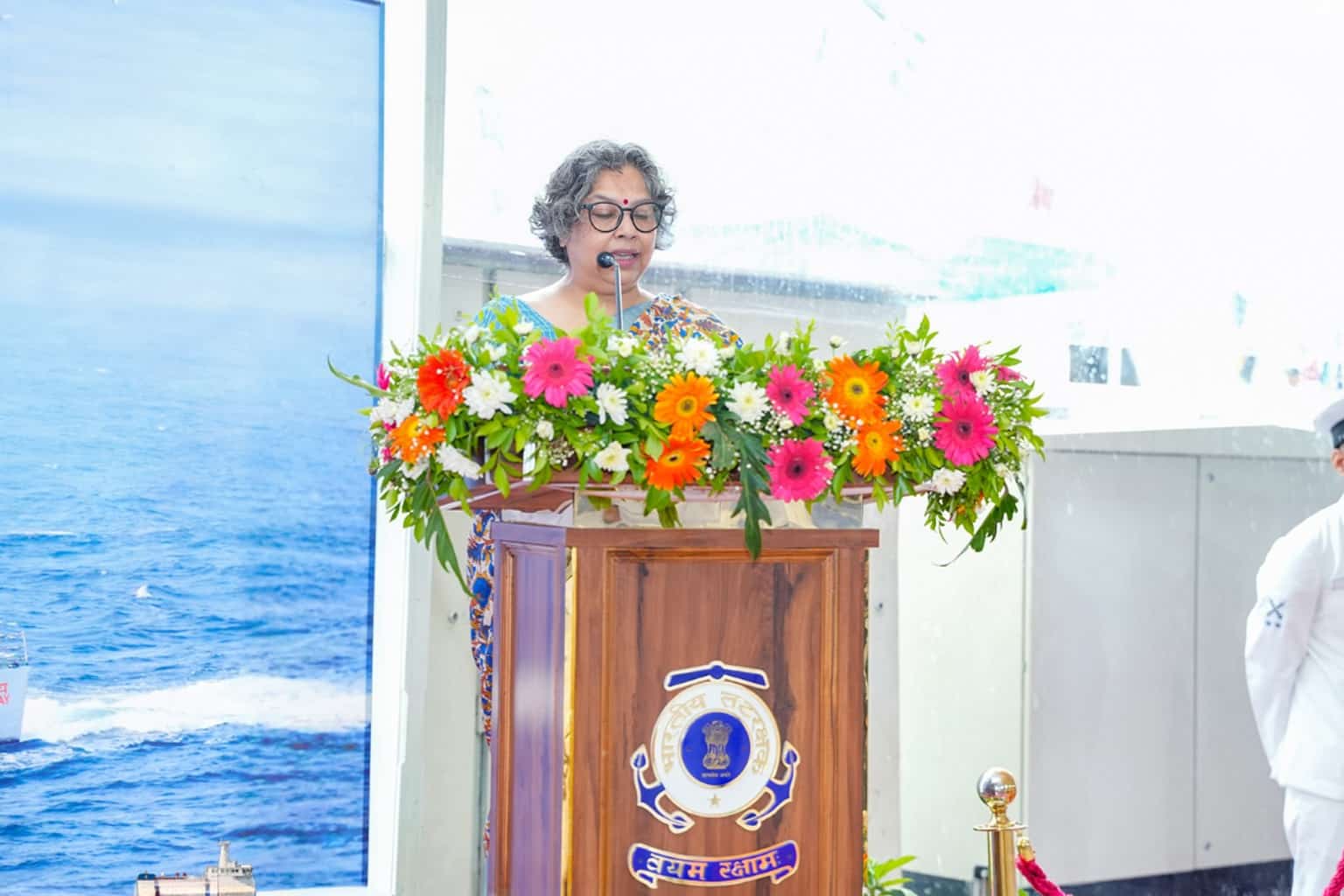
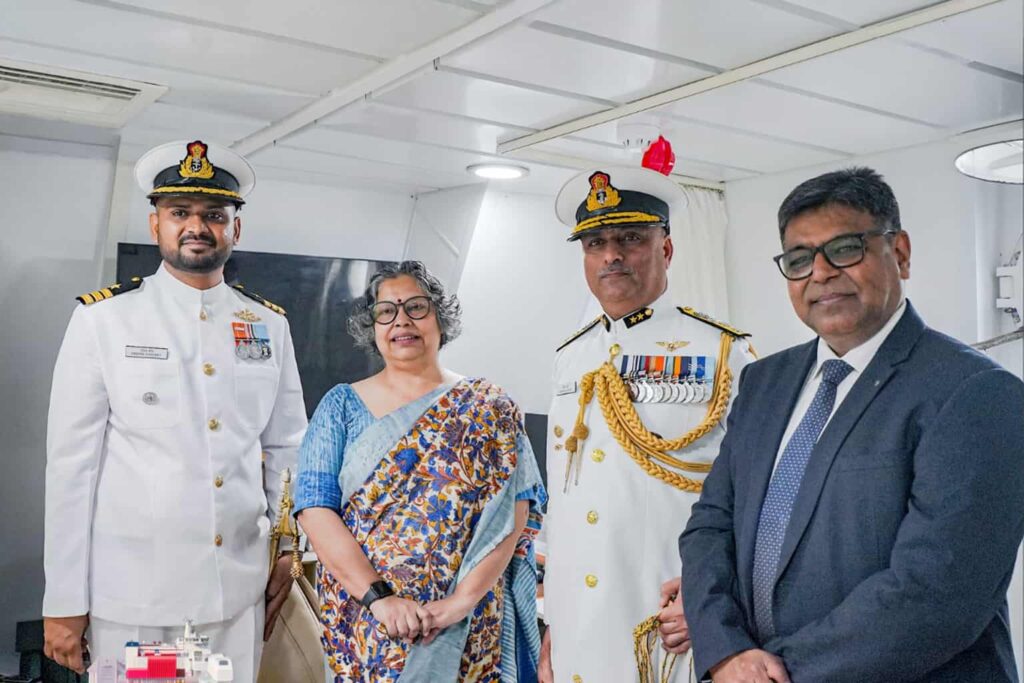
The vessel was commissioned by Smt Parama Sen, Additional Secretary (Personnel), Department of Expenditure, Ministry of Finance. Senior officers of the Indian Coast Guard and other dignitaries were present during the ceremony.
The commissioning marks another step in the Indian Coast Guard’s force modernisation journey.
The name Akshay means indestructible. For a Coast Guard platform, the name carries symbolic weight. It reflects endurance, resolve and commitment towards protecting India’s maritime interests.
What is ICGS Akshay?
ICGS Akshay is a new-generation Fast Patrol Vessel.
A Fast Patrol Vessel is not meant to be understood like a destroyer, frigate or large naval combat ship. Its role is different and equally important.
Such vessels are designed for quick patrol, coastal security, maritime surveillance, law enforcement, search and rescue, environmental protection and assistance to people in distress at sea.
In simple words, ICGS Akshay is the kind of vessel that strengthens the Coast Guard’s everyday operational presence.
It can support regular patrol duties, respond to distress calls, assist maritime law-enforcement tasks, and help protect India’s coastal and maritime zones.
Why Fast Patrol Vessels matter?
India has a long coastline and a vast maritime responsibility.
The Indian Coast Guard has to deal with multiple duties at sea, including coastal security, anti-smuggling support, search and rescue, marine pollution response, fisheries protection, and assistance to vessels or mariners in distress.
For these duties, speed and response time matter.
A Fast Patrol Vessel gives the Coast Guard the ability to move quickly, maintain presence in sensitive areas and support maritime enforcement.
In many situations, the most important requirement is not heavy firepower. It is quick detection, quick movement and quick response.
This is where vessels like ICGS Akshay become valuable.
Built by Goa Shipyard Limited
One of the strongest points of this commissioning is the indigenous shipbuilding angle.
ICGS Akshay has been designed and constructed by Goa Shipyard Limited.
This makes the vessel part of India’s larger push for self-reliance in defence manufacturing and maritime capability. The commissioning supports the spirit of Aatmanirbhar Bharat by showing that Indian shipyards are playing a growing role in building platforms for national security.
For the Coast Guard, domestic construction is not only a matter of pride. It also helps create a stronger local ecosystem for shipbuilding, maintenance, upgrades and long-term support.
When a platform is built within the country, it strengthens both operational capability and industrial confidence.
Part of a wider modernisation push
ICGS Akshay should not be seen as an isolated addition.
It is part of a broader effort to modernise the Indian Coast Guard fleet and strengthen India’s maritime response capacity.
Supporting reports describe Akshay as the fourth vessel in the Adamya-class series of eight Fast Patrol Vessels being built by Goa Shipyard Limited for the Indian Coast Guard.
This is important because one vessel adds capability, but a class of vessels adds operational depth.
A series of modern FPVs can improve patrol coverage, response distribution and operational flexibility across maritime zones.
What roles will ICGS Akshay perform?
The official description of the vessel’s role is clear.
ICGS Akshay is equipped to support a wide range of Coast Guard operations, including:
maritime law enforcement,
coastal security,
search and rescue,
marine environmental protection,
and assistance to mariners in distress.
These roles show the true nature of the Indian Coast Guard.
The Coast Guard is not only a security force. It is also a rescue force, enforcement force, pollution-response force and maritime-safety institution.
A vessel like Akshay strengthens all these responsibilities.
Safe, secure and clean seas
The Coast Guard’s larger mission is often described through the idea of safe, secure and clean seas.
This phrase is important.
Safe seas mean rescue, assistance and protection of life at sea.
Secure seas mean law enforcement, coastal surveillance and protection of maritime interests.
Clean seas mean marine environmental protection and pollution-response responsibilities.
ICGS Akshay fits into all three areas.
It can support security operations, help in distress situations and contribute to environmental protection duties.
That makes it a practical addition to India’s maritime safety architecture.
Why this matters for coastal India?
For people living away from the coast, a Coast Guard vessel may look like a routine defence update.
But for coastal communities, fishermen, merchant vessels and maritime authorities, Coast Guard presence is deeply important.
The sea can create emergencies without warning.
A fishing boat can face engine failure.
A vessel can send a distress call.
Suspicious movement can be detected.
Pollution incidents can threaten marine life.
Smuggling or unlawful activity may need quick response.
In all such situations, the Coast Guard’s ability to respond quickly becomes critical.
ICGS Akshay strengthens that ability.
Technical context
Supporting reports provide additional technical details about the vessel and the Adamya-class series.
ICGS Akshay has been described as a 52-metre Fast Patrol Vessel with a displacement of around 320 tonnes. It is reported to be operated by six officers and 35 sailors.
Reports also mention that the Adamya-class FPVs use Controllable Pitch Propeller propulsion with two 3,000 kW diesel engines. The class is also reported to be fitted with modern weapons, including a 30mm naval gun and remote-controlled machine guns.
These details help readers understand that the vessel is built for modern patrol, response and enforcement tasks.
However, the main significance of ICGS Akshay lies not in one specification, but in the operational role it will perform for the Coast Guard.
Indigenous content and Aatmanirbhar Bharat
Supporting reports also state that ICGS Akshay carries over 65 percent indigenous content.
This makes the vessel relevant to India’s defence-production story.
Aatmanirbhar Bharat in defence is not only about building fighter aircraft or missiles. It is also about building patrol vessels, surveillance platforms, support systems and maritime assets that are needed for everyday national security.
Coast Guard ships may not always receive the same public attention as major naval platforms, but they are essential for real maritime governance.
The commissioning of ICGS Akshay shows that Indian shipbuilding capability is being used to strengthen a force that works daily across India’s maritime domain.
Why this is not a Navy warship story?
It is important to understand the difference clearly.
ICGS Akshay belongs to the Indian Coast Guard, not the Indian Navy.
It should not be called a Navy warship, destroyer, frigate or combat fleet vessel.
The Indian Navy and Indian Coast Guard have different roles, though both are vital for maritime security.
The Coast Guard focuses on maritime law enforcement, coastal security, search and rescue, pollution response and protection of life and property at sea.
ICGS Akshay has been commissioned for that Coast Guard mission.
This distinction is important for accurate defence reporting.
What the commissioning tells us?
The commissioning of ICGS Akshay tells us three things.
First, the Indian Coast Guard is continuing its fleet modernisation.
Second, indigenous shipbuilding is becoming more important in maritime-security capability.
Third, India is strengthening its ability to patrol, protect and respond in coastal and near-sea areas.
The ship may not attract the drama of a missile test or a fighter aircraft induction, but its contribution is practical and continuous.
Maritime security is not built only during crises. It is built every day through patrol, presence, readiness and response.
A quieter but important capability
Fast Patrol Vessels usually do not dominate public headlines.
But they are among the most useful platforms for a Coast Guard.
They are visible where quick action is needed.
They can reach areas where larger platforms may not be the most practical choice.
They can support law enforcement, intercept suspicious activity, help distressed boats and strengthen the confidence of coastal communities.
In that sense, ICGS Akshay is a quiet but meaningful addition to India’s maritime shield.
What readers should remember?
There are four important takeaways from this commissioning.
First, ICGS Akshay is a new-generation Fast Patrol Vessel commissioned into the Indian Coast Guard.
Second, it was designed and constructed by Goa Shipyard Limited, strengthening the indigenous shipbuilding and Aatmanirbhar Bharat story.
Third, the vessel will support maritime law enforcement, coastal security, search and rescue, marine environmental protection and assistance to mariners in distress.
Fourth, Akshay is part of a broader Coast Guard modernisation push, not a one-off development.
What should not be misunderstood?
ICGS Akshay is not an Indian Navy destroyer or frigate.
It is not meant to be described as a frontline naval combat ship.
It should not be called fully indigenous without qualification, because supporting reports mention over 65 percent indigenous content.
It should also not be presented as a war-preparation story.
The more accurate and responsible angle is Coast Guard capability enhancement, coastal security, indigenous shipbuilding and maritime safety.
Final takeaway
The commissioning of ICGS Akshay is a meaningful step for India’s maritime security structure.
It strengthens the Indian Coast Guard’s ability to perform fast patrol, law enforcement, coastal security, search and rescue, environmental protection and assistance duties.
It also reflects India’s progress in indigenous shipbuilding through Goa Shipyard Limited.
The name Akshay means indestructible, and the vessel carries that spirit into the Coast Guard’s mission of guarding India’s maritime interests.
In a country with a long coastline and expanding maritime responsibilities, platforms like ICGS Akshay are essential.
They may not always be the loudest symbols of power, but they are among the most dependable instruments of safety, security and service at sea.
Sources:-
PIB / Ministry of Defence — ICGS Akshay Commissioned into Bharatiya Tatrakshak Fleet
NewsOnAIR — Indian Coast Guard commissions Fast Patrol Vessel ICGS Akshay in Goa
Economic Times — Coast Guard commissions ICGS Akshay, 4th Adamya-class FPV built by Goa Shipyard
Times of India — Indian Coast Guard commissions ICGS Akshay: All about the vessel




Leave a Reply