


A candidate may have a valid NEET score and still lose the KSB MBBS/BDS opportunity because of an incorrect priority claim, an incomplete certificate or an unreadable document upload.
For the 2026–27 academic session, Kendriya Sainik Board has opened applications for MBBS and BDS seats allotted to the Ministry of Defence under the Central Pool Scheme.
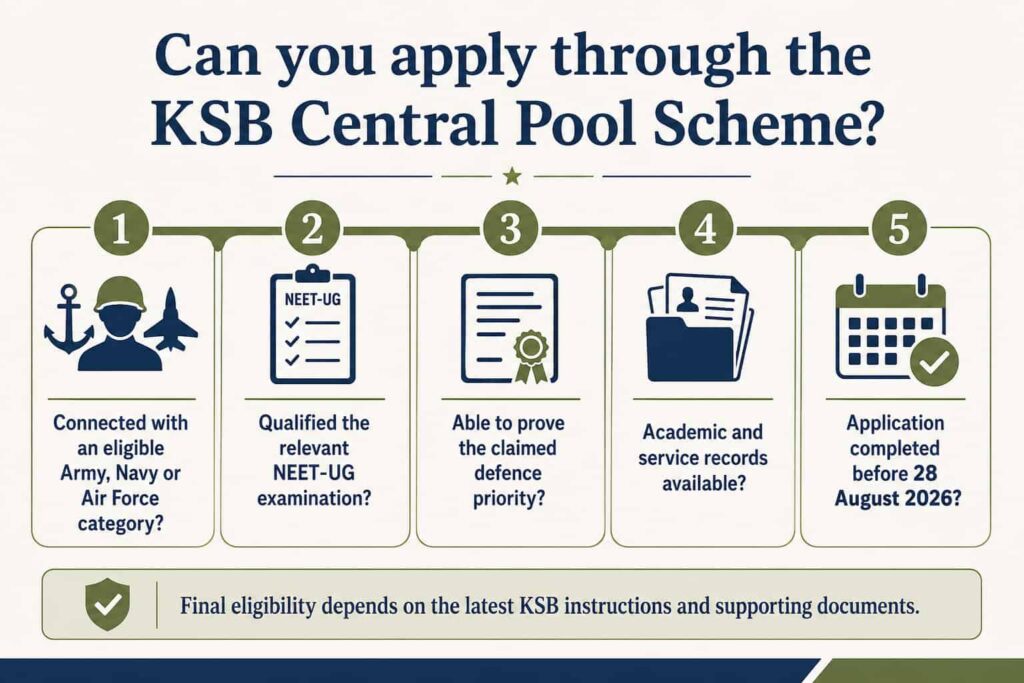
The application window opened on 21 July 2026, while the final date for online submission and document upload is 28 August 2026.
This scheme can provide an important admission opportunity to eligible members of Armed Forces families. However, it is not a direct-admission system.
A valid NEET result, correct defence priority, complete documents and successful counselling are all important for final selection.
What is the KSB MBBS/BDS Central Pool Scheme?
Every year, the Ministry of Health and Family Welfare allocates a limited number of medical and dental seats under the Central Pool.
A portion of these seats is allotted to the Ministry of Defence for eligible applicants connected with the Indian Armed Forces.
Kendriya Sainik Board performs the nomination process by:
- inviting online applications;
- checking eligibility;
- verifying the priority claimed;
- considering NEET merit;
- preparing the merit position;
- calling shortlisted candidates for counselling;
- allotting available seats.
The number of seats and participating institutions may change every academic year.
Candidates should not rely on old seat matrices or previous-year allotment lists as confirmation of availability for 2026–27.
Is this a direct MBBS or BDS admission scheme?
No.
The Central Pool Scheme does not provide automatic admission merely because the candidate is the child of a serving soldier or ex-serviceman.
The applicant must satisfy:
- current KSB eligibility conditions;
- NEET-UG qualification;
- the relevant inter-se priority;
- documentary requirements;
- merit conditions;
- counselling rules;
- seat availability.
A defence connection creates eligibility for consideration. It does not guarantee allotment.
Who should first check their eligibility?
The scheme is intended for candidates covered under the Ministry of Defence’s notified priority policy.
Potential applicants may include eligible:
- wards and widows of personnel killed in action;
- wards of personnel disabled in action and boarded out;
- wards and widows of personnel whose death is attributable to military service;
- wards of personnel disabled in service and boarded out;
- wards of recognised gallantry-award recipients;
- wards of ex-servicemen;
- wards of serving Armed Forces personnel;
- wives included in specified priority categories.
Eligibility is not established merely by selecting a category in the form.
The applicant must provide the prescribed proof supporting the particular priority.
Who should not assume automatic eligibility?
The Central Pool arrangement discussed in the KSB instructions is specifically connected with eligible Armed Forces categories.
Applicants associated with the following should verify the rules carefully instead of assuming coverage:
- defence civilian establishments;
- Central Armed Police Forces;
- General Reserve Engineer Force;
- Defence Security Corps;
- civilian Ministry of Defence organisations;
- applicants without a valid priority certificate.
The official instructions applicable to the current admission cycle should be treated as final.
Is NEET compulsory?
Yes.
The KSB Central Pool route does not replace NEET.
Candidates must qualify the relevant NEET-UG examination and submit the required result or scorecard.
However, NEET marks are not the only consideration.
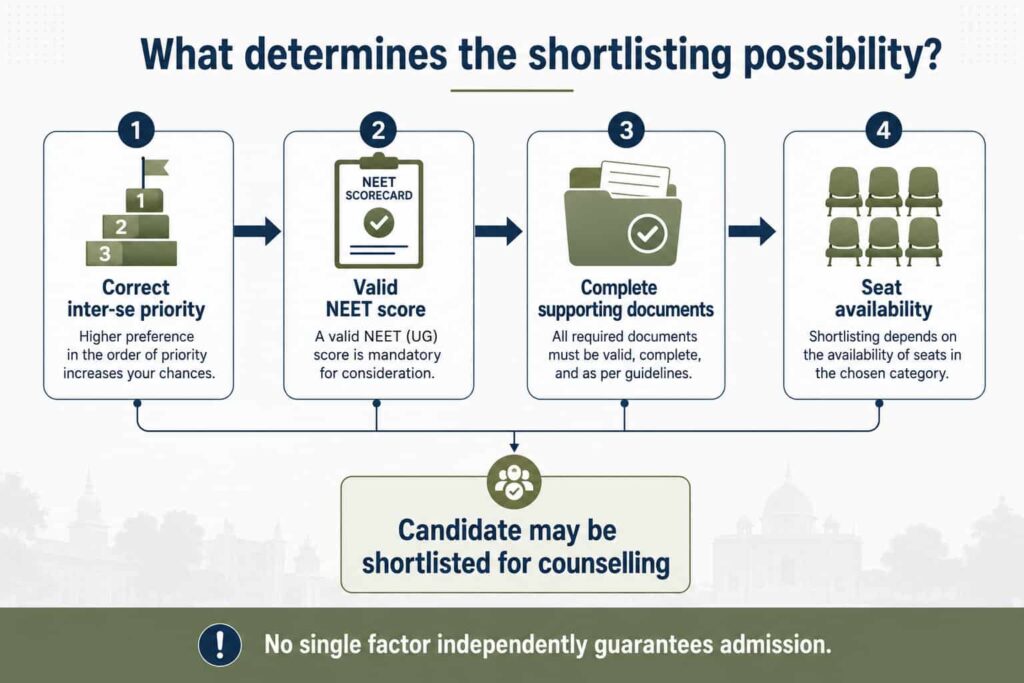
The process broadly combines:
Defence priority + NEET merit + valid documents + available seats
A candidate cannot rely only on a strong NEET score if the claimed priority is unsupported.
Similarly, a valid priority does not remove the requirement to qualify NEET.
Why does the inter-se priority matter?
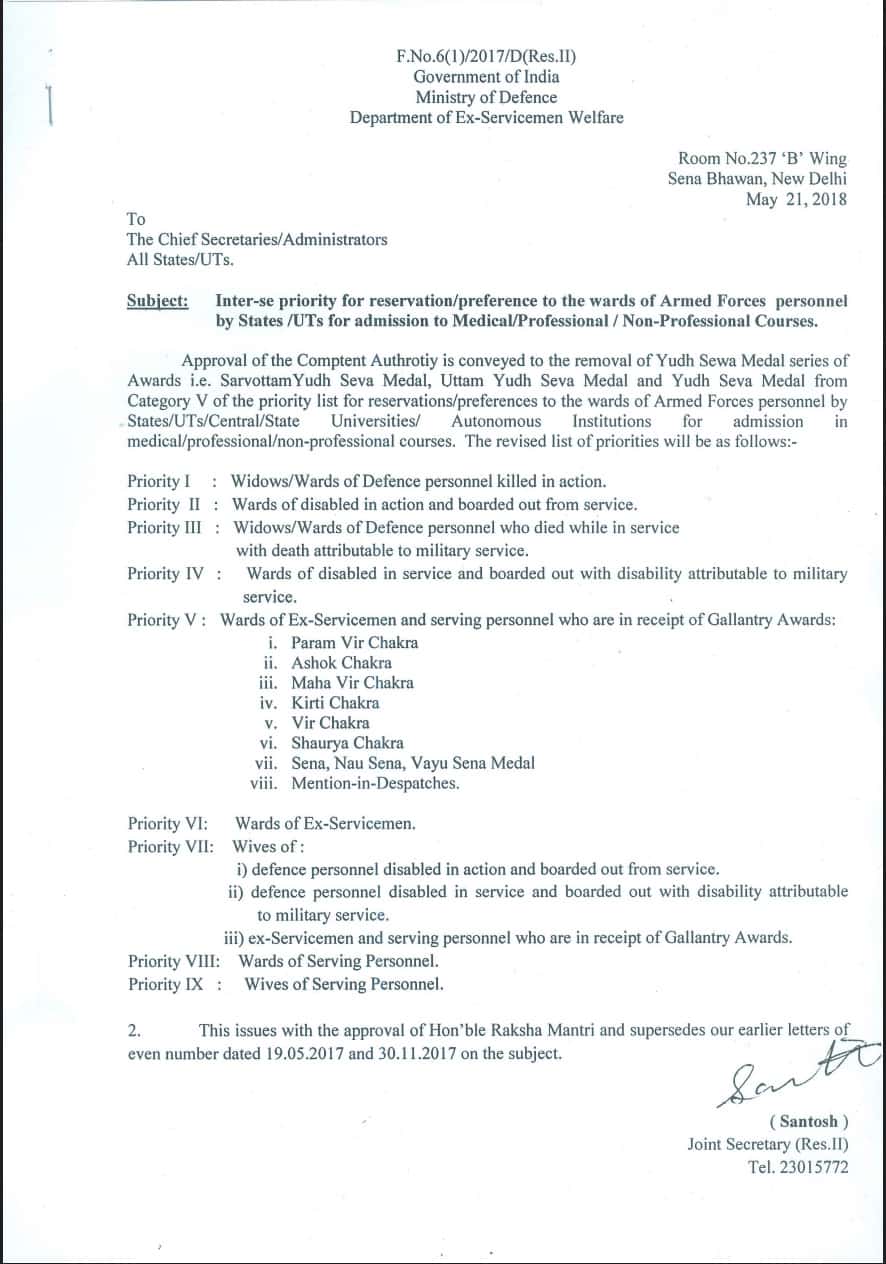
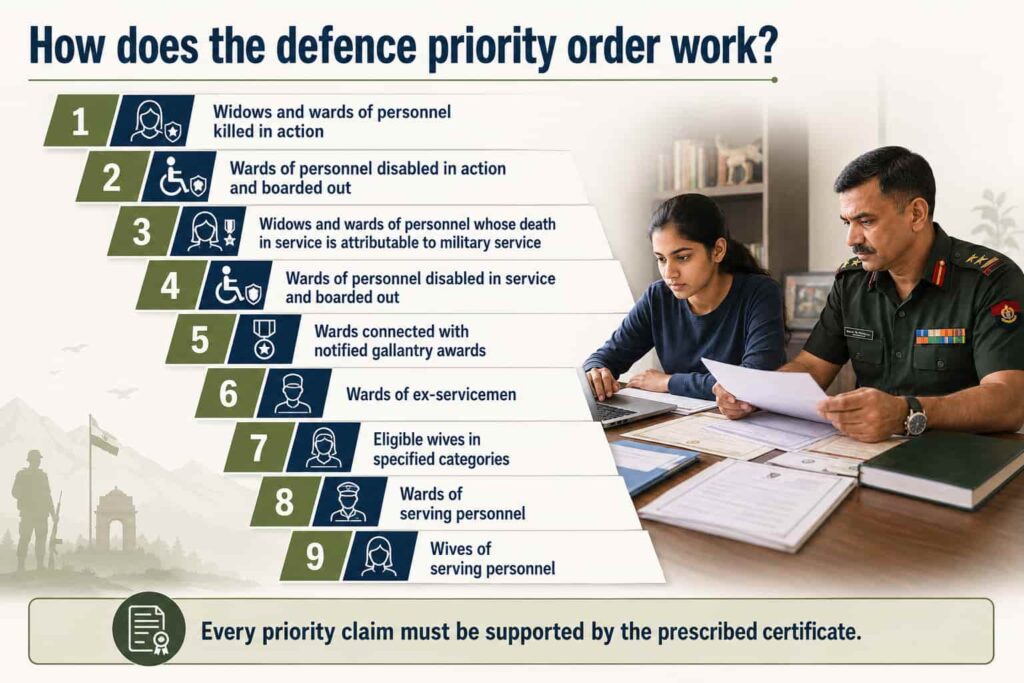
The inter-se priority establishes the order in which different categories of defence applicants are considered.
The broad hierarchy generally includes:
- Widows and wards of personnel killed in action
- Wards of personnel disabled in action and boarded out
- Widows and wards of personnel whose death in service is attributable to military service
- Wards of personnel disabled in service and boarded out
- Wards connected with notified gallantry awards
- Wards of ex-servicemen
- Eligible wives in specified categories
- Wards of serving personnel
- Wives of serving personnel
Candidates should verify the exact wording and documentation requirements for their category.
Can a higher NEET score defeat every priority category?
Not necessarily.
The Ministry of Defence priority structure and NEET merit operate together.
For example:
- Candidate A belongs to a higher notified priority but has a moderate NEET score.
- Candidate B belongs to a lower priority but has a stronger NEET score.
The selection outcome may depend on how KSB first applies the priority order and then compares merit among eligible candidates within the applicable category.
This example only explains the principle. It should not be treated as a prediction of an individual result.
Why is selecting the wrong priority risky?
A candidate may face rejection if:
- a higher priority is claimed without supporting proof;
- the certificate does not use the prescribed format;
- the service circumstance does not match the selected category;
- the certificate has not been authenticated by the competent authority;
- the uploaded document is incomplete or illegible.
Applicants should select the priority they can actually prove, not the one that appears most beneficial.
Which documents should candidates keep ready?
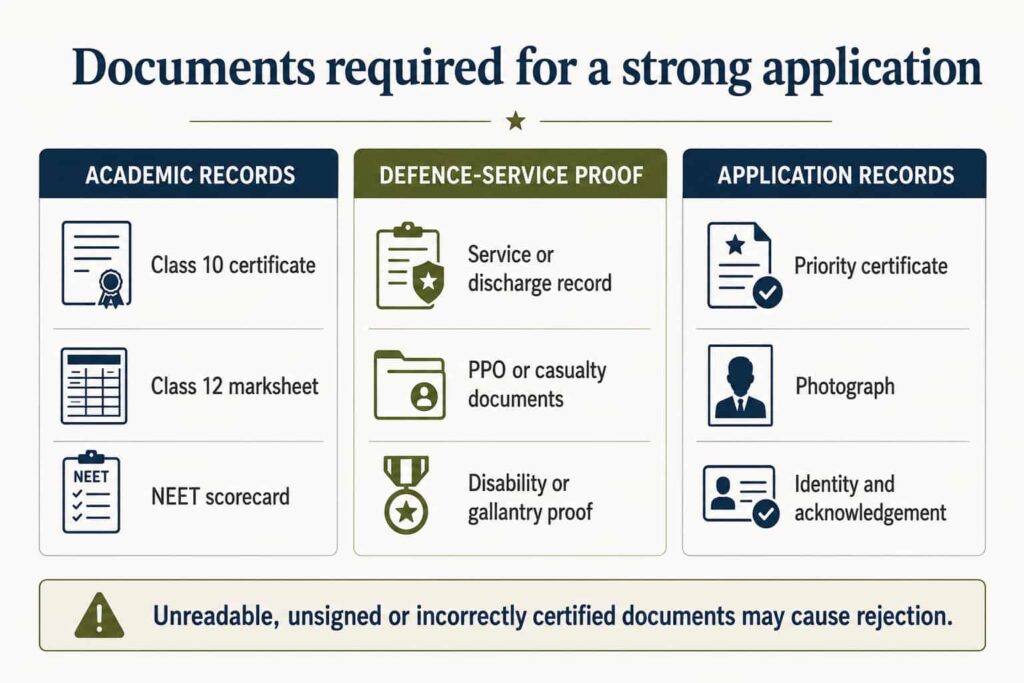
The exact current list must be checked on the KSB portal. Candidates should ordinarily prepare documents under three groups.
Academic and NEET documents
- Class 10 certificate;
- Class 12 marksheet or qualifying certificate;
- NEET-UG scorecard;
- NEET roll number and application details;
- date-of-birth proof, where required.
Defence-service documents
Depending on the priority, candidates may need:
- service certificate;
- discharge book;
- Pension Payment Order;
- casualty certificate;
- battle-casualty proof;
- attributable death certificate;
- disability documents;
- medical board or boarding-out record;
- gallantry-award proof;
- Gazette notification or Part II Order;
- Record Office certification.
Application documents
- prescribed eligibility or priority certificate;
- passport-size photograph;
- identity proof;
- active mobile number;
- functional email address;
- online acknowledgement;
- supporting declarations, where required.
What is the priority or eligibility certificate?
This certificate connects the applicant with the exact defence category claimed in the application.
A general statement saying that the parent served in the Armed Forces may not be enough.
The certificate may need to establish:
- service status;
- relationship with the applicant;
- casualty or disability circumstances;
- attribution to military service;
- gallantry-award details;
- ex-serviceman or serving status;
- exact priority category.
The issuing authority may differ depending on whether the sponsor is:
- a serving officer;
- serving JCO or other rank;
- ex-serviceman;
- pensioner;
- casualty;
- gallantry-award recipient.
Applicants should obtain the certificate from the competent authority mentioned in the current KSB instructions.
What if names differ across documents?
Document mismatch can delay or weaken an application.
For example:
- NEET scorecard: Aarav Kumar
- Class 10 certificate: Aarav K. Singh
- Service certificate: Aarav Singh
Even when all records relate to the same person, KSB may require clarification or supporting proof.
Candidates should check consistency in:
- applicant’s name;
- parent’s name;
- date of birth;
- service number;
- rank;
- relationship;
- spelling and initials.
Where a difference exists, applicants should obtain the appropriate correction or legally acceptable supporting document before the deadline.
How should documents be scanned?
Documents should be:
- complete;
- readable;
- correctly oriented;
- free from shadows;
- within the permitted size;
- uploaded in the prescribed format;
- signed and stamped where required.
Avoid photographs where fingers, background objects or folded corners hide information.
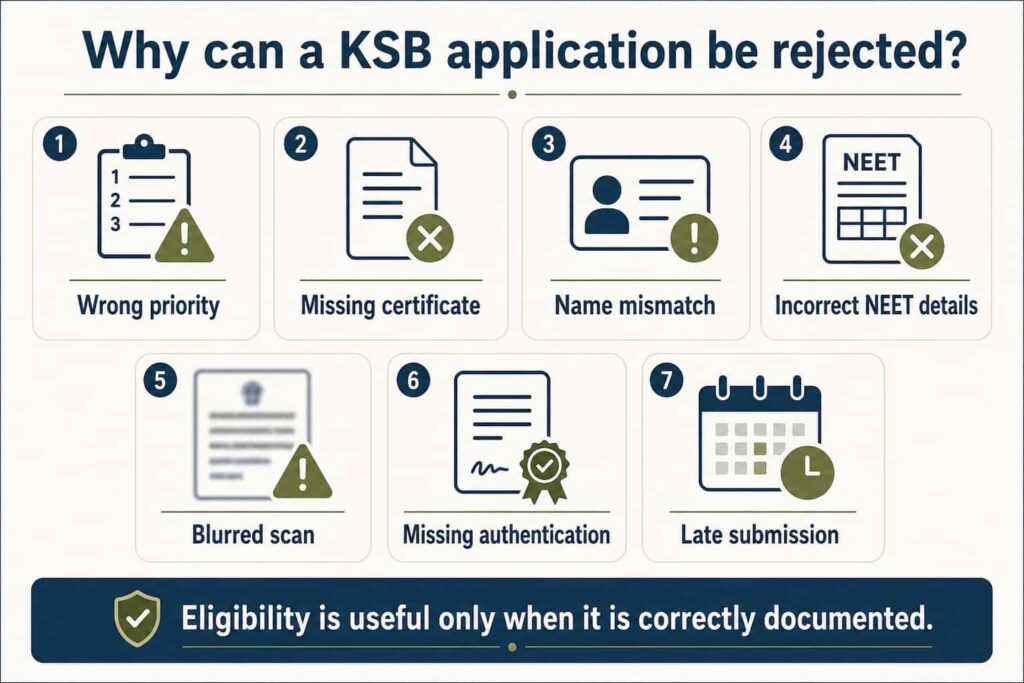
Seven mistakes that may cause rejection
1. Selecting the wrong priority
Do not choose a category that cannot be proved through the required certificate.
2. Uploading a general service certificate
A normal service certificate may not replace the prescribed priority document.
3. Entering incorrect NEET details
The NEET roll number, score, percentile and application details should match the official result.
4. Ignoring name or date-of-birth mismatch
Differences across academic, NEET and service records should be resolved before submission.
5. Uploading blurred documents
A document that cannot be read may be treated as missing.
6. Missing signature or countersignature
Certificates may require verification by a Record Office, commanding authority or Sainik Board.
7. Waiting until the final date
A last-day application leaves little time to correct portal errors, document problems or certificate deficiencies.
How does the application process work?
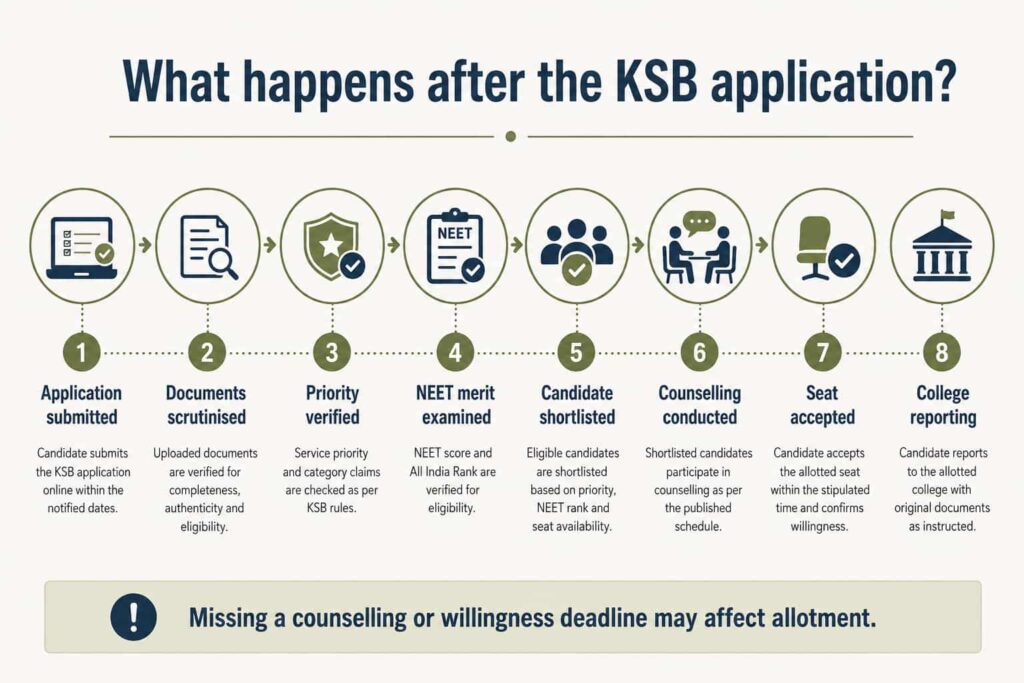
The broad process is expected to follow these stages:
- Candidate registers through the KSB portal
- Personal, academic and NEET details are entered
- Supporting documents are uploaded
- Eligibility and priority are checked
- NEET merit is considered
- Eligible candidates are shortlisted
- Counselling is conducted
- Available seats are allotted
- Selected candidates report to the allotted institution
The application itself does not confirm admission.
What happens after online submission?
After submission, candidates should preserve:
- application number;
- acknowledgement;
- uploaded document copies;
- confirmation message;
- payment receipt, where applicable;
- registered email and mobile access.
KSB may use the registered contact details for:
- scrutiny-related communication;
- shortlisting information;
- counselling schedule;
- willingness confirmation;
- seat-allotment instructions.
Candidates should check their email, spam folder and mobile messages regularly.
Does applying through KSB stop MCC or state counselling?
The KSB Central Pool route should not automatically be treated as a replacement for other counselling channels.
Subject to the rules of each process, candidates may also monitor:
- Medical Counselling Committee counselling;
- state medical counselling;
- institutional admission processes;
- other lawful quota opportunities.
A candidate should not abandon another valid admission route merely because a KSB application has been submitted.
The KSB application only creates a possibility of consideration.
Can a candidate change the priority after submission?
The photographed circular does not explain whether priority correction will be allowed after final submission.
Candidates should therefore:
- verify the category before submitting;
- confirm the certificate format;
- check whether an edit window is provided;
- avoid relying on a later correction opportunity.
Once scrutiny begins, changing a fundamental eligibility claim may be difficult.
Can old certificates be used?
The acceptability of an older certificate depends on:
- current KSB instructions;
- validity period;
- prescribed format;
- whether the service status has changed;
- whether fresh authentication is required.
Candidates should not assume that a certificate used in a previous year will automatically be accepted in 2026–27.
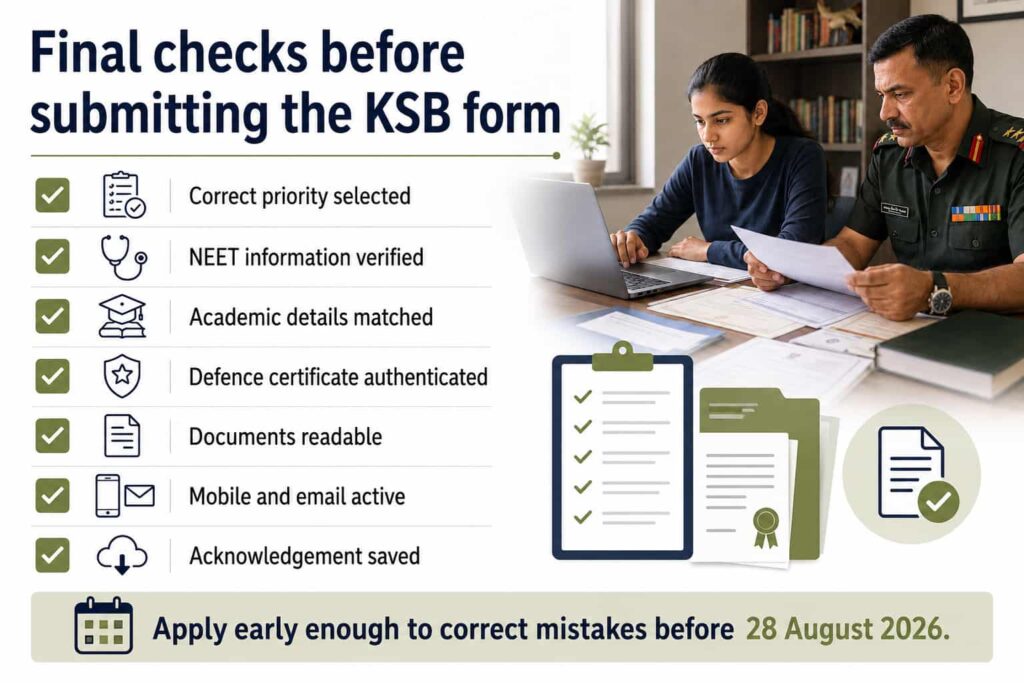
What should candidates do before 28 August 2026?
Seven days before submission
- confirm the correct priority;
- collect academic and NEET records;
- obtain the prescribed defence certificate;
- check names and dates;
- scan documents clearly.
On the application day
- use a stable internet connection;
- enter details exactly as recorded;
- upload readable documents;
- review every field;
- complete final submission.
After submission
- download the acknowledgement;
- save the application number;
- keep original documents ready;
- monitor the registered email and mobile;
- continue following MCC and state counselling;
- wait for official KSB communication.
Frequently asked questions
What is the last date for the KSB MBBS/BDS application?
The KSB circular states that applications and supporting documents must be submitted by 28 August 2026.
Is every child of a soldier eligible?
No. Eligibility depends on the current KSB rules, defence category, priority and documents.
Can an ex-serviceman’s child apply?
Eligible wards of ex-servicemen fall within the priority framework, subject to current conditions and documentary proof.
Is a NEET score enough for selection?
No. NEET merit, priority, document verification and seat availability are considered together.
Does a higher priority guarantee admission?
No. The candidate must also satisfy NEET, eligibility, document and counselling requirements.
Can CAPF families apply?
The KSB Central Pool instructions discussed here are connected with eligible Army, Navy and Air Force families. CAPF applicants should not assume eligibility without an official provision.
Can the same candidate apply through MCC and KSB?
These are separate processes. Candidates should study the rules of both and avoid missing either deadline.
Does online submission confirm a seat?
No. Submission only places the application for scrutiny and consideration.
When will counselling be held?
The circular does not provide a counselling date. Shortlisted applicants are expected to receive separate information.
Conclusion
The KSB MBBS/BDS Central Pool Scheme can be a valuable opportunity for eligible defence families, but the application must be handled carefully.
The strongest application is not simply the one with the highest NEET score. It is one that combines:
- correct eligibility;
- the right inter-se priority;
- verifiable defence records;
- accurate academic information;
- readable documents;
- timely submission;
- active participation in counselling.
The final deadline mentioned in the official circular is 28 August 2026.
Apply early, prove the exact priority claimed and treat every document as part of the selection process.


Leave a Reply