

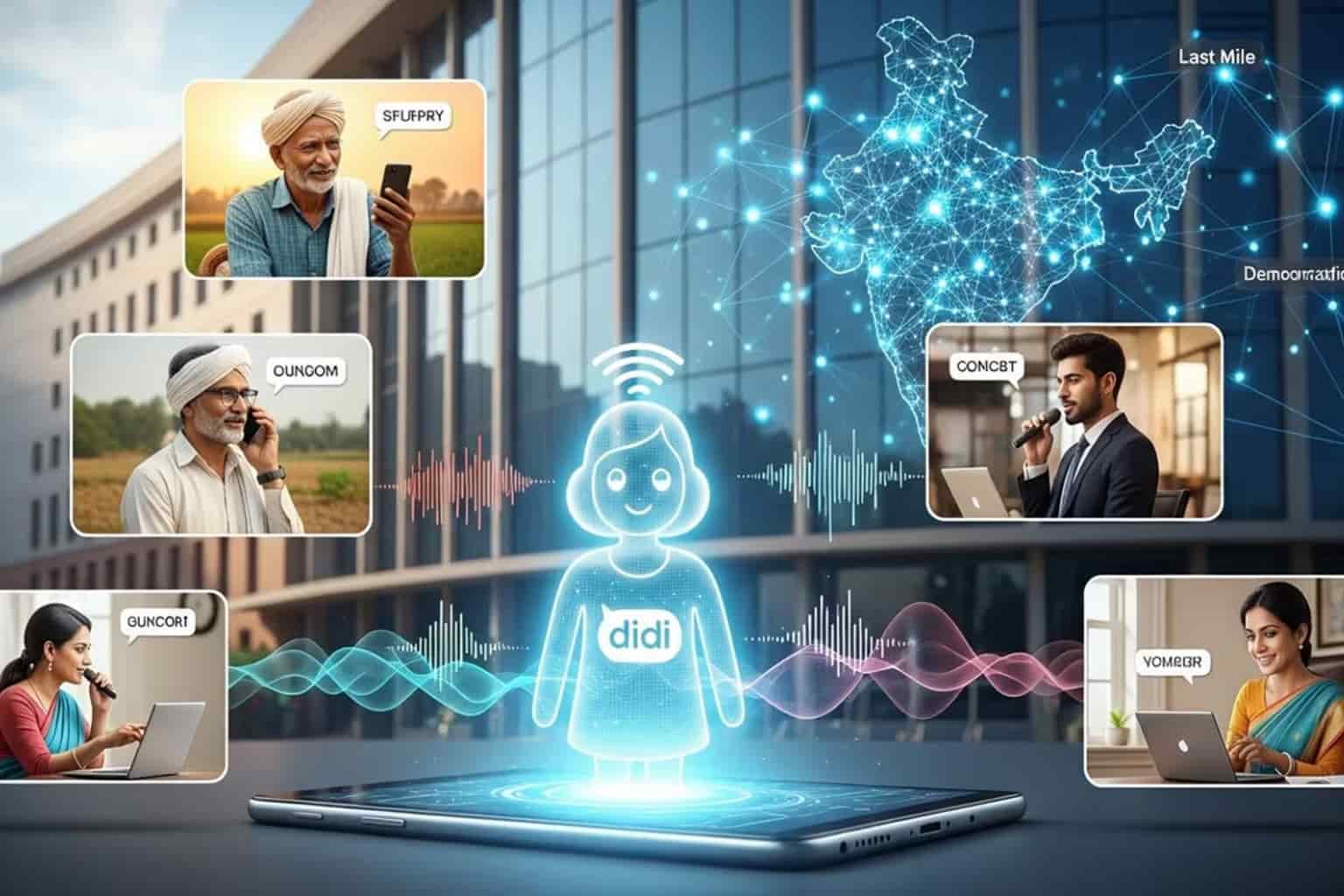
A quiet but important change is taking place in the way citizens interact with the Government’s grievance system.
Instead of expecting every pensioner or senior citizen to know the correct Ministry, Department, grievance category and administrative terminology before filing a complaint, CPGRAMS is beginning to use voice and Artificial Intelligence to simplify that first step.
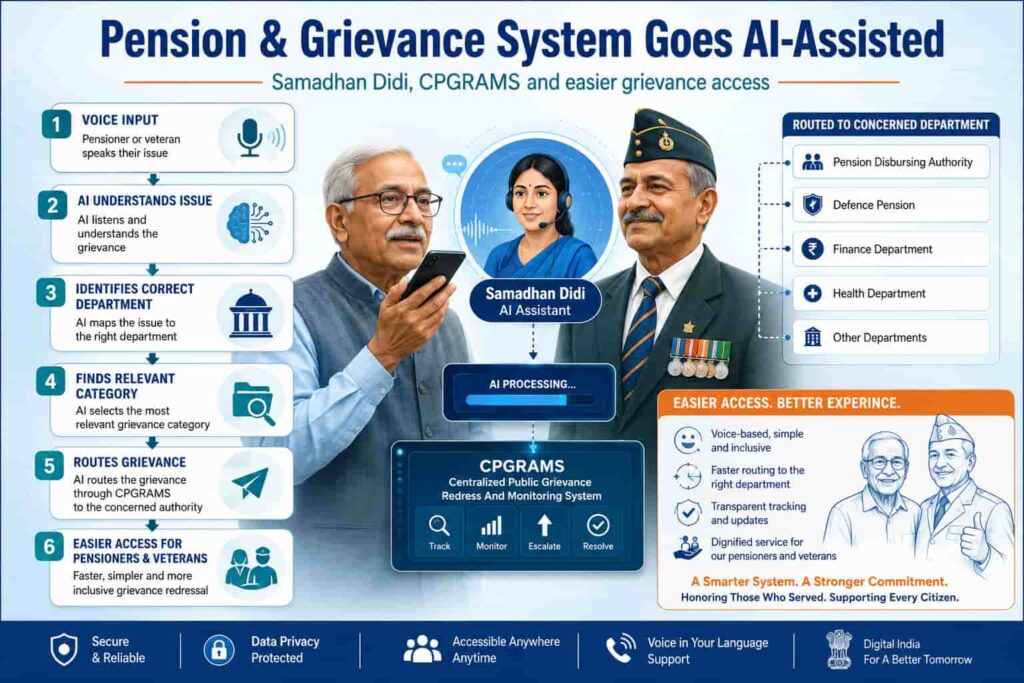
At the centre of this change is Samadhan Didi, an AI-enabled voice facility introduced within the CPGRAMS ecosystem.
For Central Government pensioners and ex-servicemen, however, the significance of this reform lies not in AI “deciding” pension cases. Its real value is simpler: helping a citizen explain a problem and reach the right Government authority more easily.
That distinction is essential.
The problem Government is trying to solve
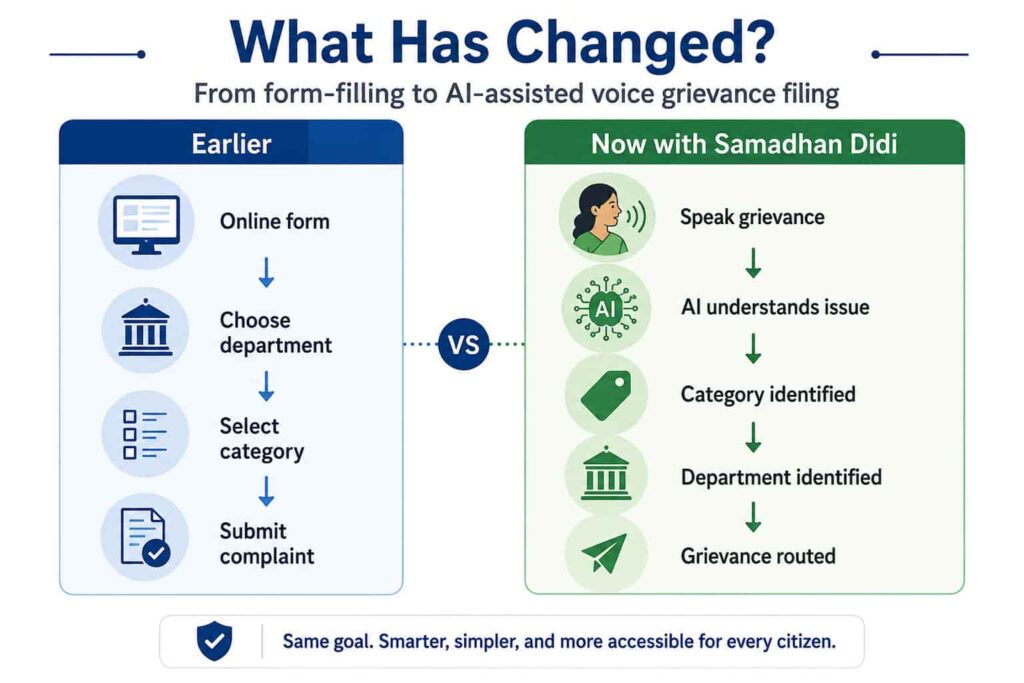
Filing a grievance online sounds simple until the complainant is asked to identify:
- the correct Ministry;
- responsible Department;
- grievance category;
- sub-category; and
- exact nature of the issue.
For a digitally confident citizen this may be manageable.
For an elderly pensioner, widow, family pension beneficiary or veteran unfamiliar with administrative structures, it can become the first major obstacle.
This is where Samadhan Didi changes the entry experience.
Instead of beginning with administrative classifications, the citizen can begin with the actual problem.
The system is designed to understand the spoken grievance, seek additional information where needed and assist in identifying the appropriate destination.
Samadhan Didi is an interface, not the decision-maker
This is where several reports about the new system can become confusing.
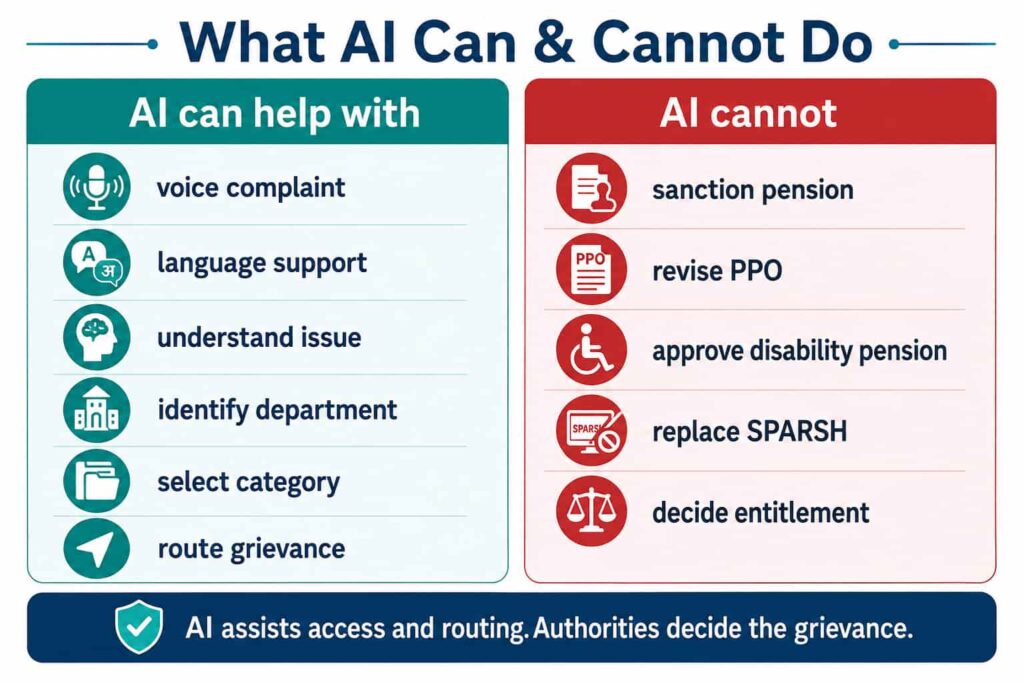
Samadhan Didi is not an AI pension officer.
It does not independently determine whether a pensioner is entitled to arrears, whether a disability pension should be sanctioned or whether a PPO needs revision.
The competent Government authority continues to decide those issues.
The AI component is meant primarily to assist with:
- voice-based grievance input;
- language accessibility;
- understanding the complaint;
- identifying the relevant category;
- identifying the concerned Government authority; and
- directing the grievance through the appropriate channel.
Therefore, the most accurate way to understand the reform is:
AI assists the grievance journey. Government authorities still decide the grievance.
Why multilingual voice access matters?
Samadhan Didi has been developed with BHASHINI-based language capabilities and supports the 22 languages listed in the Eighth Schedule of the Constitution.
This could be one of its most practical benefits.
A pensioner who is uncomfortable drafting a detailed grievance in English may find it easier to explain the issue orally in a familiar Indian language.
For senior citizens, the improvement is therefore not simply about AI.
It is about reducing three barriers simultaneously:
language barrier + digital-form barrier + department-selection barrier.
CPGRAMS and CPENGRAMS should not be confused
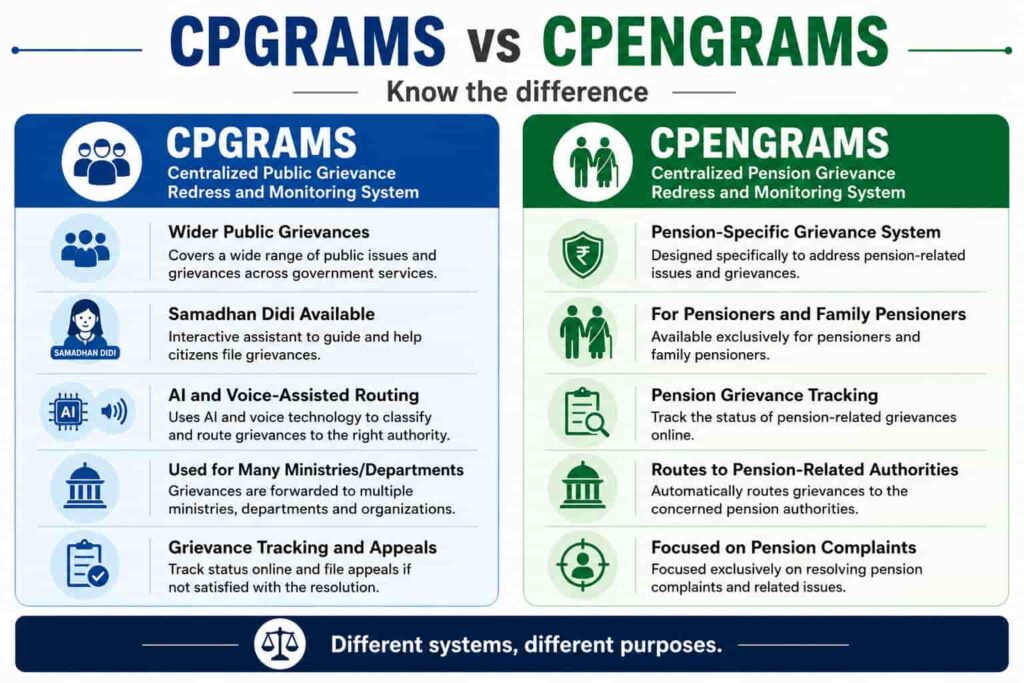
A pensioner needs to understand that CPGRAMS and CPENGRAMS serve different purposes.
CPGRAMS
CPGRAMS is the broader Centralised Public Grievance Redress and Monitoring System.
It connects citizens with Government Ministries, Departments and participating administrative authorities for public-service grievances.
Samadhan Didi belongs to this wider grievance framework.
CPENGRAMS
CPENGRAMS is the Centralized Pension Grievances Redress and Monitoring System.
It is focused specifically on pension-related grievances.
A pensioner can use the dedicated mechanism to lodge and track a pension complaint and pursue the available grievance-redressal process.
Therefore:
CPENGRAMS has not been replaced by Samadhan Didi.
The two systems should be understood as parts of a broader Government grievance environment rather than identical portals.
The defence pension data makes this especially important
The strongest reason this update matters to veterans is found in Government pension-grievance data.
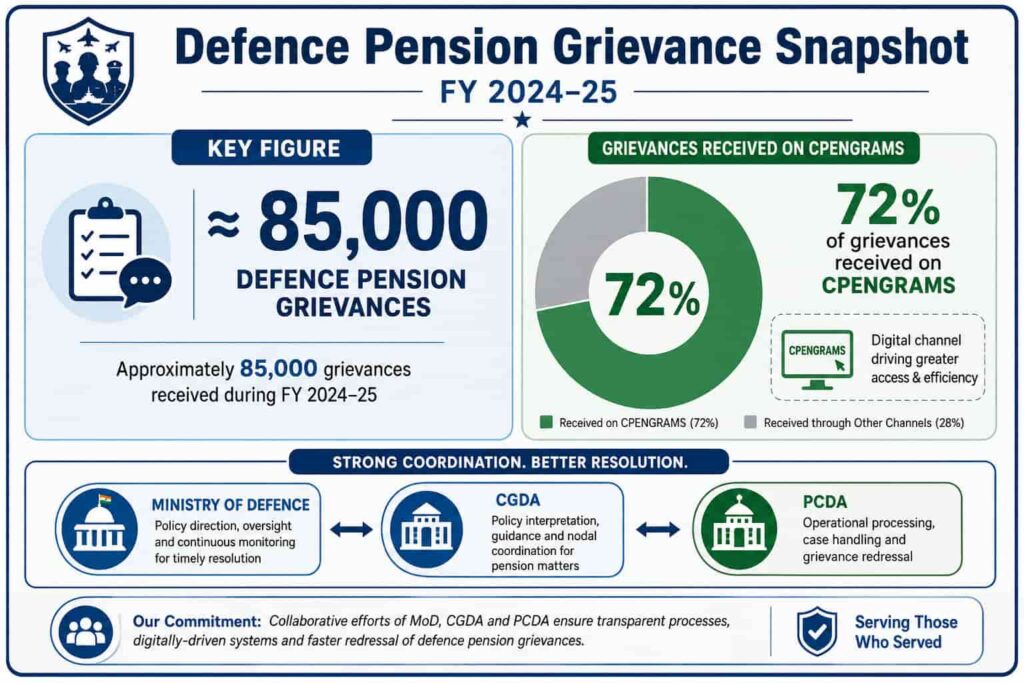
Official Department of Pension & Pensioners’ Welfare material reports that around 85,000 grievances from defence pensioners were received during FY 2024–25.
These represented approximately 72% of grievances received on CPENGRAMS during that period.
That is an unusually high share.
It shows that defence pension issues form a substantial part of the pension grievance workload.
The same official material also refers to coordination with organisations such as the:
- Ministry of Defence;
- Controller General of Defence Accounts; and
- Principal Controller of Defence Accounts
for handling defence pension-related cases.
This gives the digital grievance reforms direct relevance for the ex-servicemen community.
Ex-servicemen grievances go far beyond pension
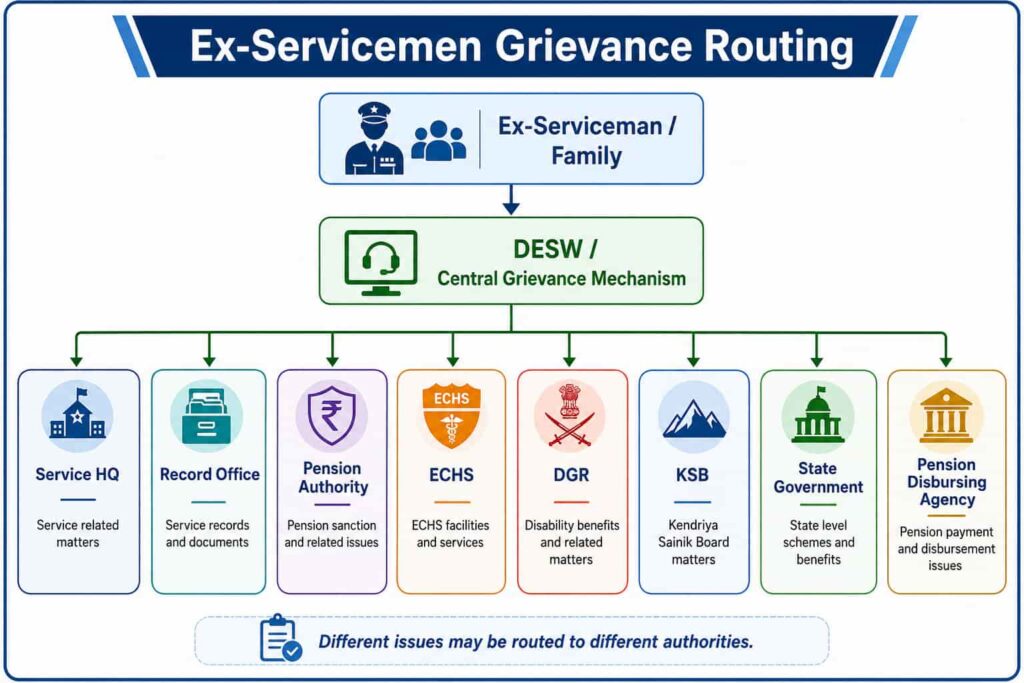
The Department of Ex-Servicemen Welfare (DESW) officially deals with grievances involving ex-servicemen and their families across several areas.
These can include matters relating to:
- pension;
- family pension;
- disability pension;
- ECHS;
- DGR and resettlement;
- Kendriya Sainik Board benefits; and
- other welfare-related concerns.
DESW also recognises the centralised Government grievance mechanism as an online route for eligible grievances.
After receiving a grievance, the matter may have to be taken up with the authority actually responsible for resolving it.
Depending on the issue, this could involve:
- Service Headquarters;
- Record Office;
- pension-sanctioning authorities;
- ECHS;
- DGR;
- KSB;
- State Government; or
- pension-disbursing agencies.
This is precisely why better routing matters.
The citizen may know the problem but may not know which office owns the solution.
ECHS beneficiaries should also pay attention
The relevance is not restricted to pension.
DESW’s official ECHS grievance information also identifies CPGRAMS among the channels through which ECHS grievances can reach the system.
That means an ex-serviceman facing a welfare issue may be dealing with one of several different administrative ecosystems.
A pension dispute and an ECHS grievance are not the same type of complaint, but both can require an effective Government grievance route when the primary mechanism does not resolve the issue.
Where does SPARSH fit?
Defence pensioners should be especially careful here.
Samadhan Didi does not replace SPARSH.
SPARSH continues to belong to the defence pension ecosystem.
If an Armed Forces pensioner has a SPARSH-related problem, the existence of a new AI voice facility in CPGRAMS does not mean that the defence pension platform itself has been discontinued.
The systems perform different jobs.
That is why the practical question should always be:
“What is my problem, and which system is responsible for that particular problem?”
One pensioner may interact with several Government systems
Another reason pension-related communication becomes confusing is that multiple portals have similar-sounding roles but completely different functions.
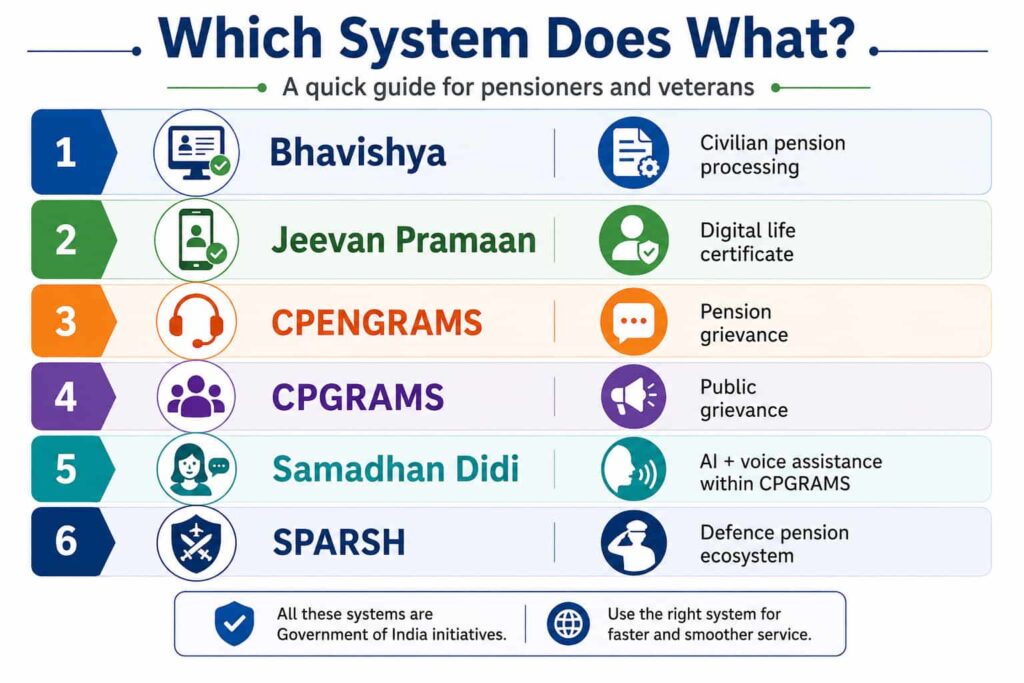
Bhavishya
Bhavishya is an end-to-end pension processing system for Central Government civilian employees.
It supports the pension case from processing up to electronic PPO-related stages.
It should not be confused with the defence pension system.
Jeevan Pramaan
Jeevan Pramaan deals with the Digital Life Certificate.
Its function is different from pension sanction and grievance redressal.
CPENGRAMS
Used for pension grievances.
CPGRAMS
Used for broader public grievances.
Samadhan Didi
Provides AI and voice assistance within the CPGRAMS framework.
SPARSH
Part of the defence pension ecosystem.
More than 15 lakh grievances reached CPGRAMS in 2026
The scale of the wider grievance system is also significant.
According to the 5 August 2026 Lok Sabha reply, CPGRAMS received 15,20,576 grievances between 1 January and 15 July 2026.
The Government reported an average disposal time of 13 days for Central Ministries and Departments for the stated period.
That number should be read carefully.
It is an average across the system, not a guaranteed resolution period for an individual pension, ECHS or defence grievance.
Complex pension matters may require documents, verification and coordination between multiple offices.
NextGen CPGRAMS is the larger reform ahead
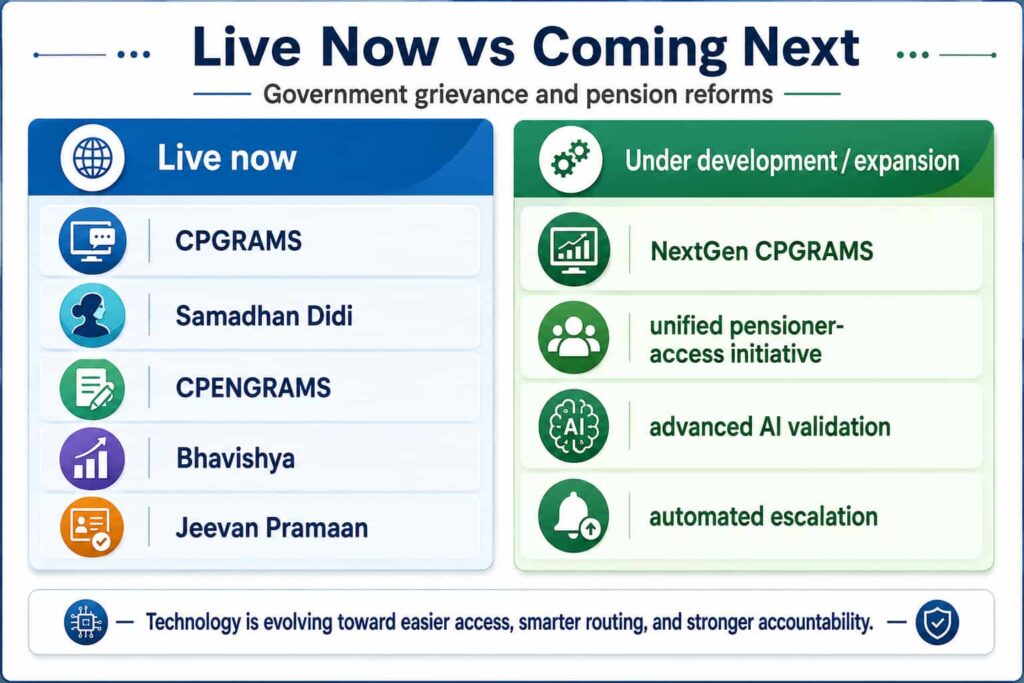
Samadhan Didi represents the visible AI element available today, but the Government is planning a considerably larger transformation through Next Generation CPGRAMS.
The proposed architecture includes capabilities such as:
- voice grievance registration;
- AI classification;
- intelligent routing;
- multilingual support;
- integration with additional grievance channels;
- automated escalation;
- real-time analytics; and
- AI-assisted validation of grievance-redressal quality.
The last point deserves attention.
Future use of AI may not remain limited to deciding where a complaint should go.
The Government is also exploring mechanisms that could help examine whether a grievance was actually resolved meaningfully rather than merely transferred or closed administratively.
However, these NextGen features must be described as under development, not as fully operational services.
A unified pensioner experience is also being explored
The Government has additionally referred to an “Improving Pensioners’ Welfare” initiative aimed at creating more user-friendly central access for pensioners.
This should not be interpreted as meaning that all pension portals have already been merged into one system.
The project represents the direction in which the Government wants the digital pension ecosystem to move:
less fragmentation and easier access for pensioners.
Whether and how existing systems will ultimately be integrated will depend on the final implementation framework.
Serving Central Government employees need one additional caution
CPGRAMS should not be treated as a substitute for every departmental service grievance.
The portal itself makes clear that matters relating to a Government employee’s own service issues, including disciplinary matters, generally require the prescribed departmental channels to be exhausted first.
Therefore, a serving employee should not assume that Samadhan Didi provides a shortcut around:
- departmental representation;
- statutory appeal;
- administrative review; or
- prescribed service grievance mechanisms.
The correct route depends on the nature of the issue.
What should pensioners and veterans take away from this change?
The latest digital reform is not about replacing human officers with AI.
It is about making it easier for citizens to enter a complicated Government grievance structure correctly.
For a pensioner, the practical improvement can be substantial if the system reduces uncertainty about:
where to complain + what category to select + which authority should receive the case.
For ex-servicemen, the importance is even clearer because Government records show a large volume of defence pension grievances, while DESW itself handles grievances extending from pensions to ECHS and resettlement.
The technology matters because the administrative journey is often as important as the complaint itself.
Final takeaway
Samadhan Didi is best understood as an AI-assisted front door to CPGRAMS.
It can make grievance registration more accessible through voice and language support.
But it does not:
replace SPARSH, replace CPENGRAMS, sanction pensions or decide entitlements.
For Central Government pensioners and ex-servicemen, the larger development is that grievance administration is gradually moving toward:
voice access → AI classification → intelligent routing → better tracking → stronger accountability.
If NextGen CPGRAMS delivers the capabilities now being developed, the next phase of grievance reform may focus not merely on receiving complaints faster, but on ensuring that they reach the correct authority and are genuinely resolved.
Sources:-
Press Information Bureau — CPGRAMS & Digital Pension Reforms, Lok Sabha Reply, 5 August 2026
Press Information Bureau — CPGRAMS Backgrounder, 9 August 2026
Department of Ex-Servicemen Welfare — Grievance Redressal for Ex-Servicemen and Families
Department of Pension & Pensioners’ Welfare — CPENGRAMS and Defence Pension Grievance Data
CPGRAMS — Official Government Grievance Portal
Department of Ex-Servicemen Welfare — ECHS Grievance Redressal


Leave a Reply