


The 8th Central Pay Commission is being watched closely for salary revision, pension revision and fitment factor expectations. But one issue that may quietly affect lakhs of employees is the review of allowances. For many government employees, allowances are not a small add-on to salary. They are linked to duty conditions, hardship, field service, risk, location, technical work, night duty, travel and family needs.
That is why the debate around 196 allowances has become important. During the 7th Central Pay Commission, 196 allowances were examined, out of which 52 were recommended for abolition and 36 were merged or brought under other heads. The 7th CPC also introduced the idea of a risk and hardship matrix for employees facing difficult conditions.
Now, employee bodies are asking a simple but serious question: if the 7th CPC studied allowances in such detail, will the 8th CPC also give every allowance a proper review?
Why Allowances matter more than people think?
For ordinary readers, the word “allowance” may sound technical. But for employees, it can decide the actual value of service. A person working in a comfortable office environment and another person posted in a difficult field area may have the same basic pay level, but their life and duty conditions can be very different.
Allowances are designed to recognise those differences. They can support employees who work in remote locations, technical roles, risk-prone duties, defence-linked services, railway operations, paramilitary deployment, medical duties, travel-heavy responsibilities or special administrative conditions.
If allowances are reviewed too broadly, specific hardships may not be visible. This is the concern now being raised by several employee groups.
The concern over 12 broad groups
The Indian Railways Technical Supervisors’ Association has flagged that while the 7th CPC dealt with 196 allowances, the 8th CPC theme format mentions only 12 broad groups of allowances. IRTSA argued that each allowance has a specific purpose and applies to a different group of staff, so the format should be expanded to cover all allowances properly.
This concern is important because one broad heading cannot always explain the real difference between two types of duties. For example, railway technical staff, defence personnel, paramilitary forces, civilian government employees and pensioners may all have separate issues connected with allowances. If they are placed under a general category, the detailed problem may not get the same attention.
In simple words, the fear is that a detailed service issue may become a short online response.
Why the submission format is also being questioned?
The official MyGov questionnaire says that only responses through MyGov will be accepted, and the questionnaire is available in English and Hindi. Another official questionnaire page also states that paper-based physical responses, emails or PDF responses are not being considered by the Commission.
This has created a practical challenge for associations and pensioners. Many pay, pension and service matters cannot be explained in a few lines. They often need tables, past orders, court judgments, old pay commission references, financial calculations and category-wise examples.
A railway association may need to submit technical cadre details. A defence-related group may need to explain field hardship. Pensioners may need to attach past government orders or judicial references. If document upload or offline submission is limited, many serious points may not be fully represented.
Digital submission is useful, but employee bodies are saying it should not become a barrier for detailed evidence.
Pensioners cannot be left behind
The 8th Pay Commission is not only about serving employees. Pensioners and family pensioners are equally affected. Their concerns include pension revision, family pension, dearness relief, medical support and long-term financial dignity.
For retired employees, the Pay Commission is not just a salary event. It decides how their past service will be valued in the new structure. If pension issues are not clearly separated and studied in detail, many pensioners may feel that their concerns have been pushed into a general category.
This is why pension revision should not be treated as a secondary issue. It must be a central part of the discussion.
MACP and career progression need fresh attention
Another important issue raised in the description is MACP, or Modified Assured Career Progression. Many employees feel that MACP should be aligned more closely with functional promotions. The reason is simple: in several departments, employees perform higher responsibilities for years, but do not always receive timely promotions.
A financial upgrade alone may not solve this problem. If the job role, responsibility and promotion structure are not reviewed together, career stagnation can continue even after a pay revision.
This point is especially relevant for technical cadres, railway employees and departments where duties have evolved over time. The 8th CPC has an opportunity to look beyond basic pay and examine whether promotion systems are still fair in today’s working environment.
Post classification needs a modern review
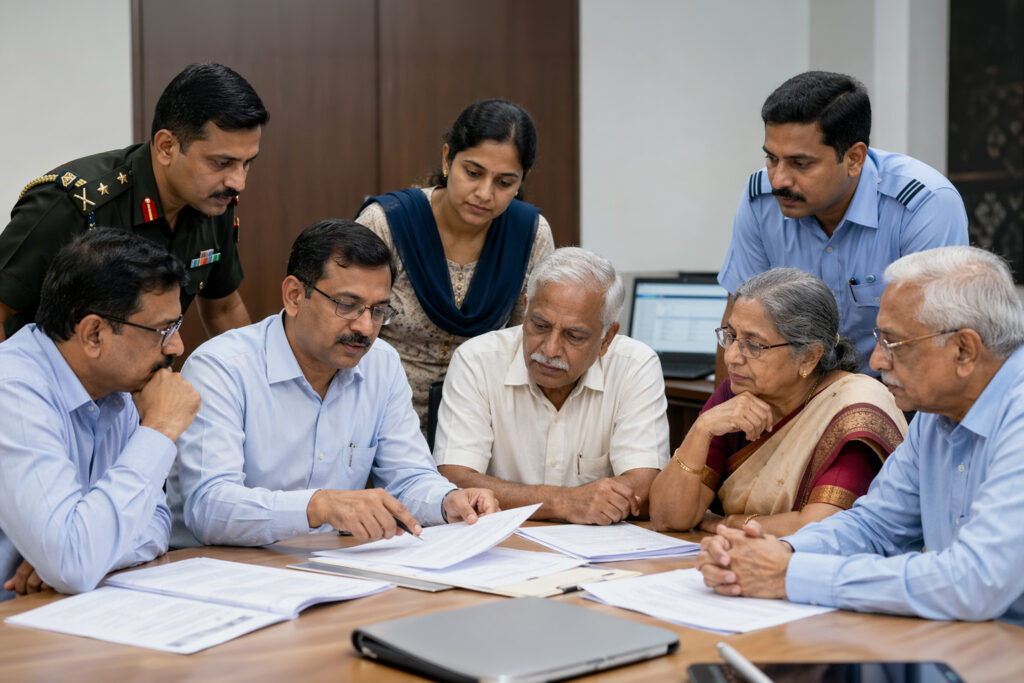
Government job roles have changed significantly over the years. Technology, digital systems, compliance work, technical operations and public service delivery have increased the complexity of many posts.
Because of this, employee bodies are also seeking a review of post classification, including Group A, Group B and Group C structures. A post that was once considered routine may now require technical knowledge, digital handling, risk management or higher accountability.
If classification is not updated, employees may continue to carry modern responsibilities under outdated service categories.
Why court judgments should be included?
Pay, pension and service disputes often reach tribunals and courts. In many cases, judgments from CAT, High Courts or the Supreme Court clarify important principles related to pay fixation, pension, promotion, seniority or service benefits.
If associations cannot submit these judgments properly, the Commission may miss important legal developments. That is why there is a demand to allow detailed attachments and case-law references. A Pay Commission report should not only study administrative data. It should also understand where employees had to approach courts for justice.
What this means for Employees now?
The bigger message is clear. Employees and pensioners should not look at the 8th CPC only through the lens of fitment factor or minimum pay. Those are important, but the real impact also comes through allowances, pension formula, MACP, post classification and service conditions.
For some employees, an allowance can make a meaningful difference in monthly income. For others, it can be recognition of hardship. For pensioners, proper revision can protect dignity after retirement.
That is why the 196 allowances question matters. It is not merely a technical objection. It is a demand for detailed evaluation, fair representation and evidence-based decision-making.
The 8th Pay Commission has the responsibility to study the changing realities of government service. If allowances are reviewed deeply, employees serving in difficult, technical or specialised conditions may get fair recognition. But if complex issues are reduced to broad categories, many genuine concerns may remain unresolved.
For central government employees, railway staff, defence personnel, paramilitary forces and pensioners, this is the moment to stay alert. The final recommendations will shape pay, pension and allowances for years. A strong and detailed consultation process can make the difference between a general revision and a genuinely fair revision.



Leave a Reply