


The discussion around the 8th Pay Commission fitment factor is entering a more serious phase.
Until recently, much of the conversation revolved around one question:
What could the next fitment factor be?
Now, employee organisations, pensioner associations and ex-servicemen representatives are trying to answer a more difficult question:
Why should the 8th Central Pay Commission consider a substantially higher fitment factor in the first place?
That distinction matters.
Figures such as 3.00 and 3.83 are now appearing repeatedly in representations and public discussions. But neither figure should be confused with an official recommendation of the 8th Central Pay Commission.
As of 26 September 2026, the Commission remains engaged in consultations with stakeholders. Its official website shows continuing interactions and forthcoming visits, including Bengaluru in October and Mumbai later that month. No final fitment factor has been announced.
First understand this: 3.00 and 3.83 are not the same demand
One reason the present debate can become confusing is that different numbers are being discussed by different organisations.
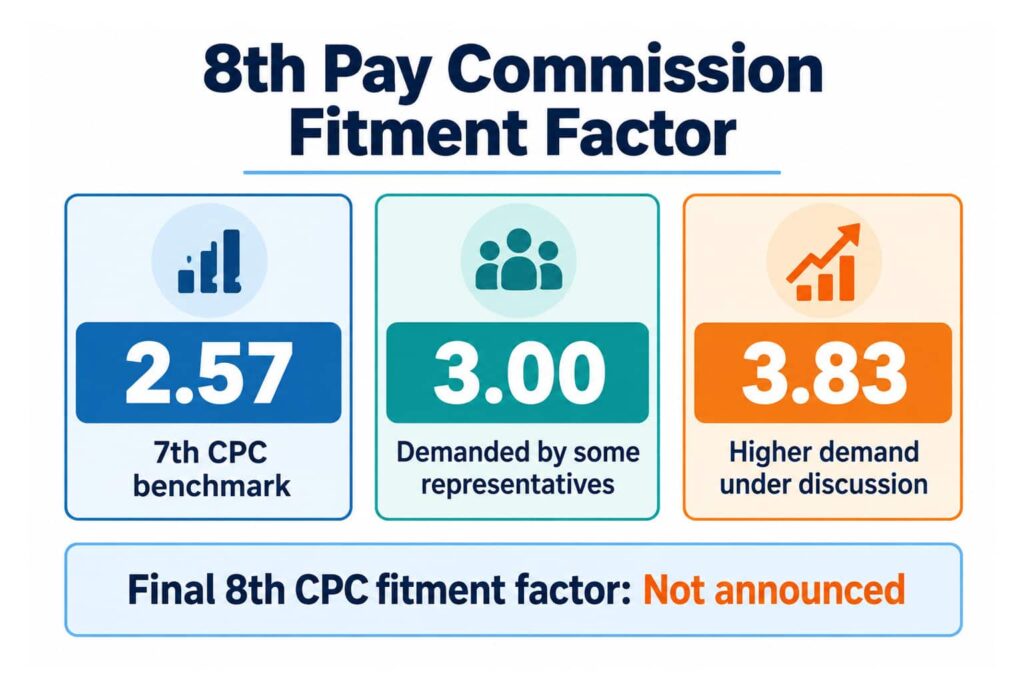
The 2.57 fitment factor is associated with implementation of the 7th Central Pay Commission pay structure.
For the 8th CPC, however, higher figures are being sought.
An ex-servicemen representation involving Dr Raj Narayan Singh, a retired District and Sessions Judge, has publicly argued for a minimum fitment factor of 3.00. The case presented included issues such as inflation, healthcare expenditure, family responsibilities and financial security after retirement.
Separately, the figure of approximately 3.83 or 3.833 has been part of wider employee and pensioner demands.
The NC-JCM draft committee’s final memorandum was reported to have sought a ₹69,000 minimum basic pay with a 3.83 fitment factor, while pensioner organisations have also raised similar demands during consultations with the Commission.
Therefore, the discussion can broadly be understood like this:
| Figure | What it represents |
|---|---|
| 2.57 | 7th CPC reference factor |
| 3.00 | Minimum being demanded in some representations, including an ex-servicemen representation |
| 3.83/3.833 | Higher fitment proposal raised by employee/pensioner organisations |
| Final 8th CPC factor | Not announced |
This distinction is important because an employee reading that “3.83 fitment factor is under discussion” should not interpret it as 3.83 being approved.
The bigger debate is actually about what minimum pay should cover
The fitment-factor debate is not merely a mathematical exercise.
Behind the number lies a more fundamental question:
What expenses should a reasonable Government salary be expected to support?
Traditionally, minimum-pay calculations consider expenditure required for a worker and family to maintain a reasonable standard of living.
The present representations are attempting to widen that discussion by drawing attention to:
rising household expenditure;
medical expenses;
responsibility towards elderly parents;
dependent family members;
post-retirement healthcare needs;
housing and caregiving responsibilities; and
the broader concept of living with dignity rather than meeting only subsistence expenses.
That is where two Government-related references become particularly interesting.
Why is the Senior Citizens Act entering an 8th CPC salary discussion?
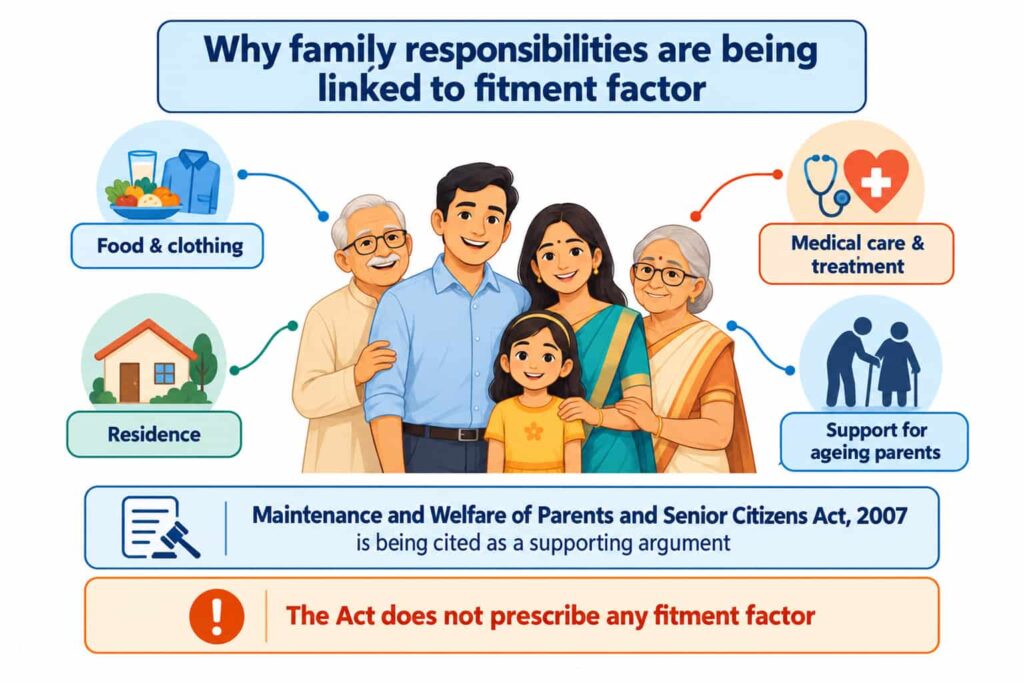
The Maintenance and Welfare of Parents and Senior Citizens Act, 2007 was not enacted to determine Government salaries.
It does not mention the 8th Pay Commission.
It does not recommend a fitment factor.
And it certainly does not state that the fitment factor should be 3.00 or 3.83.
But the Act establishes an important social and legal principle.
It recognises responsibility for the maintenance of parents and senior citizens. Section 4 provides for maintenance where a parent or senior citizen is unable to maintain himself or herself and says the obligation extends to needs enabling the parent or senior citizen to lead a normal life.
Under the Act, the definition of a parent covers a father or mother, including biological, adoptive and step-parents.
Employee representatives can therefore use the legislation to make a broader argument:
If responsibility towards ageing parents is recognised in law, should the cost of supporting parents also receive greater consideration when assessing the income requirements of an employee’s family?
That is an argument for consideration.
It is not a statutory entitlement to a particular fitment factor.
This distinction should remain clear.
A February 2026 Ministry of Defence decision adds another dimension
A separate development came from the Ministry of Defence on 11 February 2026.
The Defence Ministry announced that Raksha Mantri Rajnath Singh had approved an expanded definition of “family” for allotment of Government accommodation to Service Officers.
The revised definition includes:
parents;
dependent siblings; and
legally adopted children,
in addition to the existing coverage of spouse and dependent children/step-children.
The Ministry itself said the decision took into account the Maintenance and Welfare of Parents and Senior Citizens Act, 2007 and recognised changing family responsibilities and caregiving arrangements.
For the fitment-factor debate, this creates an interesting policy argument.
If Government policy is beginning to formally recognise that the practical family unit of an employee or Service Officer may extend beyond spouse and children, representatives can argue that the financial burden associated with those dependants deserves consideration during pay revision as well.
But once again, there is an important boundary.
The February 2026 Defence Ministry decision relates to Government accommodation for Service Officers.
It does not prescribe salary, pension, minimum pay or a fitment factor.
Its relevance to the 8th CPC is therefore supporting or contextual—not determinative.
Why is the ‘model employer’ principle also being cited?
Another argument associated with representations involves the principle that the Government should function as a model employer.
The Supreme Court discussed this principle in Bhupendra Nath Hazarika v. State of Assam, stressing that the State, as an employer, must act fairly and respect the rules governing its employees.
The judgment does not establish any formula for salary revision.
It cannot independently justify a fitment factor of 3.00, 3.83 or any other number.
Its relevance is broader.
Those presenting employee and pensioner demands may use the principle to support the proposition that Government compensation policy should be fair, rule-based and sensitive to legitimate employee concerns.
In other words:
The judgment supports a principle of fair treatment. It does not determine the amount of pay revision.
That is a much more accurate way of understanding its relevance.
Why is a minimum 3.00 factor being argued for?
Among the points discussed in the ex-servicemen representation is the argument that a future fitment factor should be materially higher than the 7th CPC’s 2.57 reference.
Dr Raj Narayan Singh’s reported representation supported a minimum factor of 3.00.
The reasoning covers several areas rather than relying on inflation alone.
For serving personnel and pensioners, supporters of a higher factor point towards the combined financial effect of:
household expenses;
medical treatment;
care of elderly parents;
education and family expenses;
retirement-related financial requirements;
health issues emerging after long service; and
preserving a reasonable standard of living.
For defence personnel, the argument is also linked to the nature of military service.
A person may enter the Armed Forces after satisfying stringent medical requirements, yet years of demanding service conditions, field postings and ageing can increase healthcare requirements after retirement.
That does not automatically establish what the fitment factor should be.
But it explains why representatives are trying to move the discussion beyond a simple inflation-adjustment formula.
Then where does the 3.83 figure come from?
The 3.83/3.833 figure has a wider employee and pensioner context.
Reports on the NC-JCM memorandum say the organisation sought approximately ₹69,000 as minimum basic pay, corresponding to a fitment factor of around 3.83 when compared with the present Level 1 basic pay of ₹18,000.
More recently, the All India Federation of Pensioners’ Association (AIFPA) reportedly raised a 3.83/3.833 fitment demand during the Chennai consultation, along with other pension-related proposals.
Therefore, 3.83 is not simply a social-media calculation.
There are documented employee and pensioner representations associated with it.
But it remains a demand before the Commission.
What would a 3.00 fitment factor mean for Level 1?
The arithmetic is straightforward.
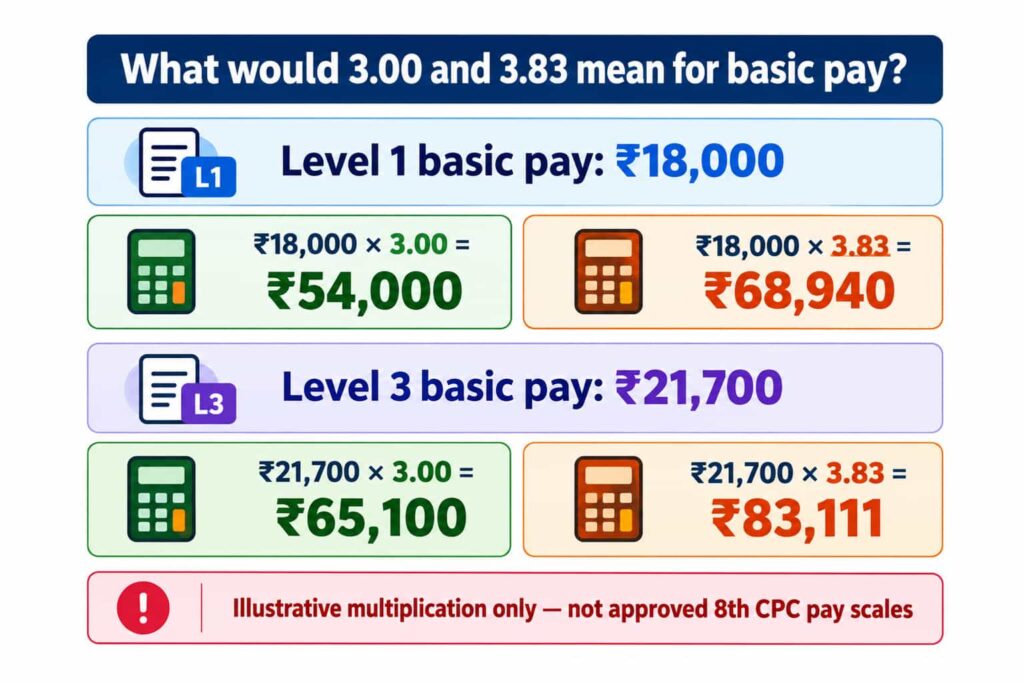
Current Level 1 basic pay: ₹18,000 If a hypothetical factor of 3.00 were applied: ₹18,000 × 3.00 = ₹54,000
If 3.83 were applied: ₹18,000 × 3.83 = ₹68,940 Therefore:
| Fitment factor | Illustrative Level 1 basic pay |
|---|---|
| 2.57 | ₹46,260 |
| 3.00 | ₹54,000 |
| 3.83 | ₹68,940 |
| 4.00 | ₹72,000 |
Recent published calculations also show the ₹68,940 figure for Level 1 at a hypothetical 3.83 factor.
What would the same factors mean for Level 3?
The Level 3 entry basic pay under the existing matrix is ₹21,700.
At 3.00:
₹21,700 × 3.00 = ₹65,100
At 3.83:
₹21,700 × 3.83 = ₹83,111
| Fitment factor | Illustrative Level 3 basic pay |
|---|---|
| 3.00 | ₹65,100 |
| 3.83 | ₹83,111 |
Published illustrative tables have also calculated Level 3 at approximately ₹83,111 using a 3.83 factor.
For defence personnel, however, this number should not be confused with complete monthly salary.
Military Service Pay, allowances and other applicable components operate separately according to the rules ultimately adopted.
A higher basic pay does not mean take-home salary rises by the same percentage
This is one of the most important points often missed in fitment-factor discussions.
Suppose someone’s present basic pay is ₹18,000 and a hypothetical revised basic becomes ₹68,940.
It would be incorrect to look only at those two numbers and conclude that the employee’s actual salary has increased by the same percentage.
Why?
Because a Pay Commission transition normally involves restructuring several components.
Existing Dearness Allowance is intended to compensate for inflation accumulated over the existing basic-pay structure. When a new pay structure is introduced, the treatment of DA, allowances and related benefits depends on the final Government-approved framework.
Therefore:
Fitment factor tells you how a hypothetical revised basic may be calculated. It does not, on its own, tell you the final increase in take-home salary.
This is why viral comparisons based only on multiplication can be misleading.
Could 3.83 produce a ₹69,000 minimum basic pay?
Mathematically, yes—approximately.
₹18,000 × 3.83 gives: ₹68,940
At 3.833:
₹18,000 × 3.833 = approximately ₹68,994
That explains why organisations demanding a minimum salary of approximately ₹69,000 commonly associate their proposal with a fitment factor close to 3.83/3.833.
But mathematically reaching ₹69,000 and the Commission recommending ₹69,000 are two completely different things.
At present, the first is a calculation.
The second has not happened.
What has the 8th Pay Commission officially said?
This is where employees should separate the official record from expectations.
The 8th Central Pay Commission’s own website confirms that it has been inviting representations and interacting with employee associations, unions, pensioners and other stakeholders.
Its September 2026 schedule also shows that the consultation process is continuing, with further interactions planned.
However, the official material does not announce a final fitment factor of 3.00, 3.83 or 4.00.
Therefore, the current position is:
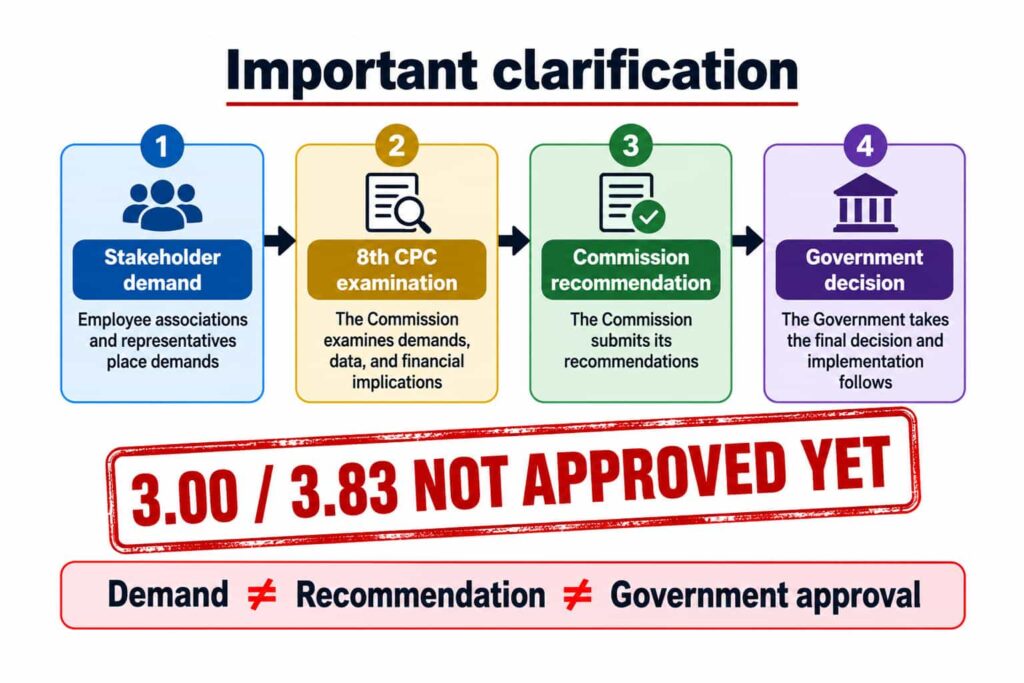
Demand submitted → Commission examines → Commission makes recommendations → Government considers recommendations → Final decision/implementation
A figure being submitted to the Commission does not mean the figure has been accepted.
A representative meeting the Commission does not mean the demand has become policy.
And an illustrative salary calculation does not become a new pay scale unless it forms part of an approved Government decision.
Why the family-responsibility argument could still matter?
The strongest part of the present debate may not actually be whether the multiplier should be exactly 3.00 or 3.83.
The more important question is whether the Commission accepts a broader assessment of the financial needs of today’s employee household.
The Maintenance and Welfare of Parents and Senior Citizens Act recognises responsibility towards parents.
The February 2026 Defence Ministry decision recognises a broader family structure for accommodation purposes.
Employee and pensioner organisations are separately seeking substantially higher minimum pay and fitment factors.
Together, these developments allow representatives to argue that the financial unit supported by a Government employee may be larger and more complex than a simple employee-spouse-children model.
That could become relevant when minimum pay, pension adequacy and overall compensation are examined.
But none of these developments, individually or collectively, automatically produces a particular fitment factor.
The Commission will have to consider these arguments alongside economic conditions, Government finances, existing pay structure, consumption requirements, pension liabilities and other factors within its mandate.
8th CPC fitment factor: verified position versus speculation
For readers trying to follow daily 8th Pay Commission news, the simplest approach is to divide information into four categories.
Verified historical position
7th CPC fitment reference: 2.57
Documented demand
Some ex-servicemen representatives: minimum 3.00
Other documented employee/pensioner demand
Around 3.83/3.833, linked with proposals for approximately ₹69,000 minimum pay.
Official 8th CPC decision
Not announced.
That final line is the most important one.
What should Central Government employees and pensioners watch next?
The fitment-factor discussion will become more meaningful only when the Commission begins revealing its own reasoning or recommendations.
Until then, employees should pay attention to:
memoranda submitted by major recognised organisations;
official stakeholder consultation records;
minimum-pay calculations placed before the Commission;
pensioner representations;
treatment proposed for DA and allowances;
the Commission’s eventual report; and
Government acceptance or modification of the recommendations.
The Commission continues to hold consultations, so additional demands and competing calculations may emerge before its recommendations are finalised.
Final takeaway
There is now a stronger basis for discussing 3.00 and 3.83 as actual demands placed in the wider 8th Pay Commission consultation process.
But that is very different from saying either figure is likely, final or approved.
The 3.00 argument has been supported in an ex-servicemen representation citing inflation, medical expenses, family responsibilities and retirement security.
The 3.83/3.833 demand has also appeared in major employee and pensioner representations linked with a proposed minimum basic pay of around ₹69,000.
Meanwhile, the Senior Citizens Act and the Defence Ministry’s expanded definition of family provide a fresh dimension to the discussion about what constitutes an employee’s real financial responsibility.
They strengthen a policy argument for examining family obligations.
They do not establish a particular salary multiplier.
Therefore, as of 26 September 2026, the responsible conclusion remains:
Fitment Factor 3.00 — demanded.
Fitment Factor 3.83/3.833 — demanded.
Fitment Factor 4.00 — hypothetical unless formally proposed in a specific representation.
Final 8th Pay Commission fitment factor — not announced.
Until the Commission makes its recommendation and the Government takes a decision, any salary figure based on 3.00, 3.83 or another multiplier should be treated as an illustrative calculation—not a revised Government pay scale.
Sources
Eighth Central Pay Commission — Official website & consultation notices
8th Central Pay Commission — Official Website
8th CPC — What’s New / Consultation Notices
8th CPC — Memorandum & Representation Submission Page 8th Central Pay CommissionPress Information Bureau, Ministry of Finance — Stakeholder representations to 8th CPC
This official PIB release of 5 March 2026 confirms that employees, pensioners, associations and organisations were invited to submit memoranda/representations. Press Information Bureau
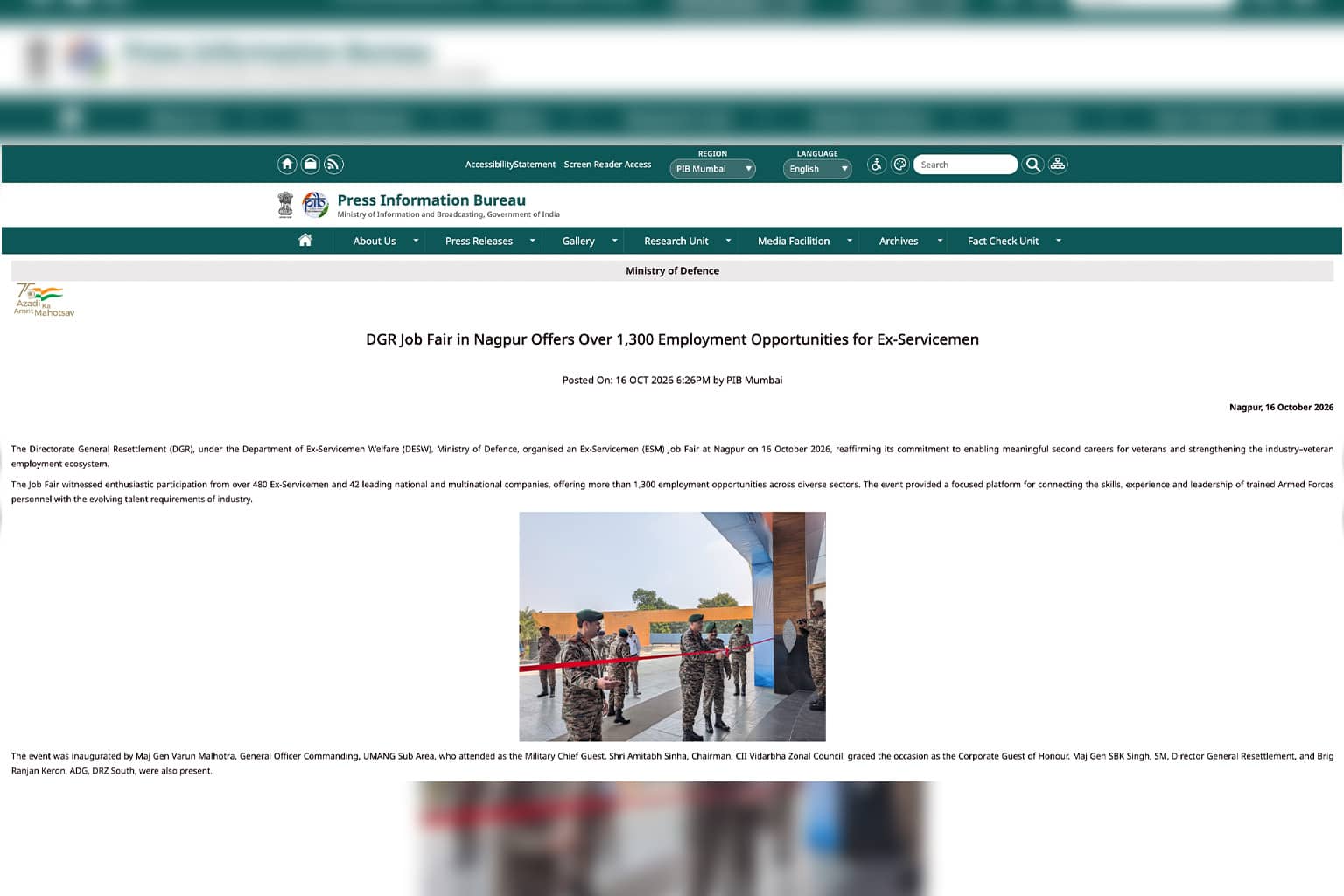
PIB — 8th Central Pay Commission Invites Representations from StakeholdersPIB, Ministry of Defence — Expanded definition of “family”, 11 February 2026
This is the official source confirming inclusion of parents, dependent siblings and legally adopted children for allotment of Government accommodation to Service Officers. Press Information Bureau
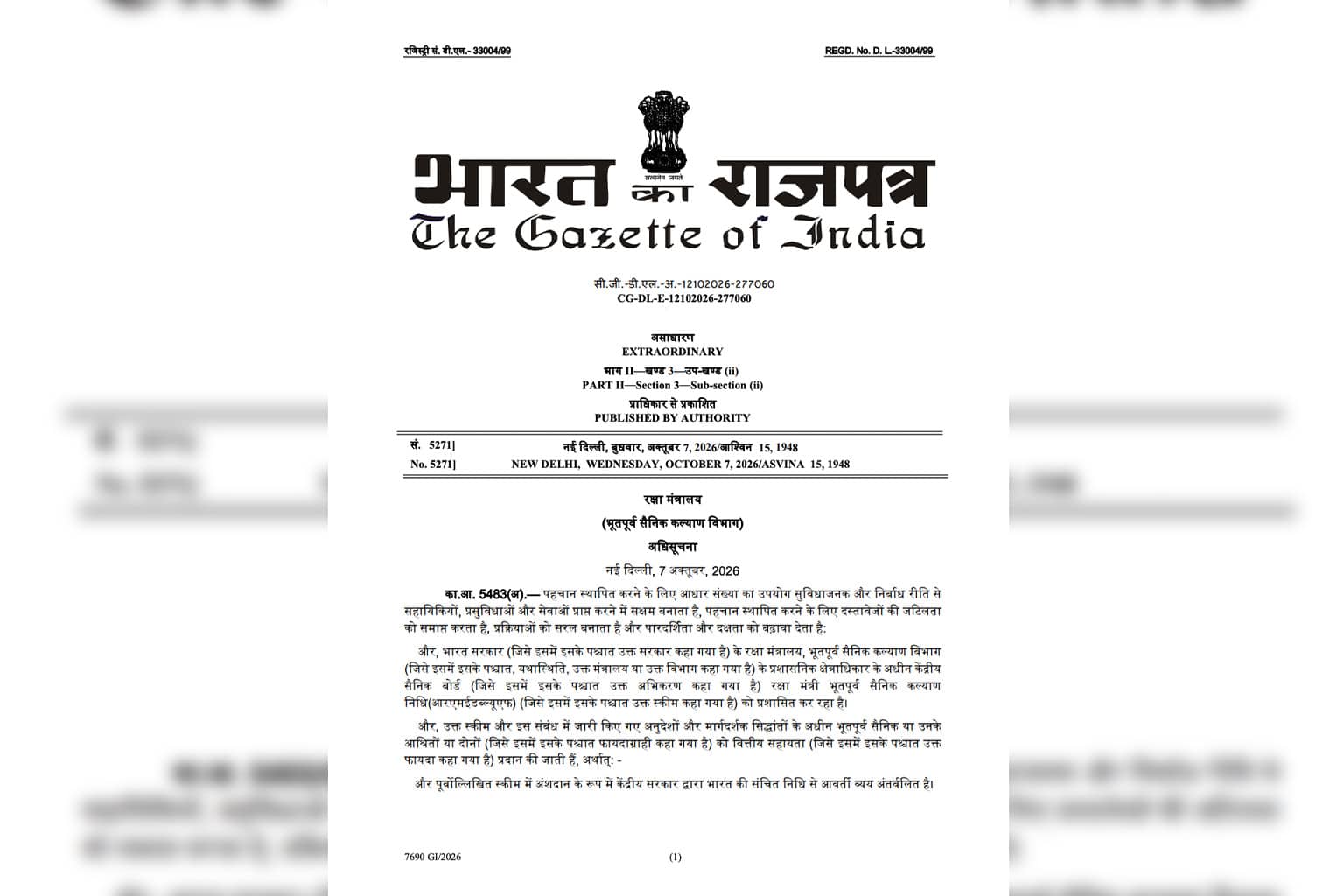
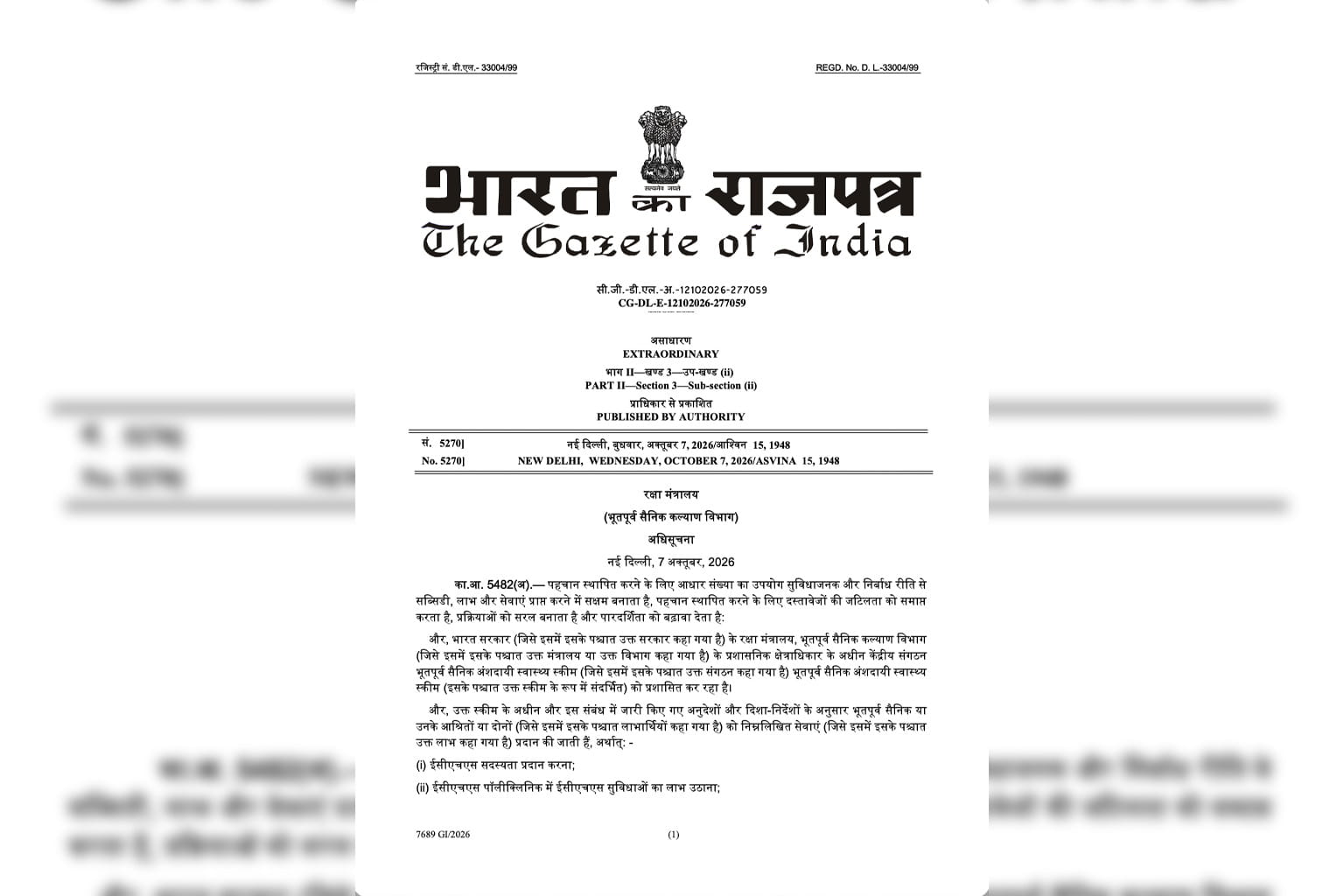
PIB — Raksha Mantri Approves Expansion of Definition of FamilyIndia Code — Maintenance and Welfare of Parents and Senior Citizens Act, 2007
This is the official Act PDF. It defines maintenance to include matters such as food, clothing, residence and medical attendance/treatment, and contains the provisions regarding maintenance of parents and senior citizens. India Code
India Code — Maintenance and Welfare of Parents and Senior Citizens Act, 2007 PDFSupreme Court — Bhupendra Nath Hazarika & Anr. v. State of Assam & Ors.
The judgment contains the discussion of the State as a “model employer” and the requirement for Government to act fairly towards employees. Sci API
Supreme Court of India — Official Judgment PDFNC-JCM — ₹69,000 minimum pay and 3.833 fitment-factor demand
This is particularly useful for your blog. The NC-JCM briefing states that the Staff Side calculated ₹69,000 minimum pay from ₹18,000, resulting in a 3.833 fitment factor. CGE News – 8th Pay Commission
NC-JCM Briefing — Meeting with 8th CPC, 28 April 2026 PDFAIFPA — 3.833 fitment factor and ₹69,000 minimum pay demand
The All India Federation of Pensioners’ Association reportedly placed the ₹69,000 minimum basic pay and 3.833 fitment factor proposal during its September 2026 Chennai interaction with the 8th CPC. The Economic Times
Economic Times — AIFPA’s 3.83 Fitment Factor & ₹69,000 Minimum Pay DemandsEx-servicemen representation — Minimum 3.00 fitment-factor demand
The strongest direct source here is the post-meeting interview with retired District & Sessions Judge and Naval veteran Dr Raj Narayan Singh, where the minimum 3.00 fitment-factor proposal is discussed at around 14:20. YouTube
Sainik Welfare News — Dr Raj Narayan Singh’s 8th CPC Interview



Leave a Reply