


For Central Government pensioners, the rule on restoration of commuted pension has not changed. The commuted portion of pension continues to be restored after 15 years under the existing CCS (Commutation of Pension) Rules.
What has changed is the intensity of the demand to review whether this 15-year period still reflects present-day economic and actuarial conditions.
Following the 16 September 2026 judgment of the Himachal Pradesh High Court, Bharat Pensioners’ Samaj (BPS) wrote to the 8th Central Pay Commission on 21 September 2026, seeking a fresh actuarial examination of the existing system and asking that restoration after 11 years also be examined.
This makes the issue important for pensioners—but it is equally important to separate the existing rule, the High Court judgment and the fresh demand before the 8th CPC.
What is the rule today?
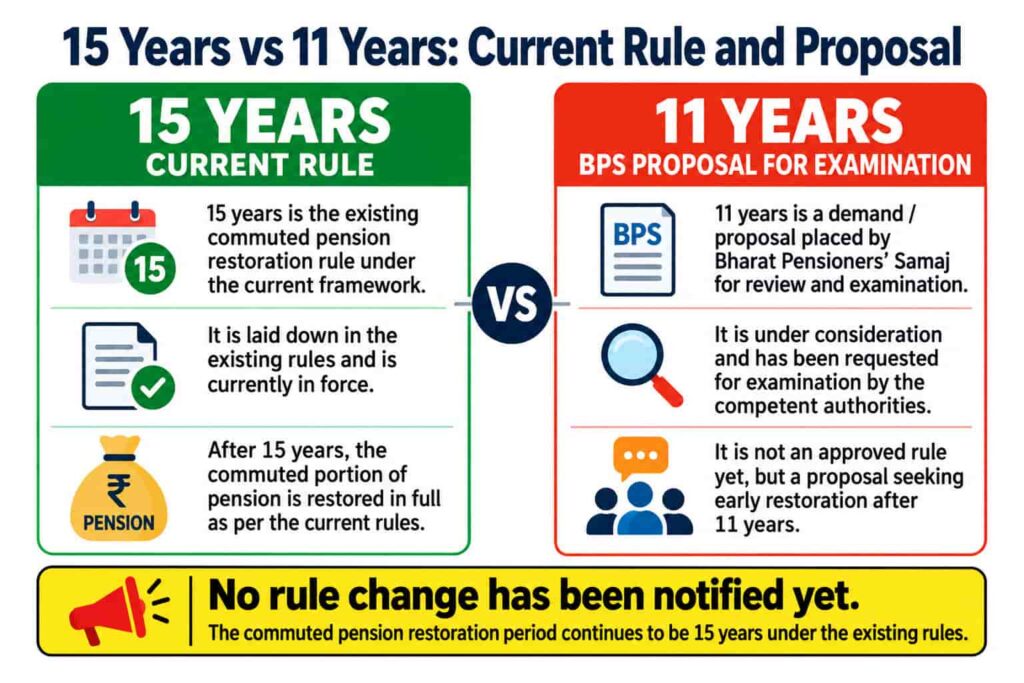
Rule 10A of the CCS (Commutation of Pension) Rules provides that the commuted amount of pension is restored after completion of 15 years from the date on which reduction on account of commutation becomes operative. The official Department of Pension & Pensioners’ Welfare rules continue to carry this provision.
Therefore, as of now:
15 years is the existing rule.
11 years is a demand for examination.
There has been no Government notification reducing the restoration period to 11 years.
This distinction is particularly important because headlines referring to the latest representation can otherwise create the impression that an 11-year restoration period has already been approved.
Why has the issue returned to the 8th Pay Commission?
The immediate trigger is the Himachal Pradesh High Court judgment dated 16 September 2026 in Bal Dev v. State of Himachal Pradesh & Others and connected matters.
The pensioners before the Court questioned continuation of the 15-year restoration period and argued, among other things, that economic and actuarial conditions had changed substantially over time.
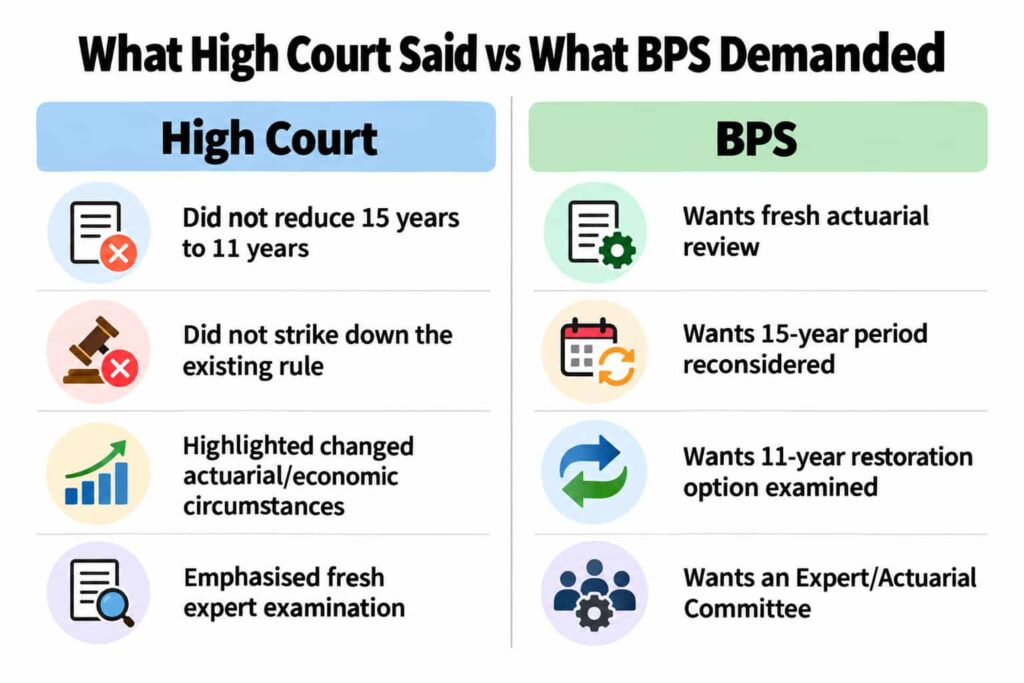
The Court did not strike down Rule 10A, nor did it judicially replace 15 years with 10, 11 or 12 years. It treated the restoration period as a matter involving actuarial science, financial assumptions and pension policy rather than a simple calculation of how many monthly deductions equal the lump sum originally received.
That part of the judgment is crucial.
A pension commutation arrangement cannot necessarily be treated in the same way as an ordinary loan in which the principal and interest are simply totalled and a recovery date calculated.
What did the High Court say about a fresh review?
Although the Court did not alter the rule itself, it recognised that considerable changes had taken place since the earlier framework was examined decades ago.
The judgment referred to factors including changes in the commutation factor, rates of return or interest and life expectancy. In the Himachal Pradesh context, it noted a reduction in the factor cited for retirement at age 58 from 10.46 to 8.371, along with other changed circumstances.
There is an important legal nuance in the judgment.
In paragraph 49, the Court observed that the State of Himachal Pradesh or Union of India may constitute an Expert Committee to examine changed circumstances and relevant parameters. In paragraph 50, it said that it was not issuing the mandamus sought by the petitioners. However, in its concluding observations, the Court used stronger language and stated that an Expert Committee must be constituted for a time-bound examination, after which the State should take a final call.
So the judgment should not be presented as an order reducing the restoration period.
Its real significance is that it places fresh expert examination of the underlying assumptions at the centre of the debate.
What has Bharat Pensioners’ Samaj now asked the 8th CPC to do?
On 21 September 2026, BPS addressed its representation to the Chairperson of the 8th Central Pay Commission and the Secretary, Department of Pension & Pensioners’ Welfare.
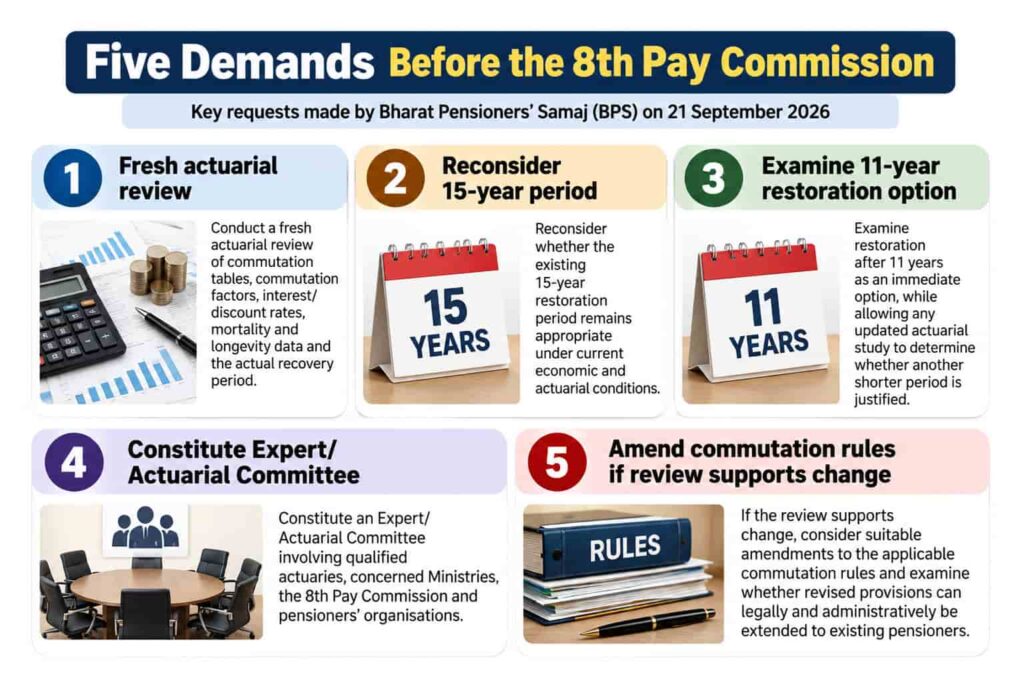
Its five principal requests are:
- Conduct a fresh actuarial review of the commutation table, commutation factors, interest or discount rates, mortality and longevity data and the actual recovery period.
- Reconsider whether the existing 15-year restoration period remains appropriate under current economic and actuarial conditions.
- Examine restoration after 11 years as an immediate option, while allowing any updated actuarial study to determine whether another shorter period is justified.
- Constitute an Expert/Actuarial Committee involving qualified actuaries, concerned Ministries, the 8th CPC and pensioners’ organisations.
- If the review supports change, consider suitable amendments to the applicable commutation rules and examine whether revised provisions can legally and administratively be extended to existing pensioners.
The representation therefore goes beyond merely asking the Government to replace “15” with “11”.
Its central demand is that the mathematical and actuarial foundation of the existing period should first be tested again using current data.
Why are pensioners questioning a formula that has existed for years?
This is where the discussion becomes more technical.
The present commutation table has its roots in recommendations accepted from the Sixth Central Pay Commission period, while the High Court judgment records that the table applicable from 1 January 2006 was not subsequently revised by the Seventh Central Pay Commission.
BPS now argues that factors such as:
commutation values, prevailing interest or discount rates, changing mortality patterns, longer life expectancy and the effective financial recovery period
should be re-examined together.
The argument is therefore not merely that “the Government has recovered the money, so deductions must stop”.
Rather, the question being placed before policymakers is:
Does the actuarial model on which a 15-year restoration period was justified earlier still produce a fair result under present conditions?
That is a materially different question—and one that requires actuarial evidence rather than a simple arithmetic comparison.
Has the High Court approved restoration after 11 years?
No.
This deserves a clear answer because it is likely to become the biggest source of confusion around this issue.
The Himachal Pradesh High Court did not fix 11 years as the new restoration period. The challenge to the existing provision was not accepted in the form sought by the pensioners, and the Court emphasised the policy and actuarial nature of the scheme.
The 11-year figure comes from the pensioners’ demand placed before the 8th CPC, not from a judicial direction changing the Central Government pension rules.
Therefore:
Court judgment ≠ 11-year approval
BPS representation ≠ Government decision
8th CPC examination ≠ automatic rule change
Any actual reduction would ultimately require an appropriate policy decision and, where necessary, amendment of the governing rules.
Why the 8th Pay Commission becomes important now?
Pension commutation is not an isolated administrative issue. It directly affects the balance between the lump-sum amount received at retirement and the reduced monthly pension paid for the restoration period.
The High Court itself noted that pension-policy questions involving commutation depend on specialised economic and actuarial judgment. The BPS representation has now placed precisely those questions before the 8th CPC.
This gives the Commission an opportunity to examine the issue in a broader pension-policy context rather than treating it only as a court dispute.
That does not mean a particular outcome is assured. The Commission could examine different actuarial assumptions, seek expert evidence and then make whatever recommendation it considers appropriate within its mandate.
What should pensioners understand right now?
The fresh development is significant, but it should not be confused with a change in entitlement.
For now, Central Government pensioners should continue to understand the position as follows:
The 15-year restoration rule remains in force.
The Himachal Pradesh High Court has highlighted the importance of examining changed actuarial and economic circumstances but has not reduced the period itself.
Bharat Pensioners’ Samaj has now asked the 8th Central Pay Commission to examine an 11-year restoration option alongside a fresh actuarial review.
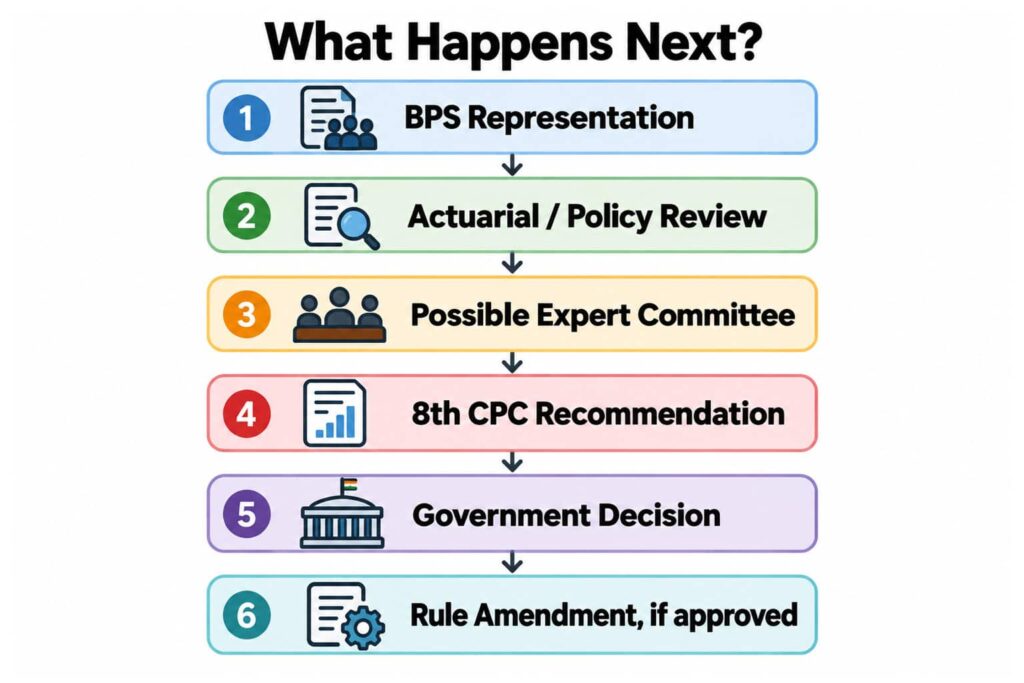
The next development that would materially change the position would be an official expert review, recommendation, Government decision or amendment to the rules.
The larger question before the 8th CPC
The real debate is no longer simply:
“Should pension be restored after 15 years or 11 years?”
The more important question is:
“What restoration period can be justified today by updated actuarial data, interest assumptions, mortality patterns and life expectancy?”
That distinction matters.
The High Court judgment has not rewritten the commutation rule, but it has given renewed momentum to the argument that a decades-old pension formula should be tested against present-day conditions.
With BPS now formally placing the issue before the 8th Pay Commission, the focus shifts from court litigation to evidence-based policy review.
For pensioners, that is the development worth watching.
Sources
Department of Pension & Pensioners’ Welfare — CCS (Commutation of Pension) Rules, 1981
Contains Rule 10A providing restoration of the commuted amount after 15 years.
Open the official CCS Commutation Rules PDF
Himachal Pradesh High Court — Bal Dev v. State of Himachal Pradesh & Others, decided 16 September 2026
Read the High Court judgment
Bharat Pensioners’ Samaj representation dated 21 September 2026 — Fresh actuarial review and 11-year restoration request
Read the BPS representation reproduced by StaffNews



Leave a Reply