

A soldier who leaves service before completing 10 years normally appears to fall short of an important pension threshold. But a recent Punjab and Haryana High Court judgment shows why invalid pension cannot always be decided by counting years of service alone.
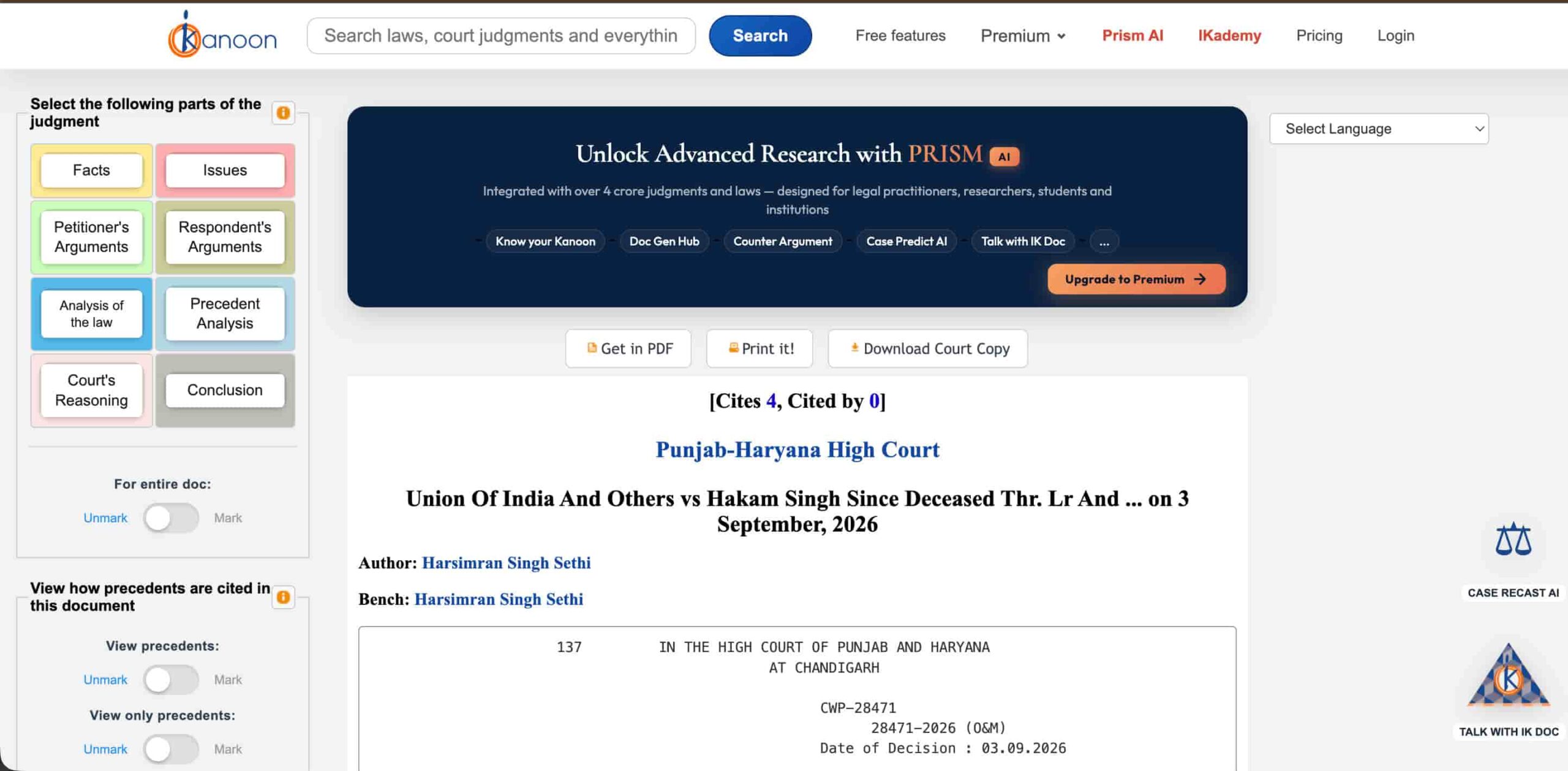
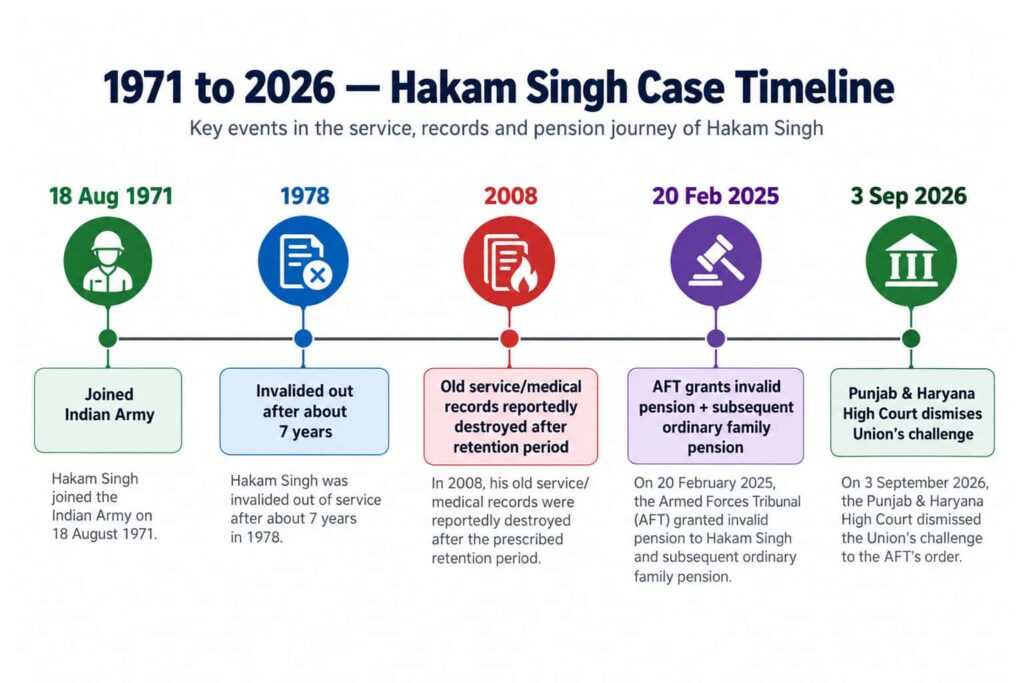
On 3 September 2026, the Punjab and Haryana High Court dismissed a Union of India petition challenging an Armed Forces Tribunal order in the case of late Sep Hakam Singh. He had joined the Indian Army on 18 August 1971 and was invalided out in 1978, after roughly seven years of service. The AFT had granted invalid pension for his lifetime and ordinary family pension thereafter to his widow, Balbir Kaur.
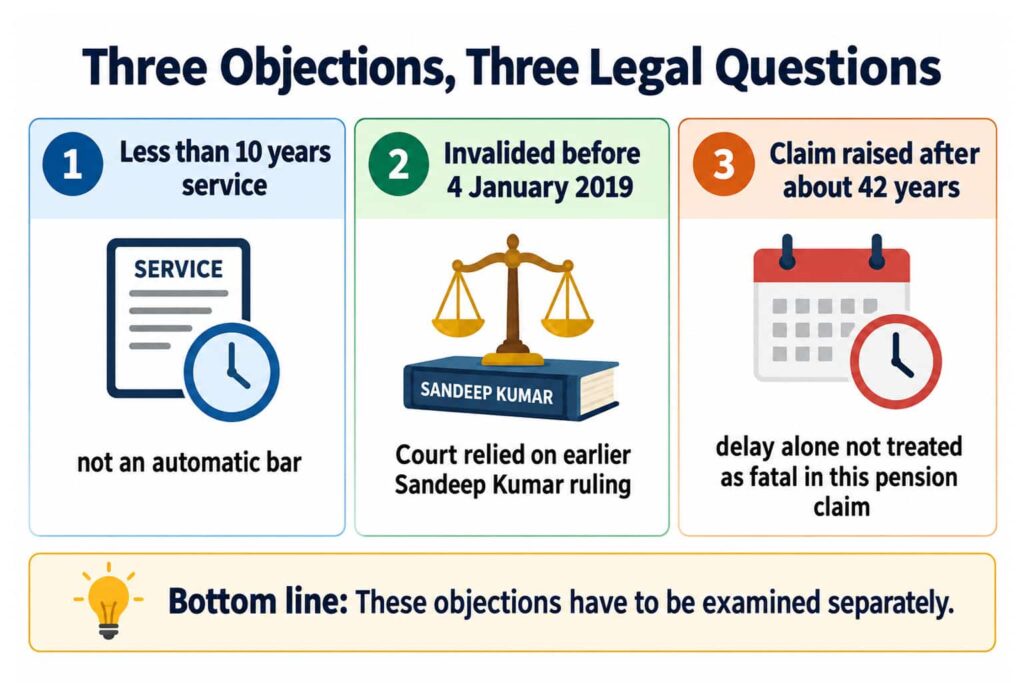
The Government challenged that relief on several grounds, including the absence of 10 years of qualifying service, destruction of old service and medical records, a delay of about 42 years in raising the claim, and the argument that the relaxed invalid-pension framework should operate only from 4 January 2019 onward.
The High Court rejected those objections in the circumstances of the case.
The real significance of the judgment is therefore not simply that a former soldier with seven years of service obtained pension relief. The more important question is:
Can lack of 10 years of service, by itself, defeat an otherwise eligible invalid-pension claim?
In this case, the High Court’s answer was no.
What happened in Hakam Singh’s case?
According to the High Court judgment, Hakam Singh was enrolled in the Army on 18 August 1971.
He was invalided out in 1978 under Rule 13(3), Item III(v) of the Army Rules, 1954.
At that time, he received Invalid Gratuity and Death-cum-Retirement Gratuity, but not a recurring invalid pension. Decades later, the pension issue reached the Armed Forces Tribunal, Regional Bench, Chandigarh.
On 20 February 2025, the AFT granted invalid pension for Hakam Singh’s lifetime and ordinary family pension thereafter to his widow.
The Union of India then approached the Punjab and Haryana High Court through CWP-28471-2026 challenging that relief.
The High Court, however, found no ground to interfere with the Tribunal’s order and dismissed the writ petition on 3 September 2026.
Why was the 10-year service requirement challenged?
The Government argued that Hakam Singh had not completed the minimum 10 years of qualifying service traditionally associated with invalid pension.
That was one of the central questions before the Court.
The High Court referred to the Supreme Court’s decision in Union of India v. P.A. Thomas and the amendments and clarification concerning Rules 38 and 49 of the CCS (Pension) Rules that were discussed in that judgment.
The Court noted the legal position that an employee retiring because of bodily or mental infirmity may, subject to the applicable conditions, receive invalid pension even before completing 10 years of qualifying service.
The judgment therefore treated the proposition that 10 years is always mandatory as inconsistent with the legal principles cited before it.
But that needs to be read carefully.
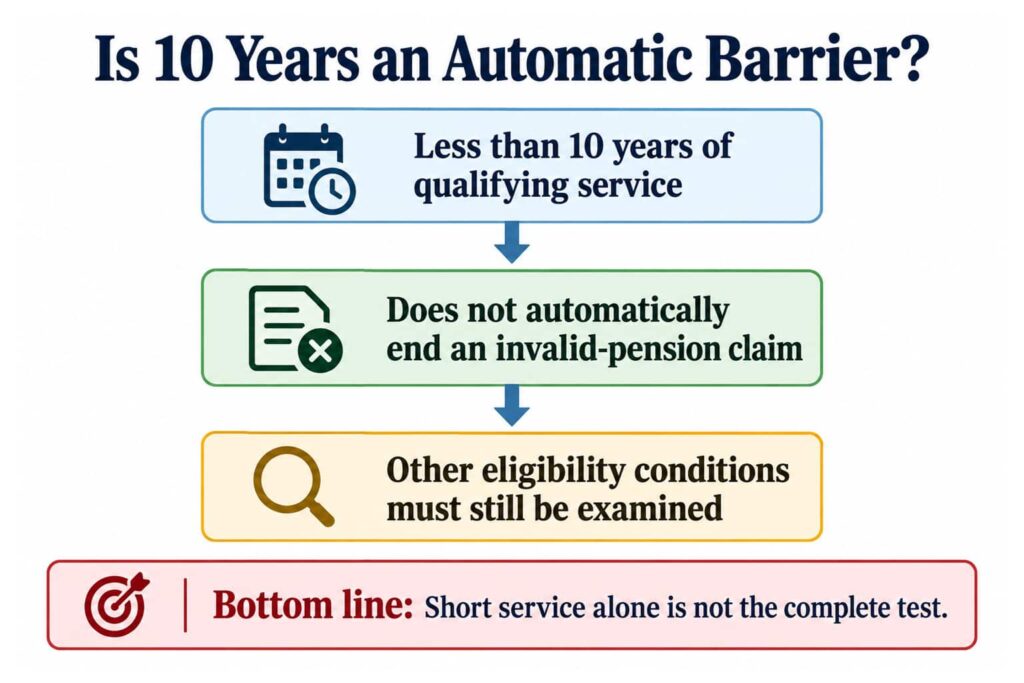
The judgment does not say that everyone with less than 10 years of service automatically receives invalid pension.
The correct point is narrower:
Less than 10 years of service cannot, by itself, be used as an automatic disqualification where the other legal conditions for invalid pension are satisfied.
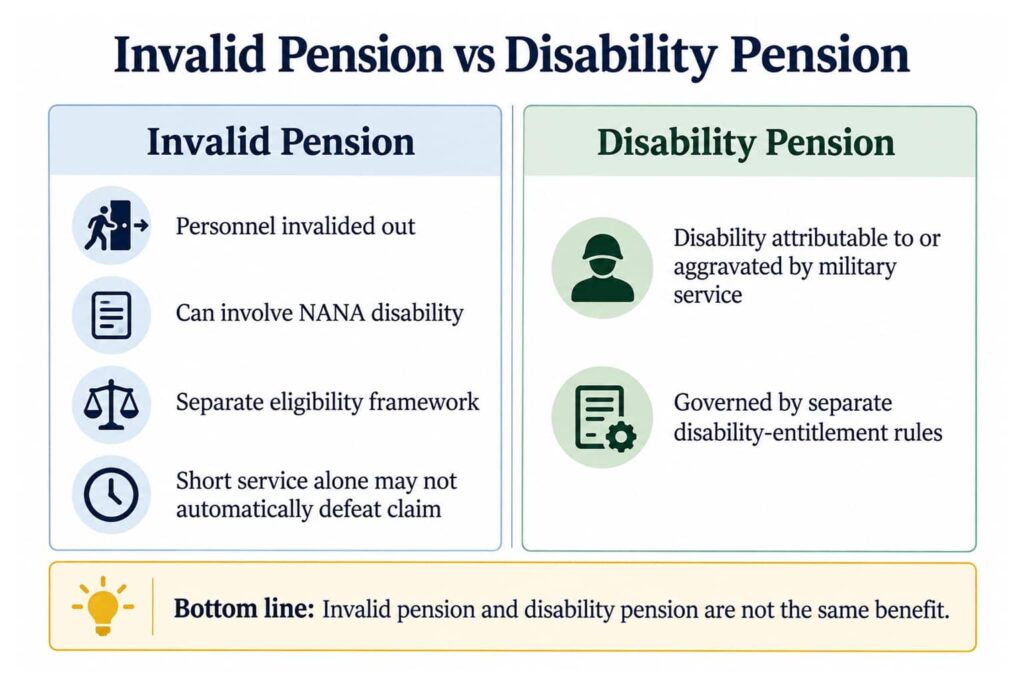
Invalid pension and disability pension are not the same thing
This distinction is essential.
The Department of Ex-Servicemen Welfare describes disability pension as a benefit associated with disability attributable to or aggravated by military service.
Invalid pension, on the other hand, is a separate category that can apply where a service person is invalided out due to a disability treated as Neither Attributable Nor Aggravated (NANA), subject to the governing conditions.
So a headline such as:
“Soldier with seven years gets disability pension”
would blur two different pension concepts.
The Hakam Singh litigation concerned invalid pension.
What does the current official rule say about 10 years?
This is where the legal landscape becomes particularly important.
The Department of Ex-Servicemen Welfare currently states that the earlier minimum requirement of 10 years qualifying service for invalid pension was removed through the Government letter dated 16 July 2020.
The official DESW material, however, also states that this benefit is available to Armed Forces personnel who were in service on or after 4 January 2019 and were invalided out because of a qualifying NANA infirmity that permanently incapacitated them from military service as well as civil re-employment.
That created another major issue in Hakam Singh’s case.
He had left service in 1978—more than four decades before the 2019 cut-off.
Why did the 4 January 2019 cut-off not defeat this claim?
The Government specifically argued that the relaxed invalid-pension provision should operate prospectively from 4 January 2019.
The High Court rejected this objection by referring to its earlier ruling in Union of India v. Sandeep Kumar, decided on 7 January 2025.
According to the Hakam Singh judgment, the earlier Division Bench had already set aside the condition restricting the benefit to cases beginning from 4 January 2019 and had held that personnel invalidated before that date could also claim the benefit in light of the legal principles relied upon by the Court.
That is important because the current administrative material and the judicial interpretation are not presented in exactly the same way.
For pensioners, this means an older invalidation date should not automatically be treated as the end of the enquiry where a judicial precedent applicable to the case says otherwise.
How could a claim survive after about 42 years?
The delay argument was another major part of the Union’s case.
According to the High Court, the claim had been raised after an inordinate delay of approximately 42 years.
Ordinarily, such a long gap would appear significant.
But the Court referred to the Supreme Court decision in M.L. Patil v. State of Goa, which treated pension as a continuing or recurring cause of action.
On that basis, the Court held that a pension claim should not be denied merely because of delay.
Again, this should not be converted into an unlimited rule.
It does not mean:
- every old service dispute can be reopened;
- every claim filed decades later must succeed;
- limitation and delay never matter;
- evidence is unnecessary in old pension cases.
The more accurate takeaway is that delay alone was not considered sufficient to extinguish this pension claim under the precedents applied by the High Court.
What about the destroyed service and medical records?
The Government also told the Court that the relevant records had already been destroyed in 2008, after expiry of the prescribed retention period.
It argued that no surviving material remained to establish important aspects of the former soldier’s medical condition.
This could have been a serious evidentiary problem.
However, the High Court ultimately found that the Union had not shown any perversity in the AFT’s decision or any ground justifying interference with the Tribunal’s order.
It therefore dismissed the writ petition.
This does not mean old medical records are unimportant.
Quite the opposite: in many pension cases, service and medical documents can be decisive.
The lesson from this judgment is only that the absence of old records did not persuade the High Court to overturn the AFT relief in this particular case, given the legal precedents and facts before it.
Why did the High Court rely on P.A. Thomas?
One of the most important parts of the judgment is its discussion of P.A. Thomas.
The High Court reproduced the legal framework considered by the Supreme Court, including the clarification that the 10-year qualifying-service condition under Rule 49(2) would not apply in the same way to an eligible Government servant retiring on invalid pension under Rule 38 before completing 10 years.
The Supreme Court had said that the amended framework would apply to eligible cases.
The word eligible matters.
It prevents the judgment from being reduced to a slogan such as:
“Less than 10 years = automatic invalid pension.”
That is not what the legal framework says.
The claimant must still fall within the applicable invalid-pension conditions.
Who could find this judgment relevant?
The ruling may be particularly important for families dealing with older Armed Forces invalidation cases where:
- the service person completed less than 10 years of qualifying service;
- invalid gratuity was paid instead of invalid pension;
- invalidation occurred before 4 January 2019;
- the pension claim was raised after a long period; or
- the pension authorities rely mainly on short service or the 2019 date to reject the matter.
But similarity on one point does not automatically make two cases legally identical.
The medical reason for invalidation, service documents, earlier benefits paid, applicable regulations and earlier orders can all affect the final outcome.
What this judgment does NOT guarantee?
This is probably the most important section for pensioners reading the news.
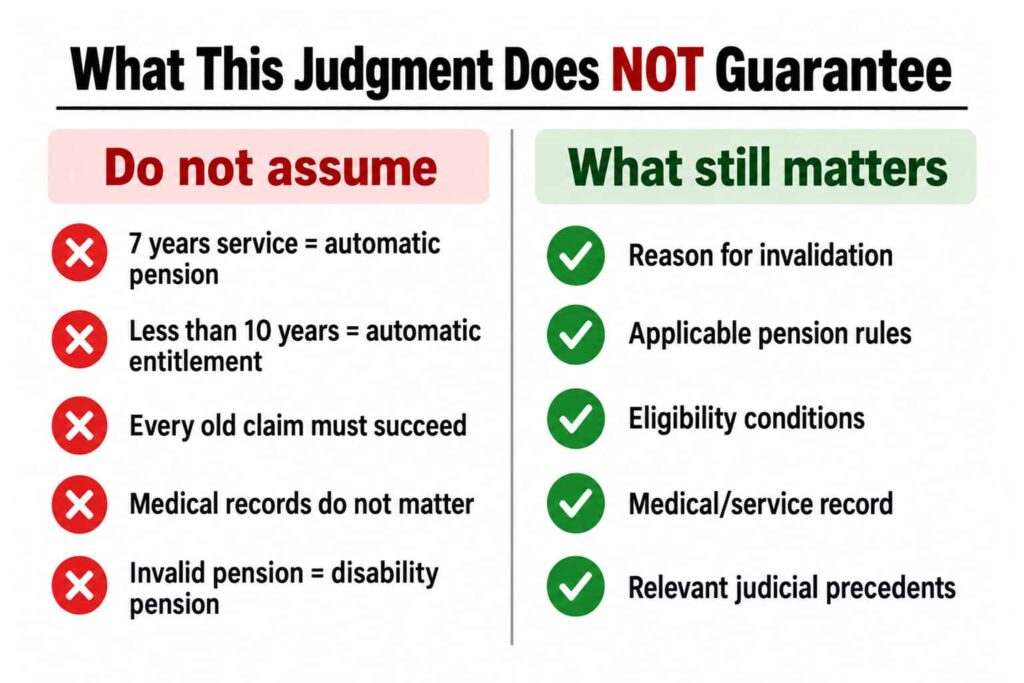
The High Court ruling does not establish that:
Every soldier with seven years of service gets invalid pension.
It does not establish that:
Everyone discharged or invalided before 10 years qualifies automatically.
It does not say:
Medical records no longer matter.
Nor does it mean:
Every 30- or 40-year-old pension case will succeed.
What the decision does show is that three common objections—short service, an old claim and pre-2019 invalidation—cannot necessarily be applied mechanically without considering the governing law and relevant judicial precedents.
Why this is more than an individual pension case?
The judgment matters because it deals with the interaction between older military pension cases and later changes in pension law.
Hakam Singh had left service in 1978.
The Government’s major invalid-pension policy relaxation came decades later.
Yet the High Court examined whether later legal principles and judicial decisions prevented the authorities from using the older 10-year requirement and the 2019 cut-off as absolute barriers.
That makes the ruling particularly relevant to legacy pension disputes.
It also explains why pension cases cannot always be decided by looking only at the rules that existed on the employee’s final day in uniform.
Subsequent amendments, clarifications and binding judicial interpretations may also become relevant.
What happened to the widow’s family pension?
The AFT’s order had granted invalid pension for Hakam Singh’s lifetime and ordinary family pension thereafter to his widow.
The Union challenged the Tribunal’s order before the High Court.
Because the High Court dismissed that writ petition and declined to interfere with the AFT’s decision, that relief remained intact.
This part of the case is particularly important for families because a pension dispute may continue even after the original service person has died.
The legal consequences can then extend to the surviving eligible family pensioner.
Conclusion
The Punjab and Haryana High Court has not created a rule saying that seven years of Army service is enough for pension in every case.
Its reasoning is more precise—and more useful.
Ten years of qualifying service cannot necessarily be treated as an absolute barrier to invalid pension.
The Court also rejected, in this case, the attempt to defeat the claim merely because the service person had been invalided before 4 January 2019 or because the pension claim surfaced decades later.
The judgment therefore shifts the focus away from a simple question—
“How many years did the person serve?”
—to a more important one:
“Was the person otherwise legally eligible for invalid pension under the framework and precedents applicable to the case?”
For veterans and widows dealing with older invalidation cases, that distinction can be crucial.
Sources
Punjab and Haryana High Court — Union of India and Others v. Sep Hakam Singh (deceased) through widow Balbir Kaur and another, CWP-28471-2026, decided 3 September 2026
Read the High Court judgment
Department of Ex-Servicemen Welfare — Types of Pensions
Official information on disability pension and invalid pension, including the 16 July 2020 relaxation. Open DESW pension information
Department of Ex-Servicemen Welfare — Pension Regulations for the Armed Forces
Official regulations setting out the invalid-pension framework and qualifying-service provisions. Open Defence pension regulations

Leave a Reply