

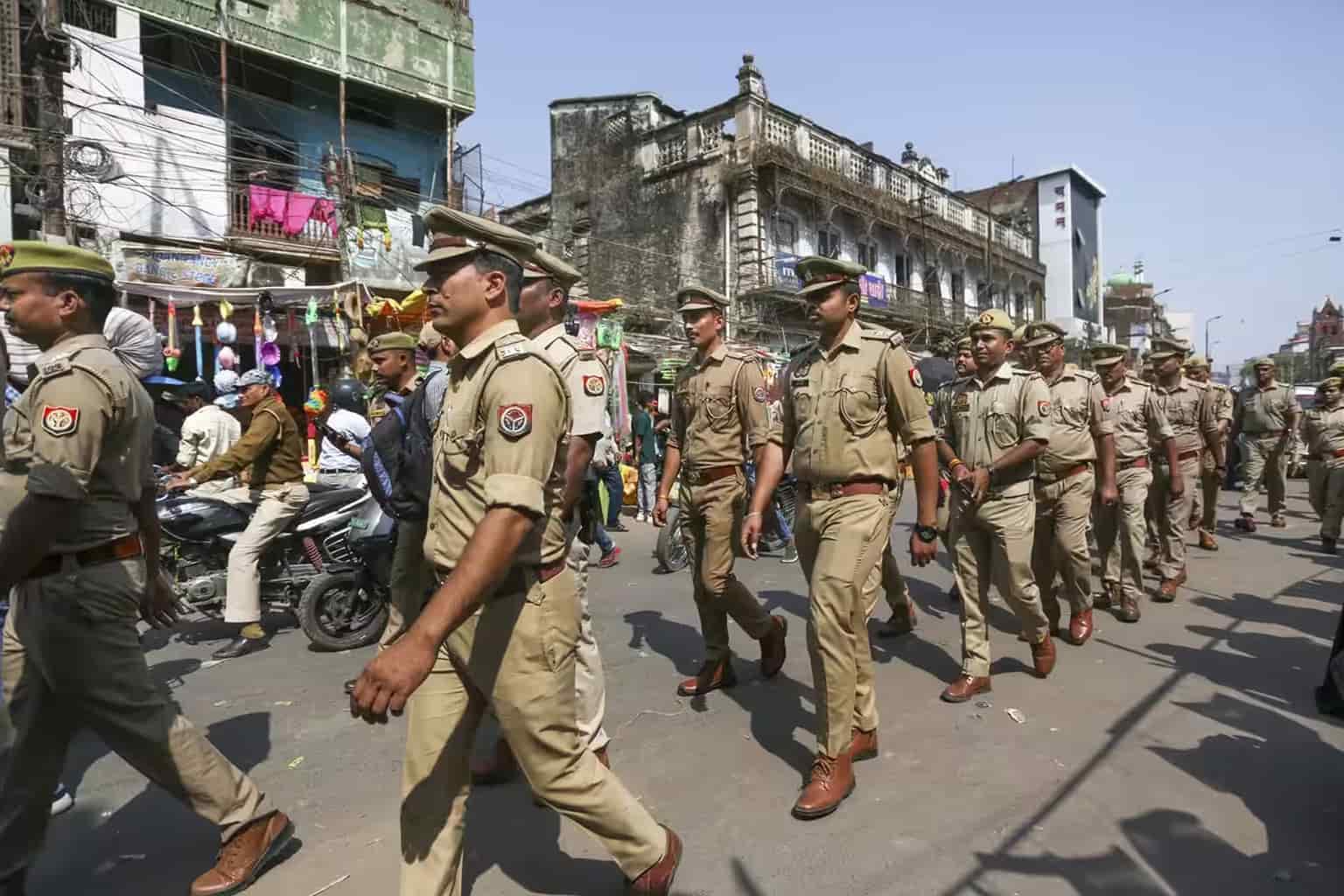
A fresh controversy around the UP Police recruitment process has raised an important question for former Armed Forces personnel: can a person receive pension, hold an ex-serviceman identity card and remain registered with the Zila Sainik Board, yet still be considered ineligible for the ex-servicemen quota in a particular recruitment?
That distinction is at the centre of the current dispute.
The issue relates to the UP Police recruitment announced on 31 December 2025 for more than 32,000 vacancies, where a 5% horizontal reservation provision was available for eligible ex-servicemen.
What did the recruitment conditions provide?
According to the recruitment conditions discussed in the case, an ex-serviceman candidate had to satisfy the following major requirements:
| Requirement | Position |
|---|---|
| Ex-servicemen reservation | 5% horizontal reservation |
| Retirement status | Candidate should be an ex-serviceman by the application closing date |
| Retiring after closing date | Not eligible for ESM quota for that recruitment |
| Age relaxation | Military service deducted from age + 3 years relaxation |
| Education | 12th pass or equivalent |
| Written examination | Mandatory |
| PST / physical standards | Applicable |
| PET / running test | No separate general ESM relaxation mentioned in the discussed notification |
| Final selection | Candidate must complete the prescribed recruitment process |
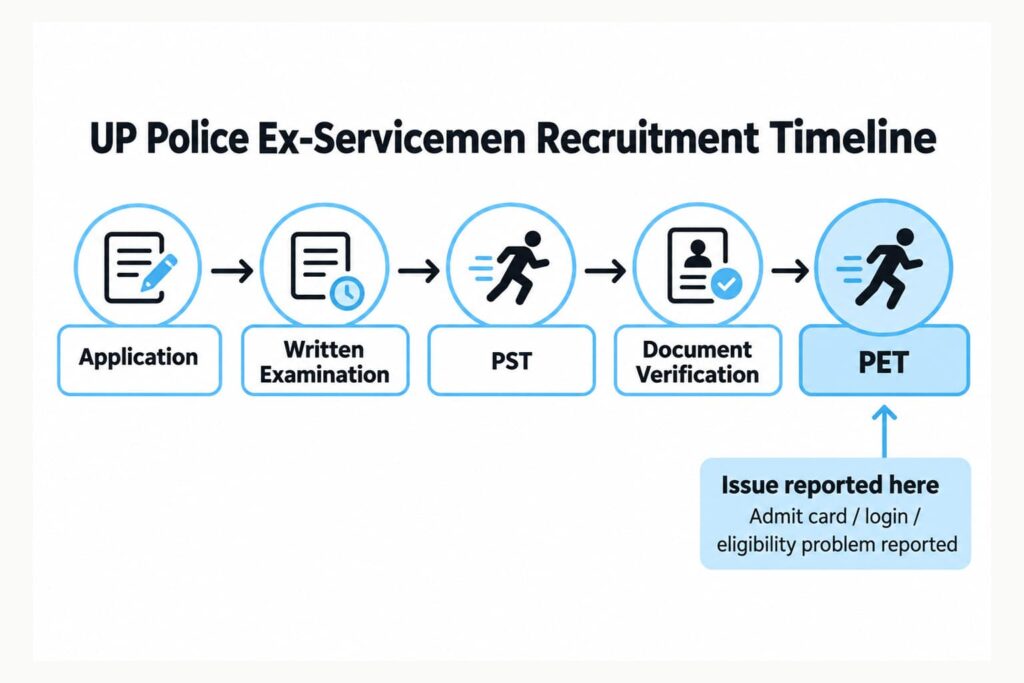
The controversy did not begin at the application stage. According to the affected candidates’ account, several ex-servicemen had already progressed through important stages of recruitment.
Why did the issue surface at the PET stage?
The candidates reportedly moved through:
Application → Written Examination → Physical Standard Test → Document Verification → Physical Efficiency Test
The problem emerged when some candidates approaching the PET stage allegedly found that admit cards were unavailable, logins were showing errors, or they were not being permitted to proceed under the ex-servicemen category.
This led some affected candidates to approach the recruitment authorities seeking clarification.
The subsequent communication reportedly indicated that certain former personnel released under specified circumstances may not qualify for reservation benefits under the applicable State recruitment rules.
Ex-serviceman status and recruitment eligibility are not always the same
This is the most important point in the entire dispute.
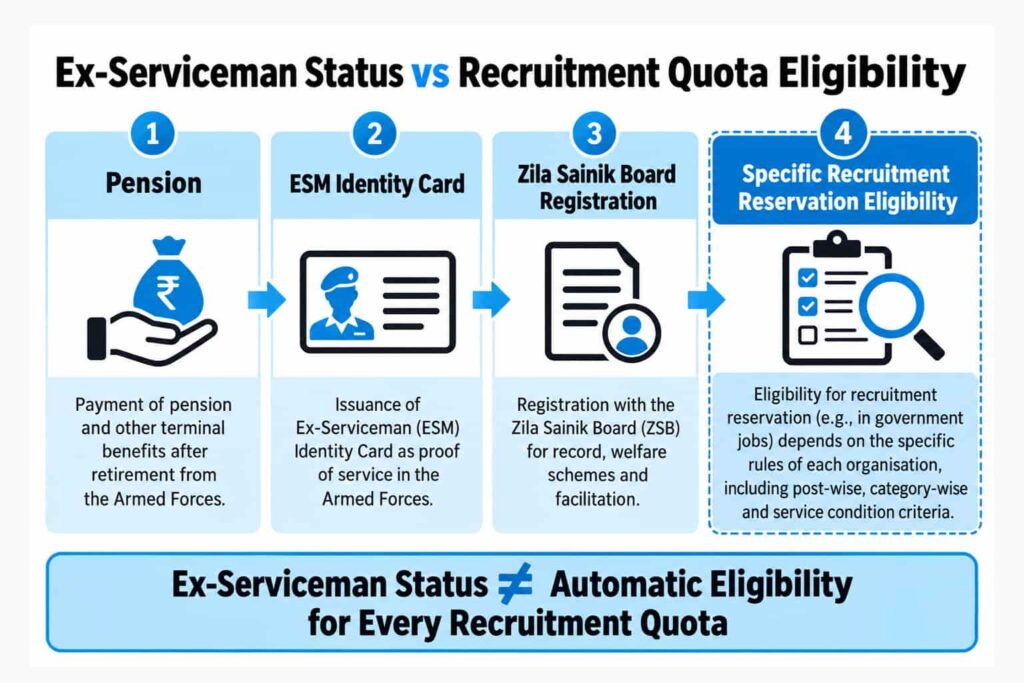
A former soldier may have:
- a pension,
- an ex-serviceman identity card,
- Zila Sainik Board registration,
- and recognised former-service status,
but these factors do not necessarily create an automatic right to reservation in every State Government recruitment.
The relevant recruitment rules can separately define which categories of ex-servicemen are eligible for reservation.
In simple terms:
Ex-Serviceman Status ≠ Automatic Eligibility for Every Ex-Servicemen Quota
Why has voluntary release become controversial?
The clarification referred to in the dispute reportedly deals with former personnel released on their own request, as well as some categories of discharge connected with specified service or disciplinary grounds.
The key legal question therefore is not whether such individuals have served in the Armed Forces.
The real question is:
Does their particular mode of release satisfy the definition required under the applicable UP recruitment reservation rules?
That distinction needs to be determined from the exact recruitment and State reservation provisions rather than only from a pension document or ex-serviceman card.
Why were candidates allowed to reach document verification?
This raises another significant administrative question.
If a candidate’s discharge category made him ineligible for ex-servicemen reservation from the beginning, affected candidates are asking why the issue was not identified at an earlier stage.
Some reportedly completed:
- application scrutiny,
- written examination,
- PST,
- and document verification
before facing difficulty at the PET stage.
This is important because an earlier eligibility check could have prevented candidates from spending months preparing for later stages of recruitment.
The issue therefore concerns not only eligibility, but also the timing and transparency of eligibility verification.
Should ex-servicemen get separate PET standards?
A second debate has emerged around physical testing.
Many ex-servicemen entering civilian recruitment may be considerably older than fresh candidates in their late teens or early twenties.
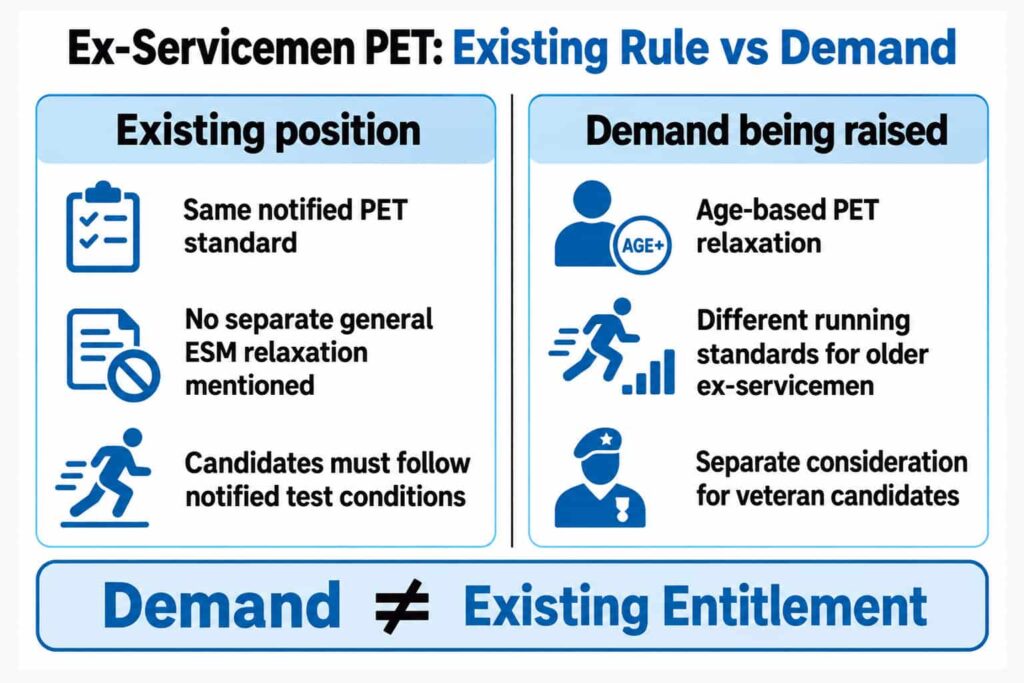
This has led to demands that former soldiers should receive age-related relaxation in the Physical Efficiency Test, particularly for running requirements.
Supporters of the demand argue that age-based physical standards are used in different forms within military service itself and that similar principles could be considered for older veterans entering civilian employment.
However, this must be clearly understood:
PET relaxation is a demand being raised by affected ex-servicemen; it should not be treated as an existing entitlement unless the recruitment rules specifically provide it.
What about reports of a court case?
There has also been discussion that some former personnel approached a court seeking relief regarding physical-test conditions.
The timing of later scrutiny has led to speculation among affected candidates.
However, without documentary evidence, it would be incorrect to conclude that any legal challenge caused candidates to be excluded from the recruitment process.
The recruitment eligibility dispute and any separate court proceedings should therefore be treated independently unless an official record establishes a connection.
What is the real issue now?
The controversy has effectively created three questions that require clarity:
First, which categories of retired or released Armed Forces personnel qualify for the UP Police ex-servicemen reservation?
Second, why was the eligibility issue reportedly raised after some candidates had already crossed several stages of recruitment?
Third, should future recruitments provide age-sensitive PET standards for older ex-servicemen?
These questions require clear rules rather than assumptions from either side.
Conclusion
The UP Police ex-servicemen dispute is more complicated than simply asking whether a candidate is a former soldier.
The decisive issue is whether the person qualifies as an eligible ex-serviceman for reservation under the specific recruitment rules.
At the same time, if candidates were allowed to complete written examination, physical standards and document verification before their reservation status was questioned, the recruitment process also needs greater clarity at the initial screening stage.
For future recruitments, the most effective solution would be to specify the eligible discharge categories and physical-test conditions clearly at the application stage itself. That would protect both the recruitment process and ex-servicemen from avoidable uncertainty.

Leave a Reply