


The latest CGEGIS development connected with the 8th Central Pay Commission is important not because any benefit has been increased, but because of the kind of information the Commission is now collecting.
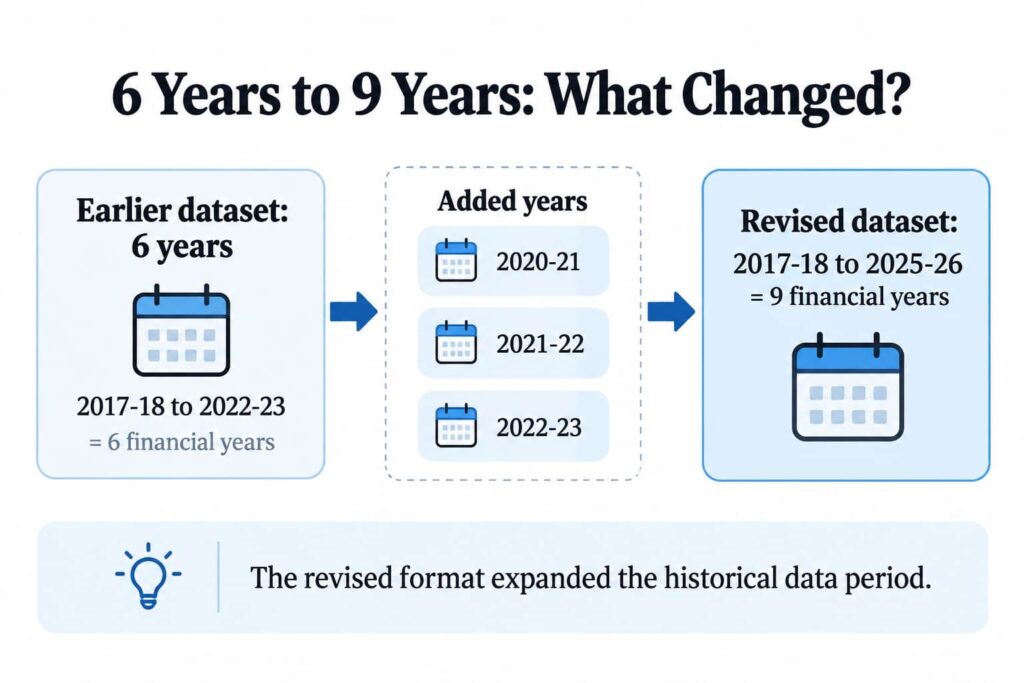
A communication dated 3 September 2026 asked Ministries, Departments and Union Territory administrations to furnish revised information under Annexure-M (CGEGIS). The revised dataset covers nine financial years from 2017-18 to 2025-26 and seeks year-wise figures for insurance payouts, savings payouts and employees who died while in service, separately for Group A, Group B and Group C.
The official 8th CPC portal also makes clear that the Commission has extensive data requirements and that specific data formats are being shared separately with Ministries, Departments, organisations and offices through its online data-collection mechanism.
So the real question is not simply “What data has been asked for?”
It is:
What can nine years of CGEGIS data tell the 8th Pay Commission?
CGEGIS is more than a simple insurance deduction
The Central Government Employees Group Insurance Scheme (CGEGIS) serves two broad purposes.
One part of the employee’s subscription goes towards an insurance fund, providing financial protection in the event of death while in service. The other goes into a savings fund, which becomes payable with applicable accumulation when employment ends, including retirement. The Seventh Central Pay Commission described these as the scheme’s twin objectives and recorded the traditional 70:30 savings-to-insurance structure.
That makes the latest data request particularly interesting.
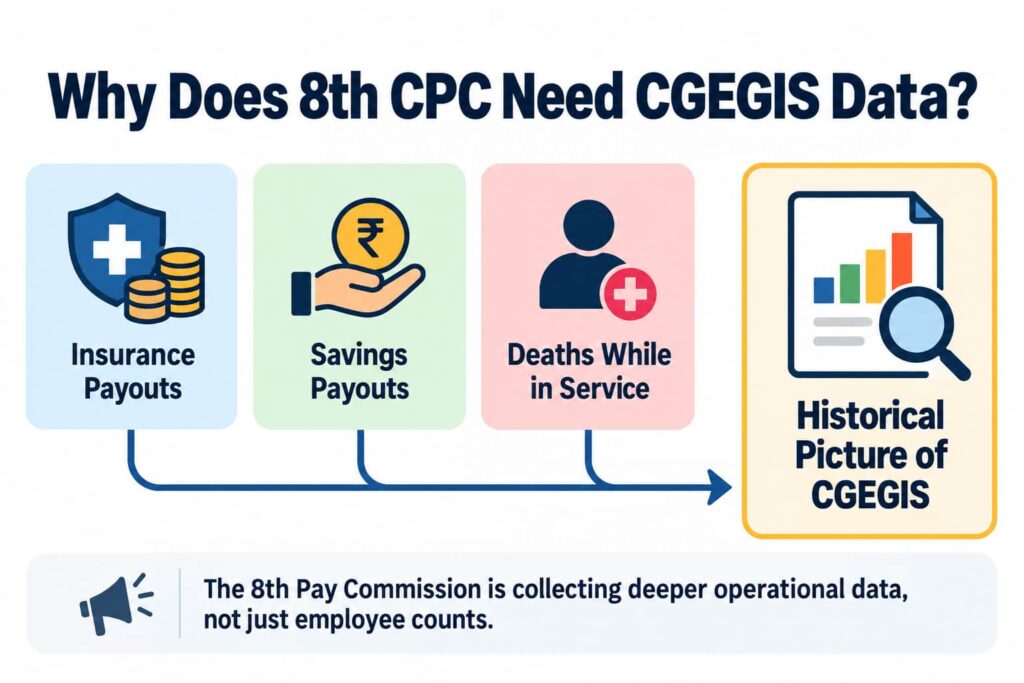
The Commission is not merely asking how many employees are enrolled. It is seeking information about how the scheme has actually operated financially over several years.
What exactly is being collected?
The revised format reportedly asks for three core figures for every financial year:
Total amount paid under the insurance component
Total amount paid under the savings component
Number of employees who died while in service
And these figures have to be provided separately for:
Group A, Group B, Group C for the period 2017-18 to 2025-26.
Viewed together, these figures can provide the Commission with a much broader picture than employee-strength data alone.
Insurance payouts show the financial outgo associated with the risk-protection side of CGEGIS.
Savings payouts show the scale of accumulated payments flowing back to employees.
Death-in-service figures provide historical claims experience.
Group-wise data can also allow the Commission to examine how these patterns differ across categories of employees.
That last point is an analytical implication of the dataset; the 3 September communication itself does not state what conclusion the Commission intends to draw from the figures.
Why were three more financial years added?
According to the reported communication, Annexure-M was revised to add 2020-21, 2021-22 and 2022-23, expanding the information sought to nine financial years. The revised information was requested through the 8th CPC Data Collection Portal by 17 September 2026.
Those three additional financial years overlap substantially with the COVID-period timeline.
But there is an important distinction.
The available communication does not say that COVID was the reason those years were added.
It would therefore be speculative to describe this as a specific investigation into pandemic-related deaths.
What can safely be said is that the Commission now wants a longer historical dataset, including those three years.
Since the 17 September deadline has passed, the next question is how the information will ultimately be examined and whether it contributes to any CGEGIS-related recommendation.
The available letter does not confirm whether every Ministry or Department completed the revised submission by the deadline.
What could this data help the Commission understand?
A nine-year dataset can potentially help policymakers examine the relationship between three parts of the scheme:
Employees covered → money paid → claims experience
For example, if the Commission has year-by-year information on actual insurance payouts and death cases, it can examine historical insurance experience rather than relying only on the nominal insurance amount prescribed under the scheme.
Likewise, savings-fund payout data can help establish the actual financial scale of the savings side of CGEGIS.
The Department of Expenditure continues to issue CGEGIS savings-fund benefit tables, including for 2026, confirming that the savings component remains an active part of the existing scheme.
None of this tells us what recommendation the Commission will eventually make.
But it explains why the nature of the data request matters.
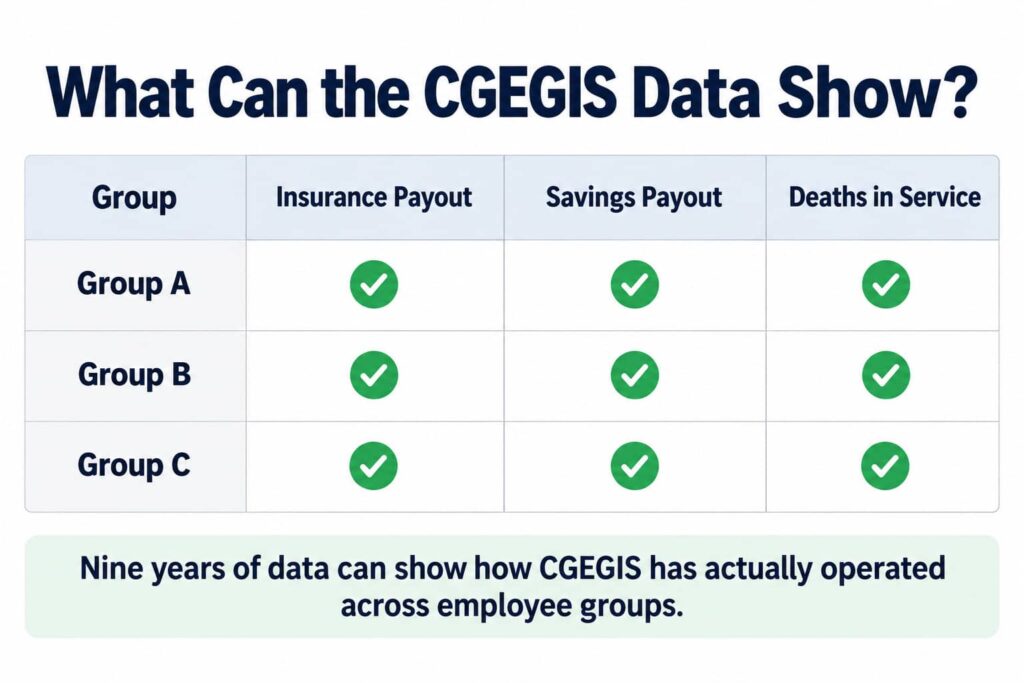
Nine years of data can provide a historical picture of how CGEGIS has operated.
Does this mean CGEGIS insurance benefits will increase?
No such conclusion can be drawn from the data request.
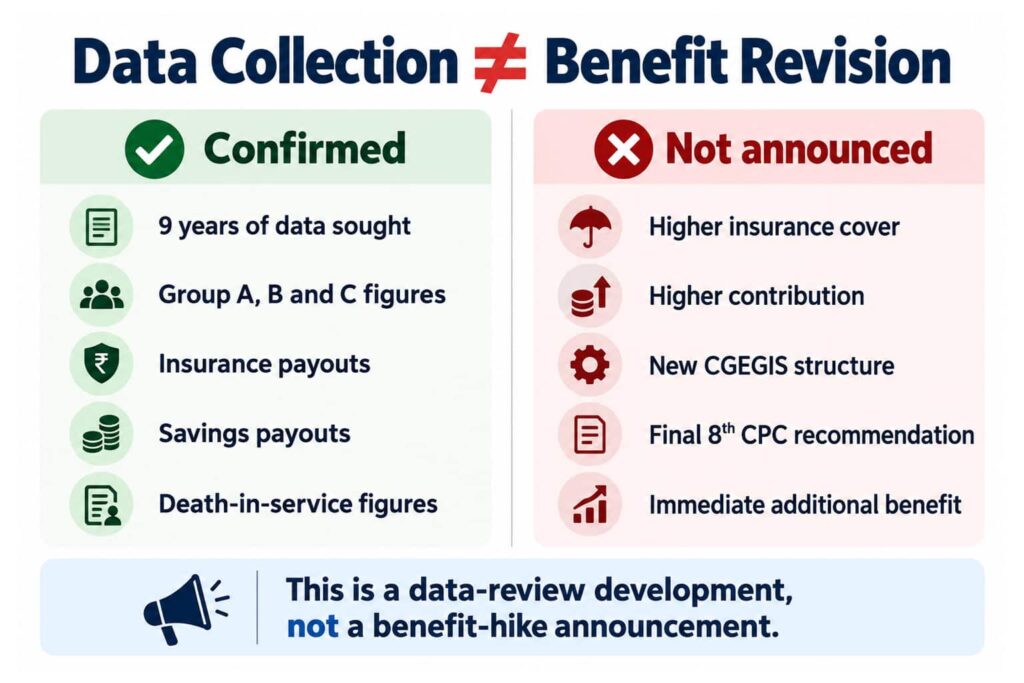
The September communication, as publicly reported, does not announce:
- a higher CGEGIS insurance amount;
- an increase in monthly subscription;
- a new savings benefit;
- a replacement CGEGIS structure; or
- an immediate additional payment to employees.
This distinction is essential.
Data collection is not the same as benefit revision.
Employee organisations have separately placed proposals for changes to CGEGIS before the 8th CPC, including demands for higher insurance coverage. Those are stakeholder demands, not decisions of the Commission or Government.
The Commission may study those representations alongside official data, but the outcome cannot be inferred from the Annexure-M exercise alone.
What about Defence personnel?
The available CGEGIS communication concerns information sought through Ministries, Departments and Union Territory administrations.
The specific document does not announce a separate revision of insurance benefits for serving Armed Forces personnel.
Therefore, this particular data request should not be presented as an approved new defence insurance benefit.
Any defence-specific change would need to be supported by a separate recommendation, Government decision or applicable order.
Why this development still matters?
The importance of this exercise lies in the move from general discussion to measurable historical data.
The Commission is reportedly asking for: nine years across three employee groups and three key financial/claims indicators.
That creates a much more detailed evidence base around CGEGIS than a simple statement of existing contribution or insurance rates.
For employees, however, expectations should remain grounded.
The September exercise tells us that CGEGIS is being examined through detailed data collection.
It does not tell us what the Commission’s final recommendation will be.
What happens next?
The logical progression is:
Government departments submit CGEGIS data – 8th CPC examines historical figures – Stakeholder demands and existing scheme structure may also be considered – Commission may formulate recommendations – Government decides whether any change should be accepted
Only at the later stages would employees know whether contribution levels, insurance cover, savings arrangements or any other aspect of CGEGIS will actually change.
Final takeaway
The latest CGEGIS development should therefore be understood as a data-review story, not a benefit-hike announcement.
The revised Annexure-M gives the 8th Pay Commission access to a nine-year picture of insurance payouts, savings payments and deaths while in service across Group A, B and C employees.
That information could help the Commission assess how the scheme has operated in practice.
But until the 8th CPC makes a recommendation and the Government takes a decision, employees should not treat the current exercise as confirmation of higher CGEGIS benefits.
For now, the important development is the depth of the review—not a change in the benefit.
Sources
- 8th Central Pay Commission — Official Online Data Portal
Open Official 8th CPC Data Portal - CGEGIS 9-Year Data Collection — 3 September 2026 development
Read the CGEGIS Data Collection Report - 7th Central Pay Commission Report — CGEGIS discussion and recommendations
Open Official 7th CPC Report PDF - Department of Expenditure — CGEGIS Savings Fund / Benefit Tables
View CGEGIS Orders and Benefit Tables

Leave a Reply